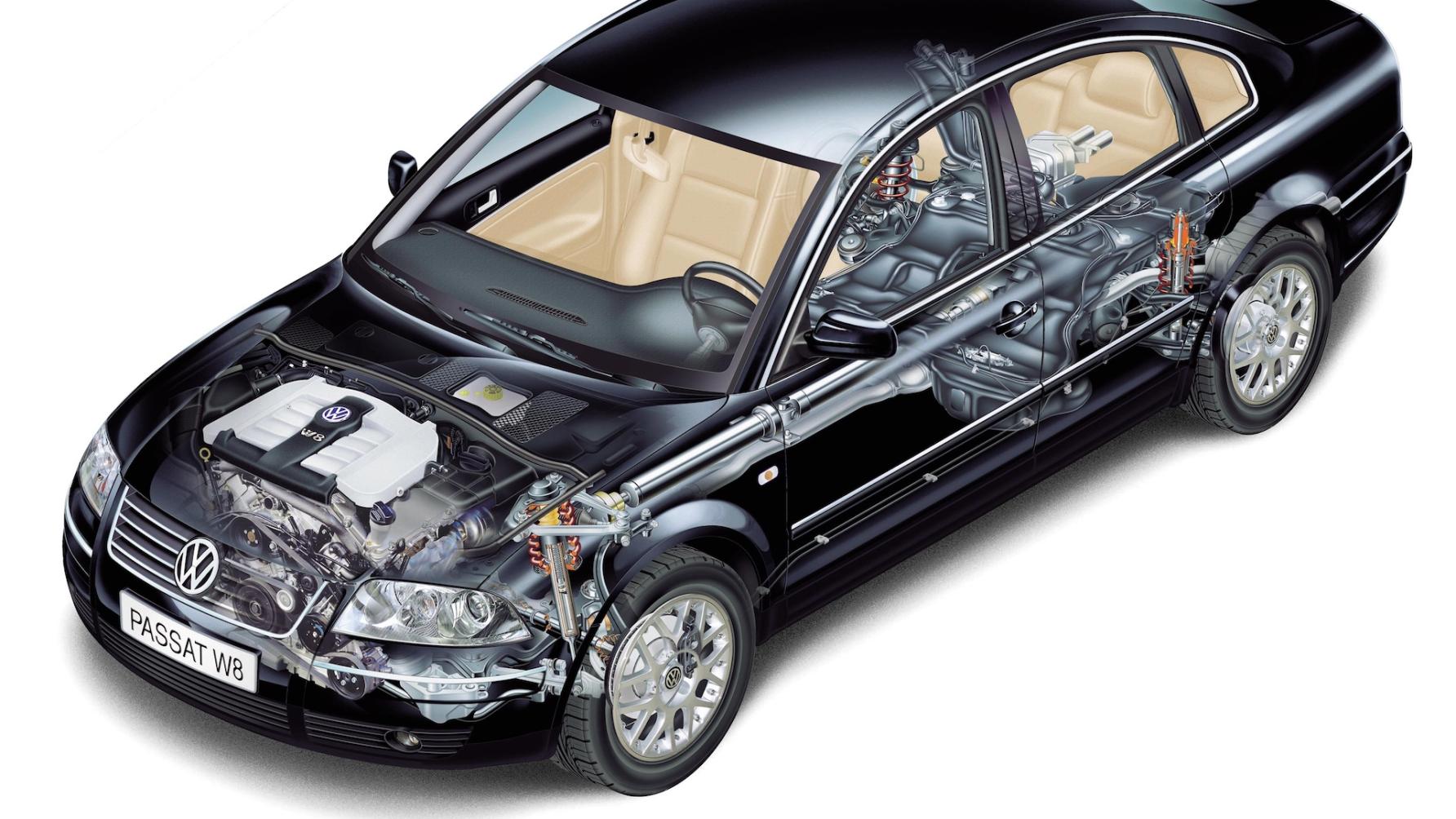
The Volkswagen Passat W8 stands as a unique chapter in automotive engineering history, representing a bold attempt by Volkswagen in the early 2000s to elevate its flagship sedan into the luxury performance segment. Combining a sophisticated 4.0-liter W8 engine with the 4Motion all-wheel-drive system, this model remains a cult classic for enthusiasts who prioritize unconventional powertrain architecture and refined, understated grand touring capabilities.
The Engineering Philosophy: The W8 Architecture
At the heart of the Volkswagen Passat W8 (produced from 2001 to 2004) lies the innovative W8 engine. Before the widespread adoption of the W-configuration by the Volkswagen Group—most notably in the Bugatti Veyron and the Bentley Continental—the Passat W8 served as a technical proof-of-concept for compact, high-displacement power.
The W8 engine design effectively joins two narrow-angle VR4 cylinder banks on a single crankshaft. By utilizing a 72-degree bank angle within each VR4 unit and a 15-degree angle between the banks, Volkswagen engineers created a powerplant that was remarkably compact, allowing it to fit into the longitudinal engine bay of the B5.5 Passat platform. This 4.0-liter, 32-valve engine produces 275 horsepower (202 kW) and 273 lb-ft (370 Nm) of torque.
The primary advantage of this configuration was packaging. Unlike a traditional V8, which would have been too wide to fit between the frame rails of the B5 platform without significant chassis modification, the W8 allowed Volkswagen to maintain the standard Passat's front suspension geometry while providing the smooth, linear power delivery typically reserved for luxury executive sedans.
Technical Specifications at a Glance
Understanding the performance envelope of the W8 requires a look at its mechanical underpinnings. The vehicle was designed to provide a "bridge" between the mainstream Passat lineup and the higher-tier luxury brands like Audi.
Core Performance Data
- Engine Displacement: 3,999 cc
- Configuration: W8, 32-valve, DOHC
- Horsepower: 275 hp @ 6,000 rpm
- Torque: 273 lb-ft @ 2,750 rpm
- Drivetrain: 4Motion permanent all-wheel drive
- Transmission Options: 5-speed Tiptronic automatic or 6-speed manual
- 0-60 mph (0-97 km/h): Approximately 6.5 seconds (automatic)
The use of the 4Motion system was non-negotiable for the W8, as the torque output would have easily overwhelmed a front-wheel-drive setup. The permanent all-wheel-drive system utilized a Torsen center differential, which provides a natural, mechanical torque split, typically operating at a 50/50 front-to-rear ratio, but capable of adjusting based on traction requirements.
Transmission and Drivetrain Considerations
The Passat W8 offered two distinct driving experiences depending on the transmission. The vast majority of models produced were equipped with the 5-speed ZF Tiptronic automatic transmission. This unit was tuned for smooth gear shifts, prioritizing luxury cruising over aggressive track performance.
The 6-speed manual transmission is significantly rarer and highly sought after by collectors. This transmission allowed the driver to better utilize the broad torque curve of the W8 engine, significantly altering the character of the car. It transformed the W8 from a "discreet executive sedan" into a more engaging machine that could hold gears through winding roads, though the heavy clutch and specific gear ratios were still clearly calibrated for grand touring rather than pure sports car driving.
Luxury and Practicality: The Interior and Exterior
Beyond the engine, the W8 trim level was the pinnacle of the B5.5 Passat range. Volkswagen distinguished these models with several specific aesthetic and functional upgrades:
- Quad Exhaust Tips: The most visible signifier of the W8, the four chrome-tipped tailpipes gave the rear end a distinctive, aggressive profile.
- Upgraded Interior Materials: The W8 featured higher-quality leather seating, upgraded wood or brushed metal trim options, and a more extensive list of standard features, including heated seats, power-adjustable settings, and improved sound insulation.
- Braking System: To account for the increased power and curb weight, the W8 featured larger brake discs and more robust calipers compared to the standard Passat 1.8T or V6 models.
Comparison of Performance Variants (B5.5 Platform)
| Feature | Passat 1.8T | Passat V6 | Passat W8 |
|---|---|---|---|
| Engine | 1.8L I4 Turbo | 2.8L V6 | 4.0L W8 |
| Horsepower | 170 hp | 190 hp | 275 hp |
| Drivetrain | FWD/AWD | FWD/AWD | AWD Only |
| Primary Use | Efficiency | Daily Commuter | Grand Touring |
| Engine Complexity | Low/Moderate | Moderate | Very High |
Maintenance Challenges and Ownership Realities
In 2026, owning a Volkswagen Passat W8 is a commitment to specialized automotive care. The primary challenge for any prospective owner is the extreme complexity of the engine bay. Because the engine is so tightly packaged, routine maintenance—and certainly major repairs—often requires the "service position," which entails removing or shifting the entire front bumper, radiator support, and headlights to gain access to the front of the engine.
Common Troubleshooting Areas
- Engine Mounts: The weight of the W8 engine places significant strain on the hydraulic motor mounts. When these fail, vibration is transmitted directly into the chassis.
- Ignition Coils: Like many Volkswagen engines of this era, the W8 is prone to ignition coil failure. Symptoms include engine misfires and a flashing check engine light.
- Cooling System: The W8 runs hot. Plastic components in the cooling system, such as coolant flanges and auxiliary water pumps, are known to become brittle over time and can cause significant leaks.
- Oil Consumption and Leaks: Given the age of these vehicles, the valve cover gaskets and cam tensioner seals are frequent points of failure, necessitating intensive labor-heavy repairs.
Financial Considerations for 2026
The W8 is no longer a depreciation-prone daily driver; it has transitioned into an "enthusiast asset." Prospective owners should budget for a significant "entry premium." While the purchase price may seem attractive compared to modern high-performance vehicles, the cost of specialized parts (many of which are no longer produced by Volkswagen and must be sourced from the aftermarket or refurbished) can exceed the market value of the car within a single year of ownership.
Insurance for a W8 is often categorized under specialty or classic car policies, as standard insurers may struggle to value the vehicle correctly or provide parts-replacement coverage for a model with such limited production numbers.
Expert Guidance: Next Steps for Enthusiasts
If you are considering a Passat W8, prioritize vehicles with verified, continuous service history. A "budget" W8 that has missed timing chain service intervals or cooling system maintenance is effectively a project car that may never return to reliable operation.
Recommended Verification Actions:
- Pre-Purchase Inspection (PPI): Do not skip a professional inspection by a mechanic who has specific experience with the W8 or W12 engine architectures. Standard generalist shops may not be familiar with the nuances of the 4.0L W8.
- Leak-Down Test: Perform a compression and leak-down test on the engine. Because the engine is expensive to rebuild, identifying internal wear early is critical.
- Record Review: Look specifically for documentation regarding the replacement of cooling components and engine mounts. If these have not been addressed in the last 60,000 miles, plan for them immediately upon purchase.
The Volkswagen Passat W8 is an automotive milestone—a testament to what engineers can achieve when given the freedom to experiment. While it demands high levels of maintenance and technical patience, the reward is a driving experience that blends the mechanical complexity of a high-end luxury sedan with the raw, mechanical presence of a W-series engine.