A radioactive element is a chemical substance whose atomic nuclei are unstable, causing them to spontaneously disintegrate over time and emit ionizing radiation. This natural or induced transformation releases energy in the form of alpha particles, beta particles, or gamma rays, ultimately converting the unstable parent atom into a more stable daughter nuclide.
Defining a Radioactive Element: The Nuclear Perspective
To understand what constitutes a radioactive element, one must examine the architecture of the atomic nucleus. Atoms consist of protons and neutrons bound together by the strong nuclear force, which works against the electromagnetic repulsion of positively charged protons. In a stable atom, this delicate balance holds the nucleus together indefinitely. However, when an atom possesses an imbalance in its neutron-to-proton ratio, or possesses an excess of total mass-energy, the nucleus becomes unstable.
This instability triggers radioactive decay. Rather than remaining in a high-energy, strained state, the nucleus sheds excess energy and matter. Every radioactive element has a characteristic half-life—the exact amount of time required for half of a given quantity of its atoms to undergo decay. Half-lives span an enormous range across the periodic table, varying from a tiny fraction of a microsecond in synthetic laboratory elements to billions of years in primordial isotopes like uranium-238.
Primordial, Cosmogenic, and Anthropogenic Sources
Radioactive elements arrive on Earth through several distinct pathways, categorized by their origin and persistence:
- Primordial Radionuclides: These elements have half-lives comparable to the age of the Earth (billions of years) and have persisted since the planet’s formation. Examples include uranium, thorium, and potassium-40.
- Cosmogenic Radionuclides: Formed continuously in the upper atmosphere through interactions between cosmic rays and atmospheric gases. Carbon-14 and tritium are prime examples, widely used in dating artifacts and tracking hydrological cycles.
- Anthropogenic Radionuclides: Synthesized by human activity, primarily within nuclear reactors, particle accelerators, or during thermonuclear detonations. Elements such as plutonium, americium, and technetium are largely human-made.
Types of Radioactive Decay and Radiation Emissions
When a radioactive element decays, it emits different types of ionizing radiation. Each type possesses unique physical properties, penetration depths, and biological interaction mechanisms.
Alpha Radiation ($\alpha$)
Alpha particles consist of two protons and two neutrons, identical to the nucleus of a helium-4 atom. Because of their relatively large mass and double positive charge, alpha particles interact strongly with matter. They possess very low penetration power and can be stopped entirely by a sheet of paper or the outer layer of human skin. However, if an alpha-emitting radioactive element is ingested or inhaled, it presents a severe internal radiation hazard to living tissue.
Beta Radiation ($\beta$)
Beta decay occurs when a neutron transforms into a proton (or vice versa) within the nucleus, ejecting a high-speed electron (beta-minus) or positron (beta-plus). Beta particles are much smaller and lighter than alpha particles, allowing them to penetrate further into materials. They pass through paper but are typically stopped by a thin sheet of aluminum or plexiglass.
Gamma Radiation ($\gamma$)
Gamma rays are high-energy electromagnetic waves emitted from the nucleus during radioactive decay, often accompanying alpha or beta particle emission. Because they have no mass and no electrical charge, gamma rays possess extreme penetrating power. Thick layers of dense materials—such as lead, concrete, or steel—are required to effectively shield against gamma radiation.
| Radiation Type | Composition | Penetrating Power | Common Shielding Materials | Primary Hazard |
|---|---|---|---|---|
| Alpha ($\alpha$) | 2 protons, 2 neutrons (Helium nucleus) | Low (Stops at skin/paper) | Paper, skin, air | Internal ingestion or inhalation |
| Beta ($\beta$) | High-speed electron or positron | Moderate (Passes paper, stopped by metal) | Aluminum foil, thin plastic, glass | Skin burns, internal exposure |
| Gamma ($\gamma$) | High-frequency electromagnetic wave | High (Deep tissue penetration) | Lead, thick concrete, dense steel | Whole-body external exposure |
The Periodic Table and Distribution of Radioactive Elements
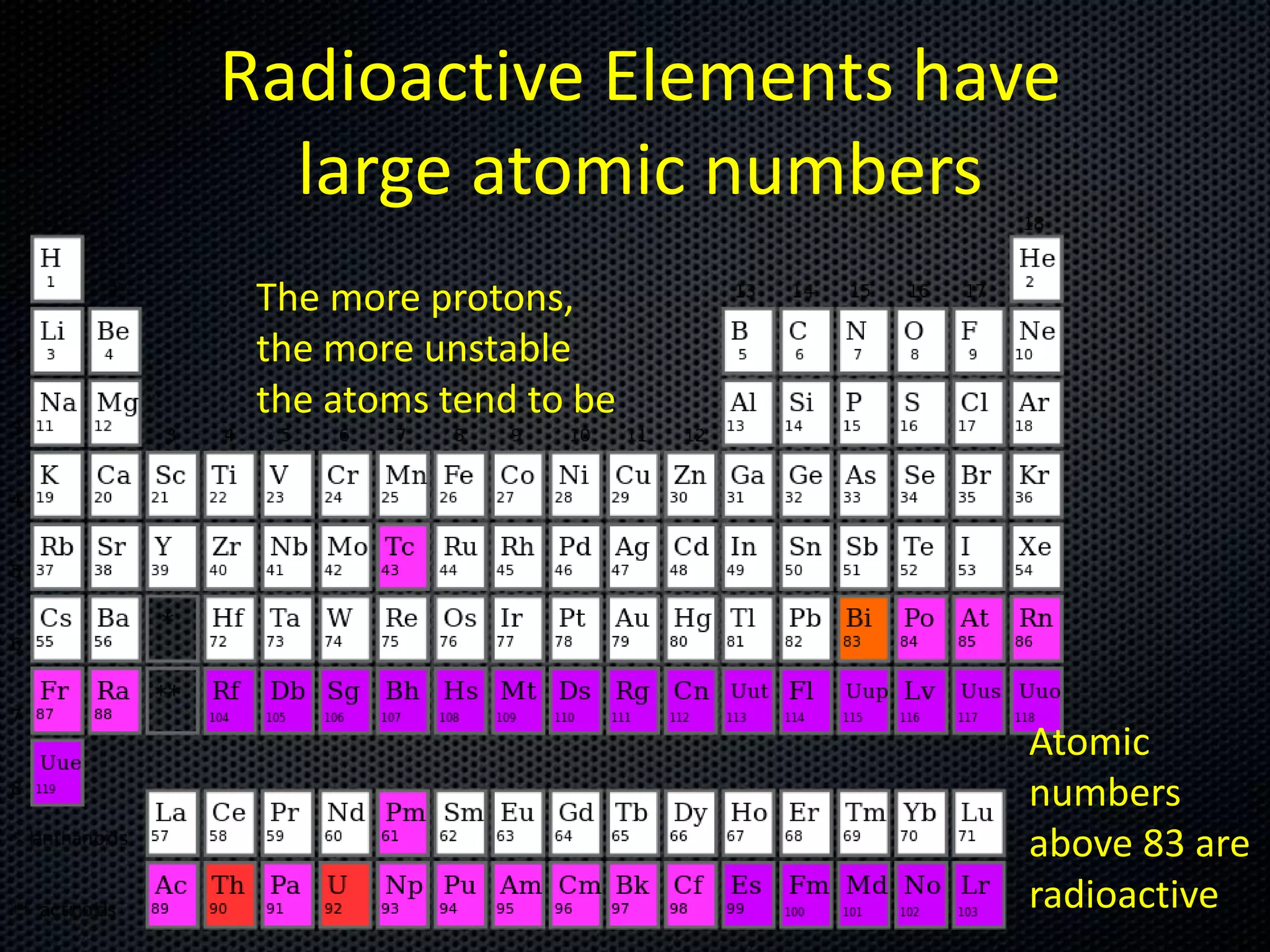
Radioactivity is not distributed randomly across the periodic table. While trace amounts of radioactive isotopes can be found in many lighter elements (such as carbon-14 or potassium-40), a clear structural pattern governs heavy elements.
The Instability Threshold
Every chemical element with an atomic number greater than 83 (bismuth) is radioactive. Bismuth itself is technically radioactive, though its half-life is so immensely long—exceeding the estimated age of the universe by many orders of magnitude—that it behaves like a stable element in most practical contexts. Polonium (atomic number 84) and every subsequent element on the periodic table possess no stable isotopes whatsoever.
The Actinide Series
The actinides comprise the f-block elements from actinium (atomic number 89) to lawrencium (atomic number 103). Prominent members include uranium and plutonium. All actinides are radioactive. While uranium and thorium occur naturally in significant quantities in Earth's crust, most of the heavier actinides—such as einsteinium, fermium, and mendelevium—are synthetic elements produced in minute quantities via particle bombardment in specialized research facilities.
Practical Applications of Radioactive Elements
Despite inherent safety risks, radioactive elements play indispensable roles across modern science, medicine, industry, and energy production.
Nuclear Power Generation
The controlled fission of heavy radioactive elements, predominantly uranium-235 and plutonium-239, supplies a massive share of global electricity. When these atoms absorb a neutron, they split into smaller fission fragments, releasing monumental amounts of thermal energy alongside additional neutrons. This heat is harnessed to generate steam, driving turbines connected to electrical generators without emitting greenhouse gases during operation.
Medical Diagnostics and Treatment
Nuclear medicine relies heavily on short-lived radioactive isotopes (radiopharmaceuticals) to diagnose and treat diseases. For instance, technetium-99m is widely utilized in diagnostic imaging to evaluate organ function and blood flow. In oncology, targeted radiation therapy employs isotopes such as cobalt-60 or iodine-131 to destroy malignant tumors while minimizing damage to surrounding healthy tissue.
Industrial Radiography and Dating
In heavy industry, radioactive sources like iridium-192 or cobalt-60 inspect structural welds in pipelines, bridges, and aircraft components for microscopic fractures without damaging the structure. In geochronology, carbon-14 dating determines the age of organic artifacts up to approximately 50,000 years, while uranium-lead dating establishes the formation age of ancient geological formations and meteorites.
Safety, Regulation, and Management
Handling any radioactive element requires strict adherence to international safety standards established by organizations such as the International Atomic Energy Agency (IAEA) and national regulatory bodies like the U.S. Nuclear Regulatory Commission (NRC).
The Three Pillars of Radiation Protection
- Time: Minimizing the duration of exposure directly reduces the total radiation dose received by workers or the public.
- Distance: Radiation intensity diminishes sharply with distance from the source, following the inverse-square law. Maintaining physical separation is a primary defense.
- Shielding: Placing appropriate physical barriers—such as lead aprons, concrete vaults, or water pools—between the source and personnel blocks penetrating radiation.
Radioactive Waste Management
A critical challenge associated with utilizing radioactive elements is the management of nuclear waste. Low-level waste, such as contaminated protective clothing and medical equipment, is compacted and stored in shallow land burial sites. High-level waste, consisting primarily of spent nuclear fuel, requires sophisticated containment. This material is typically cooled in deep water pools before transfer to robust dry cask storage systems, with long-term plans focusing on deep geological repositories engineered to isolate isotopes for hundreds of millennia.
Frequently Asked Questions
Are all radioactive elements man-made?
No. Many radioactive elements occur naturally in the Earth's crust and atmosphere. Examples include uranium, thorium, radium, and carbon-14. However, numerous heavier elements—such as technetium and the transuranic elements—are synthetic products generated exclusively through human intervention in nuclear reactors or particle accelerators.
How is the radioactivity of an element measured?
Radioactivity is quantified using several standardized units. The SI unit of radioactivity is the Becquerel (Bq), where one Becquerel equals one radioactive disintegration per second. An older, still common unit is the Curie (Ci), which equals $3.7 \times 10^{10}$ disintegrations per second. Absorbed radiation doses imparted on biological tissue are measured in grays (Gy) or sieverts (Sv).
Can a radioactive element become non-radioactive?
Yes. Through the continuous process of radioactive decay, an unstable radioactive isotope transforms into a different isotope. This cascade continues step-by-step until the nucleus reaches a stable, non-radioactive configuration, usually resulting in a stable isotope of lead or bismuth.
Is radiation from a radioactive element contagious?
No. Simply being exposed to radiation or handling a sealed radioactive source does not make an ordinary object or person radioactive. Contamination occurs only if radioactive dust or liquid physically settles on a surface or enters the body, which requires specialized decontamination procedures.
Conclusion and Next Actions
Understanding a radioactive element requires examining the delicate interplay between nuclear forces, decay kinetics, and practical applications. Whether evaluating nuclear energy infrastructure, studying geological formations, or utilizing medical isotopes, safety and precise measurement remain paramount. For professionals working with radioactive materials, consult current guidelines issued by the International Atomic Energy Agency or national regulatory authorities to ensure compliance with handling, transport, and disposal protocols.