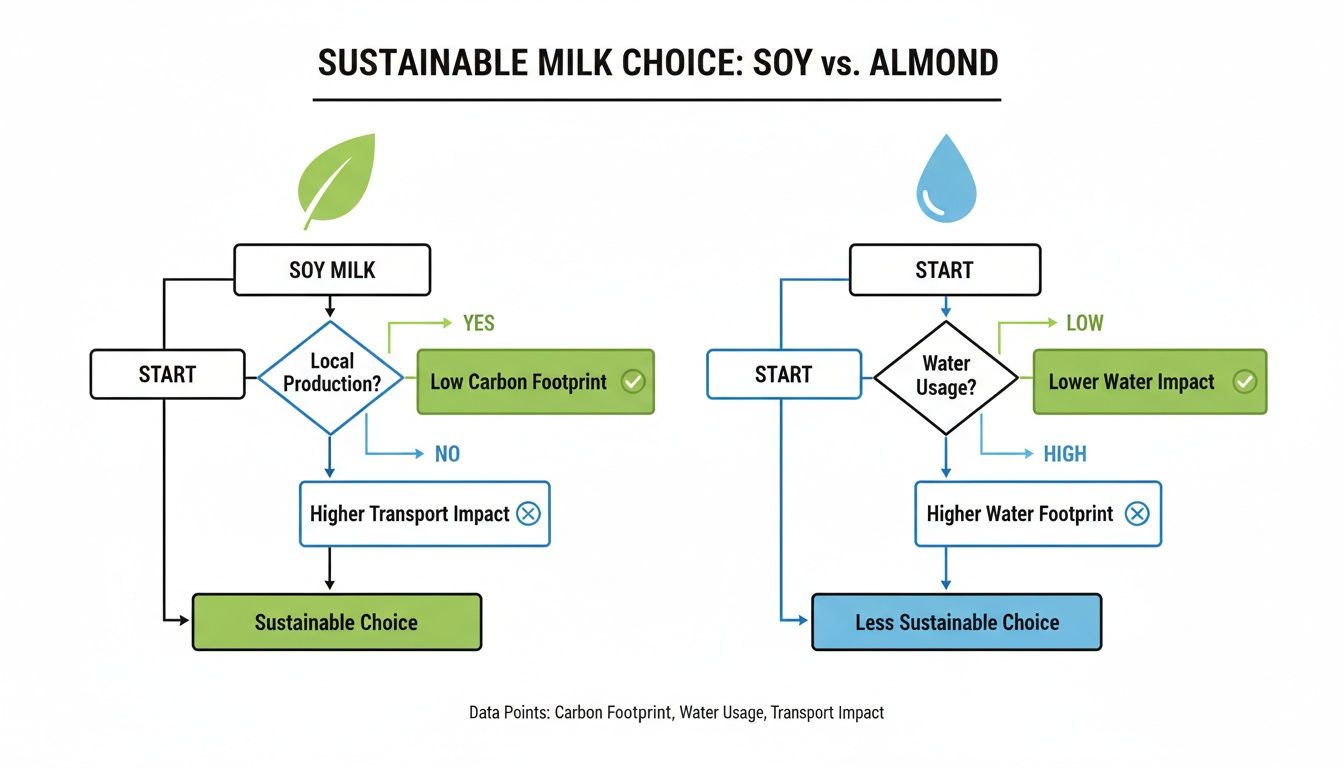
In practice, almond milk sustainability requires balancing a low carbon footprint against high agricultural water demands. While producing one liter of almond milk emits approximately 0.7 kilograms of carbon dioxide equivalent—roughly a quarter of dairy milk's emissions—it requires up to 370 liters of irrigation water. Sustainable operations rely on precision drip irrigation, pollinator habitat integration, whole-orchard recycling, and verified supply chain certifications.
- Central Valley Orchards
- Precision Irrigation
- Bee Better Habitats
- Whole-Orchard Recycling
- Processing & Filtration
- Hull & Shell Upcycling
- Water Recycling Systems
- Packaging & Logistics
- Recyclable Aseptic Cartons
- Regional Distribution
1. The Lifecycle Environmental Profile of Almond Milk
Evaluating the environmental viability of almond milk requires a multi-vector Life Cycle Assessment (LCA). Rather than viewing sustainability through a single metric such as greenhouse gas (GHG) emissions, environmental scientists assess water consumption, land use efficiency, eutrophication potential, and carbon sequestration capacity.
| Beverage | GHG Emissions (kg CO2e per Liter) | Water Footprint (Liters per Liter) |
|---|---|---|
| Dairy | 3.2 | 628 |
| Soy | 1.0 | 28 |
| Oat | 0.9 | 48 |
| Almond | 0.7 | 371 |
Carbon Sequestration vs. Emissions
Almond trees (Prunus dulcis) are perennial woody crops with a typical commercial lifespan of 25 to 30 years. Throughout their operational life, these trees fix atmospheric carbon within their roots, trunks, and scaffold branches. According to agricultural LCA data synthesized by researchers at the University of California, Davis, an acre of mature almond trees sequesters significant volumes of carbon dioxide, offsetting a portion of on-farm machinery emissions.
When calculated per liter of finished beverage, almond milk generates roughly 0.7 kg of CO₂ equivalent ($CO_2e$). This is comparable to oat milk ($\approx 0.9\text{ kg } CO_2e/\text{L}$) and soy milk ($\approx 1.0\text{ kg } CO_2e/\text{L}$), and substantially lower than fluid cow's milk ($\approx 3.2\text{ kg } CO_2e/\text{L}$).
- Atmospheric CO2
- Leaf Photosynthesis
- Biomass Sequestration
- Woody Structure (Trunk/Branches)
- Root Architecture & Soil Organic Matter
- End-of-Life Orchard Recycling
- Carbon Re-incorporation into Soil Biomass
Land Use Efficiency
Perennial orchards demand ongoing land commitment, but their spatial efficiency is high compared to livestock grazing and feed-crop production. Producing one liter of almond milk requires less than 0.5 square meters of land per year. This footprint is significantly smaller than the land required for dairy production, which includes both pasturage and feed-crop cultivation (such as corn and alfalfa).
The Regional Water Nexus
The primary sustainability challenge for almond milk is geographic concentration and water demand. Approximately 80% of the world's commercial almond supply is harvested in California's Central Valley, a Mediterranean climate zone subject to periodic prolonged droughts. Because almond trees are woody perennials, growers cannot fallow their fields during dry years without killing the trees and forfeiting decades of capital investment. Consequently, sustainable almond farming depends directly on advanced water management within water-stressed basins.
2. On-Farm Water Management and Irrigation Technologies
Because water is the primary resource input in almond production, sustainable almond milk starts in the orchard. Over the past two decades, progressive growers have transitioned away from flood and furrow irrigation toward micro-irrigation systems that optimize applied water efficiency.
- Traditional Flood Irrigation: High loss to evaporation and runoff
- Precision Micro-Irrigation: Direct root zone delivery via emitters and drippers
Micro-Drip and Micro-Sprinkler Systems
Modern sustainable orchards use micro-drip emitters and low-volume micro-sprinklers positioned near tree root zones. These systems deliver water directly to the root architecture, minimizing evaporative loss from bare soil and eliminating surface runoff.
- Evapotranspiration ($ET_c$) Scheduling: Farmers calculate crop evapotranspiration using regional weather station networks, such as California's Automated Real-time Irrigation System (CIMIS). By matching irrigation rates to daily weather dynamics, growers avoid over-watering.
- Pressure-Compensating Emitters: These devices maintain a uniform flow rate across irregular topography, ensuring equal water distribution to every tree.
- Soil Moisture Sensing Arrays: Continuous telemetry via capacitance probes at varying soil depths (e.g., 12, 24, and 36 inches) allows growers to monitor soil moisture levels real-time and apply water only when root-zone depletion reaches predefined thresholds.
Regulated Deficit Irrigation (RDI)
Regulated Deficit Irrigation is an agronomic technique where water application is deliberately restricted during specific crop development stages when the tree is less sensitive to stress. Applying mild water stress post-hull split (typically mid-to-late summer) yields three environmental and operational benefits:
- Water Conservation: Reduces seasonal water application by 10% to 15% without impacting nut yield or kernel weight.
- Disease Suppression: Drier orchard canopies reduce the incidence of hull rot (Monilinia fructicola and Rhizopus stolonifer), cutting down the need for chemical fungicide sprays.
- Uniform Harvesting: Stress signals encourage uniform hull splitting, allowing for cleaner mechanical shaking and shorter harvest windows.
Groundwater Management Compliance
In California, sustainable water stewardship is tied to regulatory mandates under the Sustainable Groundwater Management Act (SGMA). SGMA requires local Groundwater Sustainability Agencies (GSAs) to bring critically overdrafted basins into balanced pumping and recharge equilibrium. Sustainable almond producers participate in managed aquifer recharge (MAR) initiatives, directing winter floodwaters onto dormant orchard acreage to replenish local aquifers.
3. Biodiversity, Soil Health, and Pollinator Protection
Almond blooms depend heavily on insect pollination. Managing pollinator health and orchard soil biology is essential to sustainable production.
- Cover Crops & Native Flora (Mustard, Clover, Radish Seeds)
- Soil Health Enhancements
- Nitrogen Fixation
- Organic Matter Build
- Erosion Control
- Pollinator Safeguards
- Forage Availability
- Reduced Chemical Use
- Bee Better Habitat
- Soil Health Enhancements
Pollinator Safety Practices
Because almond flowers bloom in early spring (February to March), orchards require active honeybee populations for cross-pollination. Historically, high stocking rates of migratory colonies created health challenges for bees. Sustainable producers implement protection protocols certified by third parties like the Xerces Society's Bee Better Certified program:
- Application Timing: Spraying pesticides or bloom fungicides during active daylight foraging hours is restricted. Applications are limited to late afternoon or night when bees have returned to hives.
- Fungicide Selection: Growers eliminate tank mixes that combine fungicides with insecticides, protecting wild and managed bees from synergistic toxic effects.
- Permanent Habitat Strips: Dedicating hedgerows and field margins to native flowering plants provides year-round pollen and nectar for wild pollinators outside the short almond bloom window.
Soil Health and Cover Cropping
Conventional orchards traditionally maintained bare, herbicide-treated soil strips between tree rows to simplify harvest sweep operations. Sustainable orchards seed winter cover crop mixes (such as mustard, clover, vetch, and tillage radish) between rows.
| Agronomic Vector | Ecological & Structural Impact |
|---|---|
| Soil Structure | Deep taproots break compaction layers, boosting rain infiltration and preventing soil erosion. |
| Biological Nitrogen | Legumes fix atmospheric nitrogen, reducing synthetic fertilizer demand and nitrous oxide emissions. |
| Organic Matter Accumulation | Mowed biomass boosts soil organic carbon, helping the soil retain more water per root zone. |
4. Co-Product Utilization and Circular Agricultural Systems
An almond fruit consists of three distinct components: the edible kernel, the protective inner shell, and the fibrous outer hull. By weight, the kernel represents only 20% to 25% of the harvested crop. Treating hulls and shells as agricultural waste undermines sustainability; circular systems upcycle 100% of these side streams.
- Harvested Almond Fruit
- Almond Kernel (20–25% Weight)
- Food Manufacturing
- Almond Milk Base
- Flours & Oils
- Food Manufacturing
- Almond Hulls (50–60% Weight)
- Livestock Feed
- Dairy Carbohydrate Substitution
- Livestock Feed
- Almond Shells (15–20% Weight)
- Co-Generation Energy
- Renewable Biochar
- Soil Incorporation
- Co-Generation Energy
- Almond Kernel (20–25% Weight)
Hull Upcycling for Livestock Feed
Almond hulls are rich in soluble sugars and digestible carbohydrates. Upcycling hulls into dairy cattle feed replaces resource-intensive forage crops like alfalfa and silage corn. This integration connects almond farming with regional dairy nutrition, lowering the overall land and water footprint of both agricultural sectors.
Whole-Orchard Recycling (WOR)
At the end of an orchard's 25-year productive life, old trees were historically pushed into piles and burned, releasing stored carbon dioxide and particulate matter into the atmosphere. Under Whole-Orchard Recycling protocols:
- Industrial wood grinders chip entire mature trees on site.
- The resulting woodchips (up to 30 to 60 tons of biomass per acre) are spread back across the soil.
- Heavy equipment incorporates the woodchips into the top 6 to 18 inches of soil before replanting.
WOR increases soil organic matter, improves soil water-holding capacity by up to 10%, and sequesters carbon directly in the orchard soil profile for decades.
Advanced Upcycling Innovations
Research from the USDA Agricultural Research Service (ARS) has commercialized high-value uses for almond coproducts:
- Substrates for Mushroom Cultivation: Torrefied (mildly pyrolyzed) shells serve as growing media for specialty mushrooms.
- Plastic Composites: Finely ground shells act as bio-fillers in recycled plastics, improving thermal stability and reducing petroleum-derived plastic volumes in consumer goods.
- Insect Protein Medium: Hulls serve as a feed substrate for Black Soldier Fly Larvae (BSFL), yielding sustainable animal feeds and insect proteins.
5. Comparative Environmental Impact Matrix
The table below contrasts the lifecycle metrics of almond milk against major alternative plant-based beverages and standard bovine dairy milk, using standardized metrics per 1,000 liters (1 cubic meter) of finished beverage.
| Beverage Type | Irrigation & Process Water (Liters per 1,000L) | GHG Emissions (kg $CO_2e$ per 1,000L) | Land Use Demand ($m^2$ per 1,000L) | Eutrophication Potential (g $PO_4^{3-}$ eq) | Primary Environmental Constraint | Primary Environmental Strength |
|---|---|---|---|---|---|---|
| Almond Milk | 371,000 – 380,000 | 700 – 800 | 500 | 1.5 | High localized water consumption | Low GHG emissions & carbon sequestration |
| Dairy Milk | 628,000 | 3,150 – 3,200 | 8,950 | 10.6 | Methane emissions & land transformation | High nutrient density per liter |
| Oat Milk | 48,000 | 900 | 760 | 1.6 | Synthetic fertilizer runoff risks | Low water consumption footprint |
| Soy Milk | 28,000 | 980 – 1,000 | 660 | 2.3 | Land conversion/deforestation risks | Minimal water use & natural nitrogen fixation |
| Rice Milk | 270,000 | 1,600 | 340 | 4.7 | Methane emissions from flooded paddies | Non-allergenic food profile |
Data synthesized from global lifecycle assessments (including Poore & Nemecek, 2018, and UC Davis Agricultural Extension LCA models).
6. Sustainable Processing, Packaging, and Distribution
Environmental impacts extend beyond the farm gate into food manufacturing, extraction, blanched processing, bottling, and retail distribution logistics.
- Raw Kernels
- Blanch & Grind
- Thermal Reuse (Heat Exchangers)
- Decanter Separation
- Wet Pomace Waste (Upcycled to Food Base)
- Aseptic Cartons
- FSC-Fibre Sourced Packaging
Water Efficiency in Manufacturing
Converting raw almond kernels into a stable liquid emulsion requires washing, blanching, grinding, and decanting. Industrial beverage facilities employ closed-loop water recovery systems:
- Clean-in-Place (CIP) Water Recycling: Multi-stage CIP systems capture final rinse water and reuse it in initial wash cycles, reducing facility freshwater demands.
- Membrane Filtration & Reverse Osmosis: Processing plants isolate wash water, filter solids out using ultrafiltration, and run water through reverse osmosis (RO) systems to reuse it in cooling towers and boilers.
Upcycling Wet Almond Pomace
During decantation, processors separate liquid almond milk from insoluble fibrous pulp, known as almond pomace or spent solids. Unmanaged pomace represents an organic waste stream with high biochemical oxygen demand (BOD). Sustainable processors divert 100% of wet pomace by:
- Dehydrating and milling pomace into gluten-free, high-fiber baking flours.
- Extruding pomace for plant-based snack foods and protein bars.
- Compounding pomace into dairy-alternative bases, such as almond-based yogurts and cheeses.
Low-Carbon Packaging Solutions
Aseptic shelf-stable packaging options drastically alter supply-chain emissions compared to refrigerated cold-chain distribution:
Refrigerated HDPE Bottled
- Continuous Cold-Chain Transport
- High Refrigeration Energy Loads
- Shorter Shelf-Life Window
Aseptic Carton Packaging
- Ambient Temperature Storage
- Paperboard Layered with Thin Polymer
- Expanded Distro Efficiency
FSC-Certified Paperboard Cartons: Using aseptic cartons made of Forest Stewardship Council (FSC)-certified paperboard paired with plant-derived polymers reduces reliance on fossil-fuel plastics.
Ambient Logistics Optimization: Shelf-stable aseptic filling allows products to be transported via ambient freight rather than energy-intensive refrigerated trucks, cutting transport-related fuel usage by up to 20%.
7. Verification Standards and Certifications
To verify sustainability claims and avoid greenwashing, commercial buyers and consumers rely on established third-party certifications across ecological metrics.
| Standard / Certification | Audit Scope & Primary Verification Criteria |
|---|---|
| Bee Better Certified (Xerces Society) | Enforces non-chemical pest management, native forage buffers, and pollinator safety windows. |
| AWS Standard (Alliance for Water Stewardship) | Evaluates basin-level water balance, water quality management, and local aquifer preservation. |
| California Almond Sustainability Program (CASP) | Self-audited and verified 4-tier benchmark assessing water, soil, energy, and community. |
| USDA Organic Certification | Prohibits synthetic pesticides, herbicides, and artificial fertilizers in raw almond production. |
Bee Better Certified
Administered by the Xerces Society for Invertebrate Conservation, this label requires farmers to dedicate at least 5% of orchard acreage to permanent pollinator habitat (such as native flowering shrubs and wildflowers). It explicitly bans harmful neonicotinoid insecticides and restricts bloom-period spray activities.
Alliance for Water Stewardship (AWS) Standard
The AWS Standard certifies processing facilities and farm groups that demonstrate responsible water management within their immediate watershed. Certification requires site-specific audits covering:
- Sustainable water balance (ensuring extractions do not exceed natural recharge rates).
- Maintenance of local water quality status.
- Protection of Important Water-Related Areas (IWAs), such as adjacent wetlands or river systems.
California Almond Sustainability Program (CASP)
Developed by the Almond Board of California, CASP collects self-reported and audited farm practice data across thousands of acres. It benchmarks growers across pest management, nutrient efficiency, air quality, and irrigation management, giving supply-chain buyers transparent documentation of farm practices.
8. Guidance for Procurement and Conscious Consumers
Evaluating almond milk sustainability requires analyzing farm sources, processing efficiencies, and product formats.
- Origin & Sourcing
- California CASP
- Mediterranean Basin
- Certifications
- Bee Better Certified
- USDA Organic / AWS
- Format & Pack
- Concentrated / Base
- Aseptic Packaging
Procurement & B2B Purchasing Strategies
Commercial buyers, food manufacturers, and coffee chains looking to source almond milk sustainably should follow these sourcing criteria:
- Require Origin Documentation: Prioritize suppliers sourcing almonds from growers engaged in validated regional groundwater sustainability plans (such as SGMA-compliant districts in North America or protected aquifers in Spain).
- Specify Co-Product Utilization Mandates: Contract with processors that upcycle 100% of almond hulls, shells, and wet pomace into industrial streams, preventing landfill disposal.
- Prioritize Concentrates and Paste Bases: Buying almond paste or concentrated beverage bases reduces shipping weight and bulk liquid volume, cutting transport emissions prior to final reconstituting and bottling.
Consumer Buying Checklist
Consumers balancing environmental concerns when purchasing almond milk can apply a three-step decision framework:
- Step 1: Check Environmental Certifications
- Look for Bee Better Certified, USDA Organic, or AWS marks on packaging.
- Step 2: Select Packaging Format
- Choose shelf-stable aseptic cartons over refrigerated plastic jugs.
- Step 3: Evaluate Ingredients
- Select products featuring short ingredient lists with higher almond mass percentages to ensure efficient agricultural resource utilization per serving.
Frequently Asked Questions
Is almond milk worse for the environment than cow's milk?
No. Across almost every lifecycle assessment metric except localized water usage, almond milk has a lower environmental impact than cow's milk. Producing almond milk generates roughly 75% fewer greenhouse gas emissions and requires less than 6% of the land area needed for dairy milk. While almond milk uses substantial irrigation water, dairy production requires even higher overall volumes of water to grow cattle feed crops like alfalfa and corn, while also producing methane emissions.
How much water does it actually take to make one glass of almond milk?
Producing a standard 250 ml glass of almond milk requires approximately 90 to 95 liters of irrigation water. This calculation includes all the water used to irrigate the almond trees throughout the growing season, divided by the total volume of finished beverage produced from the harvest. Modern micro-drip irrigation and regulated deficit practices continue to reduce this figure.
Are almond orchards causing mass honeybee deaths?
Historically, intense migratory bee stocking and daylight pesticide spraying in conventional orchards caused high stress and mortality rates in honeybee hives. Modern sustainable management practices have largely altered this dynamic. Orchards certified under programs like Bee Better Certified prohibit systemic pesticides, eliminate spraying while bees are foraging, and plant permanent native flowering hedgerows to supply year-round forage, supporting healthier pollinator populations.
What is Whole-Orchard Recycling, and why does it matter?
Whole-Orchard Recycling (WOR) is a sustainable agricultural practice where old, non-productive almond trees are chipped into wood mulch and incorporated back into the topsoil rather than burned. WOR traps carbon within the soil, improves the soil's organic matter, boosts water-holding capacity, and eliminates the air pollution associated with open-field agricultural burning.
How does packaging affect almond milk's overall sustainability footprint?
Packaging format significantly alters distribution emissions. Ambient, shelf-stable aseptic paperboard cartons made from FSC-certified fibers eliminate the need for continuous refrigeration during transport and warehouse storage. This reduces logistics energy loads compared to heavy plastic jugs that require uninterrupted cold-chain freight.
Summary Action Plan for Supply Chain Sustainability
Achieving measurable almond milk sustainability requires targeted updates at every link in the value chain:
- Farm Operators
- Micro-Drip Systems
- Cover Cropping
- Bee Safety Protocols
- Beverage Processors
- Closed-Loop Water
- Pomace Upcycling
- FSC Paperboard Pack
- Consumers & Buyers
- Buy Aseptic Packaging
- Demand Certified Caps
- Choose Concentrates
By focusing on precision water technology, soil carbon sequestration, pollinator safety, and full co-product upcycling, almond milk production can operate responsibly within planetary boundaries while offering a low-carbon alternative to traditional dairy.