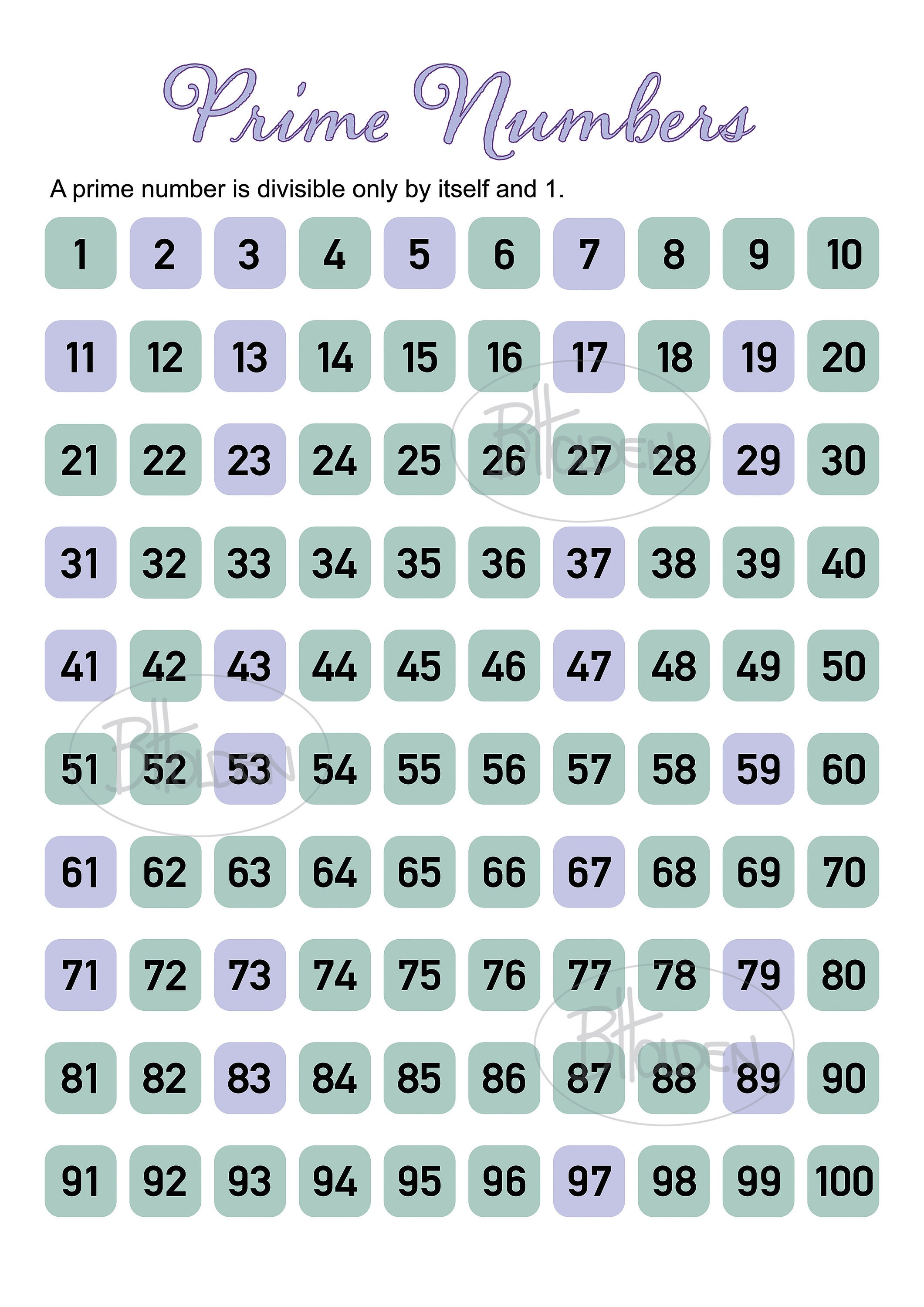
The common assertion that all prime numbers are odd is a frequent misconception in mathematics. In reality, the set of prime numbers contains exactly one even member: the number 2. While every prime number greater than 2 is necessarily odd, the existence of 2 as an even prime number means that the statement "all prime numbers are odd" is mathematically false, although the vast majority of them are.
Understanding the relationship between prime numbers and parity (evenness versus oddness) requires a deep dive into the definitions that govern number theory. By definition, a prime number is a natural number greater than 1 that has no positive divisors other than 1 and itself. This simple rule creates a unique landscape where the number 2 stands as a solitary sentinel—the only number that manages to be both even and prime. To understand why this is the case, and why no other even number can ever join it, we must examine the structural logic of divisibility and the fundamental theorems that underpin modern mathematics as of 2026.
The Mathematical Definition of a Prime Number
To analyze why almost all prime numbers are not even, we must first establish a rigid definition of what a prime number actually is. In the field of number theory, a prime number is a positive integer $p > 1$ that cannot be formed by multiplying two smaller positive integers. If a number can be formed by multiplying two smaller integers, it is called a composite number.
The number 1 is specifically excluded from the definition of prime numbers. This is not an arbitrary choice but a necessity for the Fundamental Theorem of Arithmetic, which states that every integer greater than 1 either is a prime itself or can be represented as a unique product of prime numbers. If 1 were considered prime, the "uniqueness" of this factorization would be lost, as one could multiply any factorization by 1 an infinite number of times (e.g., $6 = 2 \times 3 = 2 \times 3 \times 1 = 2 \times 3 \times 1 \times 1$).
Consequently, the sequence of prime numbers begins: 2, 3, 5, 7, 11, 13, 17, 19, and continues infinitely. In this sequence, 2 is the first and only even number.
The Logic of Evenness and Divisibility
An even number is defined as any integer that is exactly divisible by 2. In algebraic terms, an integer $n$ is even if there exists an integer $k$ such that $n = 2k$. Conversely, an odd number is an integer that is not divisible by 2, represented as $n = 2k + 1$.
The reason almost all prime numbers are not even lies in the definition of evenness itself. If a number is even and greater than 2, it must, by definition, have at least three distinct factors:
- 1 (which is a factor of every integer).
- 2 (which is a factor of every even integer).
- The number itself.
For example, consider the number 4. Its factors are 1, 2, and 4. Because it has a factor other than 1 and itself (specifically, 2), it fails the definition of a prime number and is classified as composite. This logic applies to 6, 8, 10, 100, and every other even integer in existence. The only even number that escapes this trap is 2, because for the number 2, the "factor of 2" and the "number itself" are the same entity. Thus, 2 has exactly two factors: 1 and 2.
A Formal Proof by Contradiction
To solidify the understanding that no other even prime can exist, we can utilize a formal proof by contradiction. This is a staple of mathematical reasoning used to prove that a statement is true by showing that the alternative leads to a logical impossibility.
Assumption: Suppose there exists an even prime number $P$ that is greater than 2.
- Since $P$ is even, it must be divisible by 2.
- Since $P$ is a prime number, its only divisors must be 1 and $P$.
- From step 1, we know 2 is a divisor of $P$.
- From step 2, if 2 is a divisor of $P$, then 2 must be either 1 or $P$.
- We know 2 is not 1.
- Therefore, 2 must be equal to $P$.
- However, our initial assumption was that $P > 2$.
- It is impossible for $P$ to be both equal to 2 and greater than 2.
Because the assumption leads to a contradiction, the assumption must be false. Therefore, there can be no even prime number greater than 2.
The Sieve of Eratosthenes: Visualizing the Exclusion
One of the oldest and most effective ways to identify prime numbers is the Sieve of Eratosthenes. This algorithm, dating back to ancient Greece, provides a visual representation of why even numbers (except 2) are excluded from the prime set.
When using the sieve:
- List all integers from 2 up to a desired limit.
- Identify the first prime number, which is 2.
- Cross out all multiples of 2 (4, 6, 8, 10, etc.). These are all even numbers.
- The next remaining number is 3, which is prime.
- Cross out all multiples of 3.
- Continue this process for all remaining numbers.
The very first step of the sieve—crossing out all multiples of 2—effectively eliminates half of all possible integers from being prime candidates. This step highlights the "oddity" of the prime sequence; once 2 is established as prime, it immediately invalidates the primality of every other even number in the infinite timeline of mathematics.
Comparing Primes and Parity
The following table illustrates the first ten prime numbers and their parity, demonstrating the unique position of the number 2.
| Prime Rank | Prime Number | Parity | Factors | Classification |
|---|---|---|---|---|
| 1st | 2 | Even | 1, 2 | Even Prime |
| 2nd | 3 | Odd | 1, 3 | Odd Prime |
| 3rd | 5 | Odd | 1, 5 | Odd Prime |
| 4th | 7 | Odd | 1, 7 | Odd Prime |
| 5th | 11 | Odd | 1, 11 | Odd Prime |
| 6th | 13 | Odd | 1, 13 | Odd Prime |
| 7th | 17 | Odd | 1, 17 | Odd Prime |
| 8th | 19 | Odd | 1, 19 | Odd Prime |
| 9th | 23 | Odd | 1, 23 | Odd Prime |
| 10th | 29 | Odd | 1, 29 | Odd Prime |
As observed, after the very first entry, the parity shifts to "Odd" and remains there indefinitely. This has led many mathematicians to jokingly refer to 2 as "the oddest prime," because it is the only one that is even.
Why the "Oddness" of Primes Matters in 2026
In 2026, the study of prime numbers is more than an academic exercise; it is the backbone of global cybersecurity. Most modern encryption protocols, such as RSA (Rivest-Shamir-Adleman), rely on the difficulty of factoring extremely large composite numbers into their prime components.
Because we know that all prime numbers (except 2) are odd, computational algorithms can immediately ignore half of all possible factors when attempting to break a code. If a computer is searching for the prime factors of a massive odd number, it does not even need to test even numbers, as the product of any even number and another integer would result in an even number. This simple observation—that primes greater than 2 are not even—saves trillions of computational cycles every day in the world's data centers.
Furthermore, the "oddness" of primes plays a critical role in the Goldbach Conjecture, one of the oldest unsolved problems in mathematics. The conjecture states that every even integer greater than 2 can be expressed as the sum of two prime numbers. For example, $8 = 5 + 3$ and $10 = 7 + 3$. The fact that these sums involve odd primes to reach an even total is a fundamental aspect of how integers interact.
The Distribution and Density of Primes
While it is true that all primes except 2 are not even, it is also true that not all odd numbers are prime. As we progress through the number line, prime numbers become increasingly rare. This is described by the Prime Number Theorem, which estimates the density of primes.
For an odd number to be prime, it must not be divisible by any smaller prime. As the numbers get larger, there are more potential prime divisors to check against, making it "harder" for a number to remain prime. For instance, 9, 15, 21, 25, and 27 are all odd, but they are not prime because they have divisors like 3, 5, or 7. This distinction is crucial for students: while "prime implies odd (mostly)," "odd does not imply prime."
Advanced Perspectives: Primes in Other Contexts
In some specialized areas of mathematics, such as Gaussian integers (complex numbers where both real and imaginary parts are integers), the concept of "prime" and "even" can shift. However, in the standard set of natural numbers that we use for counting and most scientific applications, the rules remain fixed.
The number 2 is also essential in binary arithmetic, which uses only 0 and 1. While the number 2 itself isn't a digit in binary, it is the base of the system. The unique primality of 2 is what makes binary logic so efficient for electronic circuits. In a sense, the only even prime is the very foundation of the digital age.
Common Misconceptions to Avoid
When discussing why all prime numbers are not even, several common errors often arise in classrooms and technical discussions:
- Confusing "Prime" with "Odd": Many people assume that if a number is odd, it must be prime. As shown with 9 or 21, this is incorrect.
- Forgetting 2: Some mistakenly believe that 1 is the first prime or that the prime sequence starts at 3. Remembering that 2 is prime is vital for accurate calculations.
- Assuming 1 is Prime: As discussed, 1 is a "unit," not a prime. It does not have two distinct divisors.
- Large Even Primes: Occasionally, people wonder if there is a "massive" even prime number yet to be discovered. Based on the proof by contradiction provided earlier, we can say with 100% certainty that no such number exists, regardless of how much computing power we develop by 2026 or beyond.
Practical Troubleshooting: Is This Number Prime?
If you are trying to determine if a specific number is prime, follow these logic steps based on parity:
- Is the number 2? If yes, it is prime.
- Is the number even and greater than 2? If yes, it is composite (not prime).
- Does the number end in 5 or 0 (and is greater than 5)? If yes, it is composite.
- Is the sum of the digits divisible by 3? If yes, the number is divisible by 3 and is likely composite (unless the number is 3 itself).
- For larger odd numbers: You must test divisibility by smaller primes (3, 7, 11, 13, etc.) up to the square root of the number in question.
Recommended Action for Learners
To master the concept of prime numbers and their parity, it is recommended to practice the Sieve of Eratosthenes by hand for numbers 1 through 100. By physically crossing out the even numbers, you will internalize the reason why 2 is unique. For those interested in the computational side, exploring the Great Internet Mersenne Prime Search (GIMPS) provides a real-time look at how mathematicians continue to find increasingly massive primes—all of which, following the rules of mathematics, are odd.
By 2026, our understanding of these numbers continues to evolve through the lens of quantum computing and advanced cryptography, but the fundamental truth remains unchanged: 2 is the only even prime, and all other primes are not even.