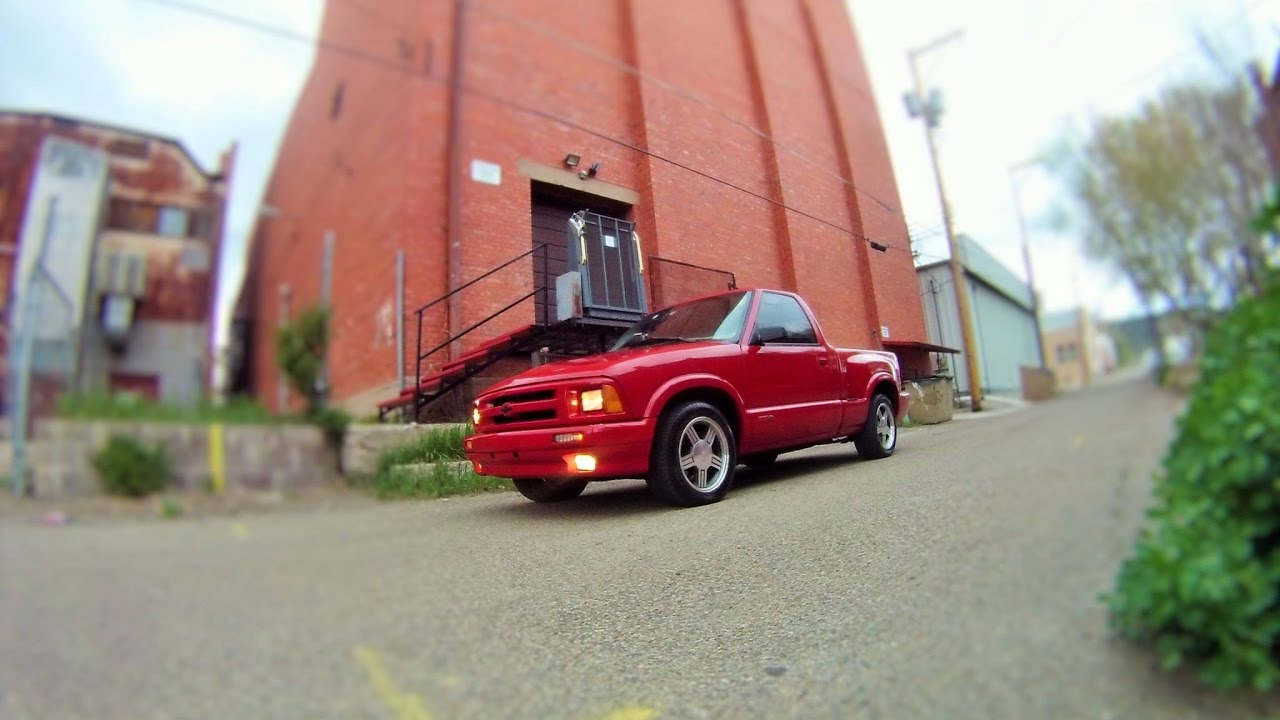
The 1997 Chevrolet S-10 SS is a factory-modified sport truck featuring the high-output 4.3L Vortec V6 engine and the specialized ZQ8 sport suspension package. Built exclusively in a regular-cab, short-box, two-wheel-drive configuration, it offers a monochromatic exterior design and enhanced handling dynamics compared to the standard S-10 models of the mid-1990s.
The Genesis of the S-10 Super Sport
By 1997, the "sport truck" craze was well-established in the American automotive market. Following the success of the limited-production, turbocharged GMC Syclone and the full-sized Chevrolet 454 SS, General Motors recognized a demand for a more affordable, insurance-friendly performance pickup. The S-10 SS (RPO code B4U) was the answer, bridging the gap between a utilitarian work truck and a dedicated performance machine.
Unlike the Syclone, which used forced induction and all-wheel drive, the S-10 SS relied on a "back-to-basics" philosophy: a lightweight chassis, a torquey naturally aspirated engine, and a significantly upgraded suspension system. This approach made the truck reliable for daily use while providing a much more engaging driving experience than the base-level four-cylinder or standard V6 models.
In the context of 2026, the 1997 S-10 SS has transitioned from a used-car bargain into a legitimate "Youngtimer" classic. Collectors value the 1997 model year specifically because it represents the final year of the original second-generation styling before the 1998 facelift, while still benefiting from the interior refinements and mechanical updates introduced mid-decade.
Powertrain and Mechanical Specifications
The heart of the 1997 S-10 SS is the L35 4.3L Vortec V6. Often referred to as "three-quarters of a 350 small block," this engine shared the 90-degree architecture of the legendary Chevrolet V8. For the 1997 model year, the engine featured Sequential Central Port Injection (SCPI), which improved fuel atomization and throttle response compared to the earlier Throttle Body Injection (TBI) systems.
Engine Output and Characteristics
The 4.3L V6 in the SS trim was rated at approximately 180 to 190 horsepower and 240 to 245 lb-ft of torque. While these numbers may seem modest by 2026 standards, the truck's relatively low curb weight—roughly 3,100 to 3,200 pounds—allowed it to feel punchy and responsive. The torque curve was particularly flat, providing plenty of low-end grunt for off-the-line acceleration.
Transmission and Drivetrain
For 1997, the S-10 SS was primarily equipped with the 4L60-E four-speed automatic transmission. This electronically controlled unit was robust and allowed for precise shift points tailored to the truck's performance mission. While some early SS models (1994–1995) were strictly automatic, by 1997, the focus remained on the automatic pairing, though the rarity of manual-swapped versions in the secondary market today highlights the original preference for the 4L60-E's consistency.
All SS models featured a 3.42 rear axle ratio as standard, often paired with a limited-slip differential (RPO G80). This combination was crucial for the truck's identity, ensuring that power was delivered effectively to both rear wheels, aiding in both cornering and straight-line traction.
The ZQ8 Sport Suspension Package
The defining characteristic of the 1997 S-10 SS is not just the engine, but the ZQ8 suspension. While the engine could technically be ordered in other S-10 trims, the SS bundled the high-output V6 with a comprehensive handling suite that transformed the truck's behavior.
Lowered Ride Height and Stiffened Components
The ZQ8 package lowered the S-10 approximately two inches compared to the base suspension. This was achieved through specific coil springs in the front and a revised leaf spring pack in the rear. To manage the increased spring rates, Chevrolet utilized heavy-duty Bilstein gas-charged shocks (though some production runs used Decarbon units), which provided superior damping and reduced body roll during aggressive maneuvers.
Steering and Bracing
One of the most overlooked upgrades in the SS was the quick-ratio steering box. Borrowed from the performance passenger car line, this gearbox reduced the number of turns from lock-to-lock, making the truck feel significantly more "darty" and car-like.
To further stiffen the chassis, the ZQ8 package included:
- Thicker Sway Bars: A 33mm front bar and a 23mm rear bar were used to minimize lateral lean.
- Frame Bracing: Additional braces were added to the frame rails to reduce flex.
- The Hop Damper: A unique third shock absorber was mounted to the rear axle to mitigate "wheel hop" during hard acceleration, a common issue with leaf-sprung trucks.
Exterior and Interior Design Cues
The 1997 S-10 SS followed the "sleeper" aesthetic common in the 90s, focusing on clean lines rather than aggressive body kits. This separates it visually from the later "Xtreme" models, which utilized prominent plastic ground effects.
Monochromatic Aesthetics
The SS featured a fully monochromatic paint scheme. The front grille, front and rear bumpers, and side-view mirrors were all painted to match the body color. In 1997, the primary color options were Summit White, Onyx Black, and Apple Red. This color-coding gave the truck a more integrated, premium appearance compared to the chrome or gray plastic found on base models.
Wheels and Tires
The truck sat on 16x8-inch five-spoke aluminum wheels that were unique to the ZQ8 and SS trims. Originally, these wheels were wrapped in 235/55R16 Goodyear Eagle GA performance tires. These wide-contact patches were essential for capitalizing on the suspension's capabilities, providing a level of grip that was highly praised by automotive journalists at the time.
Interior Layout
Inside, the 1997 model benefited from the updated dashboard design introduced in 1994, which featured more rounded contours and improved ergonomics. Most SS models were equipped with high-back bucket seats and a center console, emphasizing the sporty nature of the vehicle. However, because it was based on the standard cab, interior storage was limited to a small area behind the seats.
Technical Specifications Comparison
To understand how the SS differed from the standard S-10 of the same year, the following table breaks down the key mechanical variances.
| Feature | 1997 S-10 Base (2WD) | 1997 S-10 SS (B4U/ZQ8) |
|---|---|---|
| Engine | 2.2L I4 (Standard) | 4.3L Vortec V6 (High Output) |
| Horsepower | 118 hp | 180–190 hp |
| Torque | 130 lb-ft | 240–245 lb-ft |
| Ride Height | Standard | 2-inch Lowered (Factory) |
| Wheels | 14-inch or 15-inch Steel/Alum | 16x8-inch Sport Aluminum |
| Steering Ratio | Standard Utility | Quick-Ratio Performance |
| Sway Bars | Standard Thin | 33mm Front / 23mm Rear |
| Differential | Open (Usually) | Limited-Slip (G80 Standard/Common) |
Identifying a Genuine 1997 S-10 SS
Because the S-10 SS was essentially a parts-bin masterpiece, many standard S-10s have been modified by owners to look like an SS. For collectors in 2026, verifying authenticity is critical for maintaining value.
The primary way to identify a real SS is by checking the Service Parts Identification (SPID) label, typically located in the glove box. A genuine SS must have the RPO code B4U. This code signifies the "Super Sport" appearance and equipment group. Additionally, the code ZQ8 must be present, confirming the truck was built with the factory sport suspension.
Another indicator is the VIN. While the VIN does not explicitly state "SS," the eighth digit should be an "X" or a "W" to signify the 4.3L Vortec V6. If the truck has a 2.2L engine (VIN digit "4"), it is not a genuine SS, regardless of what the exterior badges say.
Common Issues and Maintenance for Owners
Despite its performance pedigree, the 1997 S-10 SS is built on a high-volume platform, meaning mechanical parts are generally affordable and easy to find. However, there are specific areas that require attention.
- Intake Manifold Gaskets: The 4.3L V6 is notorious for leaking coolant from the intake manifold gaskets. If left unchecked, this can lead to internal engine damage. Modern replacement gaskets are usually made of better materials than the originals.
- SCPI "Spider" Injectors: The early sequential fuel injection system used a central hub with plastic lines running to each cylinder. These lines can become brittle or the poppet valves can clog. Many owners upgrade to the "MPFI" (Multi-Port Fuel Injection) conversion kit, which replaces the poppets with actual electronic injectors at the cylinder head.
- Intermediate Steering Shaft: Over time, the steering can develop play. Replacing the intermediate shaft is a common fix to restore that "quick-ratio" feel.
- Suspension Bushings: Given that these trucks are now nearly 30 years old, the rubber bushings in the ZQ8 sway bars and control arms are often dry-rotted. Switching to polyurethane bushings can further sharpen the handling, though it may increase cabin vibration.
Market Trends and Collector Outlook in 2026
As of 2026, the 1997 Chevrolet S-10 SS has seen a steady rise in valuation. For decades, these were treated as "disposable" street trucks, frequently modified with aftermarket air suspension or engine swaps. Consequently, unmodified, low-mileage examples have become exceedingly rare.
Current market data suggests that a clean, survivor-grade S-10 SS can command prices significantly higher than its original MSRP of roughly $16,000–$18,000. Enthusiasts of the "RADwood" era—the late 80s and 90s—prize the SS for its honest mechanical nature and its place in the lineage of Chevy performance trucks. While it doesn't reach the astronomical prices of the GMC Syclone, it offers a similar aesthetic and a "daily-driver" level of reliability that the turbocharged trucks lack.
Frequently Asked Questions
Did the 1997 S-10 SS come with a V8?
No, the 1997 S-10 SS was never offered with a V8 from the factory. It exclusively used the 4.3L Vortec V6. While many owners have performed "LS swaps" or small-block Chevy V8 swaps due to the large engine bay, any V8-powered S-10 SS is an aftermarket modification.
How many 1997 S-10 SS trucks were produced?
Production numbers for the SS trim were relatively low compared to the standard S-10. While exact annual breakdowns can be difficult to verify through official GM records, it is estimated that between 2,500 and 5,000 SS units were produced annually between 1994 and 1998. The 1997 model year is one of the more common of this limited run, but still rare in the broader context of truck production.
Can the ZQ8 suspension be added to a base S-10?
Yes, the components of the ZQ8 suspension (springs, shocks, sway bars, and steering box) are physically compatible with other 2WD S-10 frames. However, a truck modified in this way will not carry the B4U RPO code and will not hold the same collector value as a factory-born SS.
What is the 0–60 mph time for a 1997 S-10 SS?
In period testing, a stock 1997 S-10 SS typically achieved a 0–60 mph time in the 8.0 to 8.5-second range. While this isn't fast by modern 2026 performance standards, the truck's appeal lies in its handling and "stoplight-to-stoplight" torque rather than its outright drag strip speed.
Is the S-10 SS the same as the S-10 Xtreme?
No. The S-10 SS was produced from 1994 to 1998. The S-10 Xtreme replaced the SS starting in 1999. While both used the ZQ8 suspension, the Xtreme featured a much more aggressive exterior with lower body cladding and was available in more cab configurations (Extended Cab) and with different engine options (including the 2.2L four-cylinder).
Recommended Next Steps for Buyers
If you are looking to acquire a 1997 Chevrolet S-10 SS in 2026, your first action should be to verify the RPO codes. Locate the SPID sticker in the glove box and look for "B4U." Without this code, the vehicle is an "SS Clone" and should be priced significantly lower.
Secondly, perform a rigorous inspection of the cooling system and fuel injection. Given the age of these vehicles, the plastic components of the SCPI system are likely nearing the end of their service life if they haven't been replaced already. Finally, prioritize trucks that retain their original 16-inch ZQ8 wheels, as these are becoming increasingly difficult to source in refurbished condition.