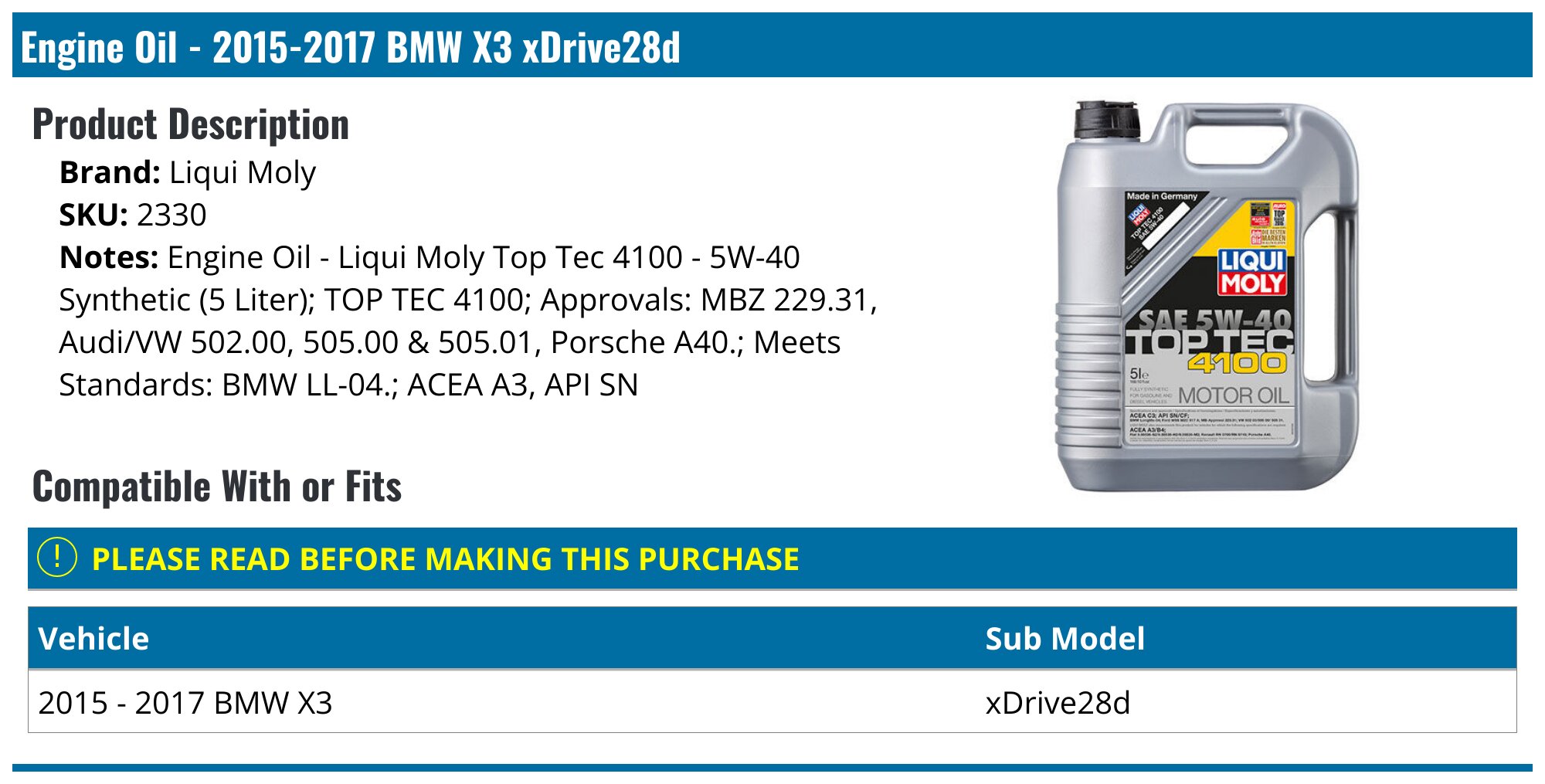
The total engine oil capacity for a 2017 BMW X3 xDrive28i equipped with the 2.0-liter turbocharged N20 4-cylinder engine is 5.3 US quarts (5.0 liters) when changing the oil along with a new oil filter. BMW recommends using a synthetic oil meeting BMW Longlife-01 (LL-01) or Longlife-01 FE standards in 0W-30 or 5W-30 viscosity.
2017 BMW X3 xDrive28i Engine and Oil Overview
The 2017 BMW X3 xDrive28i relies on BMW’s N20B20 2.0-liter TwinPower Turbo inline-4 engine. This powertrain delivers a balance of performance and fuel efficiency, but turbocharging places elevated thermal and mechanical stress on the engine oil. Knowing the exact oil capacity, viscosity rating, and manufacturer approvals is critical to preventing premature component wear, oil degradation, and turbocharger damage.
When performing a standard oil service (draining the oil pan and replacing the oil filter element), the engine requires exactly 5.3 US quarts (5.0 liters) of clean oil. Overfilling or underfilling this engine can trigger electronic warnings, harm the catalytic converter, or lead to oil starvation. Because this generation of the BMW X3 does not feature a traditional mechanical dipstick, precise fill procedures and electronic measurement verification are mandatory.
Technical Specifications and Approved Oil Standards
Engine oil in modern turbocharged BMW vehicles serves multiple vital roles: lubricating high-speed crankshaft and camshaft bearings, cooling the turbocharger center housing, hydraulically actuating the VANOS (variable valve timing) system, and preventing sludge buildup inside internal oil galleries.
Approved BMW Oil Specifications
Using standard off-the-shelf motor oil that lacks proper manufacturer approvals can lead to accelerated oil breakdown, increased carbon deposits, and potential warranty complications. For the 2017 BMW X3 xDrive28i, look for motor oils bearing these official certifications on the bottle:
- BMW Longlife-01 (LL-01): The primary full-synthetic specification required for standard gasoline engines operating under variable temperature conditions.
- BMW Longlife-01 FE (LL-01 FE): A fuel-economy variant of the standard LL-01 specification with lower High-Temperature High-Shear (HTHS) viscosity requirements.
- BMW Longlife-14 FE+ (LL-14 FE+): Specified for select newer BMW engines utilizing ultra-low viscosity (0W-20) formulations designed specifically for minimized internal friction.
If an oil labeled with official BMW approvals is unavailable, ensure the oil meets ACEA A3/B4 or ACEA C3 standards along with API SN or API SP ratings.
Recommended Viscosity Grades
Viscosity choice depends largely on regional ambient operating temperatures, driving habits, and vehicle mileage:
- 0W-30 (Recommended Standard): Offers optimal flow during cold engine starts while maintaining robust film strength at elevated operating temperatures.
- 5W-30 (Alternative Standard): Highly common and widely available; provides excellent thermal protection under warm climate conditions and heavy driving loads.
- 0W-20 (Fuel Economy Specialization): Approved only if explicitly noted under BMW LL-14 FE+ recommendations for cold-climate fuel efficiency.
Required Tools, Parts, and Torque Values
Before starting an oil service on a 2017 BMW X3 xDrive28i, gather the appropriate tools and replacement components. The N20 engine utilizes an top-accessible, cartridge-style filter housing rather than a spin-on metal filter.
Essential Parts and Materials
- 5.3 Quarts (5.0 Liters) Approved Synthetic Oil: Ensure the oil bottle lists BMW LL-01 or matching credentials.
- Oil Filter Element Kit: Includes the cartridge filter, one large rubber O-ring for the filter cap stem, one small rubber O-ring (if applicable), and a new copper crush washer for the drain plug.
- Replacement Oil Drain Plug: (Optional, but recommended if replacing plastic drain plugs found on certain composite oil pan variants).
Standard Tools Required
- 86mm 16-flute oil filter socket wrench (or compatible BMW oil filter cap tool).
- 17mm socket or 8mm Allen/Hex key (depending on drain plug style installed).
- Torque wrench capable of measuring low values (15 to 30 Nm / 11 to 22 ft-lbs).
- Catch basin/drain pan with at least 8-quart capacity.
- Vehicle ramps or hydraulic jack with safety jack stands.
- Nitrile gloves, safety glasses, and clean shop towels.
Factory Torque Specifications
| Component | Metric Torque | Imperial Torque | Notes |
|---|---|---|---|
| Oil Filter Housing Cap | 25 Nm | 18.4 ft-lbs (221 in-lbs) | Do not overtighten; plastic cap can crack. |
| Metal Oil Pan Drain Plug | 25 Nm | 18.4 ft-lbs | Always replace copper crush washer. |
| Plastic Oil Pan Drain Plug | 10 Nm | 7.4 ft-lbs (88 in-lbs) | Replace plug every service; do not reuse plastic plugs. |
Step-by-Step Oil Change Instructions
Changing the oil on a 2017 BMW X3 xDrive28i is straightforward when following proper vehicle safety and maintenance protocols.
Step 1: Vehicle Preparation and Warm-Up
- Drive the vehicle for 5–10 minutes to bring the engine oil up to normal operating temperature. Warm oil drains more completely and suspends contaminants better than cold oil.
- Park the car on a flat, level concrete surface. Engage the electronic parking brake.
- Safely elevate the front of the vehicle using an automotive lift or floor jack, securing it firmly on safety jack stands. Never work beneath a vehicle supported solely by a hydraulic jack.
Step 2: Draining the Used Engine Oil
- Open the hood and remove the engine oil filler cap to allow vacuum-free draining.
- Locate the service access trapdoor under the engine splash shield. Open or unscrew the cover to access the engine oil pan drain plug.
- Position your drain pan beneath the drain plug.
- Using a 17mm socket or appropriate hex bit, slowly loosen and remove the drain plug. Be prepared for hot engine oil to flow out rapidly.
- Allow the oil to drain completely for at least 10 to 15 minutes until it tapers down to a slow, intermittent drip.
Step 3: Servicing the Oil Filter Housing
- Locate the black plastic oil filter housing cap at the front-driver side of the engine bay.
- Attach the 86mm 16-flute oil filter socket to a ratchet extension and carefully unthread the cap counterclockwise.
- Lift the cap and old cartridge filter vertically out of the housing, placing a towel beneath to catch dripping oil.
- Pull the old filter element straight off the plastic center support spindle.
- Remove the old rubber O-ring from the grooves on the filter housing cap.
- Clean the inside of the filter housing cap and lower housing using a clean microfiber cloth.
- Install the new O-ring supplied with your filter kit into the correct upper groove on the cap. Apply a light coat of fresh engine oil to the new O-ring to ensure a proper seal and prevent tearing.
- Snap the new filter cartridge firmly onto the cap spindle until it clicks securely into place.
- Thread the filter assembly back into the engine housing by hand to prevent cross-threading. Tighten with your torque wrench to 25 Nm (18.4 ft-lbs).
Step 4: Reinstalling the Drain Plug and Refilling
- Remove the old copper crush washer from the metal drain plug. Clean the threads thoroughly.
- Place the new copper crush washer onto the drain plug. (If your N20 utilizes a plastic oil pan, install a brand-new plastic plug with its integrated seal).
- Thread the plug into the oil pan by hand until snug.
- Torque the metal drain plug to 25 Nm (18.4 ft-lbs), or the plastic plug to 10 Nm (7.4 ft-lbs).
- Place a funnel into the oil fill port on top of the valve cover.
- Pour in 5.0 quarts (4.7 liters) of fresh, approved synthetic oil. Save the remaining 0.3 quarts for fine-tuning after running the electronic oil level check.
- Reinstall the oil filler cap firmly.
How to Check the Electronic Oil Level in iDrive
Because the 2017 BMW X3 xDrive28i lacks a traditional dipstick under the hood, oil levels are monitored via an electronic condition-based oil level sensor (OILS) mounted in the oil pan.
iDrive System Navigation:
- My Vehicle
- Vehicle Status
- Engine Oil Level
- Measure
Performing the Electronic Measurement
- Start the engine and drive the vehicle for approximately 10 to 15 minutes until the engine reaches operating temperature (at least 160°F / 70°C). The electronic measurement system will not execute on a cold engine.
- Park the vehicle on a strictly level surface with the engine running and transmission in Park (P).
- Using the iDrive controller, navigate on the central screen:
- Select My Vehicle.
- Select Vehicle Status.
- Select Engine Oil Level.
- Select Start Measurement.
- The engine idle speed will automatically increase slightly while the system measures the oil level. A progress bar will display on the screen for roughly 1 to 2 minutes.
Interpreting the Results
- OK / Max Level: The bar displays at the maximum mark. No additional oil is needed.
- Below Max / Mid-Level: The oil level is safe, but slightly below maximum. If you initially added 5.0 quarts, add the remaining 0.3 quarts to reach full capacity.
- Minimum Warning (+1 Qt): The oil level is at or below the minimum safe operating threshold. Add exactly 1 quart of approved synthetic motor oil immediately.
- Overfilled Warning: The oil level exceeds maximum capacity. Drain excess oil immediately to avoid crankshaft frothing or turbo seal damage.
Common Oil System Considerations for the N20 Engine
The N20 engine inside the 2017 X3 is generally reliable when maintained properly, but owners and technicians must stay mindful of several oil-related mechanical vulnerabilities.
Timing Chain Assembly and Lubrication
Early to mid-generation N20 engines experienced documented issues with premature timing chain guide wear and oil pump drive chain failure. By the 2017 model year, BMW updated the timing chain components, plastic guide materials, and oil nozzles. However, maintaining strict 5,000 to 7,500-mile oil change intervals (rather than relying on BMW's extended 10,000-to-15,000-mile Condition Based Service interval) remains vital. Clean oil reduces abrasive friction against plastic chain guides, extending timing system longevity.
Oil Filter Housing Gasket (OFHG) Leaks
Over time, the rubber gaskets between the oil filter housing, heat exchanger, and cylinder block harden from extreme heat cycles. Symptoms include:
- Visible oil residue dripping down the front-left side of the engine block.
- Oil mixing into the cooling system or coolant leaking into the oil pan.
- Oil dripping directly onto the serpentine belt.
Caution: If engine oil leaks onto the drive belt, the belt can slip off, wrap around the crankshaft pulley, and breach the front main seal, causing internal engine destruction. Inspect the oil filter housing area for leaks during every oil service.
Valve Cover and Gasket Degradation
The plastic engine valve cover and its perimeter rubber gasket are prone to warping and cracking after 60,000 to 80,000 miles. Leaking oil often drips directly onto the hot exhaust manifold, producing a burning oil smell inside the cabin or visible smoke from the engine bay.
Technical Specifications Comparison Table
| Feature / Property | Technical Specification |
|---|---|
| Engine Code | BMW N20B20 (2.0L Turbocharged Inline-4) |
| Oil Capacity (with filter) | 5.3 US Quarts / 5.0 Liters |
| Oil Capacity (without filter) | ~4.8 US Quarts / 4.5 Liters |
| Factory Recommended Viscosity | SAE 0W-30 / SAE 5W-30 |
| Oil Approval Standards | BMW Longlife-01, LL-01 FE, or LL-14 FE+ |
| Alternative Standard Approvals | ACEA A3/B4, API SN/SP |
| Oil Filter Cap Torque | 25 Nm (18.4 ft-lbs) |
| Drain Plug Torque (Metal Pan) | 25 Nm (18.4 ft-lbs) |
| Drain Plug Torque (Plastic Pan) | 10 Nm (7.4 ft-lbs) |
| Recommended Service Interval | 5,000 – 7,500 miles (8,000 – 12,000 km) or 12 months |
Frequently Asked Questions
What happens if I overfill the oil in my 2017 BMW X3 xDrive28i?
Overfilling can cause the rotating crankshaft to dip into the oil pool, aerating the lubricant and creating foam. Aerated oil loses its hydraulic film strength, potentially causing oil starvation to the turbocharger and bearings. Excess oil can also enter the intake system through the PCV valve, fouling spark plugs and damaging catalyst converters. If overfilled, drain the excess immediately.
Can I use 5W-40 weight oil in the 2017 BMW X3?
Yes, provided the 5W-40 oil carries an explicit BMW Longlife-01 (LL-01) approval on the bottle. Full synthetic 5W-40 oils with LL-01 certification are popular for vehicles driven in warm climates or under sustained high-speed driving conditions, as they offer robust thermal protection.
Why does my BMW X3 not have a dipstick under the hood?
BMW removed traditional dipsticks on many modern engines in favor of an electronic Condition-Based Service sensor located inside the oil pan. This sensor continuously monitors oil level, temperature, and oil quality while driving, sending real-time data to the engine control unit (DME) and displaying status on the iDrive screen.
How often should I realistically change the engine oil?
While BMW’s automated system may suggest intervals up to 10,000 miles or more depending on driving style, automotive technical specialists strongly recommend changing the engine oil every 5,000 to 7,500 miles (or once a year). Shorter intervals protect the turbocharger bearings, variable valve timing solenoids, and timing chain guides from accelerated wear.
Which oil filter brand does BMW recommend?
BMW original equipment (OE) oil filters are manufactured by companies such as MANN-Filter, Mahle, or Hengst. When purchasing aftermarket filters, sticking with these OEM brands ensures proper filtration efficiency, precise O-ring fitment, and robust inner core construction that resists crushing under high oil pressure.
Practical Recommendations
To keep your 2017 BMW X3 xDrive28i running reliably:
- Strictly Adhere to 5.3-Quart Capacity: Fill the engine with 5.0 quarts initially, run the iDrive electronic measurement at operating temperature, and add the remaining portion gradually to prevent overfilling.
- Use Certified Full-Synthetic Oils: Always choose oils meeting BMW Longlife-01 specifications in 0W-30 or 5W-30 weight to maintain turbo lubrication and engine cleanliness.
- Inspect Housing and Pan Gaskets: Check for oil residue around the oil filter housing and valve cover during every maintenance service to catch leaks early.
- Replace Hardware and O-Rings: Always use a fresh copper crush washer on metal drain plugs (or a fresh plastic plug for composite pans) and lubricate new filter O-rings with fresh motor oil prior to installation.