The 2008 UEFA Champions League Final stands as one of the most dramatic climaxes in European football history. Held on May 21, 2008, at the Luzhniki Stadium in Moscow, the match featured an all-English showdown between Manchester United and Chelsea. After a 1–1 draw following extra time, Manchester United triumphed 6–5 on penalties, securing their third European Cup and cementing a legendary status in the annals of the sport.
Historical Context and Path to Moscow
The 2007–2008 European club football season unfolded against a backdrop of English dominance in the UEFA Champions League. For the first time in history, two clubs from the Premier League contested the final match. Manchester United, managed by Sir Alex Ferguson, entered the fixture as reigning English champions, boasting an explosive frontline consisting of Cristiano Ronaldo, Wayne Rooney, and Carlos Tévez, supported by a resilient defensive unit anchored by Rio Ferdinand and Nemanja Vidić.
Chelsea, meanwhile, reached their first-ever Champions League final under the stewardship of manager Avram Grant. Following the departure of José Mourinho earlier in the season, Grant successfully steered a veteran-laden squad featuring captain John Terry, Frank Lampard, Didier Drogba, and Petr Čech. Both teams demonstrated exceptional form throughout the tournament, navigating rigorous group stages and knockout rounds against continental powerhouses before meeting in the Russian capital.
Route to the Final: Manchester United
Manchester United’s journey to Moscow was characterized by defensive solidity and tactical discipline. Placed in Group F alongside Roma, Sporting CP, and Dynamo Kyiv, United topped the group with five wins and one draw, conceding only four goals.
In the knockout stages, United eliminated Lyon in the round of 16 (2–1 on aggregate) and overcame a resilient Roma side 3–0 on aggregate in the quarter-finals. The semi-final test against Spanish giants FC Barcelona proved to be the toughest hurdle. After a hard-fought 0–0 draw at the Camp Nou, Paul Scholes scored a legendary long-range strike in the second leg at Old Trafford, securing a 1–0 aggregate victory and booking United's place in the final.
Route to the Final: Chelsea
Chelsea navigated Group B alongside Schalke 04, Rosenborg, and Valencia, finishing atop the group undefeated. Their campaign was marked by tactical resilience and the prolific goalscoring of Didier Drogba.
The knockout phases saw Chelsea overcome Olympiacos in the round of 16 with a 3–1 aggregate score. They then faced Turkish side Fenerbahçe in the quarter-finals, winning 3–2 on aggregate after recovering from a first-leg defeat in Istanbul. In the semi-finals, Chelsea met Liverpool in a familiar European fixture. Following a 1–1 draw at Anfield, Chelsea secured a 3–2 victory after extra time at Stamford Bridge, sealing their maiden appearance in the tournament's showcase match.
Tactical Setup and Kickoff Dynamics
As the referee for the evening, Slovakian official Ľuboš Micheľ, blew the whistle to commence proceedings, both managers deployed formations that reflected their domestic tactical identities. Manchester United utilized a fluid 4–4–2 system that frequently shifted into a 4–3–3, with Cristiano Ronaldo drifting inside from the left wing to support Wayne Rooney and Carlos Tévez, while Owen Hargreaves operated effectively on the right flank.
Chelsea responded with a disciplined 4–3–3 formation. Michael Ballack, Claude Makélélé, and Frank Lampard formed a formidable midfield trio designed to disrupt United’s passing rhythm and provide service to a front three consisting of Joe Cole, Florent Malouda, and Didier Drogba.
| Team | Starting Formation | Key Tactical Focus | Primary Threat |
|---|---|---|---|
| Manchester United | 4–4–2 (Fluid) | High-tempo transitions, wing-play, and overloading central spaces | Cristiano Ronaldo / Wayne Rooney |
| Chelsea | 4–3–3 | Midfield compactness, physical dominance, and direct balls to Drogba | Frank Lampard / Didier Drogba |
Match Summary: Regulation and Extra Time
The match kicked off amidst persistent rain, which slicked the Luzhniki Stadium turf and contributed to the high-tempo nature of the contest. Manchester United started the brighter of the two sides, exerting pressure through quick ball movement and aggressive pressing.
The breakthrough arrived in the 26th minute. Wes Brown found space on the right wing and delivered a precise, floated cross into the penalty area. Cristiano Ronaldo rose above Chelsea's Michael Essien, hanging in the air before powering a firm header past Petr Čech into the bottom corner. The goal marked Ronaldo's eighth of the tournament and gave United a deserved 1–0 lead.
Chelsea gradually worked their way back into the game as the first half drew to a close. Frank Lampard, making trademark late runs from midfield, began to exploit spaces between United's midfield and defensive lines. The equalizer arrived in the 43rd minute in fortuitous circumstances. Michael Essien drove a speculative, deflected shot from distance. The ball ricocheted off the back of Rio Ferdinand and then clipped Nemanja Vidić, looping invitingly into the path of Frank Lampard, who slotted a clinical left-footed finish past a stranded Edwin van der Sar.
The score remained 1–1 at halftime. The second half and subsequent extra time witnessed a more cagey affair, characterized by fatigue, tactical substitutions, and missed opportunities. Frank Lampard hit the crossbar for Chelsea in the 77th minute, while Ryan Giggs, who came on as a substitute to make a record-breaking 759th appearance for Manchester United, squandered a gilt-edged chance in extra time, clearing the crossbar from close range.
The tension escalated significantly in the 116th minute. Following an off-the-ball altercation involving players from both sides, referee Ľuboš Micheľ issued a straight red card to Chelsea striker Didier Drogba for slapping Manchester United defender Nemanja Vidić. Chelsea were reduced to ten men just moments before the dreaded penalty shootout.
The Penalty Shootout Drama
With the score deadlocked at 1–1 after 120 minutes of grueling football, the 2008 UEFA Champions League Final proceeded to a penalty shootout at the goal housing the Manchester United supporters.
Tevez stepped up first for United and calmly converted. Ballack immediately leveled for Chelsea. The sequence continued with successful conversions by Michael Carrick, Juliano Belletti, Owen Hargreaves, and Ashley Cole, keeping the score tied at 3–3.
The pivotal moment arrived in the third round of kicks. Cristiano Ronaldo stepped up for Manchester United, stuttered in his run-up, and attempted to place the ball into the corner. Chelsea goalkeeper Petr Čech guessed correctly, diving to his left to parry the shot away. The miss handed Chelsea the advantage.
Lampard, Terry, and Salomon Kalou converted their subsequent penalties for Chelsea, while Nani and Anderson scored for United, bringing the score to 4–5 in sudden death. This set the stage for Chelsea captain John Terry. With the fifth penalty kick, a successful conversion would hand Chelsea their first-ever Champions League trophy.
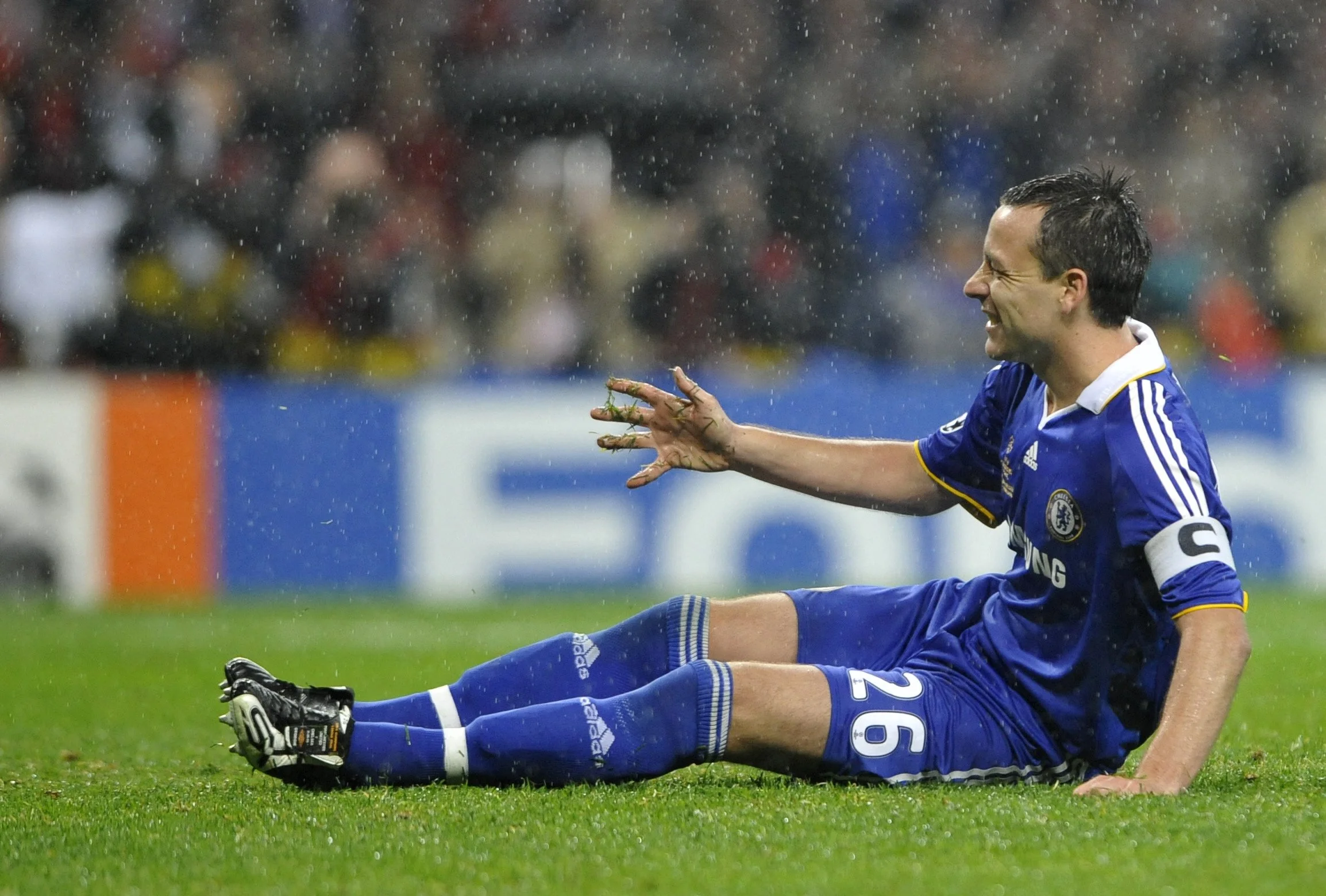
Terry approached the ball, planted his left foot, but slipped on the rain-soaked turf just as he struck the ball. His trailing right boot sent the penalty crashing against the outside of Edwin van der Sar’s right-hand post, keeping Manchester United alive in the tournament.
In the subsequent sudden-death rounds, Ryan Giggs converted for United, and veteran striker Nicolas Anelka stepped up for Chelsea. Edwin van der Sar correctly anticipated Anelka’s placement, diving to his right to beat away the Frenchman’s penalty. The save secured a 6–5 shootout victory for Manchester United, sparking euphoric celebrations on the pitch.
Post-Match Reactions and Immediate Aftermath
The immediate aftermath of the Moscow final captured the contrasting emotional extremes of elite professional sport. Manchester United players celebrated wildly, with manager Sir Alex Ferguson securing his second Champions League title, exactly nine years after the historic 1999 treble triumph in Barcelona. Rio Ferdinand and Ryan Giggs hoisted the trophy together in a poignant moment recognizing the club's veteran core.
For Chelsea, the defeat was devastating. Manager Avram Grant, who faced immense pressure throughout his tenure, expressed immense pride in his players' resilience despite the heartbreak. Captain John Terry was inconsolable on the pitch, visibly emotional as he processed the missed penalty that could have secured European glory for the West London club. The defeat compounded a frustrating domestic season for Chelsea, who finished as runners-up to Manchester United in both the Premier League and the League Cup.
Legacy and Historical Significance
The 2008 UEFA Champions League Final left an indelible mark on European football history through several key narratives:
- The Pinnacle of Sir Alex Ferguson’s Second Era: The victory cemented the greatness of Ferguson’s second great Manchester United team, blending world-class attacking talent with unyielding defensive determination.
- Cristiano Ronaldo’s Ballon d'Or Catalyst: Ronaldo’s goal in the final, combined with his 42-goal haul across all competitions during the 2007–2008 season, propelled him to win his first FIFA World Player of the Year and Ballon d'Or awards later that year.
- Chelsea’s Redemption Arc: The heartbreak in Moscow served as a crucial psychological stepping stone for Chelsea. The core group of players—including Terry, Lampard, Čech, and Drogba—used the defeat as motivation, ultimately returning to win the UEFA Champions League four years later in Munich in 2012.
- The All-English Era: The match symbolized the zenith of Premier League financial and competitive dominance in European football during the late 2000s, an era characterized by multiple English semifinalists and finalists in the UEFA Champions League.
Frequently Asked Questions
Who scored the goals in the 2008 UEFA Champions League Final?
Cristiano Ronaldo opened the scoring for Manchester United in the 26th minute with a header. Chelsea's Frank Lampard equalized just before halftime in the 43rd minute, capitalizing on a double deflection inside the penalty area.
Which players missed their penalties in the shootout?
For Manchester United, Cristiano Ronaldo had his penalty saved by Petr Čech. For Chelsea, captain John Terry slipped and hit the post with his decisive penalty kick, and Nicolas Anelka had his sudden-death penalty saved by Edwin van der Sar.
Where was the 2008 UEFA Champions League Final played?
The match was hosted at the Luzhniki Stadium in Moscow, Russia, marking the easternmost venue to host a European Cup or Champions League final at that time.
Why was Didier Drogba sent off during the match?
Didier Drogba received a straight red card from referee Ľuboš Micheľ in the 116th minute of extra time following an off-the-ball altercation with Manchester United defender Nemanja Vidić.
How many Champions League titles had Manchester United won prior to 2008?
Prior to their victory in Moscow, Manchester United had won the European Cup/Champions League twice: in 1968 against Benfica under Matt Busby and in 1999 against Bayern Munich under Sir Alex Ferguson.
Final Recommendations for Football Historians
To gain a comprehensive understanding of the 2008 UEFA Champions League Final, researchers and enthusiasts should examine full match recordings alongside tactical analyses of the 4–4–2 versus 4–3–3 tactical battles prevalent in late-2000s European football. Reviewing the post-match tactical breakdowns provides valuable insight into how Sir Alex Ferguson managed squad rotation and positional fluidity during the peak of his managerial career, while also illustrating the fine margins that define elite continental competition.