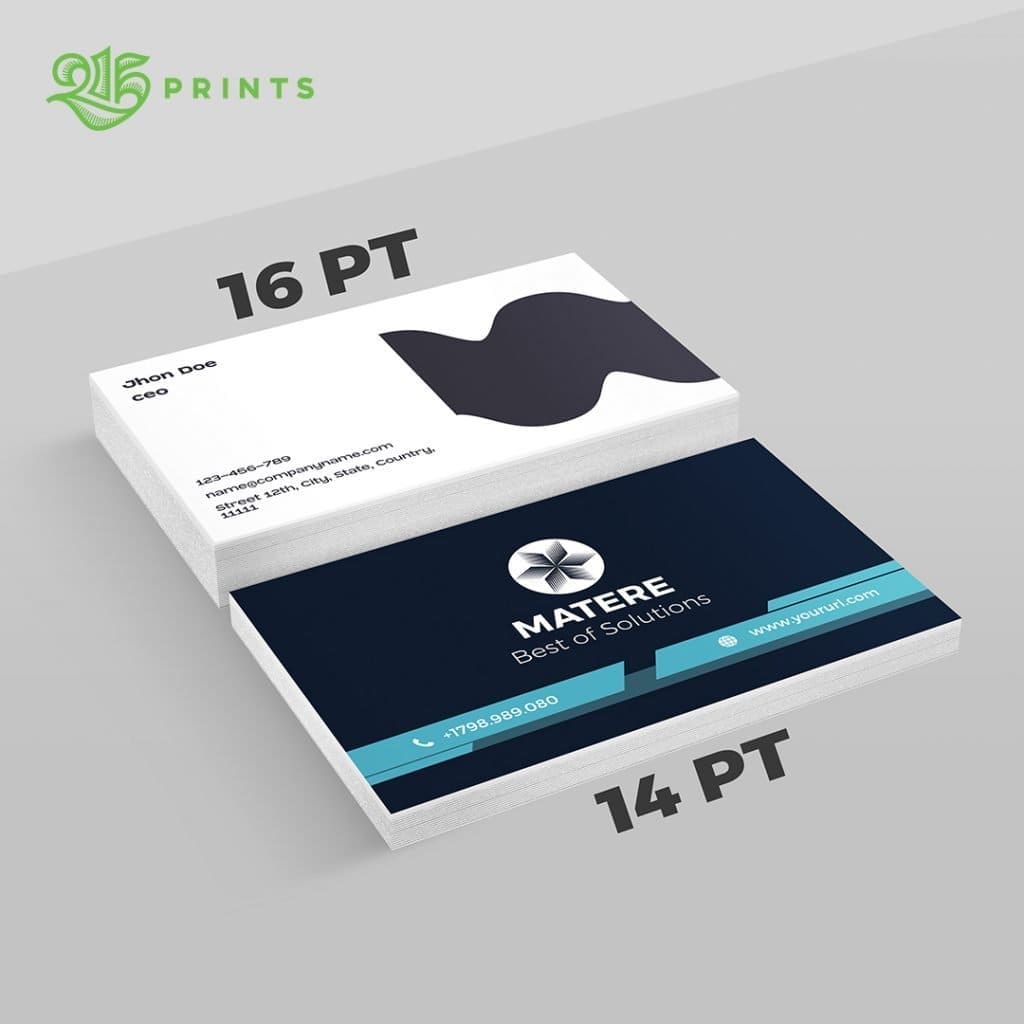
A 14pt business card is a professional-grade marketing tool characterized by its thickness of 0.014 inches (14 points). As the industry standard for modern networking, this stock provides a sturdy, durable feel that resists folding and tearing while remaining compatible with standard card holders and automated printing processes.
Understanding the Caliper: What Does 14pt Mean?
In the world of commercial printing and paper engineering, "pt" stands for "point." Unlike the points used in typography to measure font size, a paper point is a unit of length equal to one-thousandth of an inch (0.001"). Therefore, a 14pt business card has a thickness, or "caliper," of 0.014 inches. To put this into perspective, a standard sheet of 20lb office copier paper is approximately 4pt, meaning a 14pt card is roughly 3.5 times thicker than standard printer paper.
While thickness is measured in points, weight is often measured in GSM (Grams per Square Meter). A standard 14pt stock typically weighs between 300 and 310 GSM. This distinction is vital for international commerce, as European and Asian markets often categorize paper by weight (GSM) rather than thickness (caliper). In 2026, most global printing hubs have standardized these conversions to ensure consistency across digital and offset printing platforms.
The choice of 14pt is often referred to as the "Goldilocks" of the printing industry. It is thick enough to convey a sense of legitimacy and professional permanence, yet thin enough to be cost-effective for high-volume distribution. It lacks the flimsiness of 10pt or 12pt stocks—which are often perceived as "cheap" or "disposable"—but avoids the excessive bulk and high shipping costs associated with ultra-thick 32pt or 48pt specialty stocks.
Technical Specifications and Material Composition
The physical integrity of a 14pt business card depends heavily on its fiber density and coating. Most 14pt cards are manufactured using "cover stock," which is a heavy-weight paper designed specifically for folders, menus, and business cards. Unlike "text stock," which is meant to be folded, cover stock is engineered for stiffness and "snap."
Fiber Density and Stiffness
High-quality 14pt stock is made from tightly compressed wood fibers. The stiffness of the card is measured by its "Gurley Stiffness" rating, which determines how much force is required to bend the paper. A well-manufactured 14pt card should have enough internal bond strength to prevent delamination (the peeling apart of paper layers) when the card is subjected to friction or moisture in a user’s wallet.
Grain Direction
In 2026, precision cutting technology emphasizes the importance of grain direction. Paper has a "grain" similar to wood, based on the alignment of fibers during the manufacturing process. For 14pt cards, printers generally prefer a "grain-long" orientation, which helps the card maintain its flat shape and prevents the "curling" effect that can occur in humid environments.
Brightness and Whiteness
The visual impact of the card is also dictated by its brightness rating. Most premium 14pt stocks feature a brightness rating between 94 and 100. A higher brightness allows for more accurate color reproduction during the CMYK (Cyan, Magenta, Yellow, Black) printing process, ensuring that brand colors appear vibrant and true to the original digital design.
14pt vs. 16pt vs. 18pt: A Comparison of Industry Standards
Choosing the right thickness requires balancing brand perception with practical utility. While 14pt remains the universal baseline, heavier stocks have become increasingly popular for premium branding.
| Feature | 14pt Stock | 16pt Stock | 18pt+ (Premium) |
|---|---|---|---|
| Thickness | 0.014 inches | 0.016 inches | 0.018 - 0.032 inches |
| Weight (Approx) | 300-310 GSM | 350-400 GSM | 450+ GSM |
| Flexibility | Moderate; easy to hand out | Low; very rigid | Minimal; stiff as a credit card |
| Primary Use | High-volume networking | Boutique branding | Luxury/Executive cards |
| Perception | Professional & Reliable | Premium & Substantial | Exclusive & High-End |
| Wallet Capacity | Fits 10-15 easily | Fits 8-10 | Fits 3-5 |
As shown in the table, the jump from 14pt to 16pt is subtle but noticeable to the touch. A 16pt card is approximately 15% thicker than a 14pt card. While 14pt is ideal for trade shows where you might give away hundreds of cards, 16pt or 18pt is often preferred for face-to-face executive meetings where the "tactile handshake" of the card carries more weight.
Finish and Coating Options for 14pt Cards
A raw 14pt paper stock is rarely used without some form of treatment. Coatings protect the ink, enhance the colors, and provide the final texture that the recipient feels.
Gloss UV Coating
Gloss UV is a liquid coating applied to the card and then cured using ultraviolet light. This creates a high-shine, reflective surface. On a 14pt card, Gloss UV makes colors "pop" and provides a high level of protection against scratches and scuffs. However, it is nearly impossible to write on a gloss-coated card with a standard ballpoint pen.
Matte Finish
Matte coating offers a smooth, non-reflective surface. It is often chosen for a more modern, understated look. In 2026, matte finishes have evolved to be more fingerprint-resistant than their predecessors. Matte 14pt cards are excellent for designs that feature large blocks of dark colors, as they eliminate the glare that can make text hard to read under bright office lights.
Silk or "Suede" Laminate
Silk lamination involves bonding a thin plastic film to the 14pt stock. This adds a microscopic amount of thickness (making it feel closer to a 15pt or 16pt card) and gives the card a soft, "silky" texture. This finish is incredibly durable and water-resistant, making it a favorite for professionals who travel frequently.
Uncoated Stock
Uncoated 14pt cards are porous and have a natural paper texture. These are the best choice for professionals who need to write notes or appointments on their cards (such as dentists, hair stylists, or consultants). Because the ink soaks into the fibers rather than sitting on top of a coating, colors may appear slightly more muted on uncoated stock.
Printing Techniques Suited for 14pt Paper
The 14pt thickness is compatible with almost every modern printing technology, making it the most versatile choice for designers.
- Digital Printing: Ideal for short runs (50–500 cards). Modern digital presses in 2026 can handle 14pt stock with ease, providing crisp text and vibrant imagery without the setup costs of traditional plates.
- Offset Printing: The gold standard for high-volume runs (1,000+ cards). Offset printing on 14pt stock provides the highest color consistency and is more economical for large corporations.
- Spot UV and Foil Stamping: Because 14pt stock is sufficiently rigid, it can handle the heat and pressure required for foil stamping and the precision of Spot UV (applying gloss only to specific areas of the card).
- Die-Cutting: 14pt is the ideal thickness for custom shapes. If you want rounded corners or a custom-cut silhouette, 14pt offers enough structural integrity to hold the shape without sagging or fraying at the edges.
Haptic Marketing: The Psychology of Thickness
The tactile experience of a business card is a form of "haptic marketing." Research in consumer psychology suggests that the weight and texture of an object can influence a person’s perception of a brand's stability and quality.
A 14pt card provides enough physical resistance to signal that the person presenting it is an established professional. When a recipient receives a card that is too thin (e.g., 8pt or 10pt), they subconsciously associate the flimsiness of the paper with a lack of permanence or a "fly-by-night" business operation. Conversely, a 14pt card feels substantial. It has a specific "drop weight"—the sound and feel it makes when placed on a table—that commands attention without being ostentatious.
In 2026, as digital fatigue continues to grow, the physical business card has become a rare and valued touchpoint. A 14pt card serves as a physical "anchor" for a digital relationship, providing a tangible reminder of a human connection.
Design Best Practices for 14pt Business Cards
To ensure a 14pt card looks as good as it feels, designers must adhere to specific technical requirements.
Bleed and Safe Zones
Because 14pt stock is thick, the industrial blades used to trim the cards can occasionally shift by a fraction of a millimeter. To account for this, designers must include a "bleed" area.
- Standard Size: 3.5" x 2"
- Full Bleed Size: 3.75" x 2.25"
- Safe Zone: All critical text and logos should stay within a 3.25" x 1.75" area to avoid being cut off.
Color Modes and Resolution
Always design in CMYK color mode rather than RGB. RGB is for screens; CMYK is for ink. Using the wrong mode can result in muddy or unexpected color shifts when the 14pt stock goes through the press. Additionally, all images and logos must be at least 300 DPI (dots per inch) to ensure the print is sharp. On a high-quality 14pt stock, low-resolution artifacts are very easy to spot.
Typography Considerations
On a matte or uncoated 14pt stock, very small or thin fonts can "bleed" slightly as the ink settles into the paper. It is generally recommended to keep font sizes at 7pt or higher to ensure legibility. For "knockout text" (white text on a dark background), using a slightly bolder font weight prevents the surrounding ink from "closing in" on the letters.
Sustainability and Environmental Impact in 2026
The printing industry has made significant strides in sustainability. Most 14pt card stocks are now sourced from Forest Stewardship Council (FSC) certified forests. This ensures that the paper is produced in a way that protects biodiversity and indigenous rights.
Furthermore, many 14pt stocks now incorporate post-consumer recycled content. While 100% recycled paper used to be yellowish and "flecked," 2026 technology allows for bright white 14pt 100% PCW (Post-Consumer Waste) stock that is indistinguishable from virgin paper.
When choosing a finish, environmentally conscious professionals often opt for aqueous coatings (water-based) or soy-based inks. These alternatives make the 14pt cards easier to recycle, as they do not contain the heavy plastics found in some traditional laminates.
Cost Analysis and Value Proposition
From a budgetary perspective, 14pt is the most efficient choice for professional networking. Because it is the "default" for many commercial printers, the supply chain for 14pt stock is highly optimized.
- Bulk Efficiency: When ordering 1,000+ cards, the price difference between 10pt (economy) and 14pt (standard) is often negligible—frequently less than a fraction of a cent per card.
- Shipping Costs: 14pt cards are light enough to be shipped in bulk via standard carriers without incurring the "heavy weight" surcharges often applied to 32pt "trifecta" or "luxury" cards.
- Durability ROI: Because 14pt cards do not dog-ear or tear easily, they stay in a potential client's wallet or card file longer. This increased "shelf life" provides a better return on investment than cheaper, thinner cards that are discarded because they look worn out after a single day.
Frequently Asked Questions
Is 14pt thick enough for a professional business card?
Yes, 14pt is the industry standard for professional business cards. It provides a sturdy, rigid feel that is significantly better than the thin paper often used for flyers or "value" cards. While 16pt is slightly thicker and "premium," 14pt is widely accepted across all industries—from law and finance to creative arts—as a reliable, professional choice.
Can I write on a 14pt business card?
Whether you can write on the card depends on the coating, not the thickness. If the 14pt card has a Gloss UV coating, most pens will smear. If the card has a Matte coating, you can usually write on it with a permanent marker or some ballpoint pens. If you specifically need to write on your cards, you should request "Uncoated" 14pt stock, which absorbs ink and is easy to write on with any pen or pencil.
What is the difference between 14pt and 300 GSM?
14pt refers to the thickness of the card (0.014 inches), while 300 GSM (Grams per Square Meter) refers to the weight of the paper. In most cases, a 14pt card is approximately 300 to 310 GSM. The US market typically uses "pt" to describe business cards, while European and international markets use "GSM."
Does 14pt stock work well with double-sided printing?
Absolutely. 14pt stock is thick enough to be completely opaque, meaning the ink from one side will not "show through" to the other side. This makes it an ideal choice for double-sided designs, allowing you to put your logo on the front and contact details or a QR code on the back without any visual interference.
How many 14pt business cards fit in a standard card holder?
A standard pocket business card holder typically holds between 12 and 18 14pt cards. Because 14pt is the standard thickness, almost all desk holders, wallets, and "follow-up" filing systems are designed specifically around these dimensions. If you use a thicker stock, like 32pt, you may only be able to carry 5 or 6 cards at a time.
Is a 14pt card the same as a credit card?
No. A standard credit card is approximately 30pt (0.030 inches) thick and made of plastic (PVC). A 14pt business card is slightly less than half the thickness of a credit card. If you want a business card that feels exactly like a credit card, you would need to look for "30pt Plastic" or "Extra Thick 32pt" card stocks.
Final Recommendation
For the vast majority of business applications in 2026, the 14pt business card remains the most logical choice. It balances aesthetic appeal, tactile quality, and economic efficiency. When ordering your cards, prioritize a Matte or Silk finish if you want a modern, high-end feel, or an Uncoated finish if you need functionality for writing. By adhering to standard bleed and CMYK design principles, you can ensure that your 14pt cards serve as a durable and effective representation of your professional brand.