4-suit Spider Solitaire on 247 Solitaire is the expert-level version of the classic card game, utilizing two full decks (104 cards) across all four suits. To win, you must arrange cards in descending order from King to Ace within the same suit to clear them from the board.
Spider Solitaire has long been regarded as the "King of Solitaire Games" due to its complexity and the high level of skill required to achieve a victory. While many casual players are familiar with the one-suit (easy) or two-suit (medium) variations, the 4-suit Spider Solitaire mode offered by the 247 Solitaire platform represents the pinnacle of the genre. As of 2026, browser-based platforms like 247 Solitaire remain the preferred method for players to access this game without the need for heavy software installations, providing a clean, responsive interface for both desktop and mobile devices.
To succeed in this version, a player must balance short-term tactical moves with long-term strategic planning. Unlike the easier versions where you can move mixed-suit sequences with relative ease, the 4-suit version penalizes "dirty" piles—sequences containing multiple suits—by preventing you from moving them as a single unit. This guide explores the intricate mechanics, advanced strategies, and common pitfalls associated with the 4-suit challenge on 247 Solitaire.
Understanding the Foundation: Rules and Setup
The setup of 4-suit Spider Solitaire is consistent across most professional platforms, including 247 Solitaire. The game uses 104 cards, which are essentially two standard 52-card decks shuffled together.
The Tableau and Stock
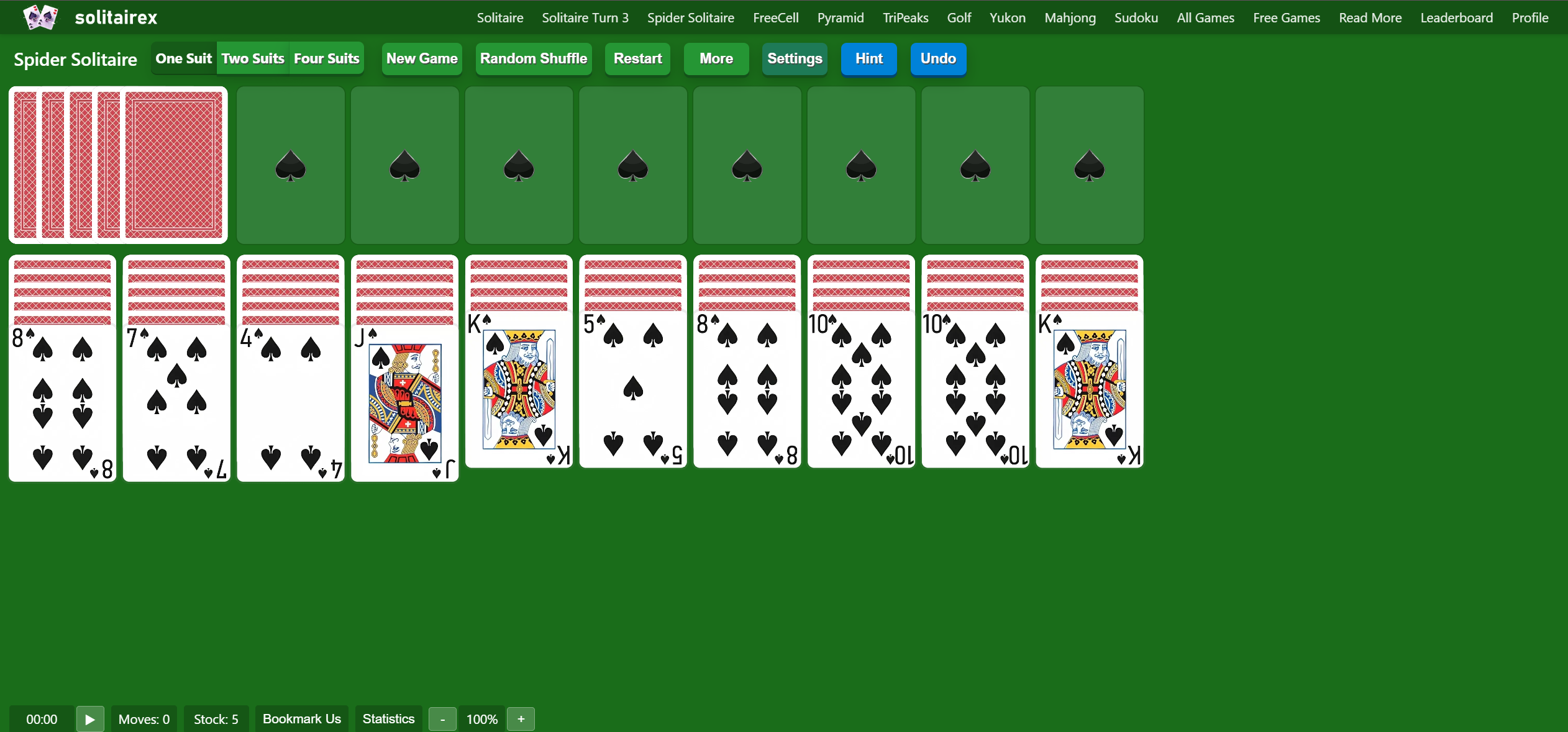
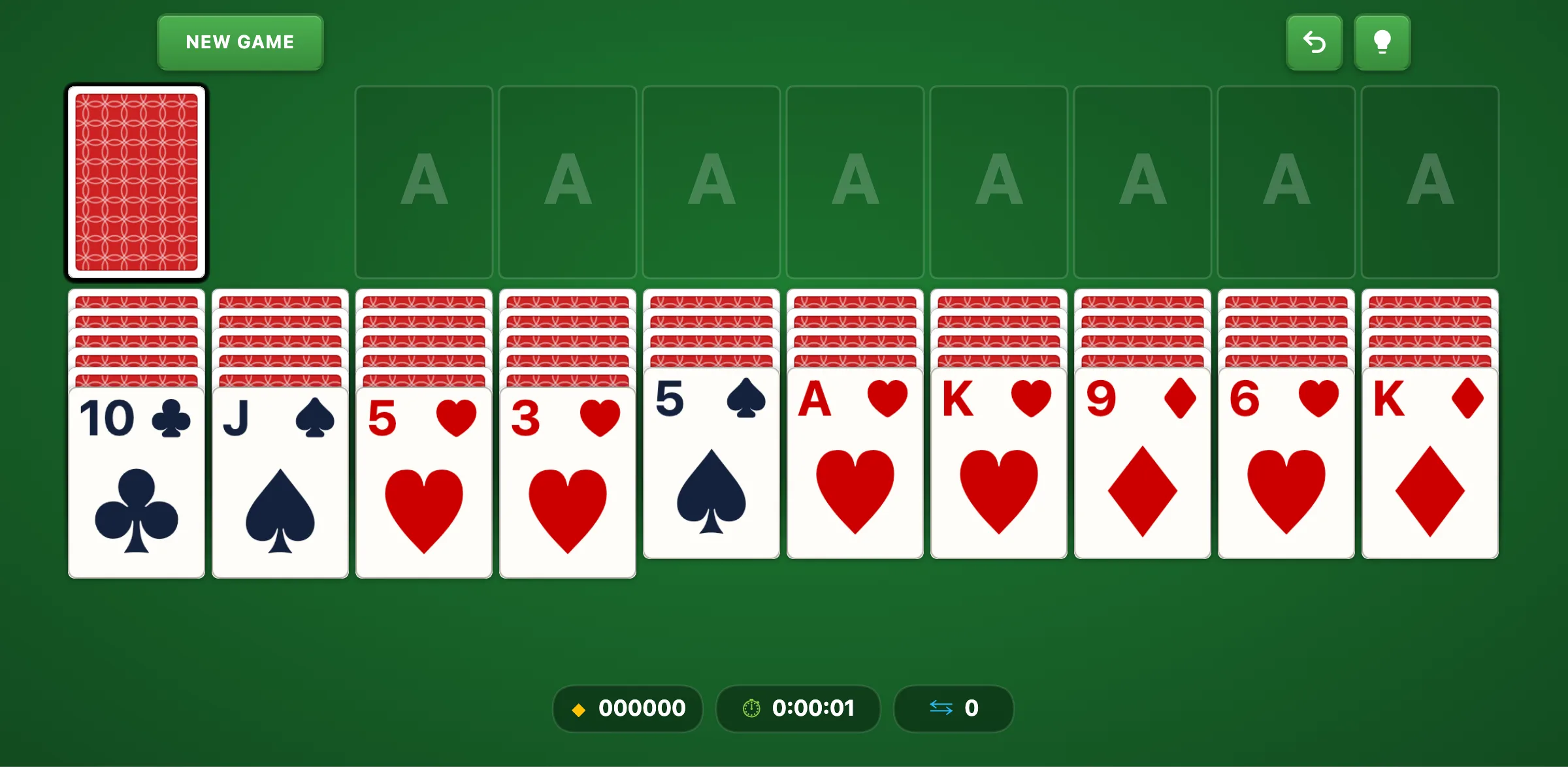
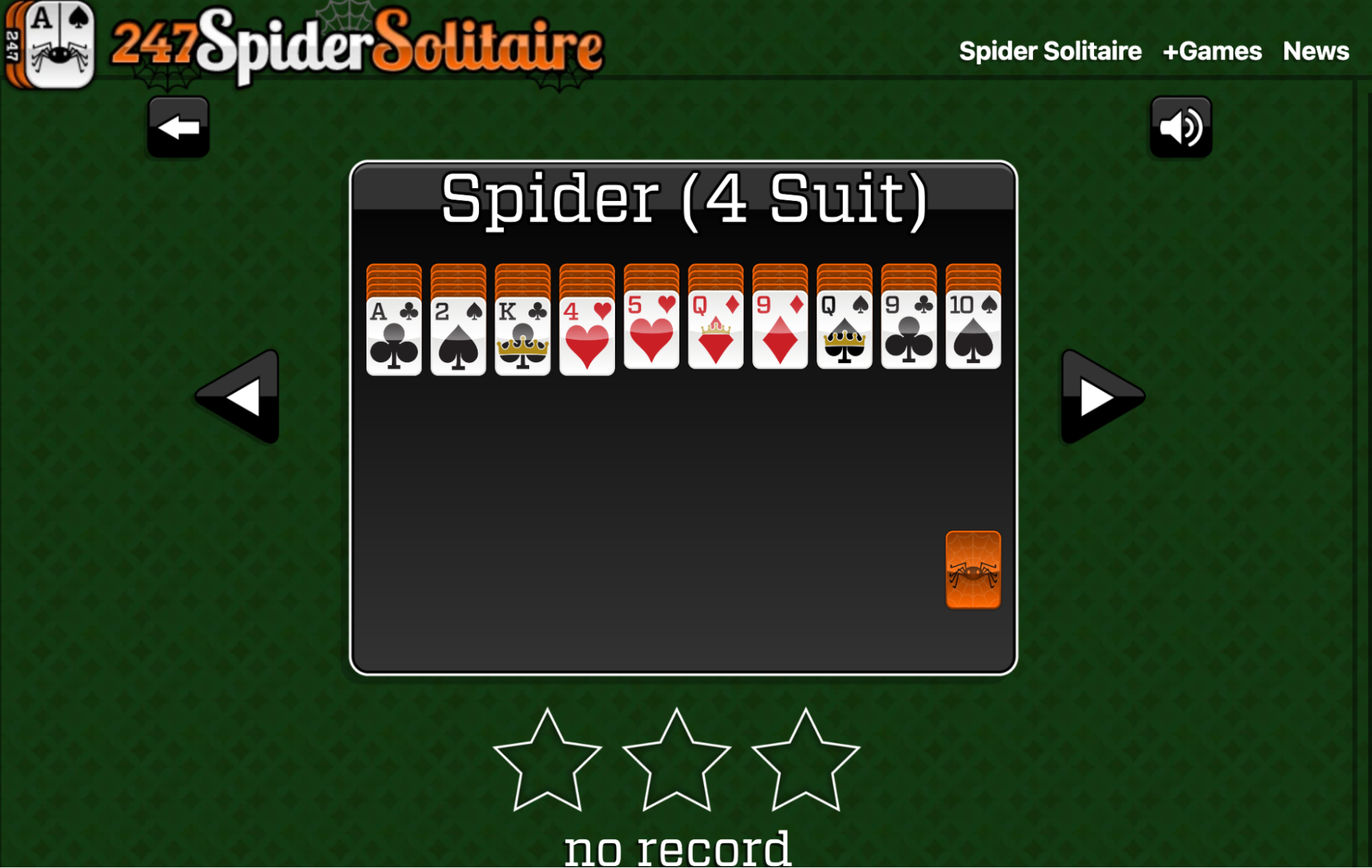
The game begins with 54 cards dealt into ten columns on the tableau. The first four columns contain six cards each, while the remaining six columns contain five cards each. Only the top card of each column is face-up. The remaining 50 cards are kept in the stock pile at the bottom right or left of the screen, to be dealt in "rounds" of ten (one card per column) when the player is stuck.
The Objective
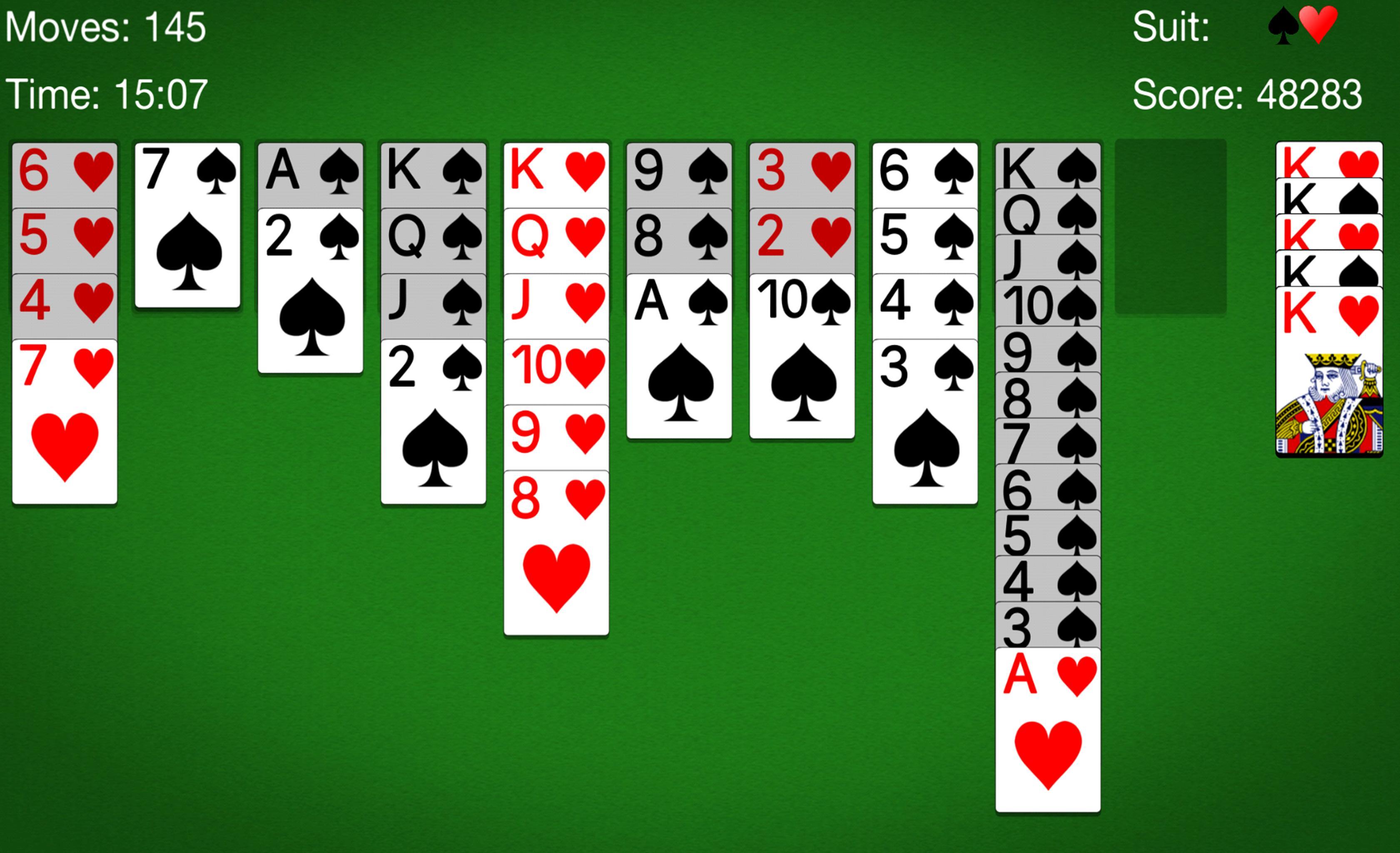
The ultimate goal is to build eight sequences of cards in descending order, from King down to Ace, within the same suit. For example, a sequence must run: King of Spades, Queen of Spades, Jack of Spades, and so on, down to the Ace of Spades. Once a full 13-card sequence of a single suit is completed, it is automatically removed from the tableau and placed in the foundation. The game is won when all 104 cards are removed.
Movement Rules
In 4-suit Spider Solitaire, you can move any face-up card onto another card that is exactly one rank higher. For instance, a 7 of Diamonds can be placed on an 8 of Hearts, an 8 of Spades, an 8 of Clubs, or an 8 of Diamonds. However, there is a critical restriction: you can only move a group of cards if they are all of the same suit and in the correct descending order. If you have a 7 of Hearts on an 8 of Spades, you can no longer move that 8 as a unit with the 7. This mechanic is what makes the 4-suit version significantly more difficult than its counterparts.
Why 4-Suit is the Ultimate Challenge
The difficulty jump from 2-suit to 4-suit is exponential rather than linear. In 2-suit games, you have a 50% chance that a card of the correct rank will also be of a movable suit. In 4-suit, that probability drops to 25%. This leads to a phenomenon known as "locking the board," where sequences become so fragmented by mixed suits that no further moves are possible.
Statistical analysis of Spider Solitaire suggests that while nearly 99% of 1-suit games are winnable, the win rate for 4-suit games—even for expert players—often hovers between 15% and 20%. On a platform like 247 Solitaire, which tracks user statistics, the 4-suit mode is consistently the least-won game type. Success requires not just luck in the deal, but a disciplined adherence to "suit management" and "empty column" preservation.
Essential Strategies for 4-Suit Success
Winning at 4-suit Spider Solitaire requires moving away from casual play and adopting a more analytical approach. Every move must be calculated based on how it affects the mobility of the rest of the tableau.
Prioritize Face-Down Cards
The most important objective in the early and mid-game is to uncover the face-down cards in the tableau. Each hidden card is a resource that could potentially be the King you need to start a new column or the specific suit-match required to clear a sequence. You should almost always prioritize a move that results in flipping a hidden card over a move that simply organizes existing face-up cards.
The Power of the Empty Column
An empty column is the most valuable asset in Spider Solitaire. It serves as a temporary "buffer" or "parking spot" that allows you to rearrange sequences. If you have a 10 of Clubs on a Jack of Hearts, and you need to move that 10 to a Jack of Clubs elsewhere, you can use an empty column to temporarily store the 10.
Expert players avoid filling an empty column permanently unless they are placing a King there. Even then, placing a King in an empty column should be a calculated decision, as it "locks" that space until the entire sequence is built or moved to another empty spot.
Build by Suit Whenever Possible
While the rules allow you to place a card on any suit of a higher rank, you should strive for "natural" builds (same suit). "Unnatural" builds (mixed suits) should be viewed as a last resort to uncover a hidden card or to create an empty column. The more you mix suits, the more "immobile" your tableau becomes. If you must build an unnatural sequence, try to do so on the highest ranks possible (e.g., putting a Queen of Spades on a King of Diamonds) rather than lower ranks, as higher cards stay on the board longer and offer more opportunities for correction later.
Emptying Columns Before Dealing from the Stock
Before you click the stock pile to deal a new row of ten cards, you must ensure two things:
- All possible moves have been exhausted.
- Every column has at least one card in it. (Most versions, including 247 Solitaire, will not allow you to deal from the stock if there is an empty column).
However, there is a strategic layer here. If you have an empty column, use it to consolidate suits and uncover as many face-down cards as possible before you are forced to fill it to deal the next round. Once the stock is dealt, it often "buries" your progress, making it harder to access the sequences you just organized.
Comparing Spider Solitaire Difficulty Levels
The following table illustrates the technical differences between the modes available on 247 Solitaire as of 2026.
| Feature | 1-Suit (Easy) | 2-Suit (Medium) | 4-Suit (Hard/Expert) |
|---|---|---|---|
| Total Decks | 2 (8 sets of 1 suit) | 2 (4 sets of 2 suits) | 2 (2 sets of 4 suits) |
| Suit Matching | Automatic | Required for movement | Required for movement |
| Complexity | Low | Moderate | Very High |
| Estimated Win Rate | 90% - 99% | 30% - 50% | 15% - 25% |
| Average Game Time | 5 - 10 Minutes | 15 - 25 Minutes | 30 - 60+ Minutes |
| Strategy Focus | Speed and clearing | Suit management | Precise column management |
The Role of the "Undo" Button on 247 Solitaire
One of the defining features of the 247 Solitaire interface is the unlimited "Undo" button. In the context of 4-suit Spider Solitaire, the use of Undo is a subject of much debate among purists.
From a learning perspective, the Undo button is invaluable. It allows you to "peek" under face-down cards to see which move yields the best result. In 4-suit play, if you have two different ways to uncover a card, using Undo to check both results can be the difference between a winnable board and a dead end. While some consider this "cheating," others view 4-suit Spider Solitaire as a puzzle to be solved rather than a test of memory or luck. In 2026, many top-tier digital versions of the game have integrated "solvability" checks, but the 4-suit version remains one of the few where a player can genuinely reach an unsolvable state through poor decision-making.
Common Mistakes to Avoid
- Blocking with Kings: Moving a King into an empty column too early can be fatal if you don't have the cards to build upon it. The King cannot be moved anywhere else except another empty column.
- Ignoring the "Short Piles": Players often focus on the columns with the most cards. However, the columns with the fewest cards are your fastest route to an empty space.
- Over-shuffling: Constantly moving cards back and forth between columns without a clear goal (like uncovering a card or aligning a suit) often leads to a messy board that is harder to read.
- Dealing Too Early: Dealing from the stock is a "reset" that usually makes the board more complex. Only deal when you have absolutely no other options for uncovering face-down cards or creating empty spaces.
Troubleshooting and Technical Tips for 247 Solitaire
When playing "1 spider solitaire 247 4 suits" on modern browsers, you may occasionally encounter performance or interface issues.
- Responsive Scaling: If the cards appear too small, check your browser zoom level. 247 Solitaire is designed to be responsive, but 10 columns of cards can be cramped on smaller mobile screens.
- Autoplay Features: Many versions of the game include an "autoplay" or "auto-complete" feature that moves cards to the foundation once the game is effectively won. In 4-suit, be careful with this, as sometimes the computer may move a card you actually needed to keep on the tableau to assist with another suit.
- Cache and Progress: Since 247 Solitaire runs in the browser, clearing your cache or using Incognito/Private mode may erase your win/loss statistics. If you are tracking your long-term progress in the 4-suit category, ensure you are using a consistent browser profile.
For more information on the history and rules of card games, the International Playing Card Society provides extensive documentation on the evolution of Solitaire (Patience) games. Additionally, for those interested in the mathematical probability of Solitaire, resources like Wolfram MathWorld offer insights into game theory and combinatorics.
FAQs
Can every 4-suit Spider Solitaire game be won?
No. Unlike some versions of FreeCell, not every deal of 4-suit Spider Solitaire is winnable. Due to the random nature of the initial deal and the stock pile, it is possible for the necessary cards (like Kings or specific suit ranks) to be buried in a way that prevents any progress. Expert players usually aim for a high win percentage rather than winning every single game.
What is the most important card in 4-suit Spider Solitaire?
The King is arguably the most important card. Because it can only be placed in an empty column and cannot be moved onto any other card, it dictates how you manage your empty spaces. Managing your Kings effectively is the key to preventing the tableau from becoming "locked."
Why can't I move a sequence of cards even if they are in order?
In 4-suit Spider Solitaire, you can only move a sequence as a group if every card in that sequence belongs to the same suit. If you have a sequence of 10-9-8, but the 9 is a different suit than the 10, you can only move the 8 individually or the 9-8 if they match. This is the primary mechanic that distinguishes 4-suit from easier modes.
How do I deal with "hidden" cards at the bottom of a pile?
The best way to reach hidden cards is to target "shallow" columns (those with fewer cards). Use your empty columns to move entire blocks of cards out of the way. If a column is blocked by a King at the top and has hidden cards beneath it, that column becomes a high-priority target for clearing.
Is there a time limit on 247 Solitaire?
Most versions of 247 Solitaire do not impose a strict time limit, allowing players to think through their moves. However, there is often a timer displayed for those who want to track their speed and compete against their own personal bests. In 4-suit mode, taking your time is highly recommended over rushing.
Should I always use the Hint button?
The Hint button on 247 Solitaire is helpful for finding moves you might have missed, but it does not always suggest the best strategic move. It usually identifies any legal move, even if that move might be detrimental to your long-term strategy (like breaking up a suited sequence to make an unsuited one). Use it as a tool for discovery, not as a definitive guide.
Final Recommendation for Players
To master 4-suit Spider Solitaire, your next step should be to practice the "Empty Column" technique. Start a game on 247 Solitaire and focus exclusively on clearing one single column as quickly as possible, even if it means creating several "unnatural" (mixed-suit) piles in the other columns. Once you have that empty space, observe how much easier it becomes to reorganize your cards. Mastering the use of that single empty spot is the threshold between a novice and an expert in the 4-suit arena.