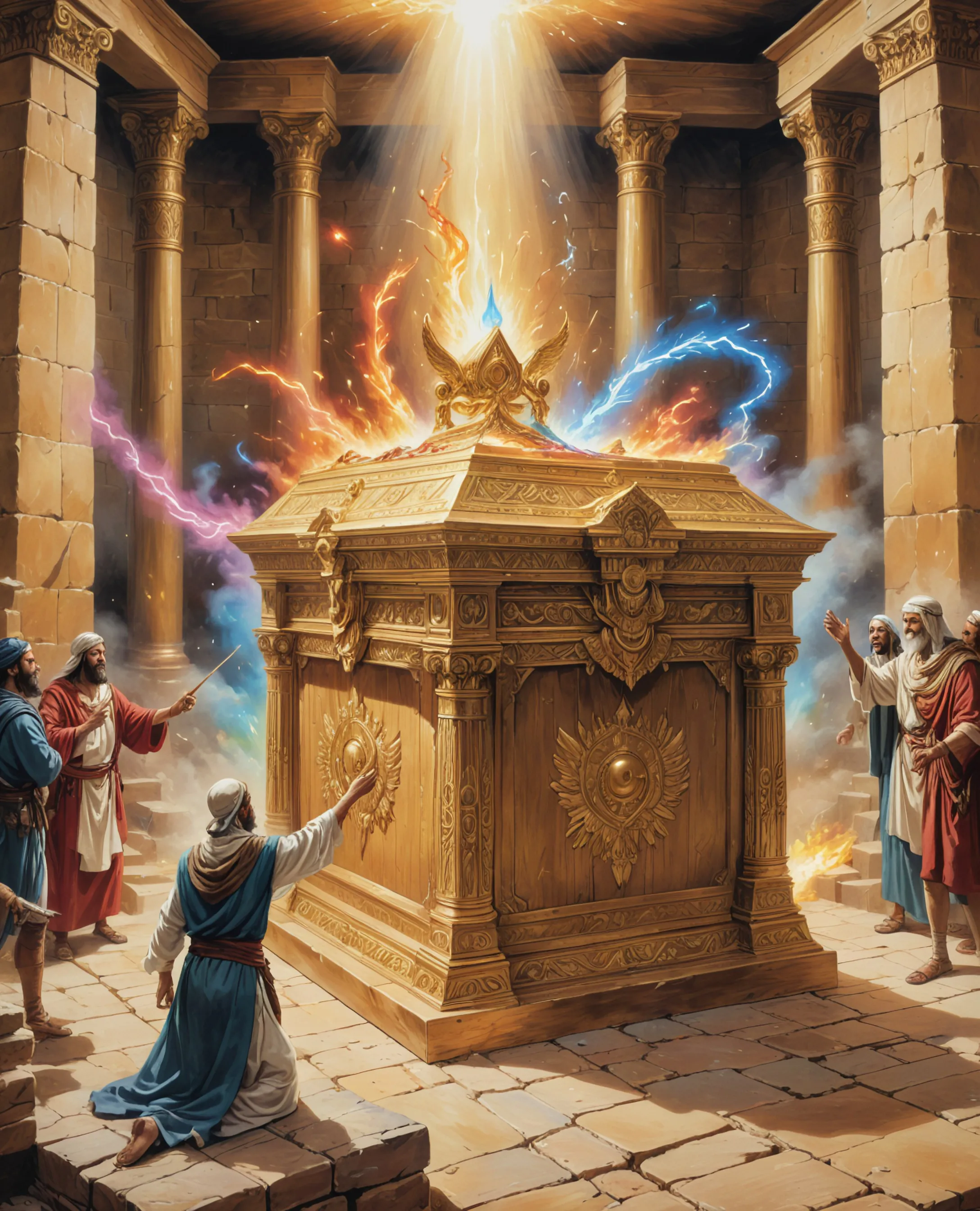
The Ark of the Covenant is described in historical and religious texts as a gold-plated wooden chest possessing immense supernatural abilities, including the power to part rivers, topple city walls, and strike individuals dead upon contact. While primarily a religious artifact representing God's presence, various theories suggest it functioned as a sophisticated ancient weapon or an electrical capacitor.
The Biblical Origins and Design of the Ark
To understand the claimed powers of the Ark of the Covenant, one must first examine its construction as dictated in the Book of Exodus. According to the narrative, God provided Moses with specific instructions on Mount Sinai. The Ark was to be built of acacia wood, measuring approximately 2.5 cubits in length and 1.5 cubits in width and height (roughly 44 x 26 x 26 inches).
Crucially, the chest was overlaid with pure gold both inside and out. This "sandwich" construction—a non-conductive material (wood) between two layers of conductive material (gold)—has led modern theorists to speculate on its potential physical properties. The lid, known as the Mercy Seat or Kapporet, was made of solid gold and featured two cherubim with outspread wings. These wings arched over the center, creating the space where the "Divine Presence" or Shekhinah was said to manifest.
The Ark served as the repository for the two stone tablets of the Ten Commandments. Later traditions suggest it also contained a golden jar of manna and the rod of Aaron. However, the Ark was never viewed merely as a storage box; it was considered the footstool of God on Earth, making it the most sacred and dangerous object in ancient Israel.
The Power of Divine Communication
The primary "functional" power of the Ark was its role as a communication portal. In Exodus 25:22, it is stated: "There I will meet with you, and from above the mercy seat, from between the two cherubim that are on the ark of the testimony, I will speak with you."
The High Priest or Moses would enter the Holy of Holies, the innermost chamber of the Tabernacle (and later the Temple of Solomon), to receive instructions. The power manifested as a visible cloud or a "voice" emanating from the void between the cherubim's wings. This communication was not just symbolic; it was a strategic necessity for the Israelites, providing them with laws, moral guidance, and military commands. The Ark was, in essence, the physical interface between the finite human realm and the infinite divine realm.
Environmental Manipulation and Military Victory
The Ark's most famous displays of power involved the manipulation of the physical environment to favor the Israelite army. These events transformed the Ark from a religious icon into a potent "war engine" that led the vanguard of the Hebrew tribes.
The Parting of the Jordan River
When the Israelites reached the Jordan River to enter the Promised Land, the Book of Joshua records that as soon as the feet of the priests carrying the Ark touched the water, the river stopped flowing upstream. The water "piled up in a heap," allowing the entire nation to cross on dry ground. This mirrors the earlier parting of the Red Sea but attributes the power directly to the presence of the Ark.
The Fall of Jericho
The Siege of Jericho provides the most dramatic example of the Ark’s destructive capabilities. For six days, the Israelites marched the Ark around the city walls once a day. On the seventh day, they circled the city seven times. Following a long blast from ram’s horns and a great shout from the people, the massive walls of Jericho collapsed outward. While theological interpretations focus on faith, others analyze this as an application of resonant frequency or a localized seismic event triggered by the Ark's presence.
The Lethal Touch: Death and Desecration
One of the most terrifying aspects of the Ark’s claimed powers was its inherent lethality to those who approached it incorrectly or without authorization. The Ark was not merely a passive object; it possessed a "holiness" that acted like a high-voltage current, punishing any breach of protocol.
The Tragedy of Nadab and Abihu
The sons of Aaron, Nadab and Abihu, were reportedly consumed by "fire from the Lord" when they offered "unauthorized fire" before the Ark. This suggests that the Ark could emit directed energy or fire that targeted individuals within the Tabernacle.
The Death of Uzzah
Perhaps the most famous instance of the Ark's danger occurred during its transport to Jerusalem. When the oxen stumbled and the Ark began to tip, a man named Uzzah reached out to steady it. The moment he touched the chest, he was struck dead. This incident reinforced the "no-touch" rule; the Ark was designed to be carried only by poles inserted through rings on its sides, ensuring that no human hand ever made direct contact with the gold-plated surface.
The Philistine Captivity
When the Philistines captured the Ark in battle, thinking they had seized a powerful totem, they suffered catastrophic consequences. In the city of Ashdod, their idol Dagon was found decapitated before the Ark. Subsequently, the Philistine cities were struck by a plague of "tumors" and an infestation of mice. The Ark’s power was so disruptive to their society that they eventually returned it to the Israelites on a driverless cart, accompanied by offerings of gold.
Exploring the "Electric Ark" Hypothesis
In the 20th and 21st centuries, engineers and researchers have proposed a technological explanation for the Ark's powers: the Leyden Jar theory. A Leyden jar is an early form of a capacitor, a device used to store high-voltage electric charges.
As noted previously, the Ark’s construction (gold-wood-gold) perfectly mimics the structure of a capacitor. In the dry climate of the Middle East, the constant friction of the inner curtains of the Tabernacle (made of goat hair and fine linen) against the Ark could have generated a massive static charge.
- The Charge: If the Ark acted as a capacitor, it could have stored thousands of volts of electricity.
- The Discharge: Anyone touching the Ark while not properly "grounded" would receive a lethal electrical discharge, explaining the sudden deaths of Uzzah and others.
- The Spark: The "Shekhinah" or light between the cherubim could theoretically have been a continuous spark or plasma discharge between the two golden wings, acting as electrodes.
While this theory is popular in "ancient astronaut" circles and was famously popularized by authors like Erich von Däniken, most archaeologists remain skeptical. They argue that the amount of charge a chest of that size could hold would be painful but likely not consistently lethal, and the "resonant frequency" required to topple walls would require a power source far beyond static electricity.
Protocols for Handling the Ark
Because of its volatility, specific "safety protocols" were established for the Ark. These were not merely religious rituals but appeared to be functional requirements for interacting with the object safely.
| Protocol Component | Description | Claimed Purpose |
|---|---|---|
| The Poles | Made of acacia wood overlaid with gold, permanently kept in the rings. | Allowed the Levites to carry the Ark without touching the main body (insulation). |
| The Veils | Multiple layers of blue cloth and skins used to cover the Ark during transport. | Prevented accidental viewing or atmospheric discharge; acted as a protective barrier. |
| The Breastplate | The High Priest wore a breastplate set with 12 stones. | Speculated to act as a grounded suit or "Faraday cage" to protect the priest. |
| Incense Cloud | The High Priest filled the Holy of Holies with thick incense smoke. | Historically to hide the "glory," but technically could ionize the air or provide a visual medium for light. |
The Ark’s Disappearance and Current Status (2026)
As of 2026, the physical location of the Ark of the Covenant remains the subject of intense debate and archaeological pursuit. It was last recorded in the Bible during the reign of King Josiah, around 620 BCE. When the Babylonians destroyed Solomon’s Temple in 586 BCE, the Ark was not listed among the looted treasures.
Common theories regarding its fate include:
- The Ethiopian Claim: The Church of Our Lady Mary of Zion in Aksum, Ethiopia, claims to possess the original Ark, brought there by Menelik I, the son of King Solomon and the Queen of Sheba.
- The Temple Mount: Some believe the Ark was hidden in a secret chamber deep beneath the Temple Mount in Jerusalem before the Babylonian invasion.
- Mount Nebo: The apocryphal Book of Maccabees suggests the prophet Jeremiah hid the Ark in a cave on Mount Nebo (modern-day Jordan).
Despite advancements in ground-penetrating radar and satellite imaging, no definitive physical evidence of the Ark has surfaced. Its "powers" remain preserved in text and tradition, serving as a bridge between ancient history and supernatural mystery.
Frequently Asked Questions
What exactly was inside the Ark of the Covenant?
According to the Epistle to the Hebrews in the New Testament, the Ark contained the two stone tablets of the Ten Commandments, Aaron's rod that had miraculously budded, and a golden pot of manna. However, 1 Kings 8:9 states that by the time it was placed in Solomon’s Temple, only the stone tablets remained.
Could the Ark really have been an ancient weapon?
While the biblical text describes it as a religious object, its use in the Siege of Jericho and its ability to inflict plagues suggests it had a military application. Whether this was divine intervention or lost ancient technology remains a point of contention among fringe historians and traditional scholars.
Is it dangerous to look for the Ark today?
The popular image of the Ark "melting faces" comes from the 1981 film Raiders of the Lost Ark. While the biblical text warns that looking into the Ark could be lethal (as seen in the 50,070 deaths at Beth-shemesh), modern archaeologists view these as historical warnings regarding the sanctity of the object rather than a persistent biological or radiological threat.
Why was acacia wood used for the Ark?
Acacia wood was one of the few trees available in the Sinai wilderness. It is known for being extremely durable, resistant to decay, and dense. From a technical standpoint, it is an excellent insulator, which supports the electrical capacitor theory.
Has anyone ever tested the "Electric Ark" theory?
Several documentaries and independent researchers have built replicas of the Ark to scale. While they have successfully generated static charges, they have generally concluded that without a consistent power source, the Ark could not maintain a lethal charge for long periods unless the atmospheric conditions were perfect.
Practical Recommendation for Further Study
For those interested in the intersection of archaeology and biblical history, the study of the Ark of the Covenant requires a multi-disciplinary approach. Begin by reviewing the primary source texts in the Hebrew Bible (Exodus, Joshua, 1 Samuel) to understand the original context. To explore the archaeological perspective, consult the works of Israel Finkelstein or publications from the Biblical Archaeology Society.
If you are investigating the scientific theories, look into peer-reviewed papers on ancient metallurgy and electrostatics. Remember that while the Ark's powers are legendary, they provide a fascinating window into how ancient civilizations perceived the relationship between the physical world and the divine.