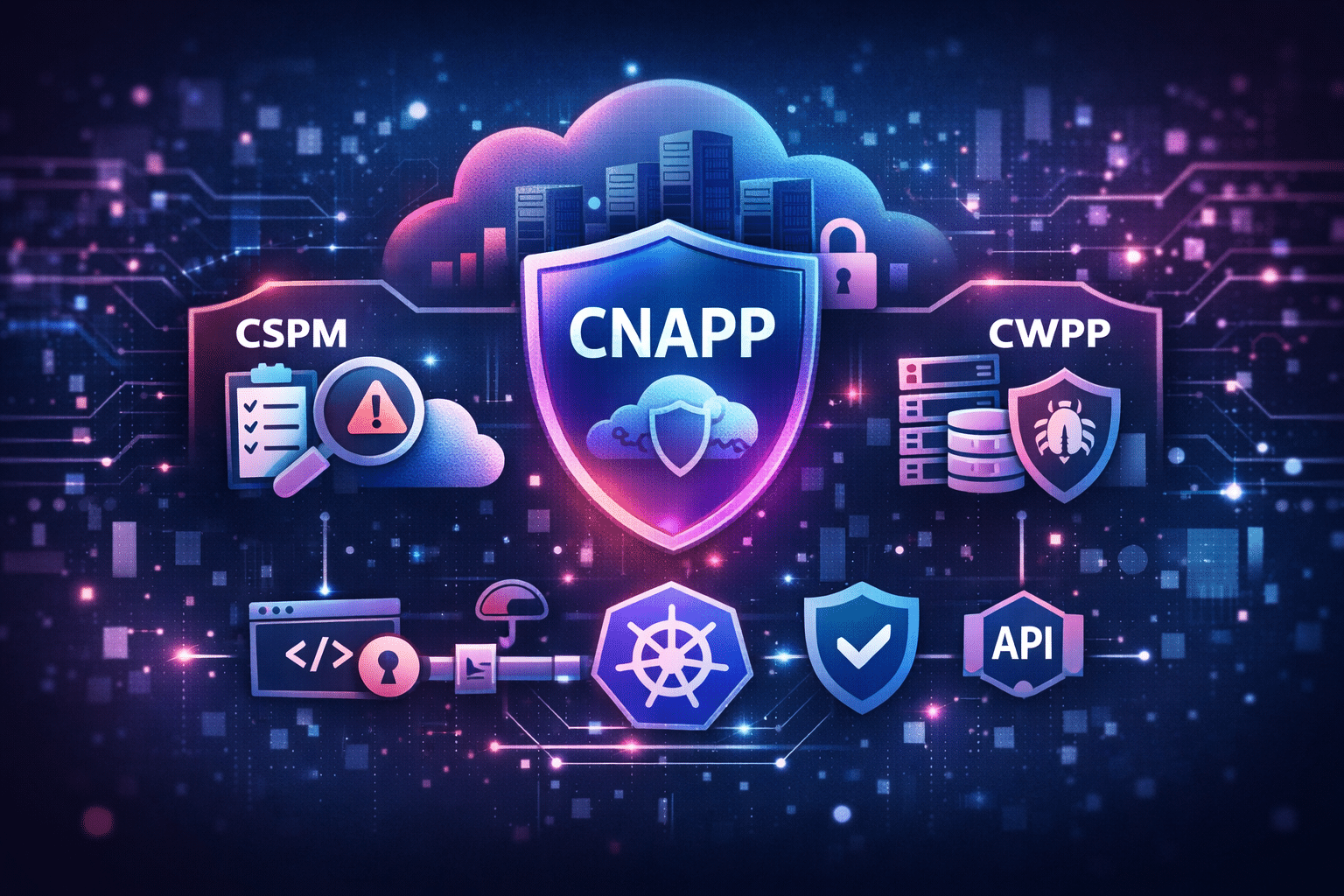
Apiiro is an Application Security Posture Management (ASPM) platform that secures software from code to cloud by mapping application architecture, code changes, developer context, and runtime risks. Unlike Cloud-Native Application Protection Platforms (CNAPPs) and standalone tools like CSPM, CWPP, CIEM, or IaC security scanners, Apiiro focuses primarily on deep codebase analysis, risk prioritization, and developer-centric remediation within the software development lifecycle.
Navigating Modern Cloud and Application Security Terminology
The rapid shift toward cloud-native development has introduced a complex taxonomy of security solutions. Organizations frequently struggle to determine whether they need runtime cloud monitoring, static infrastructure analysis, developer-focused code scanning, or a consolidated platform.
Understanding how Apiiro compares to traditional security operational categories requires clear definitions of each model:
- Cloud Security Posture Management (CSPM): Monitors cloud infrastructure configurations (such as AWS S3 buckets, Azure storage accounts, or Google Cloud IAM policies) to ensure compliance and detect operational drift or misconfigurations in deployed cloud environments.
- Cloud Workload Protection Platform (CWPP): Focuses on securing workloads—including virtual machines (VMs), containers, and serverless functions—at runtime through vulnerability management, system integrity monitoring, and behavioral threat detection.
- Cloud Infrastructure Entitlement Management (CIEM): Specializes in managing cloud permissions, identity access management (IAM) policies, and enforcing the principle of least privilege across human and machine entities in multi-cloud infrastructure.
- Infrastructure as Code (IaC) Security: Scans declarative infrastructure files (such as Terraform, AWS CloudFormation, Ansible, and Helm charts) for security flaws, hardcoded credentials, and configuration errors before code is deployed.
- Cloud-Native Application Protection Platform (CNAPP): An integrated software suite defined by analyst firm Gartner that unifies CSPM, CWPP, CIEM, and static IaC scanning into a single dashboard to simplify cloud risk management.
- Application Security Posture Management (ASPM): A developer- and application-centric security category, pioneered by platforms like Apiiro, that correlates code repositories, developer actions, open-source dependencies, API surfaces, and runtime deployment signals to prioritize and remediate application risks at their source.
What Is Apiiro and How Does It Approach Security?
Apiiro approaches cloud security by focusing first on the software build pipeline and application architecture. Rather than treating cloud security purely as an infrastructure monitoring challenge, Apiiro analyzes how application code, open-source libraries, API endpoints, infrastructure specifications, and developer activities interact across the entire Software Development Lifecycle (SDLC).
At the core of Apiiro’s platform is its Deep Code Analysis engine and Application Risk Graph. The platform ingests metadata and code directly from source code management (SCM) systems like GitHub, GitLab, and Bitbucket, continuous integration/continuous deployment (CI/CD) pipelines, and deployment registries. By maintaining a real-time inventory of software components—including secret locations, API connections, data flow pathways, and open-source packages—Apiiro links code commit history directly to deployed cloud workloads.
- Developer Commits & SCM
- Apiiro Deep Code Analysis (Ingests CI/CD, SAST, SCA, & API metadata)
- Application Risk Graph
- Code-to-Cloud Risk Mapping
- Developer SLA Remediation
- Contextual Risk Prioritization
This structural approach differs from traditional security tools. Instead of surfacing thousands of isolated vulnerability alerts from disconnected scanners, Apiiro connects signals across static application security testing (SAST), software bill of materials (SBOM) components, secret detection, IaC misconfigurations, and live cloud deployment data. This code-to-cloud mapping allows security teams to identify whether a vulnerable code library or misconfigured API endpoint is actually exposed to the public internet in production.
Detailed Comparison: Apiiro (ASPM) vs. Traditional Cloud Security Pillars
To evaluate how Apiiro fits alongside or replaces existing security controls, security architects must examine each functional domain: CSPM, CWPP, CIEM, IaC Security, and umbrella CNAPPs.
1. Apiiro vs. CSPM (Cloud Security Posture Management)
CSPM tools analyze live cloud provider APIs (such as AWS CloudTrail, Azure Resource Manager, and GCP Cloud Asset Inventory) to find deployed infrastructure that violates security benchmarks like CIS (Center for Internet Security), NIST, or PCI-DSS.
- Primary Focus: CSPM focuses on the runtime infrastructure layer. It identifies open firewall ports, unencrypted storage buckets, and missing audit logs in production environments.
- Where They Differ: CSPM detects misconfigurations after infrastructure is provisioned in the cloud. It generally lacks visibility into who wrote the code, which SCM pull request introduced the misconfiguration, or which internal application service owns the cloud asset. Apiiro operates primarily in the build and development layer. It detects the root cause of infrastructure drift inside the codebase before deployment and maps the cloud asset back to the exact developer team responsible for maintenance.
- Operational Impact: A CSPM alert prompts an infrastructure engineer to fix a live cloud setting, which may be overwritten during the next automated deployment if the underlying Terraform file is not updated. Apiiro directs the fix to the source repository, preventing re-introduction during subsequent CI/CD builds.
2. Apiiro vs. CWPP (Cloud Workload Protection Platform)
CWPP solutions inspect compute workloads running in public, private, or hybrid clouds. They deploy lightweight agents or sidecars into host operating systems, Kubernetes pods, and serverless containers to monitor system calls, file integrity, and memory execution.
- Primary Focus: CWPP prioritizes runtime threat detection and workload vulnerability patching. It detects malware execution, unauthorized privilege escalation, and zero-day exploits operating inside running application containers.
- Where They Differ: CWPP tools operate purely at operational runtime. They alert security operations center (SOC) teams when a running container exhibits anomalous behavior or contains an unpatched Common Vulnerabilities and Exposures (CVE) ID in a installed package. Apiiro does not run runtime monitoring agents inside compute workloads. Instead, Apiiro correlates runtime CVE findings with code context—determining whether the vulnerable function within that CVE is actually invoked by the application code, thereby filtering out irrelevant package vulnerabilities.
- Operational Impact: CWPP provides live defensive shielding and agent-based threat blocking. Apiiro provides code context to prevent vulnerable packages from being compiled into workload images in the first place.
3. Apiiro vs. CIEM (Cloud Infrastructure Entitlement Management)
CIEM tools analyze identity and access management (IAM) graphs across complex cloud accounts to expose over-privileged accounts, unused access keys, and dangerous permission escalation paths.
- Primary Focus: CIEM manages cloud permissions and identity governance. It answers questions like: "Which service account has permission to assume administrative control over our production database?"
- Where They Differ: Traditional CIEM platforms inspect cloud-native IAM policies (e.g., AWS IAM roles, Azure Entra ID permissions) after deployment. Apiiro inspects how identities and access credentials are defined within application code, secrets management configurations, and build manifests. While Apiiro tracks identity risks related to embedded credentials and service connections in the codebase, dedicated CIEM tools offer deeper, fine-grained permission analytics for complex cloud IAM structures.
- Operational Impact: Enterprise identity teams rely on CIEM for cloud entitlement governance. Apiiro assists development teams by enforcing secure secret storage practices and stopping hardcoded tokens from reaching repository commits.
4. Apiiro vs. IaC Security Tools
IaC security scanners (such as Checkov, tfsec, or native SCM linters) perform static analysis on configuration scripts written in Terraform, CloudFormation, Bicep, Helm, or Dockerfiles.
- Primary Focus: IaC tools validate infrastructure configuration files against security policies before the infrastructure is provisioned by automated deployment engines.
- Where They Differ: Standalone IaC scanners operate in isolation; they analyze static syntax without understanding application context, deployment runtime state, or risk exposure. They treat every rule violation equally, generating high volumes of low-priority alerts. Apiiro incorporates IaC scanning natively into its ASPM framework but enriches the static results with application context—such as whether the resource handles sensitive data, connects to external APIs, or runs in a production environment.
- Operational Impact: Standalone IaC tools tell developers that a line of Terraform violates a policy. Apiiro tells developers why that specific IaC misconfiguration represents an active risk to the broader application architecture and automates contextual fix suggestions.
5. Apiiro vs. CNAPP (Cloud-Native Application Protection Platform)
CNAPPs combine CSPM, CWPP, CIEM, and basic IaC scanning into a single cloud management platform (exemplified by tools like Wiz, Orca Security, or Palo Alto Networks Prisma Cloud).
- Primary Focus: CNAPPs aim to provide a unified cloud security platform centered around cloud runtime environments, infrastructure visibility, and cloud asset inventory.
- Where They Differ: Most CNAPP platforms are built from the cloud downward (Cloud-to-Code). They start with live cloud workloads and attempt to trace findings back to code repositories. Apiiro is built from the code upward (Code-to-Cloud). Apiiro offers deeper developer context, continuous code composition analysis, API security governance, and native integration with developer workflows. While some CNAPPs have added basic ASPM capabilities, Apiiro’s core architecture provides deeper static code analysis, software supply chain mapping, and change-impact analysis across large software engineering organizations.
- Operational Impact: Security operations (SecOps) teams often prefer CNAPPs for unified operational visibility over runtime infrastructure. Application security (AppSec) teams and engineering leaders prefer Apiiro to embed security into developer workflows, manage application risk backlogs, and lower Mean Time to Remediation (MTTR).
Architectural Comparison Matrix
The following table summarizes the structural, operational, and domain differences across Apiiro and modern cloud security models:
| Platform / Category | Primary Operational Layer | Core Focus & Artifacts Inspected | Primary Target Persona | Strengths | Limitations |
|---|---|---|---|---|---|
| Apiiro (ASPM) | SDLC, Code Repositories, Build Pipelines | Application code, SCM commits, APIs, open-source libraries, IaC, developer context | AppSec Engineers, Software Architects, Engineering Leads | Deep code-to-cloud mapping, contextual risk prioritization, high signal-to-noise ratio, developer workflow integration | Does not provide runtime host protection, agent-based detection, or live network packet inspection |
| CSPM | Cloud Runtime Control Plane | Cloud provider APIs, storage configurations, network security groups | Cloud Security Engineers, Governance & Compliance Teams | Real-time cloud misconfiguration detection, compliance framework mapping (CIS, NIST) | Lacks deep code context, cannot fix issues inside SCM source files directly |
| CWPP | Compute Workloads (VMs, Containers, K8s) | Runtime OS processes, system calls, container image vulnerabilities | SecOps, SOC Analysts, Incident Response | Live threat detection, runtime process isolation, host-level intrusion prevention | Requires agent/sidecar deployment, high operational overhead, lacks developer workflow integration |
| CIEM | Cloud Identity Layer | Cloud IAM policies, roles, entitlement graphs, service accounts | IAM Administrators, Cloud Risk Managers | Identifies toxic permission combinations and over-privileged cloud access | Narrow scope focused solely on entitlements, does not analyze application code logic |
| IaC Security | Static Repositories & CI/CD Pipelines | Terraform, CloudFormation, Ansible, Dockerfiles, Helm charts | DevOps Engineers, Platform Engineers | Shift-left configuration checks, fast feedback in pull requests | Generates high alert volume, lacks runtime context and application architecture awareness |
| CNAPP | Unified Cloud & Build Environments | Cloud assets, runtime workloads, infrastructure configurations, container images | CISOs, Cloud Security Directors, SecOps | Single pane of glass for cloud runtime, consolidated multi-pillar platform | Can be runtime-heavy, weaker deep static code analysis and developer-native workflow tools |
The Shift-Left vs. Cloud-Down Paradox: Code-to-Cloud vs. Cloud-to-Code
A central architectural debate in modern cybersecurity revolves around directionality: Should security visibility start in the cloud and trace down to code, or start in code and trace up to the cloud?
- Cloud-Down Approach (CNAPP / CSPM)
- Production Cloud Asset
- Vulnerability Alert
- Traces back to repository
- Code-to-Cloud Approach (Apiiro / ASPM)
- SCM Commit / Pull Request
- Context & Risk Analysis
- Verified Deployed Risk
The Cloud-Down Model (CNAPP / CSPM)
Cloud-down tools ingest live infrastructure data first. When a vulnerability or misconfiguration is discovered in production, the system attempts to correlate that finding with an upstream repository.
- Advantage: Guarantees that everything monitored currently exists in production.
- Drawbacks: Security teams discover issues after they are deployed, meaning vulnerable code is exposed in production until a fix cycle completes. Additionally, routing a cloud-down finding back to the exact line of code and the specific developer who authored it can be imprecise, leading to friction between SecOps and software engineers.
The Code-to-Cloud Model (Apiiro ASPM)
Apiiro’s code-to-cloud model analyzes software during development. It constructs a dynamic map of the application architecture by observing changes across repositories, pull requests, developer behaviors, and build pipelines.
- Advantage: Identifies design flaws, secret exposures, missing authorization checks, and insecure dependencies before code hits production environments.
- Contextual Correlation: Apiiro bridges the gap to runtime by connecting code analysis with deployment indicators (such as API gateway configurations, Kubernetes manifests, and cloud telemetry). If a vulnerability exists in a software package, Apiiro uses its Application Risk Graph to verify if that package is included in a live build, accessible via a public API endpoint, and linked to sensitive data stores. If all conditions are met, the issue is flagged as critical. If the vulnerable package is unreachable, its priority is reduced automatically.
How Organizations Integrate Apiiro with Existing Cloud Security Stacks
Apiiro is rarely deployed in a vacuum; standard enterprise security strategies often integrate ASPM alongside established cloud runtime tools. Rather than replacing a CNAPP or CSPM entirely, organizations use Apiiro to unify application security operations and streamline remediation workflows.
- Development Phase (SDLC)
- Code / SCM
- Build / CI-CD
- Dependencies
- IaC Scans
- Apiiro (ASPM) Context Graph
- Production Phase (Runtime)
- Cloud Provisioning (Monitored by CSPM)
- Containers/VMs (Monitored by CWPP)
- IAM / Entitlements (Monitored by CIEM)
Practical Integration Workflows
- Deduplicating and Prioritizing Runtime Vulnerabilities: A CNAPP or CWPP scanner may flag 10,000 package vulnerabilities across enterprise container registries. By ingesting these findings into Apiiro, the application security team can cross-reference the CVEs against Apiiro’s deep code context. Apiiro filters out vulnerabilities that reside in unused code paths, reducing the actionable backlog from thousands of alerts to a manageable set of true high-risk issues.
- Fixing Infrastructure Misconfigurations at the Source: A CSPM platform detects an unencrypted AWS S3 bucket in a staging account. Instead of opening an operational ticket for a cloud administrator to manually toggle an encryption setting in the AWS Console, Apiiro identifies the Terraform module that created the bucket, locates the repository owner, and automatically generates a pull request with the updated code configuration.
- Governance of Software Supply Chain and Secrets: While traditional cloud tools monitor deployed assets, Apiiro tracks code commits for introduced secrets, open-source license compliance violations, and software supply chain risks (such as malicious package dependencies or compromised developer pipelines) before deployment.
Key Selection Criteria: Choosing the Right Strategy
When deciding how to allocate resources across Apiiro (ASPM), CNAPP, CSPM, CWPP, CIEM, and IaC tools, security leaders should evaluate the following organizational factors:
Choose Apiiro (ASPM) as a Primary Investment When:
- The primary goal is developer-centric remediation: Your organization has a large engineering team and wants to fix vulnerabilities within SCM/CI/CD workflows rather than managing security alerts in production.
- Application complexity is high: You manage distributed microservice architectures, extensive internal and external API integrations, and continuous deployment pipelines.
- Alert fatigue is paralyzing AppSec: Existing SAST, SCA, and cloud scanners produce noisy, unprioritized alerts, making it difficult to identify real operational risk.
- Governance across the SDLC is required: You need visibility into software supply chain components, SBOM management, secret detection, and policy enforcement across repository changes.
Prioritize CNAPP, CSPM, or CWPP Investment When:
- Infrastructure management is isolated from development: Your infrastructure is primarily legacy, manually managed, or maintained separately from software code repositories.
- Immediate runtime compliance proof is mandatory: Regulatory requirements demand continuous runtime monitoring of production cloud assets, host agent protection, and active network intrusion prevention.
- Workload protection requires live isolation: You require host-level runtime threat detection, memory inspection, and zero-day execution blocking inside compute nodes.
Frequently Asked Questions
Does Apiiro replace the need for CSPM or CNAPP tools?
No, Apiiro does not entirely replace CSPM or CNAPP tools in organizations that require active runtime threat detection, agent-based host protection, or native cloud provider compliance monitoring. However, Apiiro can replace the static IaC scanning, vulnerability prioritization, and shift-left modules within legacy CNAPPs by providing deeper code-level analysis and developer remediation tools.
How does Apiiro differ from traditional SAST and SCA scanners?
Traditional Static Application Security Testing (SAST) and Software Composition Analysis (SCA) scanners run isolated rule checks against specific code repos or dependencies, often resulting in high false-positive rates. Apiiro is an ASPM platform that ingests data from SAST and SCA tools—or uses its native analysis capabilities—and correlates those findings with business impact, developer context, API exposures, and cloud deployment signals to prioritize true risks.
What is the difference between Code-to-Cloud and Cloud-to-Code security?
Cloud-to-Code security (typical of CNAPPs) starts by inspecting live cloud infrastructure and working backward to infer where the source code originated. Code-to-Cloud security (typical of Apiiro and ASPM) starts directly inside source code control systems, CI/CD pipelines, and application architectural components, tracing risks forward into cloud environments to prevent security flaws before code is deployed.
Can Apiiro analyze Infrastructure as Code (IaC) files?
Yes. Apiiro analyzes IaC frameworks—including Terraform, AWS CloudFormation, Helm, and Dockerfiles—directly within code repositories. Unlike standalone IaC linters, Apiiro evaluates IaC scripts alongside application code logic and deployment context to assess the true risk of a configuration flaw before deployment.
How does Apiiro help reduce Mean Time to Remediation (MTTR)?
Apiiro reduces MTTR by cutting out alert noise and identifying the exact code owners for any verified risk. Instead of sending generic cloud alerts to centralized security teams, Apiiro delivers contextual fix guidance directly to the developer who authored the change through native integrations with systems like GitHub, GitLab, and Jira.
Next Steps and Recommendations
Organizations seeking to modernize their cloud security posture should take a phased approach to evaluating their security stack:
- Audit Your Security Tooling Overlap: Map your current security tooling inventory against the functional layers (Code, CI/CD, IaC, Cloud Infrastructure, Runtime Workloads, Identity). Identify where alert redundancy occurs between AppSec and SecOps teams.
- Evaluate Signal-to-Noise Ratios: Benchmark your current Mean Time to Remediation (MTTR). If engineering teams spend significant hours sifting through unprioritized SAST or CSPM alerts, pilot an ASPM platform like Apiiro to measure reduction in actionable alert volumes.
- Adopt a Hybrid Governance Model: Use CNAPP/CSPM platforms for operational cloud infrastructure auditing, compliance reporting, and runtime protection. Pair these with Apiiro to manage application risk backlogs, secure the software supply chain, and empower software development teams to remediate flaws directly within their native CI/CD workflows.