Business requirements analysis is the systematic process of discovering, analyzing, defining, and documenting the specific needs of an organization to solve operational problems or achieve strategic goals. A practical approach integrates direct stakeholder elicitation, clear scope definition, rigorous modeling, and traceability to ensure business solutions deliver measurable ROI without costly project scope creep.
What Is Business Requirements Analysis?
At its core, business requirements analysis bridges the gap between high-level business goals and technical development execution. Organizations often fail to achieve project objectives not because of coding failures or hardware limitations, but because they fail to articulate what the business actually needs.
In professional practice—aligned with standards from the International Institute of Business Analysis (IIBA)—requirements exist in a clear hierarchy:
- Business Requirements: High-level goals, objectives, and vision of the organization (e.g., "Reduce order fulfillment processing time by 30%").
- Stakeholder Requirements: The specific needs of distinct user groups or departments that bridge business goals and concrete system actions (e.g., "Warehouse managers need real-time inventory visibility across regional hubs").
- Solution Requirements: Functional and non-functional specifications describing how the system must perform (e.g., "The inventory dashboard must update stock counts within 500 milliseconds of a database write").
- Transition Requirements: Capabilities needed to move from the current state ("As-Is") to the future state ("To-Be"), such as legacy data migration, staff training, and parallel system operations.
A practical approach avoids getting bogged down in overly theoretical documentation. Instead, it focuses on real-world constraints, active collaboration across business units, iterative refinement, and direct alignment with strategic objectives.
The 5-Step Practical Framework for Requirements Analysis
Executing business requirements analysis effectively requires a structured, repeatable framework. Skipping steps or jumping straight into solution design usually leads to missed edge cases, budget overruns, and user dissatisfaction.
5-Step Requirements Analysis Framework
- Step 1: Elicitation & Stakeholder Identification
- Step 2: Categorization & Scope Boundary Mapping
- Step 3: Business Process Modeling & Gap Analysis
- Step 4: Requirement Prioritization & Feasibility Assessment
- Step 5: Validation, Sign-off & Traceability Setup
Step 1: Elicitation and Stakeholder Identification
Requirements elicitation is the proactive discovery of requirements through interaction with people, documents, and existing systems. Effective elicitation starts with comprehensive stakeholder mapping using a RACI matrix (Responsible, Accountable, Consulted, Informed) to ensure key voices are heard.
Primary techniques for practical elicitation include:
- Structured Interviews: One-on-one sessions with domain experts and decision-makers to explore high-level objectives and underlying pain points.
- Interactive Workshops: Facilitated group sessions with cross-functional stakeholders to align conflicting priorities and achieve rapid consensus.
- Contextual Observation (Job Shadowing): Observing end users in their actual working environment to uncover tacit knowledge—unwritten procedures or manual workarounds that users forget to mention during interviews.
- Document Analysis: Reviewing existing process flowcharts, standard operating procedures (SOPs), system logs, audit reports, and contract obligations.
Step 2: Categorization and Scope Boundary Mapping
Once raw data and notes are collected, requirements must be grouped logically to establish project scope. Unstructured requirements lead to confusion and overlooked dependencies.
Practitioners classify requirements into two broad categories:
- Functional Requirements: Define specific behaviors, calculations, data manipulations, and operational functions the solution must execute (e.g., automated tax calculation during checkout).
- Non-Functional Requirements (Quality Attributes): Define system operational characteristics, such as performance, scalability, security, usability, availability, and regulatory compliance (e.g., adherence to GDPR data retention limits).
To prevent scope creep, establish clear In-Scope and Out-of-Scope boundaries immediately. Document explicit boundary statements so all stakeholders understand what will not be delivered during the current project lifecycle.
Step 3: Modeling and Analysis Techniques
Raw notes and bullet points are prone to misinterpretation. Visual and structural modeling translates subjective words into unambiguous logic that both business leaders and software developers can validate.
- Process Mapping (As-Is vs. To-Be): Diagramming current operational workflows pinpoints manual bottlenecks, redundant handoffs, and unnecessary delays. Modeling the proposed future state establishes the operational target.
- Data Flow Diagrams (DFDs): Mapping how inputs move through automated modules, transform across routines, and store in relational databases.
- Use Case Modeling: Depicting interactions between external actors (users or external systems) and the boundary of the system under development.
- Gap Analysis: Comparing existing organizational capabilities against the desired target state to highlight missing features, process gaps, or structural deficits.
Step 4: Prioritization and Feasibility Assessment
Not all requirements carry equal value, and practical project constraints—such as time, budget, and engineering capacity—require tough choices. Prioritization ensures teams deliver the highest-value capabilities first.
Common practical prioritization frameworks include:
- MoSCoW Method: Classifying items into Must have (critical for release), Should have (important but non-fatal if delayed), Could have (desirable enhancements), and Won't have (deferred for future iterations).
- Kano Model: Categorizing features based on how they impact customer satisfaction (Basic Expectations, Performance Features, and Delighters).
- Cost-Value Matrix: Graphing requirements along two axes—estimated implementation effort versus anticipated business value—to quickly identify "quick wins" and eliminate low-value/high-effort requests.
Simultaneously, assess technical, operational, and financial feasibility. If a requirement mandates real-time processing across legacy mainframe databases that lack API interfaces, the technical feasibility risk must be surfaced before locking in scope.
Step 5: Validation, Sign-off, and Traceability Setup
Validation confirms that the documented requirements accurately reflect business intent and are clear, complete, consistent, and testable.
- Requirements Reviews and Walkthroughs: Conducting peer reviews with business leads, technical architects, and quality assurance (QA) testers to identify ambiguities and contradictions.
- Formal Sign-off: Securing explicit operational approval from designated business sponsors to establish an authoritative baseline.
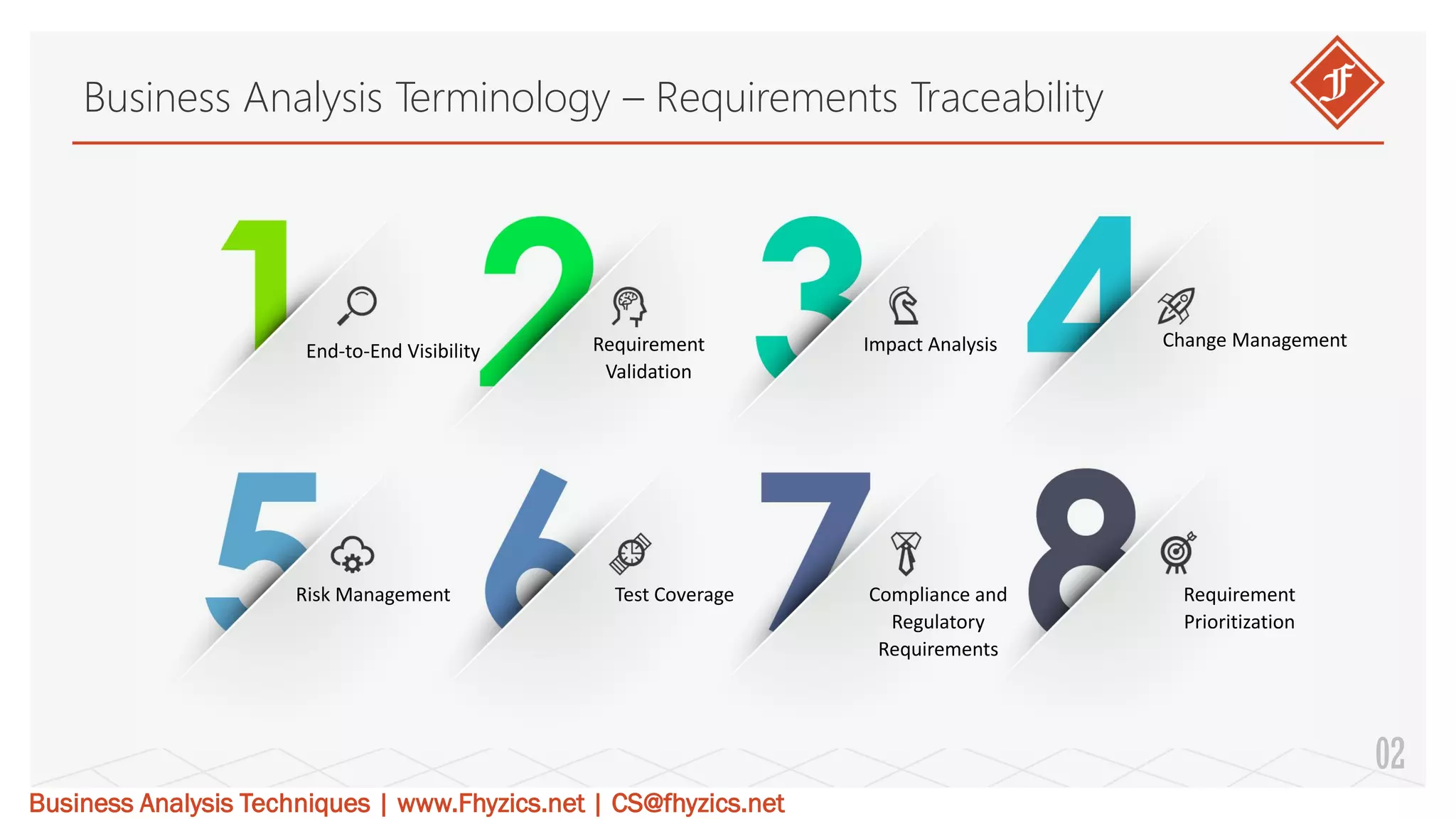
- Traceability Matrix: Creating a Requirements Traceability Matrix (RTM) linking business goals down through functional specifications, architectural designs, and QA test scripts. Traceability ensures every functional module traces back to a verified business need and every requirement is verified through software testing.
Core Analysis Techniques Compared
Choosing the right analysis technique depends on project methodology, business complexity, and stakeholder preference. The table below compares standard business analysis tools:
| Technique | Primary Purpose | Best Suited For | Key Deliverable | Major Limitation |
|---|---|---|---|---|
| Business Process Mapping (BPMN) | Visualizing workflow steps, roles, and handoffs | Operational transformation, process optimization | As-Is / To-Be Flowcharts | Can become overly complex if details are over-modeled |
| User Stories & Acceptance Criteria | Capturing end-user goals in agile sprints | Agile development, product backlogs | Concise story cards (As a... I want... So that...) |
Risk of losing high-level architecture vision without epic mapping |
| Use Case Specifications | Documenting comprehensive system interactions | Complex enterprise applications, integration projects | Detailed tabular specifications with edge-case flows | Requires significant time to maintain as requirements evolve |
| Root Cause Analysis (5 Whys / Fishbone) | Uncovering underlying operational problems | Problem definition, diagnostic initiatives | Cause-and-Effect diagrams, root cause reports | Focuses on existing problems rather than innovative capabilities |
| Data Flow Modeling | Mapping data transformation and system storage | System integrations, data warehouse builds | Data Flow Diagrams (Context & Level 1 DFDs) | Omits temporal/timing elements and user interaction nuances |
Documenting Requirements: The Business Requirements Document (BRD)
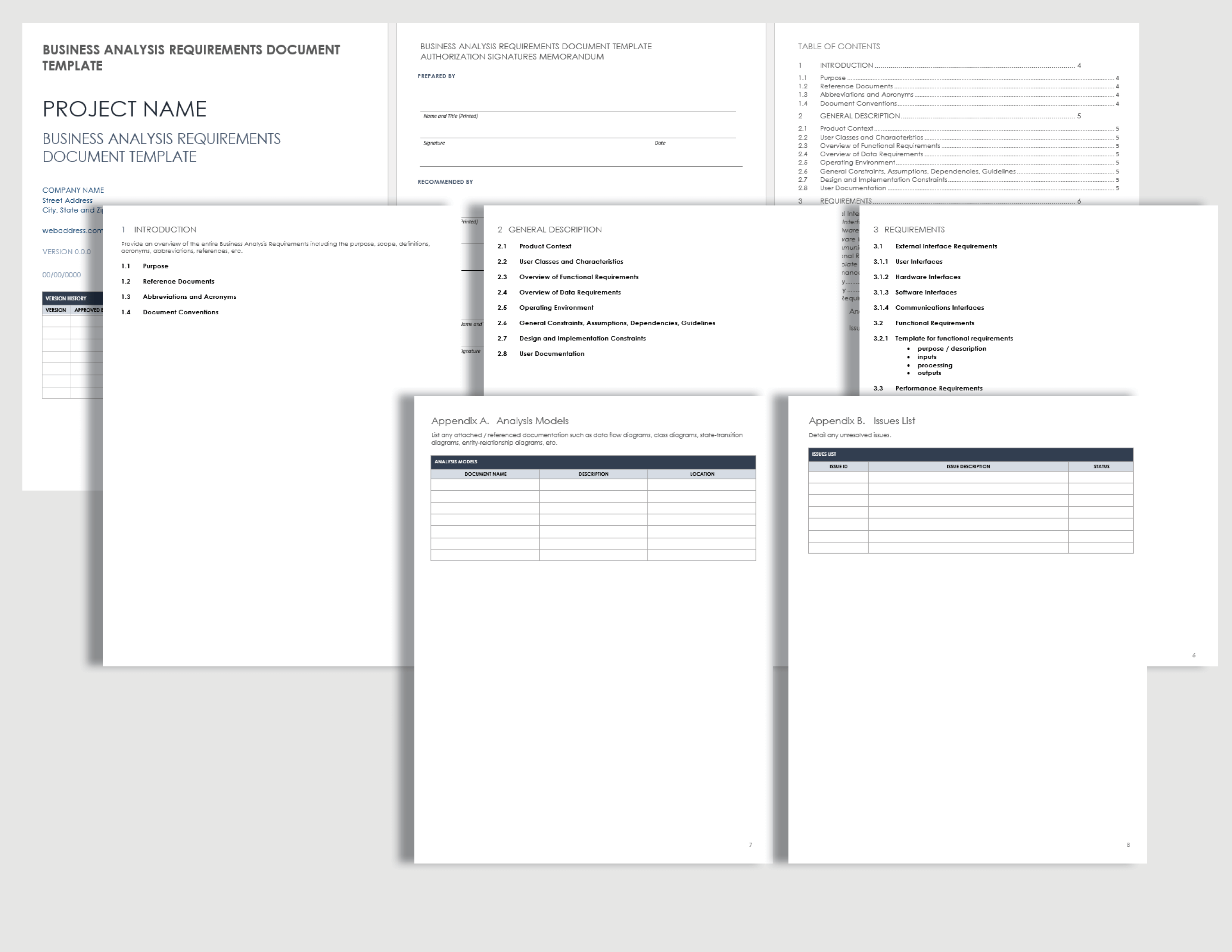
A structured Business Requirements Document (BRD) serves as the authoritative agreement between executive sponsors, business units, and technical delivery teams. While agile teams may express requirements through epic hierarchies and user story backlogs, enterprise governance typically requires a foundational document that captures strategic intent.
Anatomy of a Business Requirements Document
- Executive Summary & Project Objectives
- Current State Problem Statement & Scope Boundaries
- Proposed Future State & Process Architecture
- Functional Requirements (Categorized & Prioritized)
- Non-Functional Requirements (SLA, Security, Performance)
- Reporting, Data Migration & Compliance Needs
- Assumptions, Constraints & Dependencies
- Requirements Traceability Matrix (RTM) & Approval Sign-offs
Essential Quality Attributes of Effective Requirements
To prevent misunderstandings during technical architecture design and implementation, ensure every requirement meets the following quality criteria:
- Unambiguous: Written in plain, objective terms so that two independent readers reach identical conclusions. Avoid vague terms like "user-friendly," "fast," "flexible," or "robust."
- Testable & Verifiable: Contains quantitative acceptance criteria so QA teams can create binary pass/fail test cases (e.g., "Page load time under peak load must remain below 2.0 seconds").
- Atomic: Expresses a single distinct statement without combining multiple independent requirements into one complex sentence.
- Traceable: Assigned a unique identifier (e.g.,
REQ-FIN-004) to support end-to-end tracking throughout the development lifecycle. - Feasible: Achievable within technical limits, budget constraints, and delivery timelines.
Common Pitfalls in Requirements Analysis and How to Avoid Them
Even experienced analysts run into predictable pitfalls during complex project cycles. Recognizing these risks early allows teams to implement preventive safeguards.
1. Solutioneering (Prescribing Solutions Too Early)
The Problem: Stakeholders often state requirements as specific solutions rather than root needs (e.g., "We need a drop-down selector with red radio buttons" instead of "We need to filter orders by regional origin"). The Solution: Ask "Why?" repeatedly to abstract the request back to the core operational problem. Let UX designers and software architects determine the optimal technical solution once the underlying need is clear.
2. Scope Creep
The Problem: Continuous, uncontrolled additions to project scope without corresponding adjustments to time, budget, or resources. The Solution: Implement a formal Change Control Process. Require every new requirement request to undergo impact analysis, budget evaluation, and executive sponsor review before adding it to the baseline backlog.
3. Missing Unstated Needs (Tacit Knowledge)
The Problem: Operational experts perform routine tasks unconsciously, forgetting to mention non-standard procedures, manual workarounds, or regulatory exceptions during formal interviews. The Solution: Combine direct interviews with observational job shadowing, audit log analysis, and iterative prototype walkthroughs to validate real-world operational realities.
4. Ambiguous Language
The Problem: Using subjectively interpreted adjectives leads to mismatched expectations between product teams and business leads. The Solution: Replace adjectival requirements with quantitative Metrics and Key Performance Indicators (KPIs). Translate terms like "high security" into measurable standards such as "AES-256 encryption at rest and mandatory multi-factor authentication (MFA) for administrative roles."
Frequently Asked Questions
What is the difference between a BRD and an SRS?
A Business Requirements Document (BRD) defines what the business aims to achieve and why the project is necessary from a business perspective. A System Requirements Specification (SRS) or Software Requirements Specification defines how software engineers will build the technical solution to fulfill those business needs, detailing functional software logic, API specs, database schemas, and system interfaces.
How does business requirements analysis fit into Agile methodologies?
In Agile environments, business requirements analysis is an ongoing, iterative process rather than a massive upfront phase. High-level business needs are structured into Epics and broken down into User Stories within a Product Backlog. Analysis happens continually during backlog refinement and sprint planning, ensuring developers receive clear acceptance criteria for upcoming iterations.
Who is responsible for business requirements analysis?
Business Analysts (BAs), Systems Analysts, Product Managers, and Product Owners typically lead business requirements analysis. However, successful analysis requires direct involvement from key business stakeholders, subject matter experts (SMEs), technical architects, and quality assurance managers.
What are non-functional requirements, and why are they important?
Non-functional requirements specify operational attributes and quality constraints under which a system must operate, such as performance speed, security standards, uptime availability, disaster recovery limits, and usability guidelines. Ignoring non-functional requirements often results in software that performs correct calculations but fails catastrophically under actual user traffic or security audits.
How do you validate business requirements with executive stakeholders?
Validate requirements through structured walkthrough sessions, concise visual process models, prototype demonstrations, and formal acceptance reviews. Present business impact matrices showing direct alignment between proposed requirement scope, underlying costs, and expected business outcomes before requesting formal sign-off.
Practical Next Steps for Business Analysts and Project Leaders
To put these practical business requirement analysis principles into immediate practice within your organization, follow these actionable steps:
- Establish Standardized Templates: Standardize your organization's Business Requirements Document (BRD), User Story format, and Requirements Traceability Matrix (RTM) templates to ensure consistency across project teams.
- Audit Current Elicitation Practices: Evaluate your team's current discovery process. Incorporate direct observational job shadowing alongside standard stakeholder interviews to catch hidden process steps and workarounds.
- Institute Quantitative Acceptance Criteria: Review your current requirements backlog and remove subjective language (such as "quick," "intuitive," or "scalable"). Replace ambiguous descriptors with measurable, testable performance criteria.
- Implement Traceability Tools: Integrate requirements tracking within your team's project management platform (such as Jira, Azure DevOps, or dedicated requirements platforms) to ensure clear tracking from initial business intake through QA testing and operational sign-off.