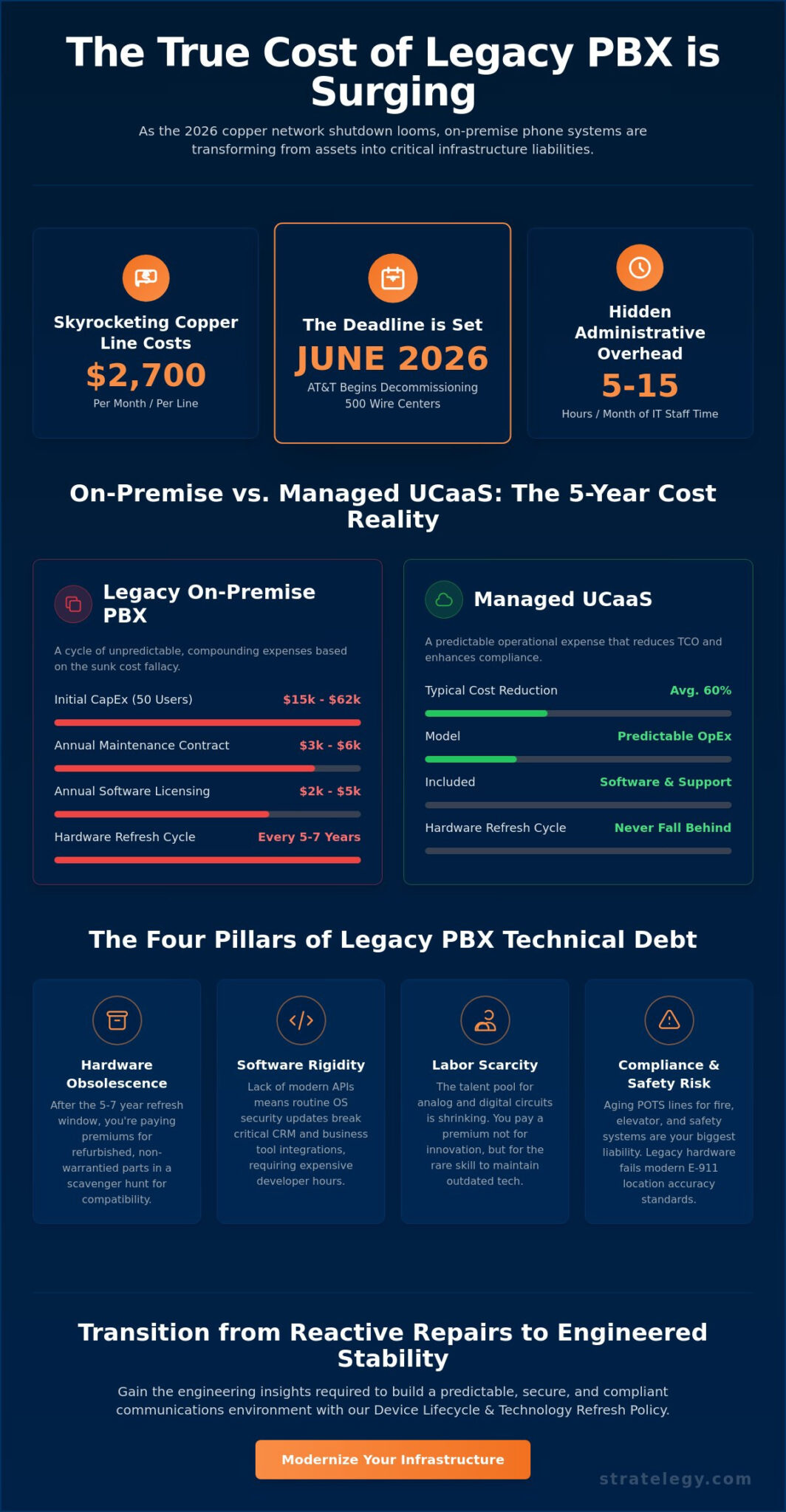
An analog Private Branch Exchange (PBX) system typically costs between $250 and $1,000 per user for initial hardware, cabling, and professional installation. Ongoing maintenance and operational expenses generally range from $15 to $45 per line per month, driven largely by escalating carrier fees for legacy copper Plain Old Telephone Service (POTS) lines, equipment replacement costs, and specialized vendor service agreements.
Understanding Analog PBX Architecture and Core Components
An analog Private Branch Exchange (PBX) is an on-premises telephone switching system that connects internal business extensions to one another and links them to the public switched telephone network (PSTN) using physical copper wiring. While digital and Voice over Internet Protocol (VoIP) platforms dominate modern enterprise communications, legacy analog PBX infrastructure remains operational across many healthcare facilities, hospitality venues, industrial sites, and multi-tenant commercial properties.
To accurately evaluate the financial commitment of maintaining or purchasing an analog telephone system, it is essential to understand the physical hardware components that comprise the network.
- Analog PBX Cabinet
- Control Card (CPU/Routing)
- Power Supply & UPS Backup
- Station Cards (FXS Ports)
- Main Dist. Frame (MDF)
- Analog Phone Handsets / Fax Machines
- Main Dist. Frame (MDF)
- Trunk Cards (FXO Ports)
- PSTN / Copper POTS Lines
- Control Card (CPU/Routing)
1. Main Switching Cabinet (Base Unit)
The central cabinet houses the power supply unit (PSU), backplane circuit boards, system controller card (CPU), and expansion slots. The CPU manages call routing logic, internal extension switching, feature assignment (such as call forwarding or speed dial), and voicemail module integration.
2. Station Cards (FXS Interface)
Foreign Exchange Station (FXS) expansion cards install inside the PBX chassis to deliver dial tone, battery voltage (-48V DC), and ring current (approx. 90V AC) to internal desk phones, wall units, analog fax machines, and overhead paging systems. Each station card typically supports 8, 16, or 32 analog extensions via modular connectors or high-density Amphenol cables.
3. Trunk Cards (FXO Interface)
Foreign Exchange Office (FXO) cards connect the PBX system to external telephone lines provided by a local exchange carrier. FXO ports simulate standard telephone handsets by opening and closing DC loops to initiate or answer calls over incoming physical POTS lines.
4. Main Distribution Frame (MDF) and Cabling
The PBX cabinet connects to a wall-mounted Main Distribution Frame (MDF) featuring 66-blocks or 110-blocks. Unshielded Twisted Pair (UTP) copper cabling—traditionally Category 3 (Cat3) or Category 5e (Cat5e)—runs from the punch-down blocks to individual RJ11 wall plates distributed throughout the building.
Initial Acquisition and Capital Costs Breakdown
Deploying a traditional analog PBX system requires significant up-front capital expenditure (CapEx). Unlike subscription-based cloud solutions that operate on monthly operational expenses (OpEx), analog systems demand purchasing all hardware, licensing, physical wiring, and installation labor prior to turning on service.
Hardware Equipment Expenses
- PBX Chassis and Main Controller: $1,200 to $4,500 depending on total capacity and redundancy features.
- Station Cards (FXS): $250 to $600 per 16-port expansion board.
- Trunk Cards (FXO): $200 to $500 per 4-port or 8-port interface board.
- Analog Handsets: $35 to $120 per single-line or multi-line desk phone. Specialist units, such as weatherproof outdoor units or industrial cleanroom phones, range from $200 to $600 each.
- Uninterruptible Power Supply (UPS): $400 to $1,800 for a rack-mount battery backup system capable of sustaining the PBX during local power outages for 2 to 4 hours.
Cabling and Infrastructure Costs
If a building does not already possess structured copper wiring, installing physical cabling represents one of the largest entry costs.
- Low-Voltage Cable Installation: Low-voltage electrical contractors typically charge $90 to $175 per cable drop (run). Wiring a facility with 50 extensions can add $4,500 to $8,750 in pure cabling costs.
- Patch Panels and MDF Hardware: Punch-down blocks, wire management racks, and distribution frames add an additional $500 to $1,500 in materials.
Professional Installation and System Configuration
Installing an analog PBX requires specialized telecommunication technicians to mount hardware, punch down copper wire pairs to the MDF, test line continuity, set up internal extensions, and program system features (e.g., automated attendants, hunting groups, night service modes).
- Labor Rates: Telecom engineering rates generally range from $100 to $180 per hour.
- Turnkey Deployment Fees: For a medium-sized office with 40 extensions and 8 trunk lines, initial installation and programming labor typically totals $2,500 to $6,000.
| System Capacity | Estimated Hardware Cost | Wiring & Infrastructure | Installation & Programming | Total Up-Front Investment | Average Cost Per User |
|---|---|---|---|---|---|
| Small Office (10 extensions, 4 POTS lines) | $1,500 – $3,000 | $1,000 – $2,000 | $1,200 – $2,200 | $3,700 – $7,200 | $370 – $720 |
| Medium Business (50 extensions, 12 POTS lines) | $5,500 – $11,000 | $4,500 – $8,500 | $3,500 – $6,500 | $13,500 – $26,000 | $270 – $520 |
| Large Enterprise (200 extensions, 32 POTS lines) | $22,000 – $45,000 | $18,000 – $32,000 | $12,000 – $22,000 | $52,000 – $99,000 | $260 – $495 |
Ongoing Maintenance and Operational Expenses
While an analog PBX hardware purchase is paid up front, running the system year after year introduces substantial ongoing operational costs. Understanding these costs is critical for IT managers and financial planners assessing whether to retain aging equipment or transition to alternative voice technologies.
- Annual Analog PBX Operating Expenses
- POTS Carrier Lines
- Maintenance Contract (Vendor SLA)
- Hardware & Spare Parts Sourcing
- Internal IT & Admin Labor Overhead
1. Carrier Circuit Fees and POTS Line Cost Increases
The primary ongoing cost of an analog PBX system is the monthly service fee paid to the local telephone company for copper POTS lines. Following telecom regulatory adjustments—such as the FCC lifting price caps on unbundled legacy analog loops in the United States—major telecommunications carriers have aggressively raised monthly rates on traditional copper lines to encourage customers to migrate off aging copper networks.
- Historical Monthly POTS Line Cost: $35 to $65 per line.
- Current Monthly POTS Line Cost: $100 to $350+ per line depending on geographical location and provider tariff structures.
- Financial Impact: A business running 16 analog trunk lines may pay between $1,600 and $5,600 per month purely in raw carrier line rentals, excluding long-distance call charges and government taxes.
2. Maintenance Contracts and Vendor Service Level Agreements (SLAs)
Because analog PBX equipment consists of proprietary circuit boards and closed software, businesses generally rely on local Interconnect Companies or specialized telecom distributors for maintenance support.
- Annual Service Contracts: Annual maintenance contracts typically cost 12% to 20% of the original total hardware valuation per year.
- Emergency Hourly Support: Without a contract, emergency dispatch for a certified analog PBX technician usually costs $150 to $250 per hour, often with a two-hour minimum call-out charge.
3. Sourcing Replacement Parts for Aging Systems
Major hardware manufacturers—such as Avaya (Partner/Definity/Merlin), Nortel (Norstar/Option series), Panasonic (KX-TA/KX-TDA), and Toshiba (Strata)—discontinued their traditional analog PBX lines years ago.
- Refurbished Equipment: Maintenance teams must source secondary-market, refurbished, or used pull cards via secondary equipment brokers or online marketplaces.
- Cost Volatility: While basic single-line phones remain inexpensive ($35–$70), specialized legacy CPU cards, power supply units, or high-density station modules can command premium prices ($400–$1,500) due to declining global stockpiles.
4. Internal IT Administrative Overhead
Managing an analog PBX demands manual physical labor. Unlike modern VoIP platforms where an IT administrator changes an extension or renames a user through a web GUI, analog systems require physical interventions:
- Moves, Adds, and Changes (MACs): Changing a physical office desk location requires tracing pair connections at the MDF block using a tone generator and probe, followed by repunching copper pairs to new termination blocks.
- Labor Expenses: Organizations without dedicated low-voltage technicians must hire external vendors for basic internal moves, spending $150 to $300 per service ticket.
Total Cost of Ownership (TCO): Analog PBX vs. IP PBX vs. Cloud VoIP
When reviewing long-term financial commitments, organizations must evaluate Total Cost of Ownership (TCO) over a 3-year to 5-year operational lifecycle. Below is a comparative overview highlighting structural cost dynamics across legacy analog PBX, on-premises IP PBX, and Hosted Cloud VoIP services.
| Cost & Operational Metric | Legacy Analog PBX | On-Premises IP PBX | Hosted Cloud VoIP |
|---|---|---|---|
| Initial Up-Front CapEx | High ($250 – $1,000 / line for hardware & wiring) | Moderate to High ($150 – $500 / line for servers & IP phones) | Very Low ($0 – $150 / line for IP phones only) |
| Monthly Telecom Line Cost | Very High ($100 – $350 per POTS line) | Low to Moderate ($15 – $30 per SIP channel) | Included in User License ($15 – $35 / user / month) |
| Physical Infrastructure Needed | MDF, 66/110 blocks, multi-pair Cat3/Cat5 cabling | IP Switch, Ethernet Cat5e/Cat6 cabling, local server rack | Standard Internet Connection, PoE Ethernet Switches |
| Hardware Maintenance & SLAs | High (Refurbished parts, physical field technician visits) | Moderate (Server maintenance, software update contracts) | Zero (Managed entirely by cloud provider) |
| Scalability & Expansion | Poor (Requires purchasing physical expansion cards/wiring) | Good (Requires software license or card additions) | Instant (Add extensions online via admin portal) |
| Disaster Recovery / Redundancy | Limited (Calls land at physical trunk; hardwired failover required) | Moderate (Local auto-failover to backup SIP trunk) | High (Geo-redundant cloud routing, mobile app failover) |
| Feature Set Flexibility | Basic (Call transfer, hold, voicemail, simple IVR) | Advanced (SIP integration, call queues, basic CRM links) | Enterprise (AI transcripts, video, CRM integration, mobile apps) |
Maintenance Best Practices and Troubleshooting Common Issues
Maintaining an analog PBX system requires disciplined hardware routines and structured cabling management. Because these systems lack modern automated diagnostic scripts, physical inspection and signal testing remain the foundation of operational uptime.
1. Routine Preventative Maintenance Checklist
To avoid unexpected system outages and extend system life, system administrators should perform recurring preventive maintenance checks:
- Quarterly Power & Battery Health Inspections: Test the primary Power Supply Unit (PSU) voltages and inspect lead-acid UPS batteries for swelling, terminal corrosion, or loss of charge capacity. A failed UPS can cause memory corruption in legacy PBX controller cards during sudden power drops.
- Cabinet Dust & Thermal Management: Analog PBX cabinets generate significant heat from power convertors and line transformers. Clean dust filters, verify internal cooling fan operation, and maintain server-room temperatures below 75°F (24°C).
- MDF Auditing and Wire Dressing: Clean up "spaghetti wiring" at the Main Distribution Frame. Label all punch-down blocks with extension numbers and pair assignments. Loose, oxidized, or tensioned copper jumper wires cause intermittent dropouts and voice static.
2. Troubleshooting Common Analog Telephony Issues
Problem A: Audio Static, Crackling, or Hum (60 Hz Ground Loop)
- Root Cause: Audio static on analog circuits is usually caused by moisture in copper cables, degraded punch-down connections, or improper electrical grounding between the PBX chassis and the building ground busbar.
- Troubleshooting Steps:
- Isolate whether the noise affects internal calls (station card/internal wiring) or external calls (FXO card/POTS line).
- Disconnect the incoming trunk from the PBX at the Demarcation point (RJ11 test jack) and plug in a standard single-line butt-set test phone. If static persists, the issue lies with the carrier line.
- If static is internal, check the MDF block connection with a tone generator. Inspect cabling for run proximity to high-voltage AC electrical lines or fluorescent light ballasts, which induce electromagnetic interference (EMI).
- Audio Quality / Static Issue
- Is static present on internal calls or trunk lines?
- Internal Extension Call
- Check MDF 66-block pair for loose punch-down or oxidation
- Inspect UTP cable run for EMI interference
- External PSTN Call
- Test line at carrier Demarcation point using butt-set test phone
- Verify FXO card impedance and ground busbar connection
- Internal Extension Call
- Is static present on internal calls or trunk lines?
Problem B: Crosstalk (Hearing Other Conversations)
- Root Cause: Crosstalk occurs when electrical signals bleed between adjacent wire pairs in a multi-conductor telephone cable due to degraded insulation, split pairs, or tight physical bundling.
- Troubleshooting Steps: Verify that wire pairs at the 66-block follow standard color-code pairings (e.g., White-Blue / Blue-White). A "split pair" occurs when tip and ring conductors from two different circuit pairs are mismatched during installation, eliminating the noise-canceling effects of twisted-pair cabling.
Problem C: False Ringing or Ringing Failure
- Root Cause: The station card's Ring Generator module is failing to supply adequate AC voltage (typically 90V AC at 20 Hz) or the line loop resistance exceeds system thresholds.
- Troubleshooting Steps: Measure the AC voltage output at the station port terminals using a digital multimeter while ringing the extension. If the voltage drops below 40V AC under load, replace the defective FXS card.
Managing the Legacy Sunset: Hybrid PBX and Migration Strategies
As traditional copper networks are phased out worldwide, maintaining a pure analog PBX is increasingly costly and technically challenging. However, organizations with significant investments in analog end-points (such as hotel guest rooms, elevator emergency phones, or sprawling industrial campuses) do not necessarily need to replace all cabling and handsets overnight.
- Hybrid Migration Topology
- Modern SIP Trunk / Cloud Provider (IP)
- FXO Gateway (VoIP-to-Analog) (Analog Trunk)
- Existing Legacy Analog PBX (Station Wires)
- Analog Desk Phones / Fax
- Existing Legacy Analog PBX (Station Wires)
- FXO Gateway (VoIP-to-Analog) (Analog Trunk)
- Modern SIP Trunk / Cloud Provider (IP)
Option 1: POTS Replacement Gateways (Cellular / Fiber Interfaces)
To eliminate escalating carrier monthly charges for traditional copper lines, businesses can deploy specialized POTS Replacement Routers (also known as Cellular FXO Gateways).
- Mechanism: These devices convert the incoming copper trunk connections of the analog PBX into dual-SIM cellular (4G LTE/5G) or high-speed fiber data streams.
- Financial Impact: Replaces $100–$350 monthly copper line charges with fixed cellular data plans ranging between $30 and $60 per line per month, delivering immediate OpEx savings without altering internal PBX hardware.
Option 2: VoIP FXS/FXO Media Gateways (Hybrid Integration)
Organizations can preserve internal analog wiring and station handsets while replacing the legacy central cabinet with a hybrid IP system using Analog Telephony Adapters (ATA) or high-density Media Gateways.
- FXO Gateways: Allow a legacy analog PBX cabinet to route outbound calls over modern, low-cost SIP trunks instead of physical POTS lines.
- FXS Gateways: Convert incoming IP telephony lines into multi-port analog outputs. A 32-port FXS gateway connects directly to existing 66-blocks on an MDF, allowing hotel rooms or hospital wards to keep cheap analog phones while the core communications engine runs on modern Cloud or On-Premises VoIP servers.
Option 3: Phased System Replacement Workflow
- Infrastructure Audit: Map all active analog lines, identifying critical safety endpoints like elevator phones, building alarms, and fax machines.
- SIP Trunk Conversion: Replace incoming copper PSTN trunks with SIP trunks via an FXO gateway to reduce monthly carrier expenses.
- Core Engine Migration: Replace the legacy PBX cabinet with an IP PBX or cloud subscription.
- Endpoint Modernization: Gradually replace desk phones with modern PoE IP phones while leaving high-density/low-duty extensions on FXS gateways.
Frequently Asked Questions
Why are monthly service costs for analog telephone lines increasing so rapidly?
Major telecommunications carriers are systematically phasing out legacy copper infrastructure in favor of fiber-optic and wireless networks. As regulatory bodies have deregulated copper line pricing, carriers have increased rates on traditional Plain Old Telephone Service (POTS) lines to reflect the high physical cost of maintaining deteriorating copper loops and to encourage business customers to move to modern VoIP platforms.
Can an analog PBX system use modern SIP trunking?
Yes, but it requires an external hardware interface known as an FXO VoIP Gateway. The gateway connects to your local network and converts digital SIP protocol signals into analog electrical signals that your existing PBX trunk cards can understand. This enables legacy systems to bypass expensive carrier copper lines while retaining original PBX hardware.
What is the average lifespan of an analog PBX system?
An analog PBX cabinet typically has a functional lifespan of 10 to 15 years. Because these systems use solid-state switching circuits without moving parts (other than cooling fans), the core hardware is durable. However, system retirement is usually forced by carrier copper phase-outs, lack of replacement board availability, or vendor discontinuation of support services.
How do I know if an audio issue is caused by my PBX hardware or the telephone carrier?
The standard isolation method is testing at the carrier Demarcation point (the Network Interface Device or NID). Disconnect the line entering the PBX and connect a standard analog telephone (or technician butt-set) directly into the carrier jack. If the static, noise, or lack of dial tone persists on the test handset, the fault lies with the service provider. If the carrier jack is clear, the issue originates within your internal wiring, MDF blocks, or PBX station/trunk cards.
Are fax machines and emergency elevator lines compatible with non-analog systems?
Standard VoIP networks compress audio, which often disrupts analog modem tones used by traditional fax machines, fire alarms, and elevator emergency phones. To ensure reliability without traditional POTS lines, organizations must use Analog Telephone Adapters (ATAs) configured with the T.38 FoIP (Fax over IP) protocol, or install dedicated cellular POTS replacement boxes certified for life-safety systems (UL 864 / ASME A17.1 compliance).
Strategic Recommendations and Next Actions
To maintain cost control and system reliability while managing an analog PBX system, consider the following practical actions:
- Conduct a Line Audit Immediately: Review your monthly telecommunications bills to identify all active POTS line accounts. Cancel unused lines, unbundle unused features, and identify which extensions are tied to physical analog trunks.
- Evaluate POTS Replacement Options: If your business pays over $100 per line monthly for traditional copper trunk lines, obtain quotes for cellular POTS replacement boxes or FXO SIP gateways. Transitioning trunks to digital delivery often yields full return on investment within 4 to 8 months.
- Inventory Essential Spare Parts: If you intend to operate your legacy PBX for another 12 to 36 months, acquire critical spare parts—specifically a primary Power Supply Unit (PSU), main CPU board, and station expansion cards—from certified refurbished equipment vendors before secondary-market stock declines further.
- Map Endpoint Safety Requirements: Identify specialized non-voice endpoints such as elevator emergency phones, entry gates, panic buttons, and credit card terminals. Ensure any future network shift accounts for battery-backed, life-safety-compliant connection options.