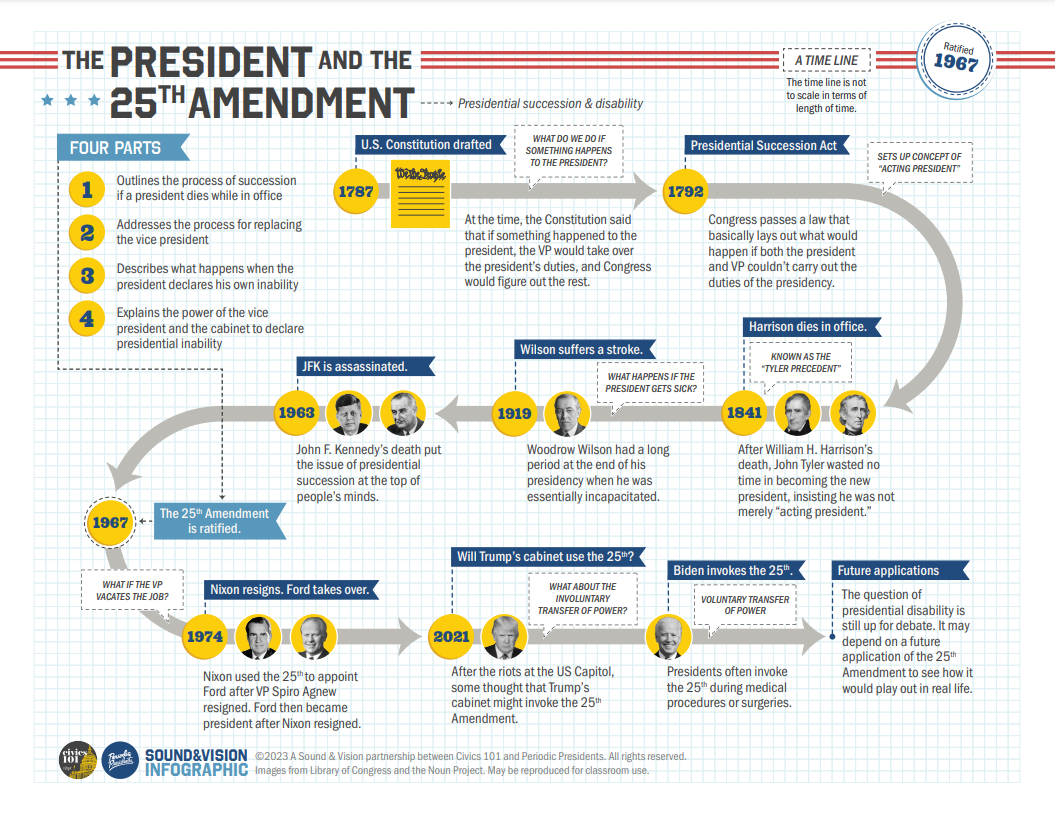
The 25th Amendment to the U.S. Constitution governs presidential succession and disability at the federal level, while the Michigan Constitution of 1963 establishes its own independent procedures for gubernatorial succession under Article V. While both frameworks ensure executive continuity, Michigan utilizes the State Supreme Court to determine "inability," a distinct departure from the federal model.
The transition of power and the management of executive disability are critical components of a stable democracy. In 2026, as legal scholars and citizens alike examine the robustness of our governing documents, understanding the interplay between federal mandates like the 25th Amendment and state-specific mandates like those found in the Michigan Constitution is essential. While the 25th Amendment is a product of the mid-20th century designed to address gaps in the U.S. Constitution regarding presidential vacancy and disability, the Michigan Constitution of 1963 provides a localized framework that addresses similar contingencies for the Governor and Lieutenant Governor.
The Federal Framework: The 25th Amendment
The 25th Amendment to the United States Constitution was ratified in 1967, following the assassination of John F. Kennedy. It was created to clarify the ambiguous language of Article II, Section 1, Clause 6 regarding what happens if a President is unable to discharge the powers and duties of the office.
The amendment is divided into four distinct sections:
- Section 1: Presidential Vacancy. This section codifies the precedent set by John Tyler, explicitly stating that if the President is removed from office, dies, or resigns, the Vice President becomes President.
- Section 2: Vice Presidential Vacancy. Whenever there is a vacancy in the office of the Vice President, the President nominates a successor who must be confirmed by a majority vote of both Houses of Congress.
- Section 3: Voluntary Disability. The President can voluntarily transfer power to the Vice President by sending a written declaration to the President pro tempore of the Senate and the Speaker of the House. Power is reclaimed by a second written declaration.
- Section 4: Involuntary Disability. This is the most complex section. It allows the Vice President and a majority of the Cabinet (or a body designated by Congress) to declare the President "unable to discharge the powers and duties of his office." If the President contests this, Congress must decide the issue by a two-thirds vote in both houses.
The 25th Amendment serves as the "gold standard" for executive succession, but its reach is limited strictly to the federal executive branch. It does not dictate how states must handle their own executive crises.
The Michigan Constitution: Article V and Gubernatorial Authority
The Michigan Constitution of 1963 serves as the state's fundamental governing document. Within it, Article V is dedicated to the Executive Branch. To understand how Michigan handles the same problems addressed by the 25th Amendment, one must look specifically at Sections 25 and 26 of Article V.
Section 25: The Lieutenant Governor’s Dual Role
Under Section 25, the Lieutenant Governor is designated as the President of the Senate, though they only have a tie-breaking vote. More importantly, this section establishes the Lieutenant Governor as the primary successor to the Governor. In the hierarchy of state power, the relationship between the Governor and Lieutenant Governor in Michigan is designed to mirror the President and Vice President, yet the constitutional requirements for their collaboration are unique to the state's political history.
Section 26: Succession and Inability
Article V, Section 26 of the Michigan Constitution is the state’s functional equivalent to the 25th Amendment. It outlines exactly what occurs when the Governor is unable to perform their duties. The section states that in case of the conviction on impeachment, removal from office, resignation, or death of the Governor, the powers and duties of the office shall devolve upon the Lieutenant Governor for the remainder of the term or until the disability ceases.
However, Michigan's mechanism for determining "inability" differs significantly from the federal model. In Washington D.C., the Vice President and the Cabinet initiate the process of declaring a President disabled. In Michigan, the process involves a different branch of government entirely.
Determining Executive Inability: A Judicial Approach
One of the most profound differences between "Amendment 25" and the Michigan Constitution is the role of the judiciary. In the federal system, the 25th Amendment keeps the determination of disability largely within the executive and legislative branches to ensure political accountability.
In Michigan, the State Supreme Court holds the ultimate power to determine gubernatorial inability. According to Article V, Section 26:
"The inability of the governor or person acting as governor shall be determined by a majority of the supreme court on joint resolution of the legislature, after a public hearing."
This creates a multi-step safeguard:
- Legislative Trigger: Both houses of the Michigan Legislature must pass a joint resolution questioning the Governor's ability to serve.
- Public Hearing: A transparent process is required, preventing "palace coups" or secret transfers of power.
- Judicial Verdict: The Michigan Supreme Court must reach a majority decision.
This procedural check-and-balance ensures that the Lieutenant Governor cannot unilaterally seize power, nor can a small group of department heads (the state equivalent of a Cabinet) displace the Governor without significant legislative and judicial consensus.
Comparing Federal and Michigan Succession Rules
To better understand the differences and similarities, it is helpful to look at how specific scenarios are handled under the U.S. 25th Amendment versus the Michigan Constitution.
| Feature | U.S. 25th Amendment | Michigan Constitution (Art. V) |
|---|---|---|
| Primary Successor | Vice President | Lieutenant Governor |
| Succession Line | VP, Speaker of the House, Pres. Pro Tempore | Lt. Gov, Sec. of State, Attorney General |
| Voluntary Disability | Written declaration by President | Written declaration by Governor |
| Involuntary Disability | Initiated by VP + Cabinet | Initiated by Legislative Joint Resolution |
| Final Arbiter of Inability | Two-thirds vote of Congress | Majority of Michigan Supreme Court |
| Filling VP/LG Vacancy | Presidential Nominee + Congress | Governor Appoints (with Senate advice/consent) |
This comparison highlights that Michigan’s system is arguably more legally rigorous and less "political" than the federal system, as it requires the highest court in the state to weigh the evidence of disability before a transfer of power occurs.
The Michigan Line of Succession
Beyond the Lieutenant Governor, the Michigan Constitution provides a clear line of succession to ensure that the state is never without an executive. Following the Lieutenant Governor, the order of succession is:
- Secretary of State
- Attorney General
If all three of these individuals are unable to serve, the Michigan Legislature has the authority to provide by law for further succession. This is a critical safety net. In contrast, the federal line of succession (established by the Succession Act of 1947, not the 25th Amendment itself) includes the Speaker of the House and the President Pro Tempore of the Senate before moving to the Cabinet. Michigan keeps the line strictly within the executive branch (elected officials) before requiring legislative intervention.
Filling Vacancies in the Office of Lieutenant Governor
At the federal level, Section 2 of the 25th Amendment was famously used by Richard Nixon to appoint Gerald Ford (a Michigander) as Vice President after Spiro Agnew resigned. Later, when Nixon resigned, Ford became President and used the same section to appoint Nelson Rockefeller as Vice President.
In Michigan, the process for filling a vacancy in the office of Lieutenant Governor is governed by Article V, Section 7, and further clarified by historical amendments. If the office of Lieutenant Governor becomes vacant, the Governor nominates a person to fill the office. This appointment is subject to the advice and consent of the State Senate. This ensures that the Governor can select a partner they can work with, while still allowing the legislative branch to vet the individual for the second-highest office in the state.
Historical Context: Why Michigan is Different
The framers of the Michigan Constitution of 1963 were operating in a different era than the framers of the federal 25th Amendment. When the Michigan "Con-Con" (Constitutional Convention) met in the early 1960s, they were focused on modernizing a state government that had been operating under an outdated 1908 document.
The decision to involve the Supreme Court in disability determinations was a deliberate choice to prevent the kind of executive infighting seen in historical cases where a leader was incapacitated but refused to step down. By requiring a joint resolution from the legislature and a hearing before the court, Michigan created a "slow-down" mechanism that ensures the removal of a Governor for health or mental reasons is treated as a legal and medical reality rather than a political opportunity.
Practical Implications for 2026
In 2026, the stability of these systems is a cornerstone of public trust. While the 25th Amendment remains a topic of national discussion regarding federal leadership, the Michigan Constitution provides a quieter, perhaps more stable path for state-level governance.
For residents of Michigan, the primary takeaway is that the state does not rely on federal law for its internal succession. If a crisis were to strike the executive residence in Lansing, the state follows its own 1963 roadmap. The 25th Amendment applies only to the Presidency, and while it provides a conceptual framework for "inability," Michigan’s specific requirement for a Supreme Court ruling offers a unique level of judicial oversight not found at the federal level.
Frequently Asked Questions
Does the 25th Amendment apply to the Governor of Michigan?
No. The 25th Amendment is part of the U.S. Constitution and applies only to the federal government (the President and Vice President). Succession and disability for the Governor of Michigan are governed by Article V, Sections 25 and 26 of the Michigan Constitution.
Who decides if the Governor of Michigan is "unable" to serve?
Unlike the federal system where the Vice President and Cabinet decide, in Michigan, the state legislature must pass a joint resolution. Following this, the Michigan Supreme Court holds a public hearing and must reach a majority decision to officially declare the Governor unable to discharge their duties.
If the Lieutenant Governor becomes Governor, who becomes the new Lieutenant Governor?
According to the Michigan Constitution, the Governor (formerly the Lt. Governor) has the authority to appoint a successor to the office of Lieutenant Governor, subject to the advice and consent of the Michigan Senate.
What is the difference between impeachment and "inability"?
Impeachment is a political and legal process used to remove an official for "corrupt conduct in office" or crimes. "Inability," as discussed in Article V, Section 26, typically refers to physical or mental health crises that prevent the Governor from performing their duties, regardless of any wrongdoing.
Can the Governor reclaim power after being declared unable to serve?
Yes. The Michigan Constitution allows for the restoration of powers once the disability ceases. However, the process for proving the disability has ended would likely involve the same bodies (the Legislature and the Supreme Court) that recognized the disability in the first place, ensuring a consistent legal standard.
Recommendation for Further Action
For those seeking a deeper legal understanding of executive succession, it is recommended to review the Michigan Constitution of 1963 directly through the Michigan Legislature's official website. Additionally, comparing these state provisions with the text of the 25th Amendment via the National Archives provides a comprehensive view of how power is protected at both levels of government. If you are involved in state policy or legal education, consulting the "Journal of the Constitutional Convention" from 1961-1962 offers invaluable insight into the original intent behind Michigan's unique succession clauses.