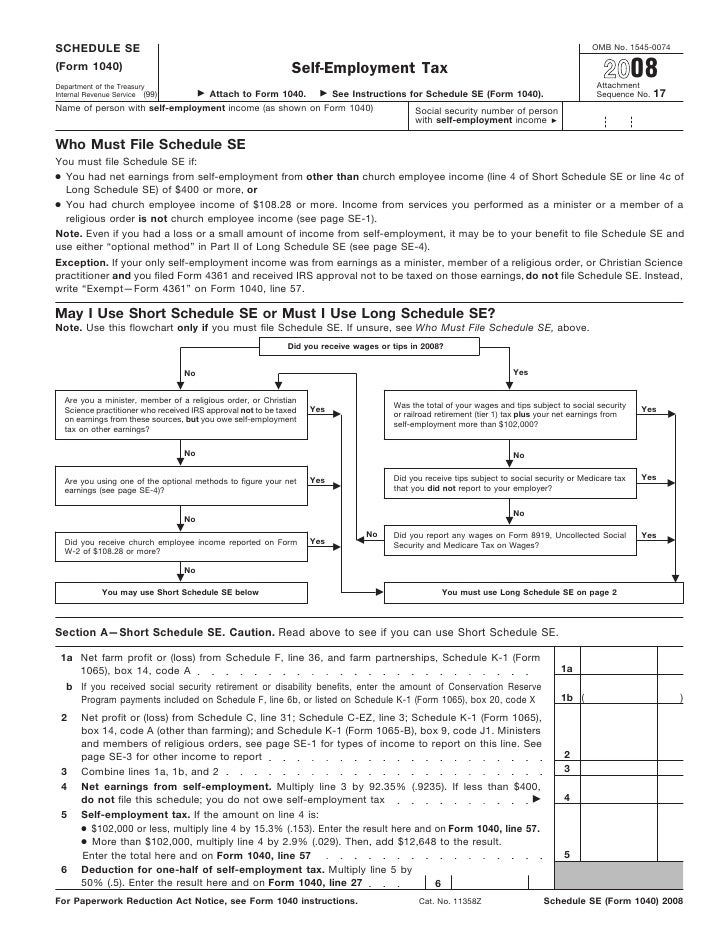
Navigating self-employment tax obligations requires completing Schedule SE (Form 1040) to calculate the tax due on net earnings from self-employment. To handle this form successfully, you must determine your net profit using Schedule C, calculate your net earnings by multiplying by 92.35%, apply the Social Security and Medicare tax rates up to the statutory wage base limit, claim the allowable deduction for half of your self-employment tax on Schedule 1, and accurately transfer the final calculated tax amount onto your main Form 1040.
For independent contractors, freelancers, sole proprietors, and single-member LLC owners, tax season brings a unique set of responsibilities. Unlike traditional employees whose employers automatically withhold Social Security and Medicare taxes from every paycheck, self-employed individuals bear full responsibility for reporting and remitting these contributions. This mechanism is governed by the Federal Insurance Contributions Act (FICA) equivalents, structured specifically through Schedule SE (Form 1040). Understanding how to complete this form correctly ensures compliance with Internal Revenue Service (IRS) regulations, prevents underpayment penalties, and allows you to claim valuable adjustments to your income.
This comprehensive guide breaks down the process into five actionable steps, examining the underlying calculations, statutory thresholds, common pitfalls, and integration points with the broader Form 1040 ecosystem.
Understanding the Purpose of Schedule SE
Before diving into the step-by-step calculation workflow, it is essential to understand why Schedule SE exists and who must file it. Schedule SE stands for "Self-Employment Tax." The self-employment tax consists of two components: Social Security (old-age, survivors, and disability insurance) and Medicare (hospital insurance).
Under United States tax law, traditional employees pay 6.2% for Social Security and 1.45% for Medicare, while their employers match these contributions for a total of 15.3%. Self-employed individuals act as both the employer and the employee. Consequently, they are responsible for paying the entire 15.3% tax rate (12.4% for Social Security and 2.9% for Medicare) on their net self-employment earnings.
You generally must file Schedule SE if your net earnings from self-employment were $400 or more. This threshold applies whether your business is full-time, part-time, a side hustle, or a freelance gig. Even if you have a full-time job where your employer already withholds Social Security taxes, any net self-employment income over $400 triggers a requirement to evaluate and potentially pay self-employment tax on your independent earnings, subject to overall wage caps.
Step 1: Calculate Your Net Earnings From Business Activities (Schedule C Integration)
The foundation of Schedule SE is the net profit or loss generated by your business activities, which you must calculate first. For most sole proprietors and independent contractors, this calculation occurs on Schedule C (Form 1040), titled "Profit or Loss From Business."
Consolidating Business Income and Expenses
To arrive at the correct net earnings figure, you must meticulously track and report all gross receipts or sales generated by your business during the tax year. From this gross income, you subtract ordinary and necessary business expenses. Common deductible expenses include:
- Home office deductions (calculated via Form 8829 or the simplified method)
- Vehicle expenses (using either the standard mileage rate or actual expenses)
- Business supplies, software subscriptions, and raw materials
- Professional fees, legal costs, and accounting services
- Advertising and marketing expenditures
- Ordinary business travel and meals
Once you net your total expenses against your gross receipts on line 31 of Schedule C, that final profit or loss figure serves as the primary input for Schedule SE. If you operate multiple distinct sole proprietorships, you must complete a separate Schedule C for each business, combine their net profits or losses, and enter the aggregated net amount onto Schedule SE.
Factoring in Special Situations
Certain types of income require specific handling before they reach Schedule SE. For instance, clergy members, statutory employees, partners in partnerships, and individuals receiving certain agricultural or fishing income encounter specialized rules. However, for standard independent contractors and freelancers, the net profit reported on Schedule C forms the baseline. It is vital to ensure your bookkeeping is accurate, as IRS audits frequently target discrepancies between gross receipts reported on 1099-NEC forms and the income declared on tax returns.
Step 2: Determine Net Earnings Subject to Self-Employment Tax (The 92.35% Adjustment)
A common misconception among new freelancers is that self-employment tax is assessed directly on 100% of their net Schedule C profit. The tax code provides a structural adjustment that acknowledges the reality faced by traditional employers. Because employers are allowed to deduct the employer-equivalent portion of FICA taxes as a business expense, the IRS grants self-employed individuals an equivalent adjustment.
Applying the Statutory Multiplier
On Schedule SE (Section A or Section B), you do not multiply your raw net profit by the full 15.3%. Instead, you multiply your net earnings by 92.35% (0.9235). This mathematical adjustment effectively reduces your taxable self-employment base by 7.65%, mirroring the employer deduction available to traditional corporate entities.
Net Schedule C Profit × 0.9235 = Net Earnings Subject to Self-Employment Tax
For example, if your net business profit after all Schedule C deductions is $50,000, your calculation for net earnings subject to self-employment tax is:
$$$50,000 \times 0.9235 = $46,175$$
This adjusted figure ($46,175) is the amount upon which your Social Security and Medicare taxes will be computed. If your total net earnings from self-employment (before the 92.35% multiplier) are less than $400, you are generally exempt from paying self-employment tax, and you do not need to file Schedule SE (unless you meet specific church employee or statutory exceptions).
Step 3: Compute Social Security and Medicare Taxes (Applying Wage Bases and Rates)
With your net earnings subject to self-employment tax established, you proceed to calculate the specific tax components: Social Security and Medicare. Schedule SE features two main parts: Short Schedule SE (Section A) and Long Schedule SE (Section B). Most filers with straightforward earnings use Section A, while individuals with church employee income, multiple businesses with conflicting net results, or earnings exceeding the annual Social Security wage base must use Section B.
The Social Security Wage Base Limit
The Social Security tax component applies only up to a specific statutory maximum earnings limit, known as the contribution and benefit base. For the tax year 2026, the maximum wage base limit is $176,100 (note that historical tax years have different thresholds, such as $168,600 for 2024 and $176,100 projected or established per statutory indexing).
If your net earnings subject to self-employment tax, combined with any wages you earned as a W-2 employee (which also report toward this limit), exceed the wage base, you stop paying the 12.4% Social Security tax on the excess amount.
- Social Security Rate: 12.4% applied up to the annual wage cap.
- Medicare Rate: 2.9% applied to all net earnings with no upper limit.
Calculating the Combined Tax Liability
To illustrate the complete tax computation, consider a taxpayer with $100,000 in net earnings subject to self-employment tax (well below the $176,100 limit):
- Social Security Tax: $$100,000 \times 12.4% = $12,400$
- Medicare Tax: $$100,000 \times 2.9% = $2,900$
- Total Self-Employment Tax: $$12,400 + $2,900 = $15,300$
For high-income earners, an Additional Medicare Tax of 0.9% may apply to earned income that exceeds certain statutory thresholds ($250,000 for married filing jointly, $125,000 for married filing separately, and $200,000 for single filers). While this additional tax is calculated on Form 8959, your total Medicare calculation on Schedule SE interacts with your broader tax picture.
| Tax Component | Tax Rate | Wage Base Limit (2026) | Description |
|---|---|---|---|
| Social Security | 12.4% | $176,100 | Funds retirement, survivor, and disability benefits. Capped annually. |
| Medicare | 2.9% | No Limit | Funds hospital insurance. Applies to all dollar amounts earned. |
| Additional Medicare | 0.9% | Thresholds apply | Surtax applied to high-income earners via Form 8959 integration. |
Step 4: Claim the Deductible Part of Self-Employment Tax on Schedule 1
Paying self-employment tax can place a significant financial burden on independent workers. To provide parity with traditional employment—where employers absorb half of the FICA tax burden—the tax code allows self-employed individuals to deduct half of their calculated self-employment tax as an above-the-line deduction.
What is an Above-the-Line Deduction?
An above-the-line deduction (officially known as an adjustment to income) is exceptionally valuable because you do not need to itemize your deductions on Schedule A to claim it. You can take this deduction even if you take the standard deduction. It directly reduces your Adjusted Gross Income (AGI), which in turn lowers your overall income tax liability.
Completing the Calculation
Schedule SE explicitly guides you through this calculation. Once you arrive at your total self-employment tax liability (calculated in Step 3), you multiply that total by 50% (0.50).
Using our previous example where the total self-employment tax was $15,300:
$$$15,300 \times 0.50 = $7,650$$
This resulting figure ($7,650) is the deductible portion of your self-employment tax.
- You take this exact dollar amount from Schedule SE.
- You enter it onto Schedule 1 (Form 1040), Part II ("Adjustments to Income"), specifically on the line designated for the deductible part of self-employment tax (traditionally line 15).
- The sum from Schedule 1 flows directly to your main Form 1040, reducing your total taxable income.
Step 5: Transfer Totals and Finalize Form 1040 Integration
The final step in handling Schedule SE is transferring all computed figures to their designated lines on your primary tax return documents. Accuracy during this transfer phase prevents processing delays, automated IRS mismatch notices, and unnecessary correspondence.
Summary of Document Flow
To ensure your tax return is assembled correctly, verify that data moves seamlessly through the following sequence:
- Schedule C: Net profit or loss is calculated and finalized.
- Schedule SE: Net profit is adjusted by 92.35%, tax rates (12.4% and 2.9%) are applied, and the total self-employment tax is determined.
- Where to enter the tax: The final self-employment tax amount from Schedule SE flows to Schedule 2 (Form 1040), Part I, line 4 ("Self-employment tax"). From Schedule 2, this tax is added to your total tax liability on Form 1040.
- Where to enter the deduction: The deductible half of the self-employment tax flows to Schedule 1 (Form 1040), Part II, and subsequently reduces your AGI on Form 1040.
Reviewing and Filing
Before submitting your return—whether electronically via commercial tax preparation software or by mailing paper forms—conduct a comprehensive final review. Ensure that your Social Security number is correct across all schedules, that your net earnings figures match between Schedule C and Schedule SE, and that you have accounted for any quarterly estimated tax payments you made throughout the year. Self-employed individuals are generally required to make quarterly estimated tax payments (using Form 1040-ES) to cover both income tax and self-employment tax, avoiding underpayment penalties when April arrives.
Common Mistakes to Avoid When Filing Schedule SE
Handling Schedule SE involves strict mathematical rules and specific filing criteria. Taxpayers frequently encounter avoidable pitfalls that trigger processing holds or result in overpayment.
1. Forgetting the $400 Threshold Rule
Many casual freelancers assume that if they earned a few hundred dollars from side projects, they do not need to report it. While all earned income must be reported on Schedule C regardless of amount, the self-employment tax itself is only triggered if net earnings reach $400 or more. Failing to report gross income at all, however, can lead to compliance flags from 1099-NEC documents issued by clients.
2. Confusing Gross Receipts with Net Profit
A critical error is applying the Schedule SE calculations directly to gross revenue rather than net profit. Gross receipts represent total money collected before expenses. Schedule SE requires net profit (gross receipts minus allowable business expenses). Using gross revenue would drastically inflate your self-employment tax liability.
3. Missing the Above-the-Line Deduction
Some taxpayers complete Schedule SE, pay the full tax, but forget to transfer the deductible half to Schedule 1. This omission causes individuals to overpay their income taxes by failing to claim a deduction to which they are legally entitled, artificially inflating their AGI.
4. Overlooking W-2 Wages and the Wage Base Cap
If you hold a traditional W-2 job while also running a freelance business on the side, your employer already withholds Social Security taxes up to the annual limit ($176,100 for 2026). When completing Schedule SE (specifically Section B), you must account for your W-2 wages so you do not exceed the statutory maximum contribution for Social Security. Modern tax software handles this automatically, but manual filers often make calculation errors here.
Frequently Asked Questions
Do I need to file Schedule SE if my business lost money?
No. If your business experienced a net loss on Schedule C, you do not owe self-employment tax, and you generally do not file Schedule SE. However, you should still file Schedule C and Form 1040 to report the business loss, which may offset other taxable income (subject to passive activity and at-risk loss limitations).
Can I deduct my health insurance premiums on Schedule SE?
Health insurance premiums are not deducted directly on Schedule SE. Instead, self-employed individuals may qualify for the Self-Employed Health Insurance Deduction, which is also claimed as an above-the-line adjustment to income on Schedule 1 (Form 1040). This deduction is calculated using a separate worksheet and has specific eligibility rules, such as not being eligible to participate in an employer-sponsored health plan through a spouse or secondary job.
What is the difference between Short Schedule SE and Long Schedule SE?
Short Schedule SE (Section A) is a streamlined version used by most sole proprietors whose net earnings are subject to standard rules and do not exceed the Social Security wage base. Long Schedule SE (Section B) is required if you have church employee income, received tips that you did not report to your employer, had multiple businesses with opposing net results, or need to calculate optional methods for farm or non-farm earnings.
How do quarterly estimated tax payments relate to Schedule SE?
Self-employment tax is a pay-as-you-go tax. Because taxes are not automatically withheld from client payments throughout the year, the IRS expects self-employed workers to estimate their total annual tax liability—including income tax and self-employment tax calculated via Schedule SE—and make quarterly payments using Form 1040-ES. Schedule SE itself is filed annually with your tax return to reconcile what you owe against what you paid via estimated installments.
Are LLC owners required to file Schedule SE?
Single-member LLCs are treated as "disregarded entities" for federal tax purposes by default. This means the LLC’s income and expenses flow directly to the owner’s personal tax return via Schedule C, making the owner responsible for filing Schedule SE. Multi-member LLCs generally file as partnerships (Form 1065), where partners report their distributive share of self-employment earnings on Schedule K-1, which feeds into their respective Schedule SE filings.
Conclusion and Next Actions
Mastering Schedule SE (Form 1040) is a core competency for anyone earning income outside of traditional W-2 employment. By methodistically calculating your net profit on Schedule C, applying the 92.35% adjustment, computing your Social Security and Medicare taxes, and claiming your above-the-line deduction on Schedule 1, you ensure full compliance while minimizing your overall tax burden.
To take immediate action, gather your year-end financial statements, reconcile all 1099 and income records, verify your business expense receipts, and use professional tax software or consult a certified public accountant (CPA) to complete your filings accurately before the tax filing deadline.