The Tesla Model 3 charges at rates ranging from roughly 3 to 44 miles of range per hour using Level 2 home AC charging, while its peak V3 or V4 Supercharging capability allows it to recover up to 175 to 200 miles of range in just 15 minutes, depending on the specific battery pack chemistry and vehicle variant.
Understanding electric vehicle infrastructure requires looking beyond marketing claims to examine how battery chemistry, charging hardware, and environmental conditions intersect. For owners and prospective buyers of the Tesla Model 3, charging speed is not governed by a single static metric. Instead, it is a dynamic process influenced by peak kilowatt limits, thermal management systems, and the output of the supply equipment. Navigating these variables ensures efficient daily operation and minimizes delays on long road trips.
The Evolution of Tesla Model 3 Battery Chemistries and Charging Limits
To understand how a Tesla Model 3 handles electrical current, one must first examine the physical battery packs housed beneath the vehicle floor. Over its production lifecycle, Tesla has utilized distinct battery chemistries for various Model 3 trims, primarily Nickel-Cobalt-Aluminum (NCA), Nickel-Manganese-Cobalt (NMC), and Lithium Iron Phosphate (LFP). Each chemical composition behaves differently under thermal stress and accepts electrical energy at varying rates.
Rear-Wheel Drive (RWD) variants equipped with LFP battery packs handle charging curves differently than Long Range or Performance variants outfitted with nickel-based cells. While nickel-based packs historically support higher peak charging speeds—reaching up to 250 kW at compatible Supercharger stalls—LFP packs prioritize longevity and stability. LFP chemistry allows the battery to be charged to 100% daily without accelerated degradation, a practice discouraged for NCA and NMC packs, which recommend an 80% or 90% daily limit. However, LFP packs can exhibit heightened sensitivity to cold weather, requiring advanced thermal preconditioning to accept maximum current when plugged in.
The maximum charging rate is also constrained by the vehicle's onboard inverter and charger hardware. Standard and older iterations featured varying AC charging limits, typically capping Level 2 input at 32 amps or 48 amps depending on whether the vehicle was configured for single-phase or three-phase power in specific global markets. Recognizing these internal hardware limits helps drivers select appropriate home wall connectors without overspending on electrical supply upgrades that the car cannot physically utilize.
Level 1, Level 2, and DC Fast Charging Performance Tiers
Charging speeds for the Model 3 vary drastically depending on the source of electricity. Electrical supply tiers are generally divided into three categories: Level 1, Level 2, and Direct Current (DC) Fast Charging. Each tier serves a specific purpose in an owner's routine, balancing installation costs against replenishment speed.
| Charging Tier | Typical Power Output | Range Added Per Hour |
|---|---|---|
| Level 1 (Standard Wall) | 1.2 kW to 1.9 kW | 2 to 4 miles |
| Level 2 (Home/Destination) | 7.6 kW to 11.5 kW | 25 to 44 miles |
| DC Supercharger (V3/V4) | Up to 250 kW (Peak) | Up to 200 miles / 15 min |
Level 1 Charging: The Emergency Option
Plugging the Model 3 into a standard household 120-volt outlet via a Mobile Connector yields Level 1 charging. This method delivers between 12 and 16 amps, translating to roughly 1.2 to 1.9 kilowatts (kW) of power. Owners gain approximately 2 to 4 miles of range per hour. This speed is generally insufficient for daily commuting needs unless the vehicle remains parked for multiple days between short trips, but it serves as a reliable emergency fallback.
Level 2 Charging: The Daily Standard
Level 2 charging operates on 240-volt electrical service, identical to what powers heavy household appliances like electric dryers or ovens. Utilizing a Tesla Wall Connector or a compatible third-party EV service equipment (EVSE) plugged into a NEMA 14-50 outlet, the Model 3 accepts between 7.6 kW and 11.5 kW. This configuration adds roughly 25 to 44 miles of range per hour. Most owners install Level 2 equipment at home to ensure the vehicle wakes up fully charged every morning.
DC Fast Charging: The Road Trip Solution
Direct Current Fast Charging (DCFC), executed via Tesla’s Supercharger network, bypasses the vehicle's onboard AC-to-DC inverter entirely. High-voltage DC electricity flows directly into the battery pack. Modern V3 and V4 Superchargers deliver peak speeds up to 250 kW for eligible Long Range and Performance variants. At peak efficiency, these stations can restore up to 200 miles of driving range in approximately 15 minutes, transforming long-distance travel logistics.
The Role of Thermal Management and Preconditioning
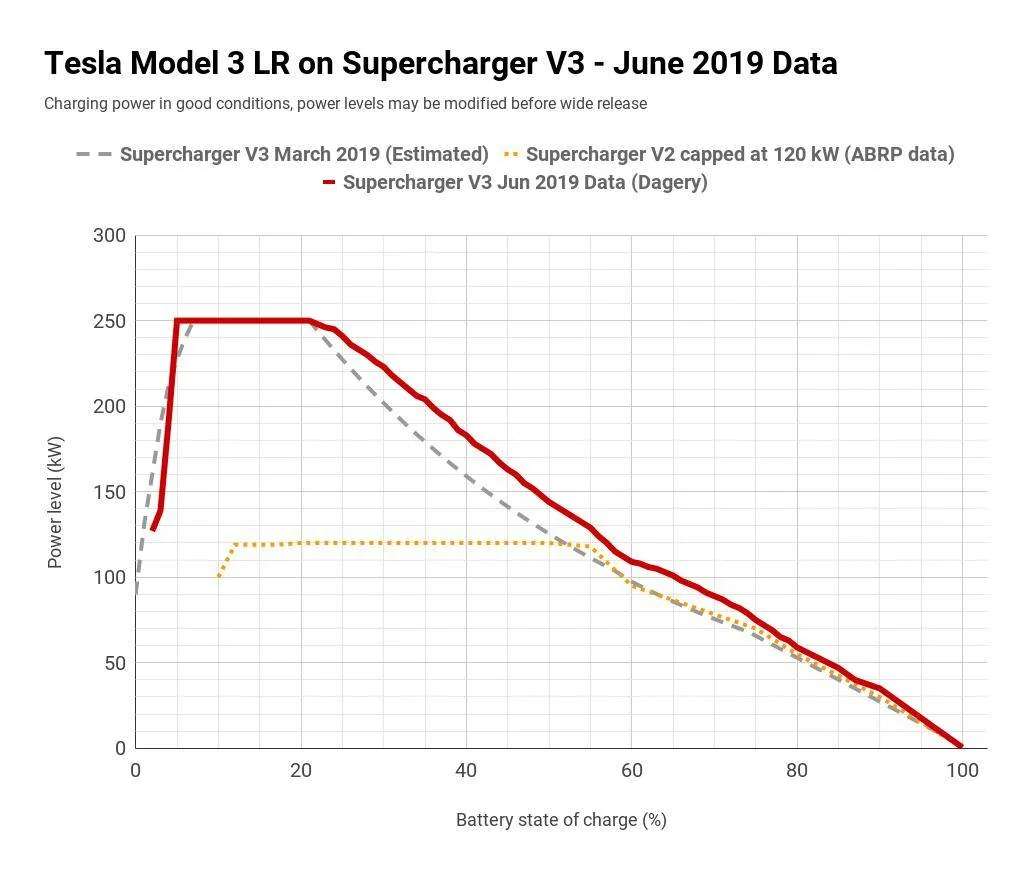
A common point of confusion for new drivers is why a Supercharger session rarely maintains its peak kilowatt rating from 0% to 100% state of charge (SoC). Charging speed is not a flat line; it follows a descending taper curve designed to protect the physical integrity of the lithium-ion cells.
As electrons flow into the battery, internal resistance generates heat. Lithium-ion chemistry is highly sensitive to temperature extremes. If a battery is too cold, lithium plating can occur, causing permanent capacity loss and potential safety hazards. Conversely, if the battery becomes too hot, the internal management system restricts power input to prevent thermal runaway.
To combat this, Tesla vehicles feature an active liquid thermal management system that warms or cools the battery pack using a complex network of coolant lines, valves, and the cabin heat pump system. When a driver inputs a Supercharger location into the built-in navigation system, the car initiates battery preconditioning. The vehicle deliberately raises or lowers the pack's temperature while en route so that it reaches the optimal thermal window precisely when plugged into the stall. Arriving at a Supercharger without using the in-car navigation often results in significantly slower charging speeds because the car must spend the first 10 to 15 minutes conditioning the cold battery before drawing high current.
Furthermore, the charging taper is dictated by the battery's current state of charge. As the pack fills up, it absorbs energy less willingly. A Model 3 might pull 250 kW at 10% SoC, but that rate steadily declines as the battery crosses 50%, 70%, and 90% capacity, dropping below 50 kW near the top end. For optimal road-trip efficiency, drivers typically unplug and resume driving once the vehicle reaches roughly 70% to 80% charge, as the time required to add the final 20% diminishes drastically in speed and economic value.
Frequently Asked Questions
Does using Tesla Superchargers degrade the Model 3 battery faster?
Frequent DC fast charging generates more heat than slower AC home charging, which can contribute to minor accelerated battery degradation over hundreds of cycles. However, Tesla’s advanced thermal management systems actively protect the cells during fast charging. Fleet data indicates that battery capacity loss over years of heavy Supercharging is often minimal, tapering off after an initial adjustment period.
Can I charge a Model 3 at non-Tesla fast-charging stations?
Yes, depending on regional infrastructure and vehicle specifications. In regions utilizing the North American Charging Standard (NACS) or via compatible Combined Charging System (CCS) adapters—such as the CCS Combo 1 adapter or native Magic Dock locations—Model 3 owners can access qualified third-party networks like Electrify America or EVgo, though charging speeds and pricing will vary based on the provider's hardware limits.
Why is my Model 3 charging slowly in cold weather?
Cold temperatures increase internal battery resistance and thicken electrolytes, making it difficult for the cells to accept high electrical current safely. The car intentionally limits charging speed to protect the pack. Using the navigation system to route to a Supercharger initiates preconditioning to warm the battery, while keeping the car plugged into Level 2 home charging overnight helps maintain operational warmth.
What is the maximum AC charging speed for a Tesla Model 3 at home?
The maximum AC charging speed depends on the vehicle's internal charger limits and the home electrical circuit. Most recent Model 3 variants support up to 48 amps on a 240-volt circuit when paired with a Wall Connector, delivering roughly 11.5 kW of power. If connected to a 32-amp circuit, the output drops to approximately 7.6 kW.
How does state of charge affect Supercharging times?
Charging speed tapers downward as the battery fills up. The vehicle accepts maximum wattage when the state of charge is low (under 20%). As the battery approaches capacity, the system reduces the electrical current to prevent overheating and cell damage, making charging from 80% to 100% significantly slower than charging from 10% to 30%.
Practical Next Steps for Model 3 Owners
Optimizing the charging experience for a Tesla Model 3 requires aligning daily habits with technical capabilities. For residential setups, consult a licensed electrician to evaluate your home's electrical panel capacity before installing a 48-amp Level 2 Wall Connector, ensuring it matches the maximum capabilities of your vehicle. For long-distance travel, always input your destination Supercharger into the vehicle's navigation system to enable automated battery preconditioning, which slashes wait times at the pump and preserves long-term battery health.