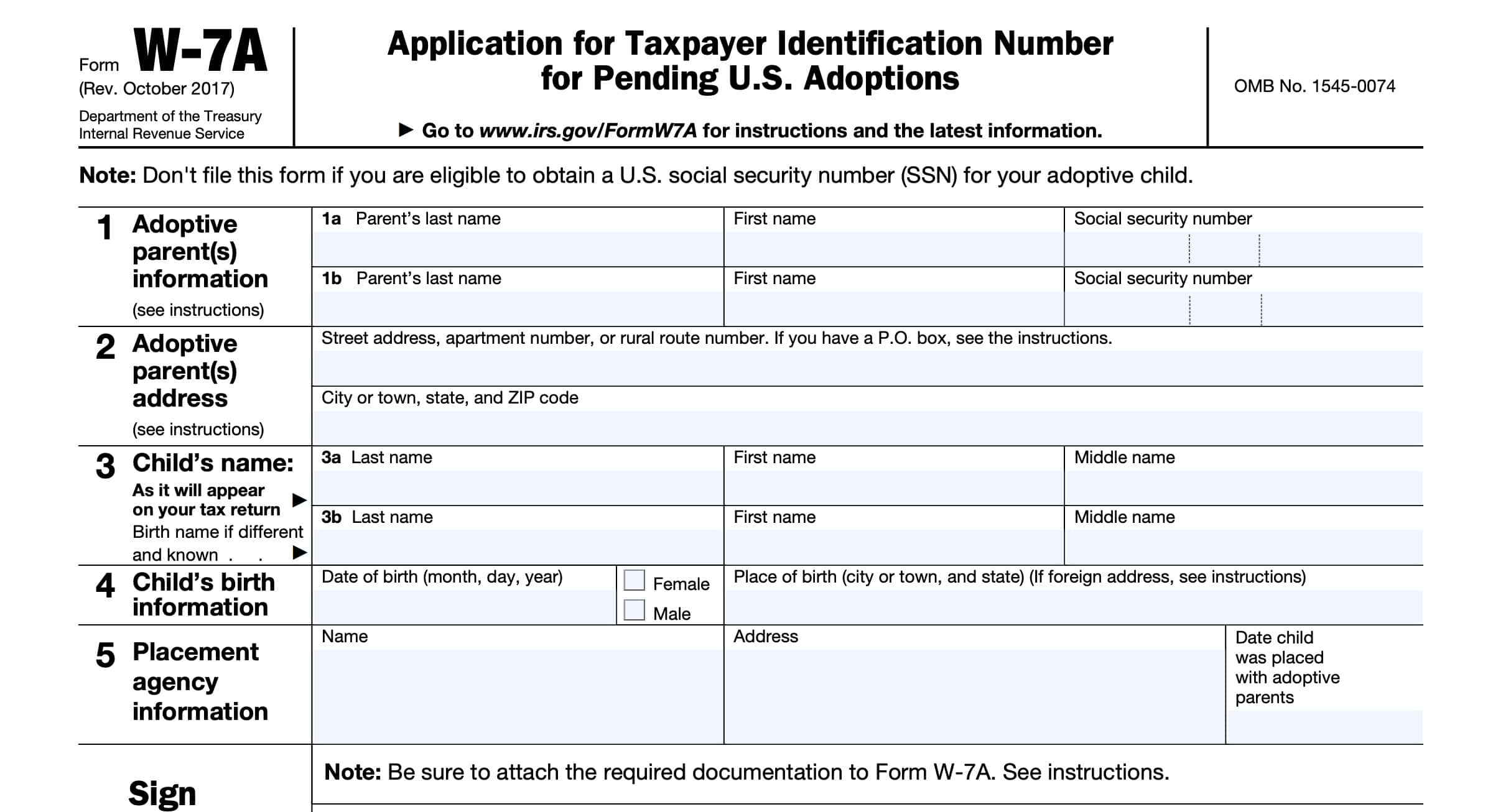
An Adoption Taxpayer Identification Number (ATIN) is a temporary nine-digit number issued by the Internal Revenue Service (IRS) to allow adoptive parents to claim a pending adopted child as a dependent and receive qualifying tax credits before an official Social Security Number is available. It does not confer legal status, finalize adoptions, or replace permanent identification.
Navigating the tax implications of an ongoing domestic adoption can be challenging. Prospective adoptive parents often face an administrative deadlock: the tax year closes while the adoption is still pending, but claiming child-related tax benefits requires a taxpayer identification number. Because the child’s legal name change is not finalized and the revised birth certificate is unavailable, the parents cannot obtain a standard Social Security Number (SSN) from the Social Security Administration.
To bridge this specific gap, the IRS provides Form W-7A (Application for Taxpayer Identification Number for Pending U.S. Adoptions). Despite its targeted utility, widespread misunderstandings surround the form. Taxpayers frequently confuse the ATIN with an Individual Taxpayer Identification Number (ITIN), assume it grants legal custody, or believe it works for international adoptions. Clarifying the statutory scope and practical boundaries of Form W-7A prevents processing delays, disallowed credits, and audit penalties.
What Is Form W-7A and the Adoption Taxpayer Identification Number?
Form W-7A is the official application prospective parents submit to the IRS to request an ATIN. Under internal revenue regulations, every dependent claimed on a federal income tax return must have a valid identifying number. In a typical household, this is an SSN issued under Section 205(c)(2) of the Social Security Act.
When a child is placed into a home for legal adoption, parental rights of the biological parents may already be terminated or in the process of termination, yet the final court decree of adoption has not been signed. During this transitional period:
- The adoptive parents cannot legally obtain the child's existing SSN due to state privacy, child-welfare confidentiality, or closed adoption rules.
- The adoptive parents cannot apply for a new SSN under the child’s new prospective name until the court enters the final adoption decree.
- The tax return filing deadline approaches, leaving the parents unable to list the child on Form 1040 without an identifying number.
An ATIN solves this exact procedural impasse. It begins with the number "9" and features specific block ranges that identify it internally within IRS processing systems as an adoption-holding identification. Once issued, the ATIN allows the prospective parents to file their tax returns on time, claim the child as a dependent, and claim eligible tax credits while the formal legal proceedings proceed through the family court system.
7 Common Myths About the ATIN and Form W-7A
Misconceptions about Form W-7A often lead to improper filings or unnecessary administrative headaches. Understanding what the form cannot do is just as important as knowing its intended use.
Myth 1: An ATIN Replaces a Social Security Number Permanently
An ATIN is strictly a temporary administrative tool. It expires automatically two years after the date the IRS issues it. The IRS does not intend for any child to maintain an ATIN throughout their childhood. Once the adoption is finalized by the court, parents are legally required to stop using the ATIN on subsequent tax returns and must apply for a permanent SSN through the Social Security Administration.
Myth 2: You Can Use Form W-7A for an International Adoption
Form W-7A is exclusively reserved for pending domestic adoptions of children who are U.S. citizens or lawful permanent residents. If you are adopting a child from abroad who does not possess a U.S. citizenship document or permanent resident card at the time of placement, you cannot obtain an ATIN. Instead, foreign adoptions generally require either waiting until the child receives an immigrant visa and enters the U.S. to obtain an SSN, or obtaining an ITIN using Form W-7 if the child meets distinct dependent residency criteria before citizenship is established.
Myth 3: Form W-7A Grants Legal Custody or Parental Rights
Submitting Form W-7A to the IRS or receiving an ATIN assignment notice (Notice CP 56A) provides zero legal standing in family court. The IRS is a tax collection and administrative agency, not a judicial or child-placement entity. The issuance of an ATIN confirms only that you have provided sufficient placement documentation to list the child on a tax return while court proceedings take place.
Myth 4: Foster Parents Can Always Get an ATIN
Foster care and legal adoption placement are legally distinct statuses. If a child is placed in your home solely for foster care, you are not legally authorized to file Form W-7A. An ATIN requires that the child has been formally placed in your home for legal adoption by an authorized placement agency, court, or legal representative. If the biological parents still retain rights and the state plan has not shifted to adoptive placement, an ATIN cannot be granted.
Myth 5: You Can Claim the Earned Income Tax Credit (EITC) Using an ATIN
This is one of the most costly errors taxpayers make. Under Internal Revenue Code Section 32, a qualifying child for the Earned Income Tax Credit must have a valid Social Security Number issued on or before the due date of the return (including extensions). An ATIN does not satisfy this statutory requirement. Claiming the EITC with an ATIN will result in an automatic mathematical adjustment by the IRS, disallowing the credit and potentially triggering statutory audit holds.
Myth 6: If the Biological Parents Disclose the SSN, You Should Still Get an ATIN
If you have legal access to the child’s existing Social Security Number—for instance, in an open kinship adoption where biological relatives freely and legally provide the card—you do not need, and should not request, an ATIN. Form W-7A specifically requires you to attest that you cannot obtain the child's SSN. Using the existing SSN allows you to claim all regular child-related tax credits without restrictions, provided all dependency tests are satisfied.
Myth 7: You Can File Form W-7A Electronically
As of 2026, Form W-7A cannot be e-filed through standard consumer tax software or commercial preparer platforms. Because the form requires physical or certified documentation confirming lawful placement from an adoption agency, attorney, or court, it must be submitted on paper by mail or hand-delivered to a local IRS Taxpayer Assistance Center.
Detailed Comparison: ATIN vs. ITIN vs. SSN
Understanding the boundaries of federal taxpayer identifiers prevents filing errors that cause delayed refunds or denied deductions.
| Feature | Adoption Taxpayer Identification Number (ATIN) | Individual Taxpayer Identification Number (ITIN) | Social Security Number (SSN) |
|---|---|---|---|
| IRS Form Used | Form W-7A | Form W-7 | Form SS-5 (via Social Security Administration) |
| Target Population | Children placed in domestic homes for pending legal adoption | Non-citizens ineligible for an SSN who have U.S. tax filing obligations | U.S. citizens, permanent residents, and authorized non-citizen workers |
| Duration / Validity | Temporary (Expires after 2 years; extendable once) | Expires if not used on a federal return for 3 consecutive years | Permanent (Lifetime) |
| Dependent Exemption / Child Tax Credit | Qualifies for Child Tax Credit under specific provisions | Subject to strict non-SSN limitations | Fully eligible for all credits |
| Earned Income Tax Credit (EITC) | Ineligible (Statute requires valid work-authorized SSN) | Ineligible | Eligible (if all other statutory income rules are met) |
| Adoption Tax Credit Eligibility | Eligible (Allows claiming qualified adoption expenses) | Generally ineligible for domestic adoption rules | Eligible |
| Geographic Scope | Domestic U.S. placements only | Domestic and international tax filers | United States and territories |
Strict Eligibility Criteria for Form W-7A
The IRS maintains precise requirements regarding who may file Form W-7A. A taxpayer must satisfy all four of the following conditions before an ATIN will be generated:
- Lawful Placement: The child must be placed in your home for legal adoption by an authorized child placement agency, an attorney, or a court of competent jurisdiction. Informal custody arrangements or unrecorded family handoffs do not qualify.
- Pending Legal Status: The adoption must not yet be final. If the judge has already signed the final adoption decree, Form W-7A is invalid; you must instead take that final decree directly to the Social Security Administration to request an updated SSN.
- U.S. Citizenship or Lawful Residency: The child must be a U.S. citizen or a lawful permanent resident of the United States.
- Inaccessibility of SSN: You must be unable to obtain the child’s existing SSN from the biological parents, the agency, or the state child protection registry after making reasonable efforts.
If any of these four factors are missing, the IRS will reject the application, issuing an explanatory notice that details the deficiency.
Tax Credits and Deductions: What an ATIN Does and Does Not Unlock
Filing a return with an ATIN impacts individual tax credits in distinct ways under the Internal Revenue Code. Taxpayers should plan their refund expectations accordingly.
Tax Credit Eligibility with an ATIN:
- Eligible:
- Dependent Status (Form 1040)
- Child Tax Credit (CTC) / Credit for Other Dependents (ODC)
- Child and Dependent Care Credit (Form 2441)
- Adoption Tax Credit (Form 8839)
- Ineligible:
- Earned Income Tax Credit (EITC) [Requires permanent SSN by law]
The Child Tax Credit (CTC)
The Tax Cuts and Jobs Act of 2017 instituted a strict requirement that a child must have an SSN valid for employment issued before the due date of the return to qualify for the full Child Tax Credit. However, children claimed under an ATIN can qualify prospective adoptive parents for the nonrefundable Credit for Other Dependents (ODC). Furthermore, taxpayers must verify annually whether standard CTC provisions allow ATIN usage depending on whether the child is a recognized U.S. national with a confirmed prior identification on file behind sealed records.
The Adoption Tax Credit (Form 8839)
The primary financial motivation for securing an ATIN is the ability to claim the Adoption Tax Credit via IRS Form 8839. This credit covers qualified adoption expenses, including:
- Reasonable and necessary adoption fees
- Court costs and attorney fees
- Traveling expenses (including amounts spent for meals and lodging while away from home)
- Other expenses directly related to the legal adoption of an eligible child
Because adoptions can take years to move from initial placement to finalization, qualified expenses incurred during the placement phase can be reported on the prior year's return using the ATIN, rather than waiting and carrying forward massive expenses across multi-year delays.
The Child and Dependent Care Credit (Form 2441)
If you must pay for licensed daycare, preschool, or a home caregiver so that you and your spouse can work or actively look for work, an ATIN satisfies the dependent identification rule on Form 2441. The IRS allows the identification number to stand in place of an SSN when calculating qualifying expenses up to statutory household limits.
Step-by-Step Guide: How to Apply for an ATIN Using Form W-7A
Applying for an ATIN requires precise recordkeeping. An incomplete application or omitted placement document will trigger a paper rejection, extending the review cycle by months.
Step 1: Obtain and Complete Form W-7A
Download the latest revision of IRS Form W-7A directly from the official IRS website. Ensure that the spelling of the child’s name matches the exact name that appears on the formal placement agreements or petition for adoption.
Step 2: Assemble Valid Placement Documentation
You must attach documentation proving that the child was placed in your home by legal authority. Acceptable documents include:
- A signed copy of the placement agreement from an authorized private or public child placement agency.
- A certified court order establishing placement for legal adoption.
- An affidavit or formal letter signed by the adoption attorney or state agency representative supervising the placement, explicitly declaring that the child was placed for legal adoption with the applicant.
Caution: The IRS will not accept informal guardianship documents, temporary restraining orders, or hospital release forms as proof of adoptive placement.
Step 3: Complete Signatures and Cross-Checks
Both prospective adoptive parents must sign Form W-7A if filing jointly on their federal income tax return. Verify that all addresses are current, as the IRS will mail the assignment letter (Notice CP 56A) containing the ATIN to the address listed on Form W-7A.
Step 4: Submit the Packet to the Dedicated IRS Processing Unit
Do not mail Form W-7A to the standard tax-filing address used for Form 1040. Form W-7A is processed by a specialized division:
Internal Revenue ServiceAustin Service CenterATIN OperationP.O. Box 934, Stop 61036Austin, TX 78767
If using a private delivery service (such as FedEx or UPS), refer to the specific street address outlined in the official Form W-7A instructions to ensure proper delivery to the Austin processing facility.
Timeline, Extensions, and Deactivation
Processing Time
The IRS normally processes Form W-7A within 4 to 8 weeks. To avoid filing past the April deadline, prospective parents should submit Form W-7A in December or January if placement occurs toward the end of the calendar year. If the tax deadline arrives before the ATIN is received, you must file Form 4868 to request an automatic six-month extension of time to file your federal tax return. Never file a return with "Applied For" written in the dependent's identification box; the IRS scanning system will automatically reject paper forms or drop the dependent.
Two-Year Expiration Window
An ATIN is valid for two years from the date of issuance. If your adoption proceedings face unexpected legal appeals, contested birth parent litigation, or administrative delays that prevent finalization within that window, you can apply for an extension.
To extend an ATIN, you must submit a written request to the Austin Service Center before the two-year period lapses. You must include:
- A copy of the original Notice CP 56A.
- A detailed explanation of why the adoption has not been completed.
- An updated status letter from your adoption attorney or the placement agency confirming that the child remains placed in your home and that legal adoption remains the operational goal.
The IRS will evaluate the request and, if approved, grant an additional one-year operational window.
What to Do Once the Adoption Is Finalized
The arrival of the final adoption decree marks the end of the ATIN's administrative lifespan. Adoptive parents must transition the child to a permanent Social Security Number through the steps below.
Transition Sequence: Post-Adoption Identification
- Court Finalization
- Receive certified copies of the Final Adoption Decree.
- State Vital Statistics
- Request an amended birth certificate showing the adoptive parents' names.
- Social Security Administration (SSA)
- Submit Form SS-5, the amended birth certificate, and the adoption decree.
- Notify the IRS
- Stop using the ATIN. Apply the new SSN to all future returns.
Applying for the Permanent SSN
- Take the certified final adoption decree and the amended birth certificate to your local Social Security Administration field office.
- Complete Form SS-5 (Application for a Social Security Card).
- Request that the SSA assign a new SSN to the child, especially if confidentiality requires severing ties with numbers associated with the child's biological lineage.
Deactivating the ATIN with the IRS
Once the new SSN is received, you must formally notify the IRS so they can link the historical ATIN records to the child's new permanent identity. Write a brief letter to the Austin Service Center containing:
- The child’s full legal name as it now appears on their Social Security card.
- The child’s newly issued SSN.
- The previously assigned ATIN.
- A copy of the final adoption decree.
This notification ensures that qualified adoption expenses carried forward under the ATIN will transfer to the permanent SSN without triggering administrative inquiries.
Frequently Asked Questions
Can I file Form W-7A if I am adopting an adult?
No. An ATIN can only be issued for an eligible child who is under the age of 18 at the time placement occurs. Adult adoptions do not require an ATIN because the adult individual already holds a permanent identification number (an SSN or ITIN) that can be shared directly with the court and the tax preparer.
What should I do if the IRS rejects my Form W-7A application?
Review the rejection notice carefully. Most rejections are caused by insufficient placement documentation, such as submitting a petition to adopt rather than a signed placement agreement or agency affidavit. You may correct the deficiency by re-submitting the application along with the specific custody or placement documents requested by the Austin Service Center.
Can an unmarried couple adopting jointly both put their names on Form W-7A?
Yes, provided both individuals are named as prospective adoptive parents in the placement documentation. If both individuals are listed on the adoption paperwork, both should sign Form W-7A. However, only the parent claiming the child as a dependent on their individual tax return will use the assigned ATIN on Form 1040.
Can I use an ATIN to open a bank account or an ABLE account for the child?
No. Financial institutions operate under Customer Identification Program (CIP) regulations overseen by the Financial Crimes Enforcement Network (FinCEN). An ATIN is exclusively an internal IRS tax-processing identifier. Banks, credit unions, and financial brokers are legally unable to accept an ATIN for deposit account verification, state-sponsored ABLE accounts, or 529 college savings plans. Those accounts must wait until the permanent SSN is issued.
What happens if I file my tax return using an expired ATIN?
If you submit a return with an expired ATIN, the IRS automated processing system will invalidate the dependent. This removes dependent exemptions, eliminates dependent-care credits, and recalculates your tax liability without the child. The IRS will issue a Notice CP11 or CP12 detailing the balance due. You will then have to submit proof that the adoption is still pending along with an extension request, or provide an updated SSN via an amended return (Form 1040-X).
Practical Next Steps for Prospective Parents
If you are currently parenting a child placed in your home for domestic adoption and tax season is approaching, take action immediately to avoid filing complications:
- Review Placement Documentation: Check your files for a signed, countersigned placement agreement from your licensed agency or child-welfare attorney clearly stating the child was placed for legal adoption.
- Determine the Filing Timeline: If it is after January and you do not yet have an ATIN, file Form W-7A immediately, and prepare to file Form 4868 to extend your tax return deadline to October 15.
- Segregate Your Receipts: Ensure all adoption-related expenditures (legal fees, home studies, agency fees, and travel costs) are logged separately so you can claim the Adoption Tax Credit on Form 8839 as soon as your ATIN arrives.
- Consult a Tax Professional: Domestic adoptions carry complex tax implications. Work with a Certified Public Accountant (CPA) or Enrolled Agent (EA) familiar with the specific dependent rules governing adoption transitions.
Disclaimer: Tax laws, forms, and administrative procedures are subject to regular updates by the Internal Revenue Service and Congress. This guide provides educational information based on operational tax procedures as of 2026. Consult a qualified tax professional or family law attorney regarding individual adoption and tax circumstances.