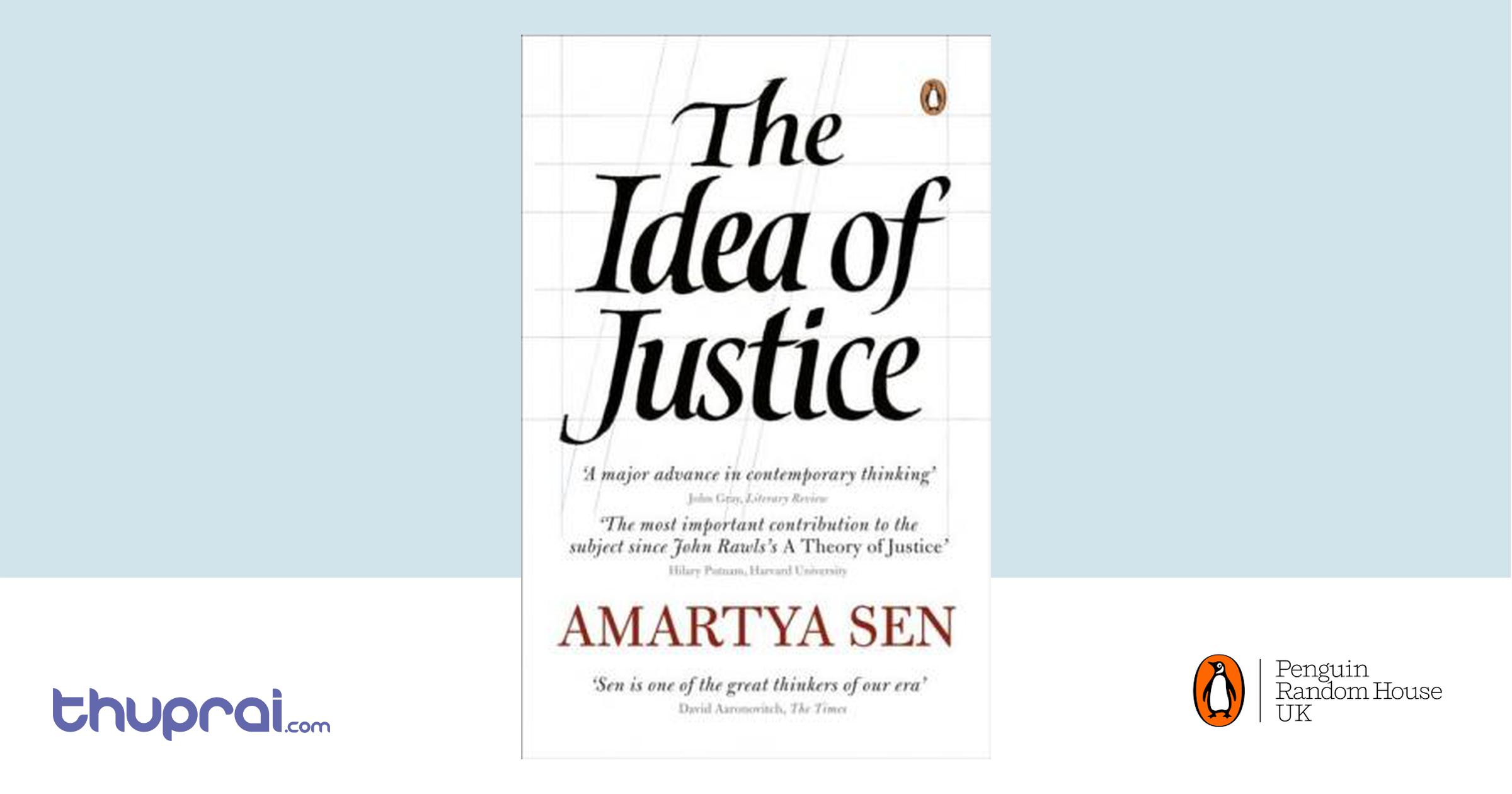
Amartya Sen’s The Idea of Justice shifts the focus of political philosophy from defining "perfectly just" institutions to a realization-based approach aimed at reducing manifest injustices. By integrating public reasoning and social choice theory, Sen argues that justice is best pursued through comparative assessments of social outcomes rather than abstract transcendentalism.
Published in 2009, Amartya Sen’s The Idea of Justice remains a cornerstone of modern political and economic philosophy. As of 2026, its relevance persists as global societies grapple with climate change, deepening inequality, and the ethical implications of artificial intelligence. Sen, a Nobel laureate in Economics, does not merely offer a minor critique of existing theories; he proposes a fundamental paradigm shift. He challenges the "transcendental institutionalism" that has dominated Western thought since the Enlightenment—most notably in the work of John Rawls—and replaces it with a "realization-focused comparison."
The Core Thesis: Moving Beyond Transcendental Institutionalism
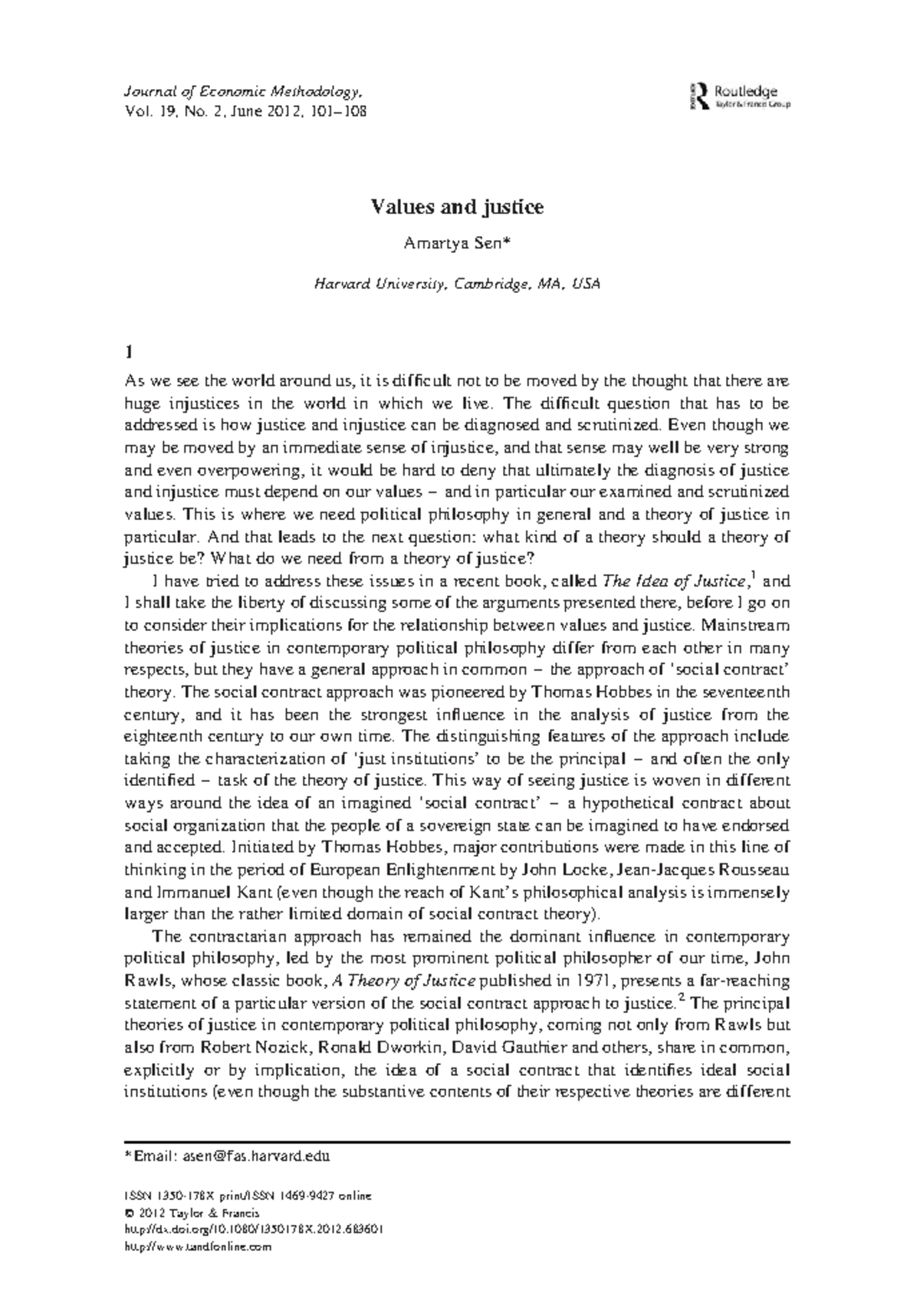
The primary target of Sen’s critical examination is the tradition he labels transcendental institutionalism. This school of thought, which includes thinkers like Thomas Hobbes, John Locke, Jean-Jacques Rousseau, and John Rawls, focuses on identifying the ideal social arrangements. The goal of this tradition is to describe what a "perfectly just" society would look like and what institutions would be required to sustain it.
Sen argues that this approach is both unnecessary and insufficient for the pursuit of justice in the real world. He uses a compelling analogy to illustrate his point: to determine that one painting is better than another, or that a mountain is taller than a hill, we do not need to have a concept of the "perfect" painting or the "highest possible" mountain. Similarly, to identify that one social policy reduces injustice more effectively than another, we do not need to define a perfectly just society.
By moving away from the search for the "perfect," Sen advocates for a comparative approach. This method focuses on ranking different social realizations based on their ability to eliminate actual, identifiable injustices, such as famine, illiteracy, or systemic discrimination. This shift from the abstract to the empirical allows for a more pragmatic and globally applicable framework for justice.
Conceptual Foundations: Niti, Nyaya, and Realized Outcomes
To deepen the distinction between institutional arrangements and social realizations, Sen draws on classical Indian jurisprudence, specifically the concepts of Niti and Nyaya.
- Niti: This term refers to organizational propriety and behavioral correctness. It focuses on the rules, institutions, and structures of society. If the laws are followed and the institutions are functioning as designed, Niti is satisfied.
- Nyaya: This concept represents a more comprehensive view of justice. It is concerned with the world as it actually emerges—the lives that people are actually able to lead. Nyaya is about realization; it asks not just whether the rules were followed, but what the actual outcome was for the individuals involved.
Sen utilizes the ancient Sanskrit example of matsyanyaya (the "justice of the fish") to illustrate why Niti is insufficient. In the world of matsyanyaya, the big fish eat the little fish. A legal system might have perfect Niti—rules that are consistently applied—but if those rules result in a world where the vulnerable are consumed by the powerful, there is no Nyaya.
For Sen, the pursuit of justice must be the pursuit of Nyaya. We must evaluate justice based on the lives people can actually live, rather than the theoretical perfection of the institutions governing them. This distinction is crucial because it allows for the critique of institutions that appear "just" on paper but produce "unjust" outcomes in practice.
The Impartial Spectator vs. The Original Position
One of the most significant technical components of Sen’s critical examination is his critique of John Rawls’s "Original Position." In Rawls’s theory, justice is determined by what individuals would agree upon behind a "veil of ignorance," where they do not know their own status, wealth, or talents. Sen argues that this framework is too exclusionary.
Instead, Sen revives Adam Smith’s concept of the Impartial Spectator. While Rawls’s Original Position focuses on a closed group of people negotiating their own social contract, Smith’s Impartial Spectator allows for the inclusion of voices from outside that specific society. This is vital for addressing global justice.
Sen identifies three main problems with the Rawlsian approach:
- The Problem of Neglect: A closed group might ignore the effects of its decisions on people outside that group (e.g., environmental policies in one country affecting another).
- The Problem of Parochialism: A closed group may be trapped in its own local prejudices and traditions, failing to consider alternative ethical perspectives.
- The Problem of Feasibility: It is unlikely that a single set of "just" principles would emerge from the Original Position; different, equally valid perspectives might coexist.
The Impartial Spectator provides a more flexible and inclusive model for public reasoning. It encourages us to look at our choices from a distance and consider the viewpoints of "distant others," making it a more suitable tool for a globalized world in 2026.
The Capability Approach as a Metric for Justice
If we are to compare different social realizations, we need a metric to measure them. Sen rejects traditional metrics like utility (happiness) or primary goods (income and resources). Instead, he proposes the Capability Approach.
The Capability Approach focuses on what people are actually able to "do and be." It distinguishes between:
- Functionings: The actual states of being and doing (being well-nourished, having a job, participating in community life).
- Capabilities: The real opportunity or freedom a person has to achieve these functionings.
Justice, in Sen’s view, is about expanding human capabilities. A person’s wealth is only a means to an end; the true measure of justice is whether that person has the freedom to lead the kind of life they have reason to value. This approach accounts for human diversity—a person with a physical disability may require more resources to achieve the same "capability" as a person without one. By focusing on capabilities, Sen provides a framework that is sensitive to individual needs and social contexts.
Critical Examination: Challenges to Sen’s Framework
While Sen’s work is widely celebrated, a critical examination must acknowledge the significant challenges and critiques leveled against his theory.
1. The Problem of "The Missing List"
One of the most frequent criticisms, most notably from Martha Nussbaum, is that Sen refuses to provide a definitive list of essential capabilities. Nussbaum argues that without a core list of capabilities (such as life, bodily health, and political participation), the theory lacks the prescriptive power necessary to guide constitutional law or international policy. Sen counters that any such list should be the result of public reasoning within a specific society, rather than being dictated by a philosopher.
2. The Difficulty of Comparative Ranking
Sen’s reliance on social choice theory suggests that we can rank different social states. However, critics argue that in complex societies, there are often "incommensurable" values. If two different policies both reduce different types of injustice, how do we decide which is "more" just? Sen acknowledges that "incomplete rankings" are inevitable, but critics argue this leaves his theory too vague for practical policy-making.
3. Institutional Under-specification
By focusing so heavily on Nyaya (realizations), Sen is sometimes accused of neglecting the importance of Niti (institutions). Critics argue that while institutions are not the end goal of justice, they are the primary tools we have to achieve it. Without a clearer theory of how to build and maintain stable institutions, a realization-focused approach may struggle to sustain long-term improvements in justice.
4. The Risk of Relativism
Because Sen emphasizes public reasoning and rejects a single "transcendental" standard, some fear his theory could slide into cultural relativism. If justice is whatever a particular society decides it is through public debate, what prevents a society from "reasoning" its way into upholding discriminatory practices? Sen’s answer lies in the Impartial Spectator—the requirement to consider external perspectives—but whether this is a strong enough safeguard remains a subject of intense debate.
Summary Comparison: Rawls vs. Sen
The following table summarizes the key distinctions between the traditional transcendental approach and Sen's realization-focused approach.
| Feature | Transcendental Institutionalism (Rawls) | Realization-Focused Comparison (Sen) |
|---|---|---|
| Primary Goal | Identification of perfectly just institutions. | Removal of manifest injustices. |
| Philosophical Focus | Niti (Rules and organizational propriety). | Nyaya (Actualized social realizations). |
| Method of Reasoning | The Original Position (Closed group). | The Impartial Spectator (Open/Global). |
| Metric of Justice | Primary Goods (Income, rights, wealth). | Capabilities (Freedom to do and be). |
| Scope | Primarily the Nation-State. | Inherently Global. |
| Outcome | A unique set of principles of justice. | Plurality of views and incomplete rankings. |
The 2026 Perspective: Applying Sen’s Comparative Justice Today
In the current year, 2026, Sen’s framework is increasingly applied to modern crises that the 18th-century social contract theorists could not have envisioned.
Climate Justice: Transcendental theories struggle with climate change because the "original position" cannot easily account for future generations or non-human entities. Sen’s comparative approach, however, allows us to rank current climate policies based on how they reduce the immediate and future injustice of environmental degradation and displacement.
Digital Equity and AI: As artificial intelligence reshapes the labor market, the Capability Approach provides a tool for evaluating justice that goes beyond "universal basic income." It asks whether individuals have the capability to navigate a digital society, focusing on education, digital literacy, and the freedom to opt-out of algorithmic surveillance.
Global Health: Following the lessons of the early 2020s, global health policy has shifted toward realization-focused outcomes. Justice is measured not by the existence of international treaties (Niti), but by the comparative reduction in mortality and morbidity rates across different regions (Nyaya).
Sen’s insistence on public reasoning is also more critical than ever. In an era of fragmented information and "echo chambers," the demand for open, impartial discussion serves as a necessary check on parochialism and extremist ideologies.
Frequently Asked Questions
What is the "Three Children and a Flute" parable in Sen’s book? Sen uses this story to show that there can be multiple, competing, yet valid arguments for justice. One child wants the flute because they can play it (utilitarianism), another because they are poor and have no toys (egalitarianism), and the third because they actually made the flute (libertarianism). Sen argues that there is no "transcendental" way to resolve this; the choice depends on which injustice we prioritize in a given context.
Does Amartya Sen reject John Rawls’s theory entirely? No. Sen expresses deep admiration for Rawls and considers A Theory of Justice a monumental achievement. He views his own work not as a rejection of Rawls, but as an evolution that addresses the limitations of the "social contract" tradition, particularly its inability to handle global justice and its over-emphasis on perfect institutions.
How does "Social Choice Theory" fit into the idea of justice? Social choice theory is a mathematical and logical framework for aggregating individual preferences or viewpoints into a collective decision. Sen uses it to demonstrate that we can make rational, comparative judgments between different social states even when we don't have total agreement on what is "perfectly" just.
Why is the distinction between "freedom" and "agency" important in Sen's work? Agency refers to a person's ability to act on behalf of what they value and have reason to value. Freedom includes the opportunities available to a person. Sen argues that justice must respect a person's agency—their role as a participant in change—rather than seeing them as a passive recipient of institutional benefits.
Is The Idea of Justice a book about law or economics? It is both, and more. It is a work of moral and political philosophy that draws heavily on economic logic (social choice theory) and legal concepts (jurisprudence). It is intended for anyone interested in how we can make the world more just through reason and action.
Practical Recommendation for Readers
For those looking to apply Sen’s principles, start by identifying a manifest injustice in your local or professional environment rather than searching for an ideal system. Utilize public reasoning by seeking out the perspectives of those most affected and, crucially, the views of "impartial spectators" who have no direct stake in the outcome. By focusing on expanding the capabilities of the marginalized—giving them the real freedom to achieve what they value—you move the needle of justice closer to Nyaya.