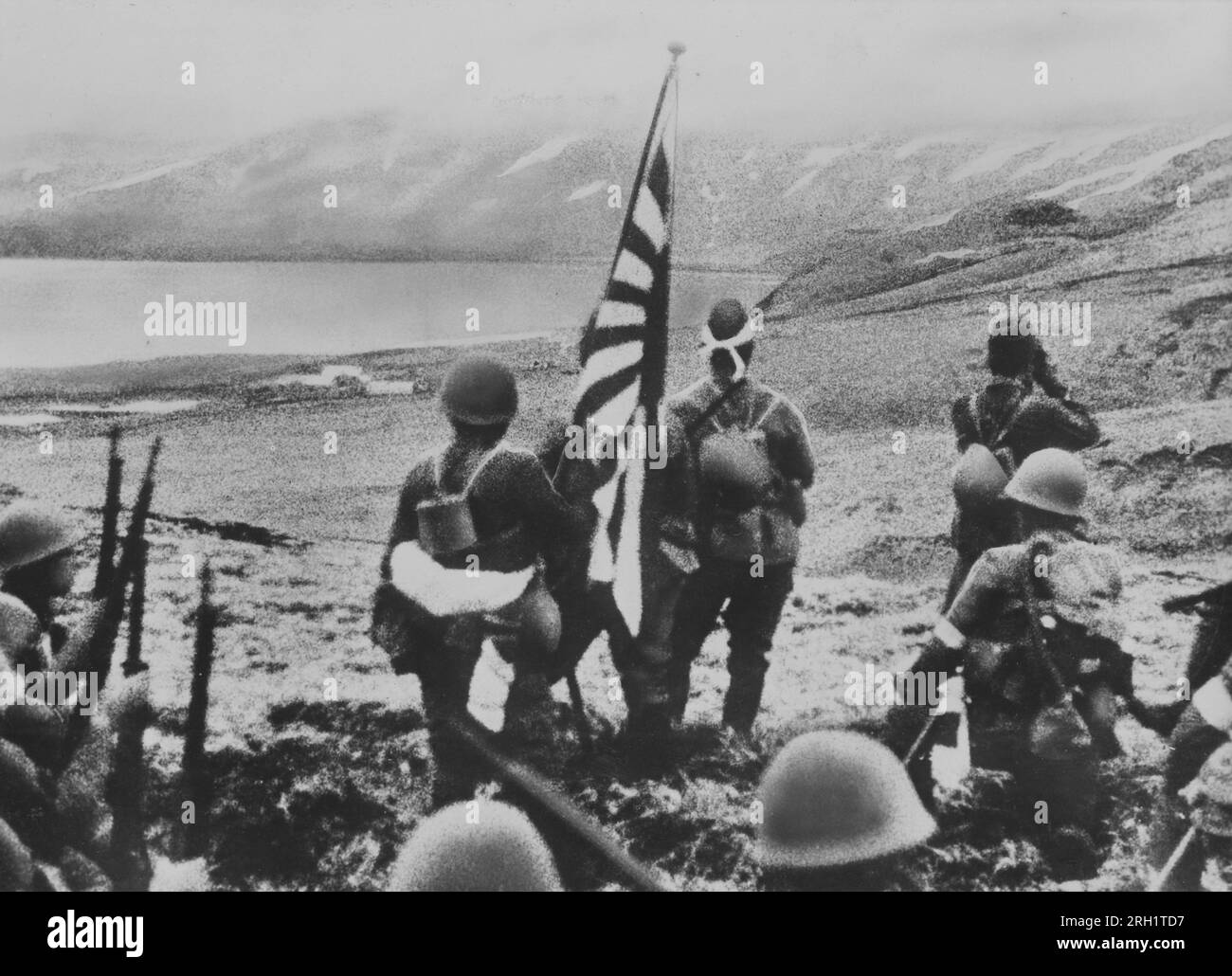
The Aleutian Islands Campaign was a 13-month military conflict (June 1942–August 1943) during World War II, where U.S. and Canadian forces fought to expel Japanese occupiers from the Alaskan islands of Attu and Kiska. It remains the only land battle of the war fought on incorporated United States territory.
The Aleutian Islands Campaign is often referred to by historians as the "Forgotten War," a secondary theater that saw some of the most brutal environmental conditions of the entire global conflict. While the Pacific Theater is often characterized by tropical jungles and coral atolls, the Aleutians presented a nightmare of sub-arctic temperatures, "williwaw" winds exceeding 100 mph, and a permanent shroud of dense fog. Spanning exactly 13 months of active combat operations, this campaign was a pivotal moment in North Pacific strategy, marking the first time since the War of 1812 that American soil was occupied by a foreign power.
The Strategic Significance of the North Pacific
In the early 1940s, military theorists were divided on the importance of the Aleutian chain. To the Japanese, the islands represented the northern flank of their "ribbon defense," a protective perimeter designed to prevent an American northern approach to the Home Islands. To the United States, Alaska was the "Achilles' heel" of continental defense. General Billy Mitchell famously remarked in 1935 that "he who holds Alaska will hold the world," citing its position as the shortest air route between North America and Asia via Great Circle routes.
Despite this, the region was woefully unprepared for war. At the time of the Japanese attack, the U.S. presence was minimal, consisting of a few under-equipped outposts. The Japanese objective in the Aleutians was two-fold: first, to create a diversion that would draw the U.S. Pacific Fleet away from Midway Atoll; and second, to establish airbases that could intercept American bomber routes and monitor naval movements in the North Pacific.
The 13 Months of Conflict: A Chronological Breakdown
The campaign began on June 3, 1942, and concluded on August 15, 1943. Understanding the 13-month progression requires looking at the specific phases of occupation, attrition, and eventual liberation.
The Attack on Dutch Harbor and Occupation (June 1942)
The Japanese carrier-based planes from the Ryujo and Junyo launched a surprise strike on Dutch Harbor on June 3 and 4, 1942. While the damage to the naval base was significant, the primary strategic goal—diverting the U.S. fleet from the Battle of Midway—failed because U.S. intelligence had already cracked the Japanese naval codes. Following the air raids, Japanese forces landed on the islands of Attu and Kiska on June 6 and 7, meeting no resistance as the islands were only inhabited by small weather station teams and local Unangax (Aleut) civilians.
The War of Attrition (July 1942 – March 1943)
For several months, the campaign was defined by long-range aerial bombardment and naval blockades. The U.S. 11th Air Force, operating out of newly constructed bases on Umnak and later Adak, flew "blind" through fog to strike Japanese positions. This period was characterized by more aircraft lost to weather than to enemy fire. American forces utilized "Operation Clean Slate" to leapfrog toward the occupied islands, building secret airfields on Adak (August 1942) and Amchitka (January 1943) to bring Kiska and Attu within range of medium bombers and fighter escorts.
The Battle of the Komandorski Islands (March 1943)
The naval component of the campaign culminated in the Battle of the Komandorski Islands on March 26, 1943. This was one of the last "classic" naval engagements—a pure daylight gunnery duel between cruisers and destroyers without the involvement of aircraft or submarines. Despite being outnumbered, a U.S. task force under Rear Admiral Charles McMorris successfully turned back a Japanese supply convoy, effectively ending Japan's ability to reinforce their Aleutian garrisons by surface ship.
Operation Landcrab: The Recapture of Attu
In May 1943, the U.S. launched Operation Landcrab, the amphibious assault to retake Attu. This operation was a sobering preview of the "island hopping" tactics that would later define the Central Pacific. The 7th Infantry Division, despite being trained for desert warfare in California, was deployed into the freezing muskeg of Attu.
The battle lasted nearly three weeks. The Japanese, under Colonel Yasuyo Yamasaki, utilized the high ground, forcing American troops to climb steep, snow-covered ridges while being fired upon from above. The environmental toll was catastrophic; thousands of American soldiers suffered from trench foot and exposure because their leather boots and standard-issue gear were not designed for the Alaskan climate.
The conflict ended on May 29, 1943, with one of the largest banzai charges of the war. With no hope of reinforcement, the remaining Japanese forces launched a final, desperate bayonet charge through American lines. The fighting was hand-to-hand and brutal. Almost the entire Japanese garrison of roughly 2,600 men was killed, with only 28 taking the option of surrender.
Operation Cottage: The Invasion of Kiska
Following the victory at Attu, the U.S. and Canadian forces prepared for an even larger assault on Kiska, which was more heavily fortified. On August 15, 1943, nearly 35,000 troops landed on the island under the code name Operation Cottage.
However, they found the island completely deserted. Under the cover of dense fog, the Japanese Navy had successfully evacuated all 5,000 personnel in a daring night operation two weeks prior. Despite the lack of an enemy, the "battle" of Kiska resulted in over 300 casualties due to friendly fire incidents in the fog, Japanese booby traps, and the accidental detonation of a naval mine by the destroyer USS Abner Read.
Technical Analysis of Combat in the Aleutians
The Aleutian Campaign was a laboratory for cold-weather warfare. The technical challenges necessitated rapid innovation in logistics and engineering.
Engineering and Airfield Construction
The most significant technical achievement was the construction of the Adak airfield. Engineers diverted a creek and drained a tidal marsh to create a runway in just 10 days. This allowed the 11th Air Force to maintain a continuous "Kiska Blitz," a relentless bombing campaign that pressured the Japanese garrison and forced their eventual evacuation.
Aviation Technology
The P-38 Lightning emerged as a critical asset due to its twin-engine reliability over the freezing North Pacific. If one engine failed due to the extreme cold or mechanical stress, the pilot still had a chance to return to base. Conversely, the Japanese A6M Zero, while agile, struggled with carburetor icing and cold-start procedures in the damp Aleutian environment.
Combat Gear and Logistics
The failure of standard U.S. equipment led to the development of the "Alaskan Combat Boot" and better insulated, layered clothing systems. The campaign proved that leather-soled boots were death sentences in wet, sub-freezing conditions, leading to the rapid deployment of rubberized footwear and specialized cold-weather parkas that would later be used during the winter of 1944 in Europe.
Comparative Overview of the Major Aleutian Engagements
The following table summarizes the primary metrics of the two major island reclamation efforts during the 13-month campaign.
| Feature | Operation Landcrab (Attu) | Operation Cottage (Kiska) |
|---|---|---|
| Date | May 11 – May 30, 1943 | August 15 – August 24, 1943 |
| Allied Forces | ~15,000 (7th Infantry Division) | ~35,000 (US/Canadian Forces) |
| Japanese Presence | ~2,650 troops | 0 (Evacuated prior to landing) |
| U.S. Casualties | 549 KIA, 1,148 WIA, 2,100+ non-battle | 313 (Friendly fire/Mines/Disease) |
| Japanese Casualties | ~2,622 KIA, 28 POW | 0 (Successful evacuation) |
| Strategic Outcome | Tactical/Strategic U.S. Victory | Strategic U.S. Victory / Tactical Failure |
| Key Equipment | P-38, P-40, Kingfisher, C-47 | F4U Corsair, B-24 Liberator |
Common Misconceptions and Forgotten History
One of the most persistent myths is that the Aleutian Campaign was purely a "sideshow." In reality, it tied up significant Japanese naval and air assets that could have been used in the Solomon Islands or at Midway. Additionally, the campaign had a profound impact on the indigenous Unangax people. During the conflict, the U.S. government evacuated nearly 900 Unangax residents to "duration camps" in Southeast Alaska. These camps were poorly maintained, leading to the death of nearly 10% of the evacuees from disease and exposure—a tragic civilian chapter of the campaign that was not formally recognized or compensated until the late 20th century.
Frequently Asked Questions
Why is it called the "13-month" campaign?
The "13 months" refers to the period between the first Japanese attack on Dutch Harbor (June 3, 1942) and the final liberation of the Aleutian chain with the landing on Kiska (August 15, 1943). While minor cleanup and patrol operations continued after August 1943, the active combat phase for the territory spanned this exact duration.
Was the Battle of Attu the only land battle on American soil?
Yes, in the context of World War II. While there were naval bombardments of the U.S. West Coast and the U-boat threat in the Atlantic, Attu was the only location where a full-scale ground campaign was fought between organized armies on incorporated U.S. territory.
Why did the Japanese evacuate Kiska but fight to the death on Attu?
The Japanese High Command realized after the fall of Attu and the naval defeat at Komandorski Islands that Kiska was no longer sustainable. They prioritized saving their 5,000 veteran troops for the defense of the Kuril Islands. On Attu, however, the U.S. naval blockade was so tight that evacuation was impossible, leading the Japanese garrison to choose a final "Gyokusai" (shattered jewel) charge over surrender.
What role did Canadian forces play in the Aleutians?
Canada contributed significantly to the Kiska invasion (Operation Cottage) with the 13th Canadian Infantry Brigade. Additionally, the Royal Canadian Air Force (RCAF) provided several squadrons that flew combat missions alongside the U.S. 11th Air Force throughout the campaign, marking a high point of North American continental defense cooperation.
Are there still remains of the battle in the Aleutians today?
Yes. Due to the extreme cold and remote location, the Aleutians are a "living museum." As of 2026, many sites are part of the Aleutian World War II National Historic Area. Visitors can still see the rusted remains of Japanese midget submarines on Kiska, crashed P-38 aircraft, and the extensive network of foxholes and trenches on Attu. However, many areas remain dangerous due to unexploded ordnance.
Next Actions for Historians and Travelers
For those interested in exploring this history further, the Aleutian World War II National Historic Area provides extensive digital archives and maps. If you are planning a physical visit to the islands, it is essential to coordinate with the U.S. Fish and Wildlife Service, as most of the islands are part of the Alaska Maritime National Wildlife Refuge.
Researchers should focus on the 11th Air Force records and the official U.S. Army "Green Books" on the Pacific Theater for technical data on logistics. Understanding the Aleutians is crucial for anyone studying the broader scope of WWII, as it demonstrates the absolute limit of military endurance when faced with the dual enemies of an entrenched foe and a merciless environment.