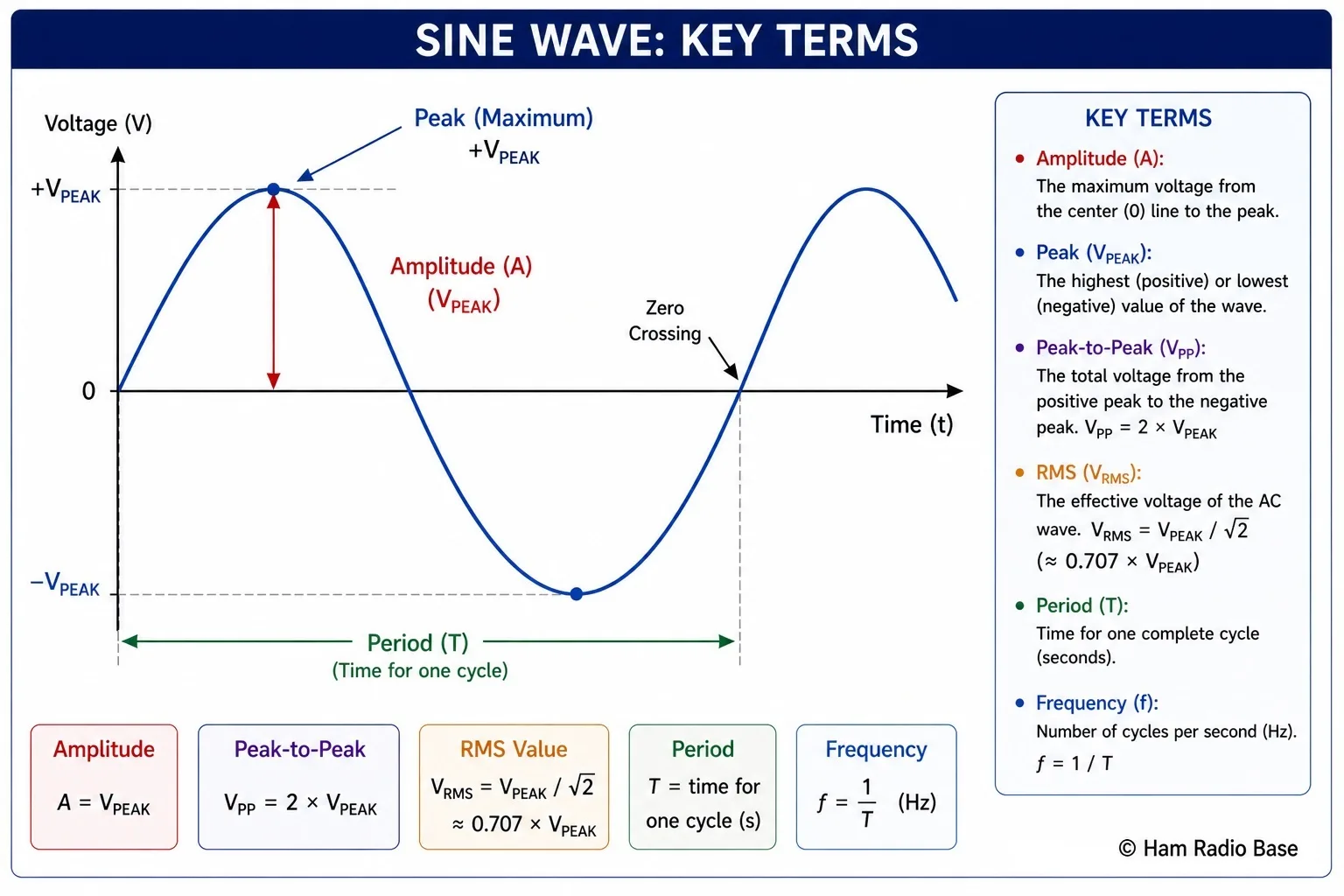
A 1 Hz sine wave is a fundamental periodic oscillation that completes exactly one full cycle every second. Characterized by its smooth, repetitive "S" shape, it represents the simplest form of periodic motion in physics and signal processing, often serving as a baseline for measuring time-dependent phenomena across various scientific and engineering disciplines.
In the fields of electronics, physics, and signal processing, understanding the 1 Hz sine wave is essential for grasping the behavior of waves at the lower end of the frequency spectrum. While 1 Hz is far below the range of human hearing and many common electrical signals, its properties dictate the behavior of everything from seismic vibrations to the rhythmic pulses of biological systems. As of 2026, the precision with which we can generate and measure these low-frequency signals has reached unprecedented levels, allowing for more accurate calibration of medical devices, industrial sensors, and structural monitoring systems.
Fundamental Definition of a 1 Hz Sine Wave
To define a 1 Hz sine wave, one must first understand its two primary components: the "1 Hz" frequency and the "sine wave" geometry.
The Concept of Frequency (Hertz)
The term Hertz (Hz) is the SI unit of frequency, defined as one cycle per second. When a signal is described as having a frequency of 1 Hz, it means that the signal undergoes one full transition from its starting point, through its peak and trough, and back to its starting point within the span of one second. This frequency is exceptionally low; for comparison, a standard electrical outlet in North America operates at 60 Hz, and the middle C note on a piano vibrates at approximately 261.63 Hz.
The Sine Wave Geometry
A sine wave (or sinusoid) is a mathematical curve that describes a smooth periodic oscillation. It is named after the sine function in trigonometry. Geometrically, a sine wave represents the projection of a point moving at a constant speed around a circle onto a vertical or horizontal axis. This results in a waveform that is perfectly "pure," meaning it consists of only a single frequency with no additional harmonics or overtones. This purity makes the 1 Hz sine wave a critical reference signal in laboratory environments.
Core Technical Characteristics
The technical profile of a 1 Hz sine wave is defined by several interrelated parameters. These parameters determine how the wave interacts with circuits, physical structures, and measurement instruments.
Period (T)
The period is the time required for one complete cycle. It is the mathematical inverse of frequency ($T = 1/f$).
- For a 1 Hz wave: $T = 1 / 1\text{ Hz} = 1\text{ second}$. This one-second period makes the 1 Hz wave a convenient tool for time-based synchronization. In many mechanical and electronic timing systems, a 1 Hz "tick" (often a pulse but sometimes a smoothed sine) is the standard for marking the passage of seconds.
Amplitude (A)
Amplitude refers to the "height" of the wave. It can be measured in several ways:
- Peak Amplitude ($V_{pk}$): The maximum displacement from the center (zero) line.
- Peak-to-Peak Amplitude ($V_{pp}$): The total distance from the highest peak to the lowest trough. For a symmetrical sine wave, $V_{pp} = 2 \times V_{pk}$.
- Root Mean Square (RMS): This is the effective value used in power calculations. For a sine wave, $V_{rms} \approx 0.707 \times V_{pk}$. In a 1 Hz signal, the RMS value tells us the equivalent DC voltage that would deliver the same power to a load.
Phase ($\phi$)
Phase describes the starting position of the wave at time $t=0$. It is measured in degrees (0 to 360°) or radians (0 to $2\pi$). If a 1 Hz sine wave starts at its zero-crossing and moves upward, it has a phase of 0°. If it starts at its maximum peak, it is functionally a cosine wave, which is simply a sine wave shifted by 90° or $\pi/2$ radians.
Angular Frequency ($\omega$)
In physics and control theory, angular frequency is often more useful than standard frequency. It is measured in radians per second.
- Formula: $\omega = 2\pi f$.
- For a 1 Hz wave: $\omega = 2\pi \approx 6.283\text{ rad/s}$. This value is vital when calculating the impedance of capacitors and inductors in a 1 Hz circuit.
Mathematical Representation and Physics
The behavior of a 1 Hz sine wave can be expressed through a standard trigonometric equation. This equation allows engineers to predict the instantaneous value of the signal at any given millisecond.
The general formula is: $$y(t) = A \cdot \sin(2\pi f t + \phi)$$
For a standard 1 Hz wave with a peak amplitude of 1 and no phase shift: $$y(t) = \sin(2\pi t)$$
Derivatives: Velocity and Acceleration
In mechanical systems, a 1 Hz sine wave might represent the physical displacement of a mass. The first derivative of this displacement with respect to time gives the velocity, which is a cosine wave. The second derivative gives the acceleration, which is an inverted sine wave. Because the frequency is low (1 Hz), the acceleration forces are relatively small compared to higher frequencies, which is why 1 Hz is often used to test the "static-like" response of sensors.
Wavelength ($\lambda$) in Different Media
The wavelength is the physical distance the wave travels during one period (one second). It depends entirely on the medium through which the wave propagates.
| Medium | Velocity (approx.) | Wavelength of 1 Hz Sine Wave |
|---|---|---|
| Vacuum/Air (EM Wave) | $300,000,000\text{ m/s}$ | $300,000\text{ kilometers}$ |
| Air at 20°C (Sound) | $343\text{ m/s}$ | $343\text{ meters}$ |
| Water (Sound) | $1,480\text{ m/s}$ | $1,480\text{ meters}$ |
| Steel (Sound) | $5,960\text{ m/s}$ | $5,960\text{ meters}$ |
As seen in the table, a 1 Hz acoustic wave in air has a massive wavelength of 343 meters. This is why infrasonic waves (sounds below 20 Hz) can travel vast distances and penetrate solid walls and earth with minimal attenuation; the waves are simply too long to be easily blocked by standard objects.
Physical Manifestations and Real-World Examples
While we cannot hear a 1 Hz sine wave, it is ubiquitous in the physical world. Its presence is often felt rather than heard, or measured through specialized instrumentation.
Human Physiology: The Heartbeat
A resting human heart rate of 60 beats per minute (BPM) is exactly 1 Hz. While a heartbeat is not a pure sine wave (it consists of a complex "PQRST" wave complex), its fundamental frequency is 1 Hz. Many medical monitoring devices use a 1 Hz reference to calibrate heart rate variability (HRV) sensors and pulse oximeters.
Seismology and Structural Engineering
Earthquakes produce a wide range of frequencies, but the "long-period" waves that can cause high-rise buildings to sway are often in the 0.1 Hz to 1 Hz range. Engineers use 1 Hz sine wave simulations on "shake tables" to test how skyscrapers and bridges respond to slow, rhythmic ground movements. If a building's natural resonant frequency is near 1 Hz, a 1 Hz seismic wave can cause catastrophic amplification of movement.
Infrasound and Animal Communication
Certain large animals, most notably elephants and blue whales, communicate using infrasound. While their vocalizations are often slightly higher (15–35 Hz), the fundamental atmospheric oscillations caused by massive storms or volcanic eruptions can reach 1 Hz and below. These signals can be detected by specialized infrasound microphones thousands of miles from the source.
Horology: The Pendulum
A classic grandfather clock pendulum has a "period of swing" (from one side to the other and back) of two seconds, meaning it has a frequency of 0.5 Hz. However, many precision timing pendulums are designed with a "half-period" of one second. The 1 Hz rhythm is the literal heartbeat of mechanical timekeeping.
Signal Generation and Measurement Challenges
Generating and measuring a 1 Hz sine wave requires different considerations than working with kilohertz or megahertz signals.
Generation Methods
- Direct Digital Synthesis (DDS): In 2026, most 1 Hz sine waves are generated using DDS. A digital-to-analog converter (DAC) outputs a series of discrete voltage levels that follow a sine lookup table. Because 1 Hz is so slow, the resolution is typically very high, resulting in an extremely smooth wave.
- Analog Oscillators: Creating a 1 Hz sine wave with analog components (like a Wien Bridge oscillator) is difficult. It requires very large capacitors and resistors. Analog low-frequency oscillators are also prone to "drift," where the frequency changes slightly as the components warm up.
Measurement with Oscilloscopes
To view a 1 Hz sine wave on an oscilloscope, the "Timebase" or "Horizontal" setting must be adjusted significantly.
- To see one full cycle across a standard 10-division screen, you would set the timebase to 100 ms/division (100 ms $\times$ 10 divisions = 1,000 ms = 1 second).
- If the oscilloscope is set to "AC Coupling," the 1 Hz signal may be filtered out or distorted. Most AC coupling circuits have a "cutoff frequency" around 5 Hz to 10 Hz. Therefore, DC Coupling must be used to accurately measure a 1 Hz sine wave.
Comparison with Other Waveforms at 1 Hz
A 1 Hz sine wave is unique because it contains no harmonics. Other waveforms at the same frequency have very different technical characteristics.
- 1 Hz Square Wave: This wave stays at a high voltage for 0.5 seconds and a low voltage for 0.5 seconds. It contains the 1 Hz fundamental plus an infinite series of odd harmonics (3 Hz, 5 Hz, 7 Hz, etc.). It is used for digital clocking.
- 1 Hz Triangle Wave: This wave ramps up and down linearly. It also contains odd harmonics, but they taper off much faster than in a square wave. It is often used in synthesizer LFOs (Low-Frequency Oscillators) to create smooth volume or pitch swells.
- 1 Hz Sawtooth Wave: This wave ramps up and then drops instantly. It contains both even and odd harmonics.
In signal processing, a 1 Hz sine wave is often the "test case" for determining how a system handles pure, low-frequency energy without the interference of higher-frequency components.
Challenges in Low-Frequency Signal Integrity
Working with 1 Hz signals introduces specific engineering hurdles that are not present in high-frequency design:
- 1/f Noise (Pink Noise): Electronic components exhibit more noise at lower frequencies. This "flicker noise" can easily obscure a low-amplitude 1 Hz sine wave.
- Settling Time: When a 1 Hz signal is modified (e.g., by changing its amplitude), it takes several seconds for the system to "settle" and for the change to be fully observed. This makes real-time troubleshooting a slow process.
- DC Offset: Because 1 Hz is so close to 0 Hz (DC), any small DC voltage "leakage" in a circuit can shift the entire sine wave up or down. In a 5V system, a 0.5V DC offset on a 1 Hz wave is a 10% error, which can be significant in precision sensing.
Summary Table: Technical Parameters of a 1 Hz Sine Wave
| Parameter | Value / Description | Unit |
|---|---|---|
| Frequency ($f$) | 1 | Hertz (Hz) |
| Period ($T$) | 1 | Second (s) |
| Angular Frequency ($\omega$) | $\approx 6.283$ | Radians/sec (rad/s) |
| Wavelength (Air, 20°C) | 343 | Meters (m) |
| Classification | Infrasound / ULF (Ultra Low Frequency) | Category |
| Mathematical Form | $\sin(2\pi t)$ | Function |
| Harmonic Content | None (Pure Fundamental) | - |
| Ideal Coupling | DC Coupling | Mode |
Frequently Asked Questions
Can humans hear a 1 Hz sine wave?
No. The human hearing range typically begins at 20 Hz. A 1 Hz sine wave is classified as infrasound. While you cannot hear it, a 1 Hz wave at a very high amplitude (high sound pressure level) might be felt as a physical vibration in the chest or detected as pressure changes in the ear, but it will not be perceived as a musical pitch.
How do you generate a 1 Hz sine wave in software?
In most programming environments, you can generate a 1 Hz sine wave by iterating a time variable ($t$) and calculating the sine of $2\pi t$. For example, in Python using NumPy: signal = np.sin(2 * np.pi * 1 * time_array). In 2026, modern audio API libraries handle the sampling rate math automatically to ensure the 1 Hz frequency remains stable regardless of the hardware's clock speed.
Is a 1 Hz sine wave dangerous?
Generally, no. However, in specific mechanical contexts, a 1 Hz sine wave can be dangerous if it matches the resonant frequency of a large structure. If a bridge or building has a natural resonance of 1 Hz, even a small amount of energy at that frequency can cause the structure to oscillate violently. In human biology, extremely high-intensity infrasound has been studied for its ability to cause nausea or dizziness, but a standard 1 Hz signal is harmless.
What is the difference between 1 Hz and 1 BPM?
There is a significant difference. 1 Hz is one cycle per second, which equals 60 cycles per minute. Therefore, 1 Hz is equal to 60 BPM. A frequency of 1 BPM would be 1/60th of a Hertz (approximately 0.0167 Hz), which is a much slower oscillation.
Why is 1 Hz used in clock synchronization?
1 Hz is used because it aligns perfectly with the standard SI unit of time (the second). In distributed systems, such as the power grid or global telecommunications networks, a "Pulse Per Second" (PPS) signal is used for synchronization. While the PPS is usually a square pulse, the underlying timing reference is a 1 Hz frequency derived from atomic clocks or GPS satellites.
Practical Recommendation
If you are tasked with measuring or using a 1 Hz sine wave in a laboratory or industrial setting, ensure that your equipment is set to DC Coupling. Using AC coupling will likely result in a "sloping" or attenuated version of the wave, leading to incorrect amplitude readings. Additionally, when designing filters for 1 Hz signals, be aware that you will need large-value capacitors (often electrolytic or tantalum), and you should allow for at least 5 to 10 seconds of observation time to confirm the signal's stability and purity.