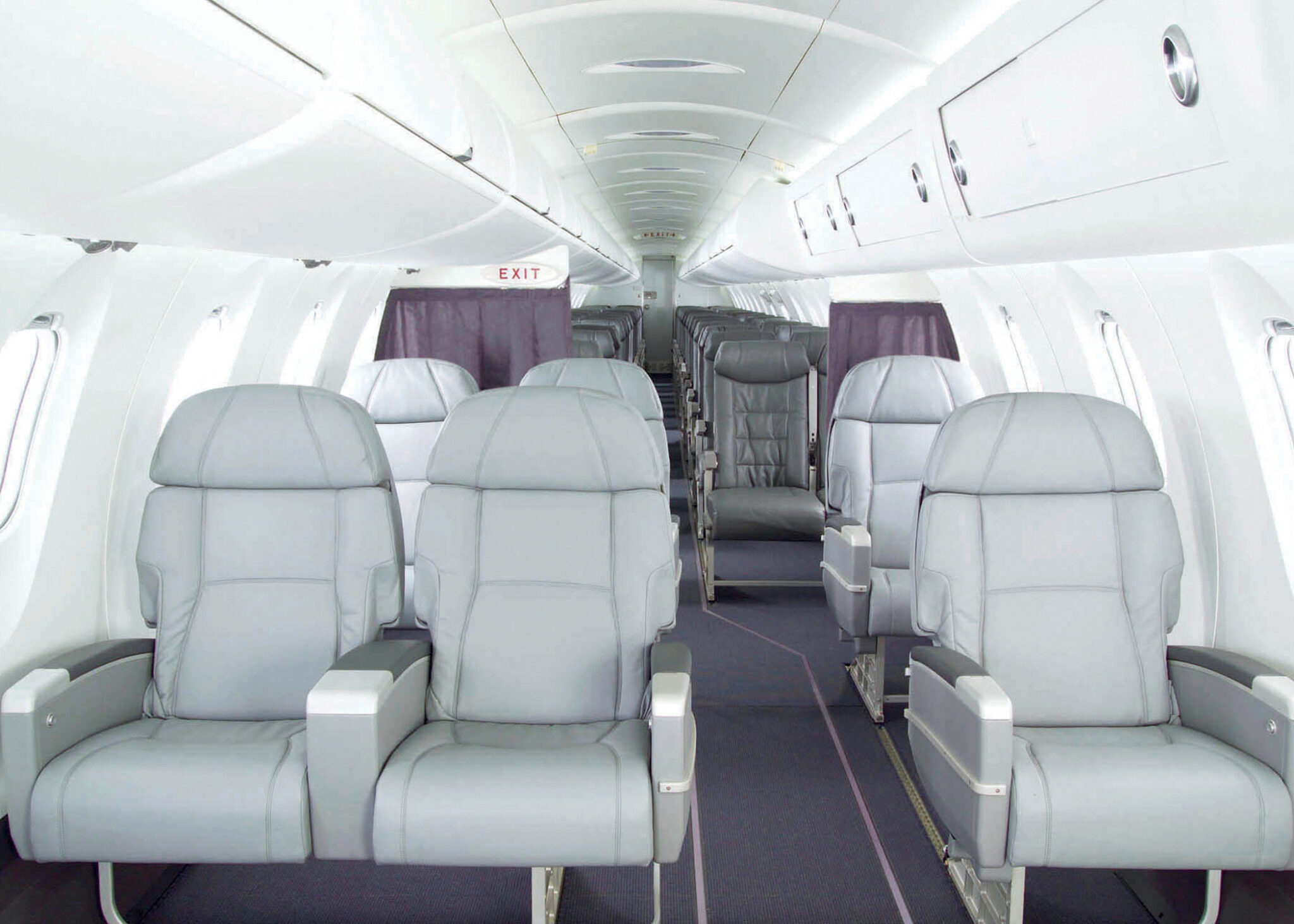
The Bombardier CRJ900 interior is a high-efficiency regional jet cabin typically configured to hold between 76 and 90 passengers in a multi-class or single-class layout. Known for its 2-2 seating configuration in economy, which eliminates the dreaded middle seat, the CRJ900 provides a streamlined travel experience specifically optimized for short-to-medium-haul regional routes.
The CRJ900, now supported and serviced by MHI RJ Aviation Group following Mitsubishi's acquisition of the program, remains a workhorse of the regional airline industry in 2026. While many associate regional jets with cramped quarters, the CRJ900 has undergone significant interior evolutions, most notably the "Atmosphère" cabin upgrade. This overview examines the technical specifications, seating ergonomics, storage solutions, and passenger amenities that define the CRJ900 interior today.
The Evolution of the CRJ900 Cabin: From Classic to Atmosphère
To understand the current state of the CRJ900 interior, one must distinguish between the "Classic" cabin found on older airframes and the modernized "Atmosphère" cabin. Introduced in the late 2010s, the Atmosphère interior was designed to bring the "big jet" feel to the regional market.
The Atmosphère cabin focuses on four pillars: enhanced passenger space, increased carry-on capacity, improved aesthetic ambiance, and inclusive design. In 2026, many operators have retrofitted their existing fleets to match these standards, as passenger expectations for regional travel have shifted toward a seamless transition from mainline narrow-body aircraft (like the A320 or 737) to regional feeders.
Key improvements in the modern CRJ900 interior include:
- Larger Entrance Area: A redesigned galley and entryway create a more open "welcome" feeling as passengers board.
- Enhanced Lighting: The integration of full-spectrum LED mood lighting allows airlines to customize the cabin environment based on the phase of flight, which helps reduce perceived fatigue.
- Spacious Lavatories: Updated lavatory designs provide more floor space and modern fixtures, addressing one of the most common complaints regarding regional jet travel.
Seating Configurations and Ergonomics
The CRJ900 cabin is approximately 69 feet 5 inches (21.16 meters) long, with a maximum width of 8 feet 5 inches (2.57 meters). Within this tube, airlines generally employ a three-class configuration to cater to business travelers and loyalty program members.
First Class (Business Class)
In a typical North American configuration (such as those used by Delta Connection or American Eagle), the First Class cabin features a 1-2 seating arrangement. This provides solo travelers on the left side of the aircraft (Seat A) with both an aisle and a window, a highly coveted position.
- Seat Pitch: Usually ranges from 37 to 39 inches.
- Seat Width: Approximately 19 to 20 inches.
- Amenities: These seats often feature dedicated power outlets (AC and USB), adjustable headrests, and larger tray tables suitable for laptop use.
Premium Economy (Main Cabin Select)
Positioned immediately behind First Class, this section retains the 2-2 configuration but offers additional legroom.
- Seat Pitch: 34 to 35 inches.
- Seat Width: 17.3 inches.
- Value Proposition: For many travelers, the extra three to four inches of pitch in Premium Economy is the difference between their knees hitting the seatback in front of them and having a comfortable flight.
Main Cabin (Economy)
The standard economy section is where the majority of passengers reside. The 2-2 layout is the primary advantage here, as it ensures everyone has either a window or an aisle seat.
- Seat Pitch: 30 to 31 inches.
- Seat Width: 17.3 inches.
- Ergonomics: Modern CRJ900 interiors utilize "slimline" seats. While thinner than older padded seats, they are anatomically contoured to provide better lumbar support and, crucially, to carve out more knee room for the passenger behind.
Overhead Bins and Storage Solutions
Historically, the CRJ series was criticized for its small overhead bins, which forced passengers to "gate-check" standard-sized roll-aboard bags. The CRJ900 interior overview must highlight how the Atmosphère cabin addressed this bottleneck.
The updated overhead bins are roughly 50% larger than the original CRJ design. They are engineered to allow standard "wheels-first" loading for most modern carry-on luggage. By increasing the bin capacity, airlines have significantly reduced boarding times and improved passenger satisfaction, as travelers no longer have to wait on the jet bridge after landing to retrieve "pink-tagged" bags.
Despite these improvements, the CRJ900 remains a narrow-body regional jet. The bins on the left side (port side) of the aircraft are often smaller than those on the right (starboard side) due to the curvature of the fuselage and the placement of internal systems. Experienced travelers know to aim for the starboard side if they have bulkier items.
Technical Specifications Table: CRJ900 Interior Dimensions
The following data outlines the physical constraints and capabilities of the CRJ900 cabin environment.
| Feature | Specification (Standard/Atmosphere) |
|---|---|
| Cabin Length | 69 ft 5 in (21.16 m) |
| Max Cabin Width (Centerline) | 8 ft 5 in (2.57 m) |
| Max Cabin Height | 6 ft 2 in (1.89 m) |
| Floor Width | 7 ft 1 in (2.16 m) |
| Seating Capacity | 76 to 90 passengers |
| Number of Lavatories | 2 (1 Forward, 1 Aft) |
| Galley Areas | 1 Forward (Standard), 1 Aft (Optional) |
| Overhead Bin Volume | ~40-50% increase in Atmosphère models |
Cabin Environment: Noise, Windows, and Air Quality
Operating at altitudes up to 41,000 feet, the CRJ900 interior must maintain a pressurized environment that is comfortable for the duration of a two-to-three-hour flight.
Noise Levels
The CRJ900 is powered by two GE CF34-8C5 turbofans mounted at the rear of the fuselage. This mounting choice is a double-edged sword for the interior. Passengers in the front of the cabin (First Class) enjoy one of the quietest rides in aviation because the engines are 50-60 feet behind them. However, passengers in the last few rows of the Main Cabin will experience significantly higher decibel levels and vibration.
Window Placement
The windows on the CRJ900 are somewhat lower than those on larger Boeing or Airbus aircraft. For a passenger of average height, this may require leaning down slightly to look out. The Atmosphère upgrade improved the window surrounds to make them appear larger and allow more natural light to penetrate deeper into the cabin, reducing the "tunnel" feeling associated with long, narrow fuselages.
Air Quality and Filtration
In 2026, air filtration remains a top priority for operators. The CRJ900 utilizes HEPA (High-Efficiency Particulate Air) filters that circulate and refresh the cabin air every 2 to 3 minutes. This system removes 99.9% of airborne particles, ensuring that the interior air quality meets or exceeds hospital standards.
Connectivity and In-Flight Entertainment (IFE)
By 2026, the "connected cabin" is no longer an option but a requirement. Most CRJ900 interiors have been retrofitted with high-speed satellite Wi-Fi (often utilizing Ka-band or Ku-band systems).
Unlike larger long-haul aircraft, the CRJ900 rarely features seatback screens in the Main Cabin due to the weight and maintenance costs. Instead, airlines favor "streaming IFE" models where passengers connect their personal devices (tablets, phones, laptops) to an onboard server.
- Personal Device Entertainment: Access to movies, TV shows, and flight maps via a browser or airline app.
- Power Access: Most First Class and Premium Economy seats feature 110V AC outlets. Main Cabin seats are increasingly being retrofitted with high-output USB-C ports to accommodate modern hardware.
Comparison: CRJ900 vs. Embraer E175 Interior
The primary competitor to the CRJ900 is the Embraer E175. When analyzing the interior, the two aircraft offer different philosophies.
- Fuselage Shape: The E175 features a "double-bubble" fuselage, which provides more vertical sidewalls and more shoulder room for passengers in window seats. The CRJ900 has a more traditional circular cross-section, which can feel slightly more restrictive at the shoulder level.
- Ceiling Height: The E175 generally offers a slightly higher ceiling, making it feel more spacious for taller passengers. However, the CRJ900's Atmosphère cabin has largely closed this gap by using recessed lighting and sculpted ceiling panels.
- Storage: While the E175 has traditionally had larger bins, the CRJ900's 2026-era Atmosphère bins are now competitive, often allowing the same "wheels-first" storage.
Operational Considerations for Crew and Maintenance
The interior isn't just for passengers; it is a workspace for flight attendants and a maintenance zone for engineers.
Galley Functionality
The forward galley is the nerve center for cabin service. On the CRJ900, this space is compact but highly organized. It includes convection ovens (on some configurations), coffee makers, and storage for "Atlas" standard carts. The efficiency of the galley layout directly impacts how quickly the crew can perform service on short flights.
Durability and Cleaning
In 2026, interior materials are chosen for their antimicrobial properties and durability. Seat covers are typically made of synthetic leather (e.g., E-Leather), which is lighter than traditional leather and much easier to sanitize between flights. The carpets and sidewalls are treated with fire-retardant coatings that meet stringent FAA (Federal Aviation Administration) and EASA (European Union Aviation Safety Agency) regulations.
Frequently Asked Questions
Does the CRJ900 have middle seats?
No. The CRJ900 features a 2-2 seating configuration in the Main Cabin and a 1-2 configuration in First Class. This is one of the most popular features of the aircraft, as every passenger is guaranteed an aisle or window seat.
Will a standard carry-on fit in the CRJ900 overhead bin?
In aircraft equipped with the "Atmosphère" cabin, standard roll-aboard bags (approx. 22" x 14" x 9") will fit wheels-first. On older "Classic" CRJ900s, these bags usually need to be gate-checked or placed sideways, which significantly limits capacity.
Where is the best seat on a CRJ900?
For solo travelers, seat 1A (in a 3-class layout) is often considered the best because it offers both an aisle and a window with no neighbor. In the Main Cabin, the exit row (usually around Row 15 or 16 depending on the airline) offers the most legroom, though these seats may not recline.
Are there power outlets on the CRJ900?
Most airlines have retrofitted their CRJ900 fleets to include power. First Class almost always has 110V AC outlets. Premium and Main Cabin seats usually offer USB-A or USB-C ports, though availability can vary by the specific airline operator.
How many lavatories are on the CRJ900?
The CRJ900 typically has two lavatories: one located at the very front of the aircraft (intended for First Class) and one at the very rear of the cabin (for Main Cabin passengers).
Recommendations for Travelers and Operators
For passengers, when booking a flight on a CRJ900, it is highly recommended to check the seat map for the "Atmosphère" designation if available. If you are traveling with a standard carry-on, try to board in an earlier zone to ensure bin space, even on modernized planes. Avoid the last three rows of the aircraft if you are sensitive to noise or vibration, as the proximity to the engines is noticeable.
For operators and lessors, maintaining the CRJ900 interior in 2026 requires a focus on "mid-life" refreshes. Updating seat foams, installing USB-C charging hubs, and ensuring HEPA filters are serviced according to MHI RJ specifications are critical for maintaining the asset's value and passenger appeal. As the regional market remains competitive, the interior quality of the CRJ900 often serves as the primary differentiator for codeshare partners.