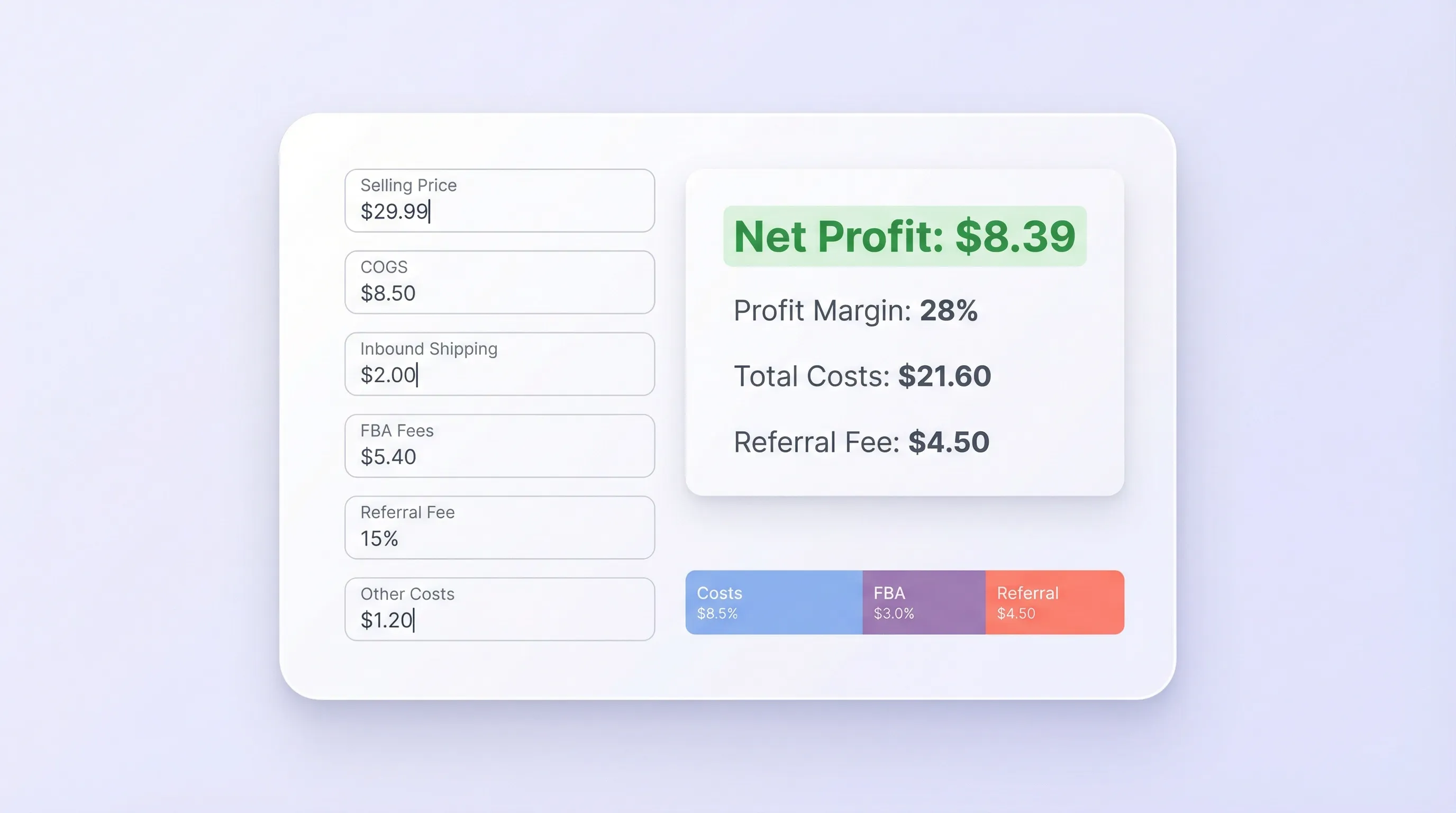
An Amazon profit breakdown is the systematic calculation of your net income after subtracting all costs—including manufacturing, shipping, Amazon referral fees, FBA fulfillment charges, advertising spend, and overhead—from your gross sales. Understanding these granular expenses is essential for maintaining sustainable margins and ensuring long-term business viability in today’s competitive marketplace.
As we move through 2026, the landscape for Amazon sellers has become increasingly sophisticated. While the platform offers unparalleled reach, the "hidden" costs of doing business can quickly erode a seller's bottom line if not meticulously tracked. To truly understand your profitability, you must look beyond the "Net Proceeds" shown in your Seller Central dashboard and account for every penny that leaves your business.
The Architecture of Amazon Revenue
Before diving into the expenses, it is critical to define what constitutes revenue. On Amazon, your Gross Sales is the total amount paid by customers. However, this is a "vanity metric" because it includes sales tax (which you don't keep) and the cost of the items themselves.
Net Sales is a more accurate starting point, representing the revenue after deducting discounts, promotions, and sales tax. However, even this figure does not reflect the cash you take home. For a proper profit breakdown, you must categorize your expenses into three main buckets: Amazon Marketplace Fees, Fulfillment Costs, and Operating Expenses.
1. Amazon Marketplace Fees (The "Entry" Costs)
Every seller, regardless of their fulfillment method, must pay Amazon for the privilege of using their platform. These fees are generally non-negotiable and are deducted at the point of sale.
Referral Fees
The referral fee is essentially a commission. Amazon charges a percentage of the total sales price (including shipping and gift wrap charges) for every item sold. For most categories, this fee remains at 15%, though it can range from 8% (for personal computers) to 45% (for Amazon Device Accessories). In 2026, Amazon continues to use tiered pricing for certain categories, where the referral fee percentage drops once the sale price exceeds a specific threshold.
Closing Fees
If you sell in "Media" categories—such as books, DVD, music, or software—you will encounter a fixed Closing Fee. This is typically a flat charge (around $1.80 per item) added on top of the referral fee.
Subscription Fees
Professional sellers pay a monthly subscription fee (currently $39.99). While this is a small amount for high-volume sellers, it is a fixed cost that must be accounted for in the overall profit breakdown, especially for those just starting out.
2. Fulfillment Costs: FBA vs. FBM
How you get the product to the customer is often the largest variable in your profit breakdown. In 2026, Amazon’s fulfillment structures have become more complex, rewarding efficiency and punishing poor inventory management.
Fulfillment by Amazon (FBA) Fees
If you use FBA, Amazon handles storage, picking, packing, and shipping. The fees are broken down into:
- Fulfillment Fee: A per-unit fee based on the weight and dimensions of the product. This fee covers the labor and shipping costs.
- Monthly Inventory Storage Fees: Charged per cubic foot. These fees increase significantly during the "peak" holiday season (October–December).
- Aged Inventory Surcharge: Formerly known as the Long-Term Storage Fee, this applies to units stored in a fulfillment center for more than 181 days. In 2026, these charges are stepped, becoming progressively more expensive the longer the inventory sits.
- Inbound Placement Service Fees: Introduced in recent years, this fee applies when you ask Amazon to distribute your inventory across their network for you, rather than shipping to multiple locations yourself.
Fulfillment by Merchant (FBM) Costs
If you ship products yourself, you avoid FBA fees but take on the costs of:
- Packaging materials (boxes, tape, dunnage).
- Carrier shipping rates (UPS, FedEx, USPS).
- Labor for picking and packing.
- Warehouse rent and utilities.
3. The "New" 2026 Efficiency Fees
To optimize their logistics network, Amazon has implemented fees that target seller inefficiency. These must be included in any modern profit breakdown.
Low-Inventory-Level Fee
This fee is triggered if your inventory levels are consistently low relative to your sales volume. Amazon implemented this because low inventory forces them to ship products from distant warehouses, increasing their costs. Sellers must maintain a minimum "historical days of supply" to avoid this surcharge.
Returns Processing and Administration Fees
When a customer returns a product, Amazon doesn't just give back the referral fee. They often retain a Refund Administration Fee (the lesser of $5.00 or 20% of the referral fee). If you are in categories like Apparel or Shoes, you may also be charged a specific Returns Processing Fee to cover the cost of re-inspected or repackaged items.
4. Cost of Goods Sold (COGS) and Logistics
Your COGS is the bedrock of your profit breakdown. This is the total cost to produce or acquire your product and get it to an Amazon fulfillment center.
- Manufacturing/Wholesale Cost: The price paid to the supplier.
- Freight and Shipping: The cost of transporting goods from the factory to your door or an Amazon warehouse.
- Duties and Customs: Essential for international sellers importing goods into the US.
- Inspection Fees: The cost of third-party quality control to prevent high return rates.
- Packaging and Inserts: Branding materials that add value but cost money per unit.
5. Advertising and Marketing (PPC)
In 2026, "organic" reach on Amazon is harder to achieve than ever. Most successful sellers must use Sponsored Products, Sponsored Brands, or Sponsored Display ads.
ACoS vs. TACoS
- ACoS (Advertising Cost of Sales): Ad Spend / Ad Revenue. This tells you if your individual ads are profitable.
- TACoS (Total Advertising Cost of Sales): Ad Spend / Total Revenue. This is a critical metric for your profit breakdown. It shows how much of your total "pie" is being consumed by marketing. A healthy TACoS is typically between 10% and 15%.
Comprehensive Cost Comparison: FBA vs. FBM (2026 Estimates)
The following table compares the typical profit breakdown for a standard-sized product (e.g., a $30.00 yoga mat) weighing 2 lbs.
| Expense Category | FBA (Fulfillment by Amazon) | FBM (Merchant Fulfilled) |
|---|---|---|
| Sale Price | $30.00 | $30.00 |
| Referral Fee (15%) | $4.50 | $4.50 |
| Fulfillment Fee | $6.20 | $0.00 |
| Shipping to Customer | $0.00 (Included) | $8.50 (Est. Carrier Rate) |
| Storage Fee (Monthly) | $0.85 | $0.20 (Warehouse Pro-rata) |
| Packaging/Labor | $0.00 (Included) | $1.50 |
| COGS (Landing Cost) | $8.00 | $8.00 |
| PPC Ad Spend (10%) | $3.00 | $3.00 |
| Total Expenses | $22.55 | $25.70 |
| Net Profit | $7.45 | $4.30 |
| Net Margin | 24.8% | 14.3% |
Note: FBM may be more profitable for oversized or heavy items where Amazon's surcharge is higher than private carrier rates.
6. Operating Expenses and Overheads
The final layer of the profit breakdown involves costs that aren't tied to a specific unit sale but are necessary to run the business.
- Software Subscriptions: Tools for keyword research (Helium 10, Jungle Scout), bookkeeping (QuickBooks), and inventory management.
- Virtual Assistants (VAs): Outsourced labor for customer service or listing optimization.
- Product Samples: Research and development costs for new launches.
- Insurance: Amazon requires professional sellers to carry Commercial General Liability Insurance if they reach a certain sales threshold.
- Tax Obligations: While Amazon collects sales tax in most US states, you may still have income tax liabilities or VAT/GST responsibilities if selling internationally.
How to Calculate Your Net Profit Margin
To find your final "take-home" percentage, use the following formula:
((Total Revenue - COGS - Amazon Fees - Fulfillment Costs - Ad Spend - Overheads) / Total Revenue) x 100
In 2026, a "good" net profit margin for a private label Amazon business is generally between 15% and 25%. If your margin is below 10%, your business is at high risk of turning negative if there is a slight increase in shipping costs or a spike in returns.
Common Mistakes in Profit Calculation
- Ignoring the "Refund Administration Fee": Sellers often assume a return is a "wash," but Amazon keeps a portion of the fee, and you lose the original fulfillment cost.
- Miscalculating Inbound Shipping: Forgetting to add the cost of shipping items from your home/warehouse to Amazon's warehouse into the COGS.
- Underestimating PPC Drag: High ACoS can look okay on a single product but can destroy the profitability of an entire brand if not monitored at the TACoS level.
- Neglecting Storage Surcharges: Leaving slow-moving inventory in FBA warehouses during Q4 can result in storage bills that exceed the value of the inventory itself.
FAQs
What is the most significant "hidden" fee on Amazon in 2026?
The Low-Inventory-Level Fee is currently the most significant hidden cost. Because it is calculated based on historical supply, many sellers don't realize they are being charged until after the billing cycle ends. It essentially penalizes sellers for being too lean with their inventory, forcing a balance between storage fees and inventory health.
How do returns affect my total profit breakdown?
Returns are a double hit to profitability. First, you lose the sale revenue. Second, you are charged a refund administration fee by Amazon. Third, if the item is unsellable, you lose the original COGS and must pay a Removal Order Fee to have Amazon ship the item back to you or dispose of it.
Should I include my own salary in the profit breakdown?
For a true technical breakdown of the business performance, you should treat your salary as an operating expense (overhead). This allows you to see the "Net Operating Margin." If you are a sole proprietor, you might calculate "Owner’s Benefit," which includes net profit plus your own draw.
Does Amazon charge different referral fees for different products?
Yes. Referral fees vary by category. For example, while the standard is 15%, categories like Personal Computers are only 8%, while Clothing and Accessories have seen various incentive structures to compete with other platforms. Always check the current Amazon Fee Schedule for your specific sub-category.
How can I reduce my FBA fulfillment fees?
The most effective way to reduce FBA fees is through packaging optimization. Since FBA fees are based on size and weight tiers, reducing your package dimensions by even half an inch can sometimes move your product into a lower "size tier," saving you $0.50 to $1.00 per unit sold.
Practical Recommendation
To master your Amazon profit breakdown, move away from manual spreadsheets and toward automated financial integration. In 2026, tools that sync directly with the Amazon API can provide "real-time" profitability that includes PPC spend and current storage fees. Conduct a SKU-level audit every 30 days. Identify products with a net margin below 15% and decide whether to increase prices, reduce COGS through supplier negotiation, or liquidate the inventory to reinvest in higher-margin opportunities.