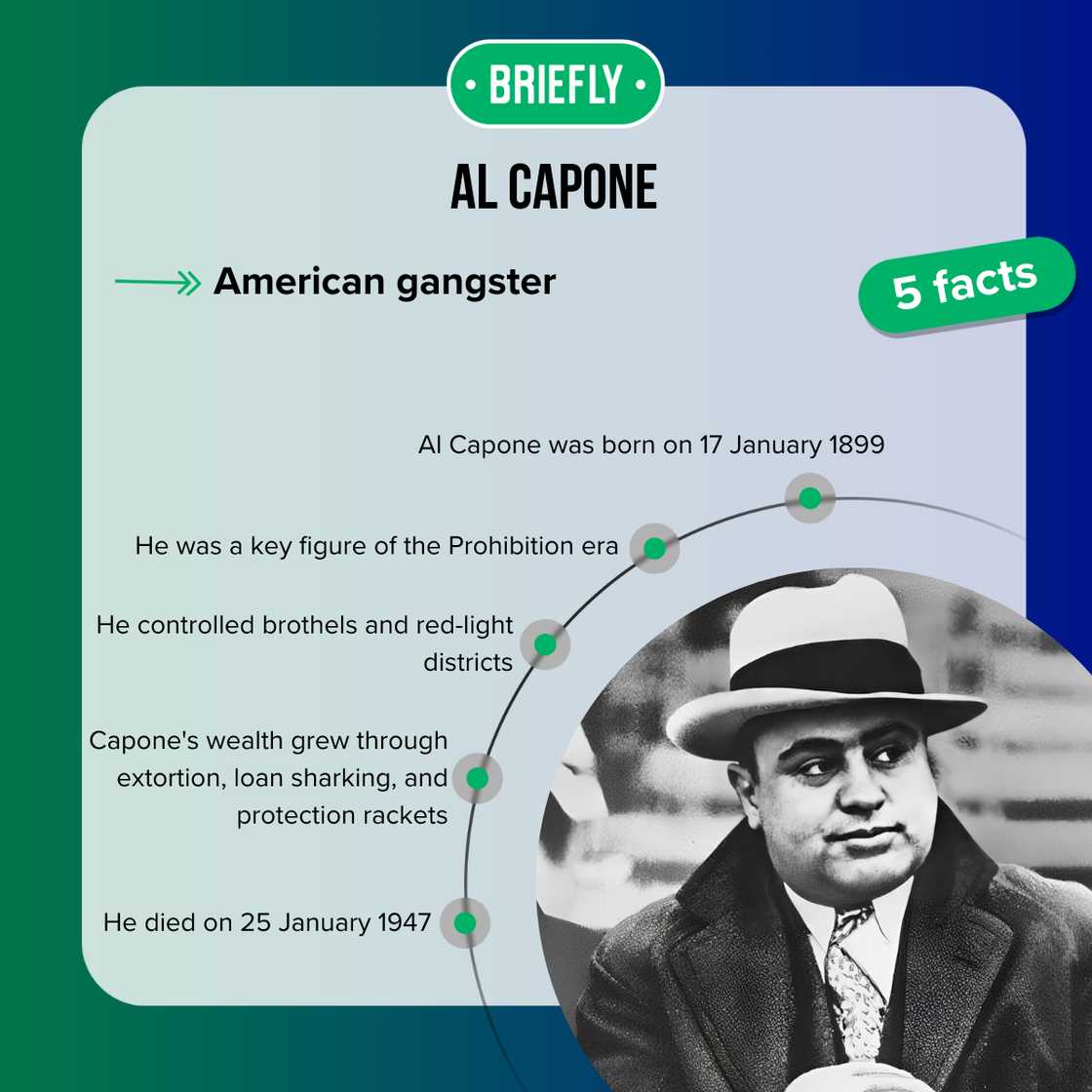
At the peak of his power in 1927, Alphonse "Al" Capone had an estimated personal net worth of $100 million, while his criminal syndicate generated over $105 million in gross annual revenue. Adjusted for inflation in 2026, Capone’s peak net worth equals approximately $1.75 billion, establishing him as one of the wealthiest crime figures in recorded history.
Unpacking Al Capone's Wealth: 1920s Cash vs. Modern Inflation
To understand the magnitude of Al Capone’s fortune, one must look beyond headline numbers and evaluate the purchasing power of the U.S. dollar during the late 1920s. In 1927, a brand-new house in an American city cost roughly $5,000, a luxury automobile cost around $1,000, and the average annual salary for a working-class adult was less than $1,500. Against this economic backdrop, Capone was controlling tens of millions of dollars in liquid cash every year.
Historians and federal forensic accountants estimate that at his financial apex between 1927 and 1929, Capone’s personal accumulated net worth hovered near $100 million. Converting historical currency figures requires analyzing the Consumer Price Index (CPI) alongside changes in total monetary supply and real estate value adjustments over the past century.
When adjusting for cumulative inflation, $100 million in 1927 translates to approximately $1.75 billion to $1.85 billion.
However, gross revenue and personal net worth represent two distinct financial realities. While Capone's broader syndicate—the Chicago Outfit—grossed upwards of $105 million annually (equivalent to nearly $1.84 billion per year today), a vast percentage of that income went directly into operating expenses, massive payrolls, bribes, legal defenses, and territorial enforcers.
The Financial Engines of the Chicago Outfit
Capone did not build his fortune through a single criminal enterprise. Instead, he operated a highly diversified, vertically integrated syndicate that controlled supply chains, retail distribution, real estate, and corrupt municipal oversight across Illinois and neighboring states.
- CHICAGO OUTFIT ANNUAL REVENUE (~$105 Million in 1927)
- BOOTLEGGING: ~$60M (57.1%)
- GAMBLING: ~$25M (23.8%)
- RACKETS & OTHER: ~$20M (19.1%)
1. Illegal Alcohol Distribution (Bootlegging)
Bootlegging was the primary engine of Capone's empire, accounting for roughly $60 million per year (over 57% of total syndicate revenue). Following the ratification of the 18th Amendment and the passage of the Volstead Act in 1919, national prohibition created an overnight black market with inelastic consumer demand.
Capone controlled the entire supply chain:
- Importation: Smuggling Canadian whiskey across the Great Lakes and importing rum through coastal sea routes.
- Domestic Production: Operating large-scale secret distilleries and breweries across rural Illinois, Indiana, and Wisconsin.
- Retail Outlets: Supplying thousands of illegal speakeasies, nightclubs, and secret saloons in Greater Chicago.
2. Gambling Operations and Dog Racing
Gambling was the Outfit’s second most lucrative venture, bringing in an estimated $25 million annually. Capone owned and operated dozens of illegal casinos, off-track betting parlors, slot machine networks, and dog-racing tracks in suburban enclaves like Cicero, Illinois, where municipal law enforcement was fully compromised.
3. Protection Rackets, Vice, and Extortion
Protection rackets and vice operations generated an estimated $20 million annually. Capone’s enforcers levied mandatory "protection fees" on legitimate local businesses, including dry cleaners, bakeries, laundromats, and taxi services. Businesses that refused to pay faced pipe bombings, property destruction, or physical violence. Additionally, the Outfit controlled hundreds of brothels and illegal gaming dens across Cook County.
Financial Breakdown of Capone's Peak Empire (1927–1929)
The following table contextualizes the estimated revenues, expenses, and inflation-adjusted values of Al Capone's criminal enterprise during its height:
| Revenue / Asset Category | Estimated Value (1927 USD) | Adjusted Value (2026 USD) | Percentage of Enterprise |
|---|---|---|---|
| Bootlegging Operations | $60,000,000 | $1,050,000,000 | 57.1% |
| Gambling & Race Tracks | $25,000,000 | $437,500,000 | 23.8% |
| Protection Rackets & Vice | $10,000,000 | $175,000,000 | 9.5% |
| Nightclubs & Saloons | $10,000,000 | $175,000,000 | 9.5% |
| Total Gross Annual Revenue | $105,000,000 | $1,837,500,000 | 100% |
| Annual Payroll & Bribes (Expense) | -$30,000,000 | -$525,000,000 | 28.5% (of gross) |
| Personal Net Worth (Peak) | $100,000,000 | $1,750,000,000 | — |
Gross Empire Revenue vs. Personal Net Cash Flow
A common misconception in historical finance is confusing an organization's gross earnings with an individual's liquid net worth. While Capone’s enterprise generated over $100 million annually, maintaining a criminal empire required extraordinary operational expenses.
Operational Overhead and Security Costs
Capone maintained a standing army of hundreds of enforcers, guards, drivers, and lookouts. Weaponry, armored vehicles, safehouses, and specialized smuggling equipment required continuous capital investment.
Systemic Corruption and Bribes
To operate openly without police interference, Capone directed a massive portion of his budget toward systemic bribery. According to historical records documented in the FBI Vault records on Al Capone, the Outfit spent tens of millions of dollars annually bribing law enforcement officers, city prosecutors, judges, ward committeemen, and mayors. It was estimated that up to half of Chicago’s police force received regular stipends from Capone's lieutenants.
- ESTIMATED ANNUAL EXPENSES
- POLICE & JUDICIAL BRIBES: ~$15M
- OPERATIONAL SAFE HOUSES & LOGISTICS: ~$10M
- ENFORCERS & GANG PAYROLL: ~$5M
Territorial Disputes and Revenue Losses
Gang warfare was an ongoing financial drain. Conflict with rival syndicates, such as the North Side Gang led by Dean O'Banion and later Bugs Moran, resulted in hijacked shipments, destroyed property, and costly retaliatory operations, culminating in events like the 1929 St. Valentine's Day Massacre.
How Capone Spent, Hidden, and Spent His Fortune
Unlike modern billionaires whose wealth is held in public equities, bonds, and audited bank accounts, Capone relied primarily on physical cash, real estate straw-buyers, and untraceable luxury acquisitions.
Real Estate Holdings
Capone reinvested criminal proceeds into high-end real estate using shell names and family members:
Palm Island Estate (Miami, Florida): In 1928, Capone purchased a 14-room waterfront estate at 93 Palm Avenue in Miami for $40,000 (roughly $700,000 today). He subsequently spent over $100,000 installing concrete security walls, searchlights, a gatehouse, and a swimming pool.
Metropole Hotel (Chicago): Capone leased fifty rooms permanently at the Hotel Metropole in downtown Chicago, effectively turning it into his operational headquarters at a cost of thousands of dollars per week.
Suburban Properties: He owned multiple residential compounds across Cicero and Western Springs, Illinois, designed to provide operational security and quick exit routes.
CAPONE ASSET HOLDINGS
- PALM ISLAND ESTATE (FL)
- CASH HELD IN STRAW ACCOUNTS
- LUXURY GOODS & ARMORED CARS
Luxury Goods and Personal Upkeep
Capone was notorious for lavish spending:
- Custom tailored silk suits costing $500 each ($8,500 in today's currency).
- Rare jewelry, including a 11.5-carat diamond pinky ring valued at $50,000 in 1928.
- A custom-built 1928 Cadillac Town Sedan fitted with 3,000 pounds of steel armor plating, bulletproof glass, and a modified rear window designed for Tommy-gun deployment.
Early Money Laundering Strategies
The term "money laundering" is widely believed to have gained traction during the Prohibition era due to criminals purchasing cash-heavy businesses to disguise illicit income. Capone acquired interests in commercial laundries, sanitary cleaning services, horse tracks, and cigar stores. By commingling bootlegging cash with daily cash register receipts from retail businesses, the Outfit attempted to create a veneer of legal income.
The Paper Trail That Destroyed an Empire: The IRS Tax Evasion Case
Capone’s ultimate financial downfall was not brought about by rival gangsters or murder charges, but by federal forensic accountants working for the United States Treasury Department.
The Special Intelligence Unit
In 1928, President Herbert Hoover ordered federal agencies to target Capone. The Treasury Department's Special Intelligence Unit, led by Chief Elmer Irey and agent Frank J. Wilson, pursued a financial strategy rather than attempting to prove murder or bootlegging conspiracy.
The legal foundation rested on the 1927 Supreme Court ruling in United States v. Sullivan (274 U.S. 259), which established that income gained through illegal activities was fully subject to federal income tax.
- 1927 SULLIVAN RULING: Illegal Income Taxable
- IRS FORENSIC AUDITS: Ledgers & Ledger Entries
- 1931 TAX CONVICTION: 11-Year Federal Sentence
Key Evidence Uncovered by Investigators
Treasury agents painstakingly examined financial transactions, cash receipts, and bank records across multiple states. Key pieces of evidence gathered by the IRS, as archived by the National Archives Prohibition-era criminal records, included:
- The Ledger of the Hawthorne Smoke Shop: Federal agents seized a handwritten ledger detailing daily gambling profits from one of Capone’s primary gambling hubs, explicitly listing cash payouts to "Al."
- The Mattingly Letter: Capone’s tax attorney, Lawrence P. Mattingly, sent a letter to the IRS in 1930 attempting to negotiate tax liabilities, acknowledging that Capone had taxable income between $26,000 and $100,000 per year during the late 1920s. Prosecutors introduced this letter as a confession of undeclared income.
- Cash Wire Transfers: Investigators tracked Western Union money transfers sent by Capone’s associates under alias names to fund his Miami estate expenses.
The 1931 Trial and Sentence
In October 1931, Capone was tried in federal court on 23 counts of tax evasion and failure to file tax returns. He was convicted of five counts of income tax evasion involving over $1 million in unreported income (a fraction of his total earnings, but sufficient for conviction).
Judge James H. Wilkerson sentenced Capone to 11 years in federal prison, fined him $50,000 (plus $7,692 in court costs), and ordered him to pay $215,000 plus interest in back taxes. This verdict stripped Capone of his leadership over the Chicago Outfit and permanently shattered his financial domain.
Historical Comparison: Capone vs. Other Notorious Crime Figures
To understand Capone's financial magnitude, it is useful to evaluate his wealth alongside other prominent historic and modern figures in organized crime.
| Figure | Era / Syndicate | Estimated Peak Net Worth (Nominal USD) | Adjusted Peak Net Worth (2026 USD) | Primary Wealth Source |
|---|---|---|---|---|
| Al Capone | 1920s Chicago Outfit | $100 Million | ~$1.75 Billion | Bootlegging, Gambling, Rackets |
| Meyer Lansky | 1930s–1970s National Syndicate | $300 Million | ~$1.2 Billion | Illegal Casinos, Money Laundering |
| Frank Costello | 1940s–1950s Luciano Family | $50 Million | ~$600 Million | Gambling Rackets, Real Estate |
| Pablo Escobar | 1980s Medellín Cartel | $30 Billion | ~$70+ Billion | Global Cocaine Trade |
| Amado Carrillo Fuentes | 1990s Juárez Cartel | $25 Billion | ~$45+ Billion | International Narcotics |
While modern drug cartel leaders operated on a global scale that dwarf Prohibition-era earnings, Capone remains among the wealthiest crime figures in American history, particularly when evaluated relative to the national GDP of the 1920s.
Key Financial Takeaways from Prohibition-Era Wealth Tracking
The forensic investigation into Al Capone’s financial empire permanently altered modern law enforcement and asset-tracing procedures.
- Cash-Intensive Enterprises Leave Secondary Trails: Even without bank accounts, physical cash transactions create secondary documentation through luxury purchases, real estate deeds, and wire receipts.
- The Legal Precedent of Income Definition: Federal tax law does not distinguish between legal and illegal earnings; all economic gains represent taxable gross income.
- Overhead Reduces Net Wealth: Massive gross revenue numbers in illicit syndicates often mask heavy structural overhead, including protection payments, legal defense costs, and asset seizures.
Frequently Asked Questions
What was Al Capone's exact peak net worth?
Al Capone's estimated personal net worth at his peak in 1927 was approximately $100 million in 1927 dollars. Adjusted for inflation, this represents roughly $1.75 billion today. His broader organization generated over $105 million in gross annual revenue during the height of Prohibition.
How did the government figure out how much money Al Capone made?
The IRS Special Intelligence Unit tracked Capone’s wealth through forensic accounting. Agents audited financial ledgers seized from illicit gambling halls, analyzed Western Union cash transfers, interviewed straw purchasers, and utilized admissions made by Capone's tax attorney regarding his unreported income. Detailed documentation of these financial enforcement techniques is preserved through the Internal Revenue Service historical overview.
How much money did Al Capone make from bootlegging compared to gambling?
Bootlegging was Capone’s most profitable operation, generating approximately $60 million per year (over 57% of total revenue). Gambling operations, including casinos and race tracks, generated an estimated $25 million annually, while protection rackets and vice produced around $20 million annually.
Did Al Capone lose his fortune after going to prison?
Yes. Following his 1931 conviction for federal income tax evasion, Capone paid substantial fines, legal costs, and back taxes. Deprived of operational control while serving time in Atlanta Federal Penitentiary and Alcatraz, combined with the repeal of Prohibition in 1933, his revenue sources collapsed. By his release in 1939, his mental health had deteriorated severely due to advanced neurosyphilis, and his personal fortune was largely depleted.
Why was Capone charged with tax evasion instead of murder or bootlegging?
Federal prosecutors struggled to secure witnesses or physical evidence linking Capone directly to violent crimes due to widespread witness intimidation and police corruption. However, tax evasion offered a clear paper trail governed by the 1927 Supreme Court ruling (United States v. Sullivan), which made unreported illegal income a federal crime.
Final Summary and Historical Impact
Al Capone's estimated peak net worth of $100 million ($1.75 billion adjusted) demonstrates how the economic distortion of Prohibition created unprecedented wealth accumulation within organized crime. However, the inability to legally bank or report these financial flows ultimately provided federal authorities with the exact mechanism required to dismantle his empire. Modern asset-tracing procedures, anti-money laundering regulations, and forensic accounting standards continue to rely on the legal and investigative precedents established during the federal prosecution of Chicago's most famous gang leader.