An AHA ACS guidelines checklist provides a standardized framework for the rapid diagnosis and management of Acute Coronary Syndromes, including STEMI and NSTE-ACS. It prioritizes early ECG acquisition, high-sensitivity troponin testing, and prompt reperfusion therapy to minimize myocardial damage and improve patient survival rates across various clinical and emergency settings.
The Evolution of the AHA ACS Management Framework
In 2026, clinical practice for Acute Coronary Syndrome (ACS) is governed by the unified management strategies developed by the American Heart Association (AHA) and the American College of Cardiology (ACC). The most significant shift in recent years has been the consolidation of ST-elevation myocardial infarction (STEMI) and non-ST-elevation ACS (NSTE-ACS) into a single, cohesive pathway. This "Unified ACS" approach acknowledges that while the initial reperfusion urgency differs, the underlying pathophysiology and the long-term secondary prevention requirements are largely shared.
The checklist serves as more than just a memory aid; it is a quality-improvement tool designed to reduce "door-to-needle" and "door-to-balloon" times. By following a structured sequence, healthcare providers ensure that critical diagnostic steps—such as the 12-lead electrocardiogram (ECG)—are not delayed by administrative hurdles or secondary assessments. In the high-pressure environment of the Emergency Department (ED) or the Cardiac Catheterization Lab, these guidelines provide the objective criteria needed to make life-saving decisions under time constraints.
Medical professionals must recognize that the ACS checklist is a living document. It integrates the latest evidence on high-sensitivity cardiac troponin (hs-cTn) assays, potent P2Y12 inhibitors, and the nuances of radial-first access for percutaneous coronary intervention (PCI). Understanding the "why" behind each checklist item is essential for clinical reasoning, especially when managing complex patients with multi-vessel disease or significant comorbidities.
Phase 1: Immediate Triage and Diagnostic Assessment
The first ten minutes of patient contact are the most critical in the ACS pathway. The AHA guidelines emphasize a "symptom-to-action" mindset, where chest pain or equivalent symptoms (such as unexplained dyspnea, diaphoresis, or epigastric pain) trigger an immediate protocol.
12-Lead Electrocardiogram (ECG) Interpretation
The absolute priority is the acquisition and interpretation of a 12-lead ECG within 10 minutes of the patient's arrival at the medical facility. The checklist requires a specific search for:
- ST-segment elevation: Defined as new ST elevation at the J point in at least two contiguous leads (≥1 mm in all leads other than V2–V3; for V2–V3, specific age and sex thresholds apply).
- New Left Bundle Branch Block (LBBB): Traditionally treated as a STEMI equivalent in the presence of concordant symptoms.
- ST-segment depression or T-wave inversion: Indicative of ischemia without total occlusion, directing the provider toward the NSTE-ACS pathway.
- Posterior MI signs: Assessing for ST-depression in leads V1–V3, which may require posterior leads (V7–V9) to confirm a circumflex artery occlusion.
Initial Stabilization and Symptom Relief
While the ECG is being processed, the checklist includes immediate supportive care. This involves establishing intravenous (IV) access and monitoring vital signs. Oxygen therapy is no longer universal; according to the latest AHA/ACC guidelines, oxygen should only be administered if the patient’s peripheral oxygen saturation (SpO2) is below 90% or if they are in respiratory distress. Nitroglycerin remains the first-line agent for ischemic pain, provided the patient is not hypotensive and has not recently used phosphodiesterase inhibitors.
Phase 2: Laboratory Evaluation and Biomarker Kinetics
The integration of high-sensitivity cardiac troponin (hs-cTn) has revolutionized the "checklist" approach to NSTE-ACS. Unlike older assays, hs-cTn allows for much faster "rule-in" and "rule-out" protocols, often within one to two hours of arrival.
High-Sensitivity Troponin Protocols
The AHA recommends using validated rapid algorithms (e.g., 0/1-hour or 0/2-hour) rather than waiting the traditional six hours for a second troponin draw. The checklist items for laboratory evaluation include:
- Baseline hs-cTn: Drawn at presentation.
- Serial hs-cTn: Drawn at 1, 2, or 3 hours depending on the institutional protocol.
- Delta-change assessment: The absolute change in troponin levels is often more diagnostic of acute myocardial injury than a single elevated value, which could be related to chronic kidney disease or structural heart disease.
Differential Diagnosis and Non-Ischemic Elevation
A crucial part of the ACS checklist is the "pause for differentiation." Elevated troponin does not always equal a myocardial infarction (MI). The guidelines require clinicians to consider Type 2 MI (supply-demand mismatch), myocarditis, pulmonary embolism, and Takotsubo cardiomyopathy. This step ensures that patients are not inappropriately subjected to aggressive anticoagulation or invasive procedures that could cause harm if the underlying cause is non-thrombotic.
Phase 3: Risk Stratification and Decision Pathways
Once STEMI is ruled out and ACS is suspected or confirmed via troponin, the next step in the checklist is risk stratification. This determines the timing of invasive versus conservative management.
Utilizing Validated Scoring Systems
The AHA guidelines emphasize the use of standardized scores to guide the urgency of cardiac catheterization.
- GRACE Score: A high GRACE score (>140) suggests a high risk of in-hospital mortality and usually warrants an early invasive strategy (within 24 hours).
- TIMI Score: Useful for quick bedside assessment of the likelihood of adverse cardiac events.
- HEART Score: Often used in the ED to identify low-risk patients who may be safely discharged for outpatient follow-up.
Invasive vs. Ischemia-Guided Strategy
The checklist must clearly distinguish between patients who need an immediate trip to the lab and those who can be stabilized medically first.
- Immediate Invasive (Within 2 Hours): Reserved for patients with refractory angina, signs of heart failure, hemodynamic instability, or life-threatening arrhythmias.
- Early Invasive (Within 24 Hours): For stabilized NSTEMI patients with high-risk features like dynamic ST changes or elevated GRACE scores.
- Selective Invasive: For low-risk patients where a non-invasive stress test may be performed first to look for inducible ischemia.
Phase 4: Pharmacological Management Checklist
Pharmacotherapy in ACS is a multi-layered process involving antiplatelet agents, anticoagulants, and adjunctive therapies. The sequence of administration is vital to prevent stent thrombosis and minimize bleeding risks.
Antiplatelet Therapy (DAPT)
Dual Antiplatelet Therapy (DAPT) remains the cornerstone of treatment.
- Aspirin: 162 mg to 325 mg non-enteric coated, chewed for rapid absorption.
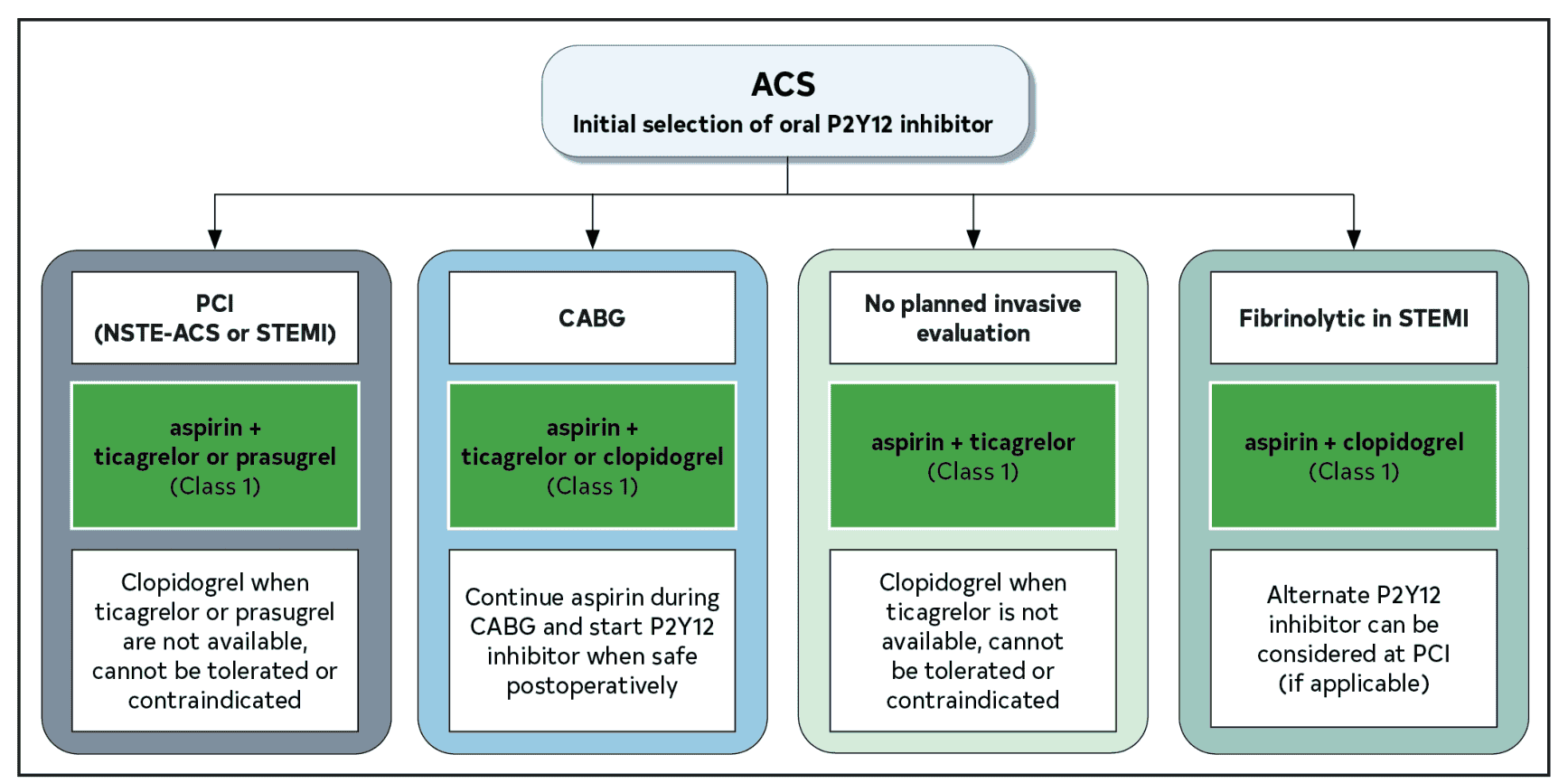
- P2Y12 Inhibitor: Loading doses of Ticagrelor (180 mg) or Prasugrel (60 mg) are generally preferred over Clopidogrel (600 mg) for patients undergoing PCI, unless the patient has a high bleeding risk or a history of stroke (specifically for Prasugrel).
- GP IIb/IIIa Inhibitors: These are now reserved for "bailout" situations in the cath lab rather than routine pretreatment.
Anticoagulation Options
The choice of anticoagulant depends on the intended management strategy.
- Unfractionated Heparin (UFH): The gold standard for patients going directly to PCI due to its predictable reversibility.
- Enoxaparin or Fondaparinux: Often preferred for patients in the NSTE-ACS pathway being managed conservatively or awaiting a delayed invasive procedure.
- Bivalirudin: An alternative for patients with a high risk of bleeding or a history of Heparin-Induced Thrombocytopenia (HIT).
| Strategy | Recommended Primary Anticoagulant | Antiplatelet Preference |
|---|---|---|
| STEMI / Immediate PCI | Unfractionated Heparin (UFH) | Prasugrel or Ticagrelor |
| NSTE-ACS (Invasive) | UFH or Enoxaparin | Ticagrelor or Prasugrel |
| NSTE-ACS (Ischemia-Guided) | Fondaparinux or Enoxaparin | Clopidogrel or Ticagrelor |
| Fibrinolytic Therapy | Enoxaparin or UFH | Clopidogrel (Aspirin mandatory) |
Phase 5: Reperfusion for STEMI Patients
For the STEMI patient, "Time is Muscle." The checklist for reperfusion is focused on the logistics of opening the occluded artery.
PCI Goals and Timelines
The AHA/ACC guidelines maintain strict time-to-treatment goals:
- Door-to-Balloon (D2B) Time: Within 90 minutes for patients presenting at a PCI-capable center.
- First Medical Contact (FMC)-to-Device: Within 120 minutes for patients requiring transfer from a non-PCI center. If the transfer time exceeds this window, fibrinolytic therapy should be considered.
Fibrinolytic Therapy Requirements
When PCI is not available within the recommended timeframe, fibrinolysis is the alternative. The checklist for fibrinolysis must include a rigorous screening for contraindications, such as a history of intracranial hemorrhage, recent major surgery, or active internal bleeding. Following fibrinolysis, patients should still be transferred to a PCI-capable center for a "pharmacoinvasive" approach, with angiography ideally performed between 3 and 24 hours after the bolus.
Phase 6: Secondary Prevention and Discharge Planning
The ACS checklist does not end with a successful procedure. The transition from acute care to long-term management is where the most significant gains in life expectancy are made.
Guideline-Directed Medical Therapy (GDMT)
Before discharge, every ACS patient should be evaluated for the "Big Five" medications:
- DAPT: Usually continued for 12 months, though shorter or longer durations may be tailored based on bleeding and ischemic risk scores (e.g., DAPT or PRECISE-DAPT scores).
- Beta-Blockers: Started within the first 24 hours unless there are signs of heart failure or low output.
- High-Intensity Statins: Atorvastatin 80 mg or Rosuvastatin 40 mg, regardless of baseline LDL-C levels.
- ACE Inhibitors / ARBs: Particularly for patients with an ejection fraction <40%, hypertension, or diabetes.
- Mineralocorticoid Receptor Antagonists (MRA): For patients already on ACE inhibitors and beta-blockers with an EF ≤40% and heart failure or diabetes.
Lifestyle and Education
The discharge checklist must include a referral to cardiac rehabilitation, which has been shown to reduce mortality significantly. Smoking cessation counseling, dietary education (e.g., Mediterranean or DASH diets), and physical activity plans are essential components. In 2026, the use of digital health monitoring and wearable tech to track adherence and recovery is increasingly integrated into these discharge protocols.
Frequently Asked Questions
What is the most significant change in the 2024-2026 AHA ACS guidelines?
The most significant change is the unification of the STEMI and NSTE-ACS guidelines into a single clinical pathway. This update prioritizes the early use of high-sensitivity troponin and emphasizes a radial-first approach for all invasive procedures, reflecting evidence that shows reduced bleeding and lower mortality rates with radial access compared to femoral access.
How does the 0/1-hour troponin protocol work?
The 0/1-hour protocol involves drawing a high-sensitivity troponin at the time of presentation and exactly one hour later. If the initial level is very low, or if the change (delta) between the two draws is minimal and below a specific threshold, the patient can be "ruled out" for an acute MI. Conversely, high initial levels or a significant rise trigger a "rule-in" for further cardiac evaluation.
Is oxygen always necessary for someone having a heart attack?
No. Current AHA guidelines explicitly state that oxygen should be withheld if the patient’s oxygen saturation is ≥90%. Clinical trials, such as the DETO2X-AMI study, demonstrated that supplemental oxygen in patients with normal saturations does not reduce mortality or the size of the infarct and may potentially cause harm through coronary vasoconstriction.
Can Clopidogrel still be used if Ticagrelor is unavailable?
Yes, Clopidogrel is an acceptable alternative, particularly in patients who have a high risk of bleeding, need concomitant oral anticoagulation (triple therapy), or cannot tolerate the side effects of Ticagrelor (such as dyspnea). However, for the majority of ACS patients undergoing PCI, the more potent P2Y12 inhibitors like Ticagrelor or Prasugrel are preferred due to more consistent platelet inhibition.
What are the absolute contraindications for fibrinolytic therapy?
Absolute contraindications include any prior intracranial hemorrhage, known structural cerebral vascular lesion, known malignant intracranial neoplasm, ischemic stroke within three months (except acute stroke within 4.5 hours), suspected aortic dissection, active bleeding, or significant closed-head or facial trauma within three months. In these cases, even if transfer is delayed, the risk of life-threatening bleeding outweighs the benefit of the drug.
Practical Recommendation for Implementation
To effectively implement the AHA ACS guidelines checklist in 2026, healthcare facilities should move beyond paper forms and integrate these protocols into their Electronic Health Record (EHR) systems as "smart sets." Automated alerts for 10-minute ECG deadlines and "order sets" that default to high-intensity statins and appropriate DAPT loading doses can significantly reduce clinical inertia. Furthermore, regular "Morbidity and Mortality" (M&M) reviews should specifically audit adherence to these checklist items to identify systemic bottlenecks, such as delays in transfer or underutilization of cardiac rehabilitation referrals.