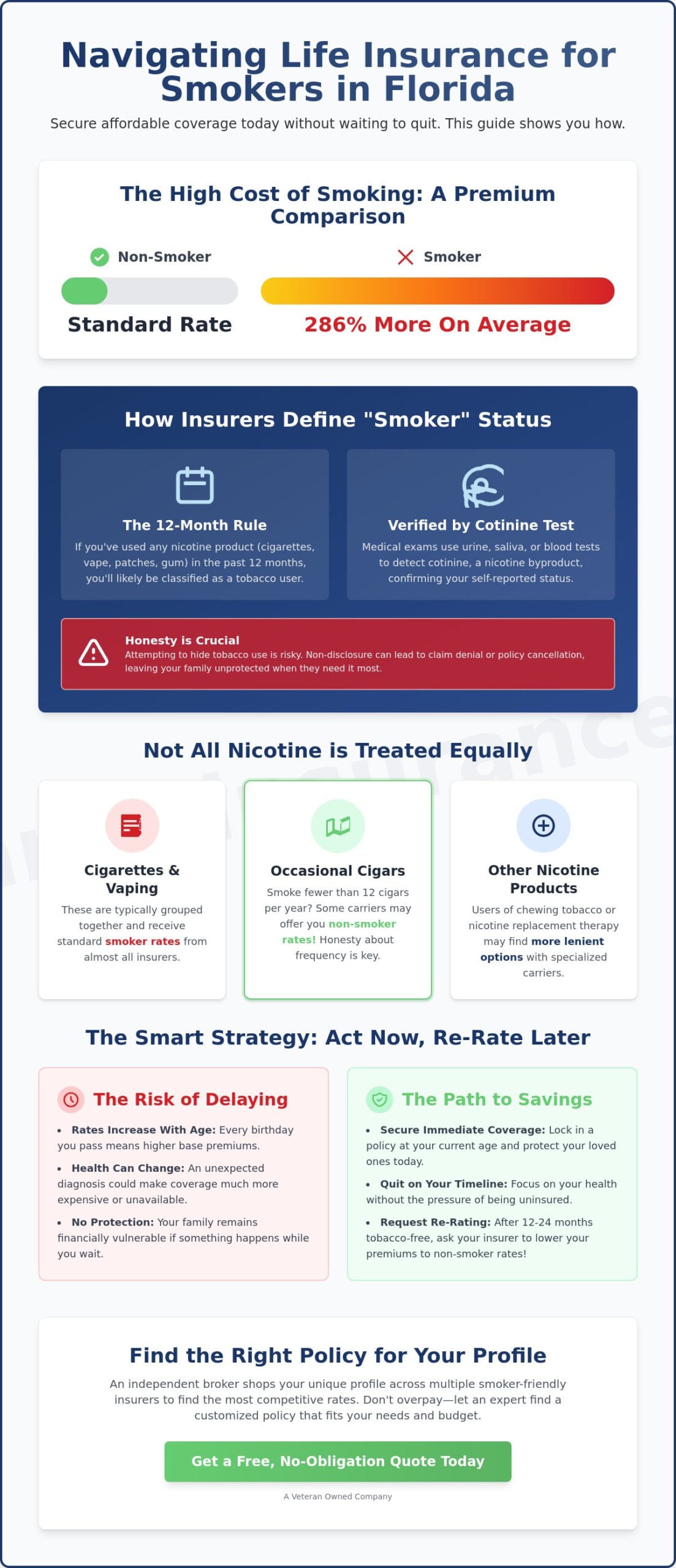
AARP life insurance for non-smokers offers significantly lower premiums than smoker rates through the AARP Life Insurance Program from New York Life. Non-smokers can access up to $150,000 in Term Life coverage or $50,000 in Whole Life coverage, provided they have not used tobacco or nicotine products for at least 12 to 24 months.
The AARP Life Insurance Program, underwritten exclusively by New York Life Insurance Company, remains one of the most recognized financial products for seniors in 2026. For those who have maintained a tobacco-free lifestyle, the program provides a distinct financial advantage. Insurance companies categorize smokers as high-risk due to the well-documented health complications associated with nicotine use, ranging from cardiovascular diseases to respiratory issues. Consequently, non-smokers are rewarded with more accessible entry points and lower monthly obligations, making it easier to secure a legacy or cover final expenses without straining a retirement budget.
Defining the Non-Smoker Advantage in 2026
In the context of AARP life insurance, being a "non-smoker" is not merely about whether you have a cigarette in your hand today. New York Life uses specific criteria to determine eligibility for non-smoker rates. Generally, to qualify for these preferred rates in 2026, an applicant must not have used any tobacco or nicotine products in the past 12 to 24 months.
This definition is broader than many applicants realize. It typically includes:
- Traditional cigarettes and pipes.
- Cigars (though some policies allow for very occasional "celebratory" cigars if disclosed).
- Chewing tobacco and snuff.
- Nicotine replacement therapies, such as patches, gums, or lozenges.
- Electronic cigarettes and vaping devices, regardless of whether the liquid contains high or low levels of nicotine.
The distinction is critical because the premium difference can be substantial. In many cases, a smoker might pay two to three times more than a non-smoker for the exact same death benefit. For seniors living on a fixed income, this "non-smoker discount" is essentially a health dividend paid back to the policyholder.
Core Coverage Options for Non-Smokers
AARP offers three primary types of life insurance for its members. While non-smoker status impacts the two medically underwritten products the most, it is important to understand how each functions within the 2026 landscape.
1. Level Benefit Term Life Insurance
Term life insurance is designed to provide high coverage amounts for a lower initial cost. For non-smokers, this is often the most popular choice when they still have significant financial obligations, such as a mortgage or a spouse who relies on their income.
- Coverage Limits: Members can typically apply for up to $150,000 in coverage.
- Premium Structure: Rates are based on your age at the time of application and increase as you move into new five-year age brackets (e.g., ages 60, 65, 70).
- Duration: The coverage can stay in effect until the age of 80, at which point the policy generally expires, though some conversion options may exist.
- Medical Requirements: There is no physical exam for most applicants. Instead, eligibility is determined through a series of health questions and a review of medical records and prescription history.
2. Permanent (Whole) Life Insurance
For those seeking lifelong protection that will not expire, Whole Life insurance is the standard. Unlike term insurance, which is temporary, whole life is designed to pay out regardless of when the insured passes away, provided premiums are maintained.
- Coverage Limits: Generally capped at $50,000.
- Premium Structure: Premiums are "level," meaning they are locked in at the age you apply and will never increase.
- Cash Value: A portion of the premium builds cash value over time, which the policyholder can borrow against if needed.
- Eligibility: Like the term product, this requires answering health questions but does not usually require a medical exam for non-smokers.
3. Guaranteed Acceptance Life Insurance
This product is unique because it does not require any health questions or medical exams. Everyone who meets the age requirements is accepted.
- Non-Smoker Status: Interestingly, because there is no medical underwriting, the price gap between smokers and non-smokers is often non-existent or minimal in this specific product. However, the premiums are generally higher per dollar of coverage than the underwritten plans because the insurer is taking on a higher risk.
- Waiting Period: These policies usually have a two-year graded death benefit period. If the insured dies of natural causes within the first two years, the beneficiary receives the premiums paid plus interest, rather than the full face value.
2026 Coverage Details Comparison Table
The following table outlines the specific differences in coverage and requirements for non-smokers under the AARP program.
| Feature | Level Benefit Term Life | Permanent (Whole) Life | Guaranteed Acceptance |
|---|---|---|---|
| Max Coverage | $150,000 | $50,000 | $25,000 |
| Age Range (Application) | 50–74 | 50–80 | 50–80 |
| Medical Exam | No (Health questions only) | No (Health questions only) | None |
| Premium Changes | Increases every 5 years | Fixed for life | Fixed for life |
| Cash Value | No | Yes | No |
| Smoker/Non-Smoker Rates | Significant Price Difference | Moderate Price Difference | Usually One Rate |
| Benefit Payout | Immediate (Full) | Immediate (Full) | 2-Year Graded Period |
The Underwriting Process: How They Verify Non-Smoker Status
A common question among AARP members is how New York Life knows if someone is truly a non-smoker, especially since the program emphasizes "no medical exam." In 2026, the underwriting process has become highly sophisticated, relying on data rather than physical fluid samples.
Health Questionnaires
The application asks direct questions about tobacco and nicotine use. Applicants must disclose their history accurately. Misrepresentation (lying on the application) is considered insurance fraud. If a policyholder claims to be a non-smoker but dies within the "contestability period" (usually the first two years) and the insurer finds evidence of smoking, they can legally deny the claim.
Medical Information Bureau (MIB)
New York Life, like most major insurers, consults the MIB. This is a central database where insurance companies share coded information about previous applications. If you applied for a different insurance policy three years ago and disclosed smoking status then, it will likely show up in the MIB report.
Prescription History Checks
Insurers use third-party services to review an applicant's prescription drug history. If the records show a history of prescriptions for smoking cessation aids (like Chantix) or treatments for COPD or emphysema, the insurer will flag the application for further review regarding smoker status.
Why Non-Smoker Premiums are Lower
The financial logic behind lower non-smoker rates is rooted in actuarial science. Actuaries are the professionals who calculate risk and determine how much an insurance company needs to charge to remain solvent while paying out claims.
Data consistently shows that non-smokers have a significantly longer life expectancy. Smoking is a primary risk factor for the "big three" killers of seniors: heart disease, cancer, and stroke. By choosing not to smoke, an individual moves into a lower-risk pool. For the insurer, this means they will likely collect premiums for a longer duration before having to pay a death benefit. These savings are passed on to the member in the form of lower monthly or quarterly costs.
Accelerated Death Benefits for Non-Smokers
A critical feature of the AARP Life Insurance Program in 2026 is the inclusion of "living benefits," specifically the Accelerated Death Benefit. This is available to non-smokers and smokers alike but is particularly valuable for those who have invested in higher coverage amounts.
If a policyholder is diagnosed with a terminal illness and has a life expectancy of 12 to 24 months (depending on state regulations), they can request to receive a portion of their death benefit while they are still alive. This money can be used for:
- Experimental medical treatments.
- Hospice and end-of-life care costs.
- Paying off a mortgage to ensure a spouse's security.
- General living expenses during a period when they can no longer work.
Accessing these funds reduces the final amount paid to beneficiaries, but it provides vital financial flexibility during a time of crisis.
Potential Limitations and Exclusions
While AARP life insurance is designed to be accessible, non-smokers should be aware of certain limitations that apply to these policies in 2026.
- AARP Membership Requirement: To apply for or hold these policies, you must be an AARP member. If your membership lapses, it can complicate the policy's standing, though usually, the insurance remains as long as premiums are paid to New York Life.
- Age Ceilings: The Term Life product generally ends at age 80. If a non-smoker reaches 80 and still needs insurance, they may find themselves without coverage unless they converted to a permanent policy earlier.
- Maximum Coverage Gaps: For many seniors, $150,000 (Term) or $50,000 (Whole) is sufficient. However, for those with significant debt or young dependents, these limits may be too low compared to what they could get through a fully underwritten policy from a different carrier.
- The Contestability Period: As mentioned, the first two years of the policy are a "contestability period." The insurer has the right to investigate the medical history if the insured dies during this window to ensure all application questions were answered truthfully.
Converting Coverage: Moving from Term to Permanent
A valuable detail for non-smokers who start with a Term Life policy is the ability to convert. As seniors age, their needs often shift from "income replacement" (high coverage) to "final expense coverage" (permanent coverage).
In 2026, the AARP program allows members to convert their term coverage to a permanent whole life policy without undergoing a new medical review or answering new health questions. This is a major benefit for non-smokers who may have developed other health issues (like high blood pressure or diabetes) later in life. By converting, they can "lock in" permanent protection based on their original health standing, though the premium will be adjusted to reflect their current age at the time of conversion.
Frequently Asked Questions
If I quit smoking recently, do I qualify for non-smoker rates?
Most New York Life policies for AARP members require you to be tobacco-free for at least 12 months to qualify for non-smoker rates. If you quit less than a year ago, you will likely be charged the smoker rate initially. However, once you hit the 12-to-24-month milestone, you can often request a rate reconsideration.
Does "non-smoker" include people who use nicotine patches or gum?
Generally, yes. Most insurance carriers, including New York Life, view any nicotine delivery system as "tobacco use" for rating purposes. This is because nicotine itself has physiological effects on the heart and blood pressure. To get the best rates, you typically need to be free of all nicotine products.
Can I be denied coverage as a non-smoker?
Yes. Being a non-smoker is only one part of the eligibility criteria. For the Term and Whole Life products, New York Life also looks at your history of heart disease, cancer, stroke, and organ failure. If you have a serious pre-existing condition, you might be denied the underwritten plans and directed toward the Guaranteed Acceptance plan.
Are AARP non-smoker rates the cheapest on the market?
Not necessarily. AARP policies are designed for convenience and "no-exam" ease. If you are a non-smoker in excellent health and are willing to undergo a full physical exam (including blood and urine samples), you might find lower rates through a fully underwritten policy from another provider. AARP’s value lies in its simplified application process.
Is the death benefit taxable for my beneficiaries?
In almost all cases, the death benefit from an AARP life insurance policy is paid out to beneficiaries tax-free. However, if the death benefit becomes part of a very large estate, it could be subject to estate taxes. You should consult a tax professional for specific advice regarding your estate.
What happens if I start smoking after the policy is issued?
If you were a non-smoker when you applied and truthfully answered all questions, and you pick up the habit later, your policy remains in force at the non-smoker rate. Life insurance is "rated" at the time of application. However, if you let the policy lapse and have to re-apply, you would then have to disclose your new status as a smoker.
Final Recommendation for Non-Smoking AARP Members
If you are a non-smoker over the age of 50, the AARP Life Insurance Program offers a streamlined way to secure financial protection without the hassle of a physical medical exam. The primary advantage is the significant cost savings associated with your tobacco-free lifestyle.
Before applying, evaluate whether you need temporary coverage to bridge a specific financial gap (Term Life) or permanent coverage for funeral and final expenses (Whole Life). If you have been tobacco-free for at least one year, ensure you specifically apply for the non-smoker rates to maximize your value. For those who may have health complications beyond their smoking status, the Guaranteed Acceptance plan remains a reliable fallback, though it lacks the specific non-smoker pricing tiers found in the other products.