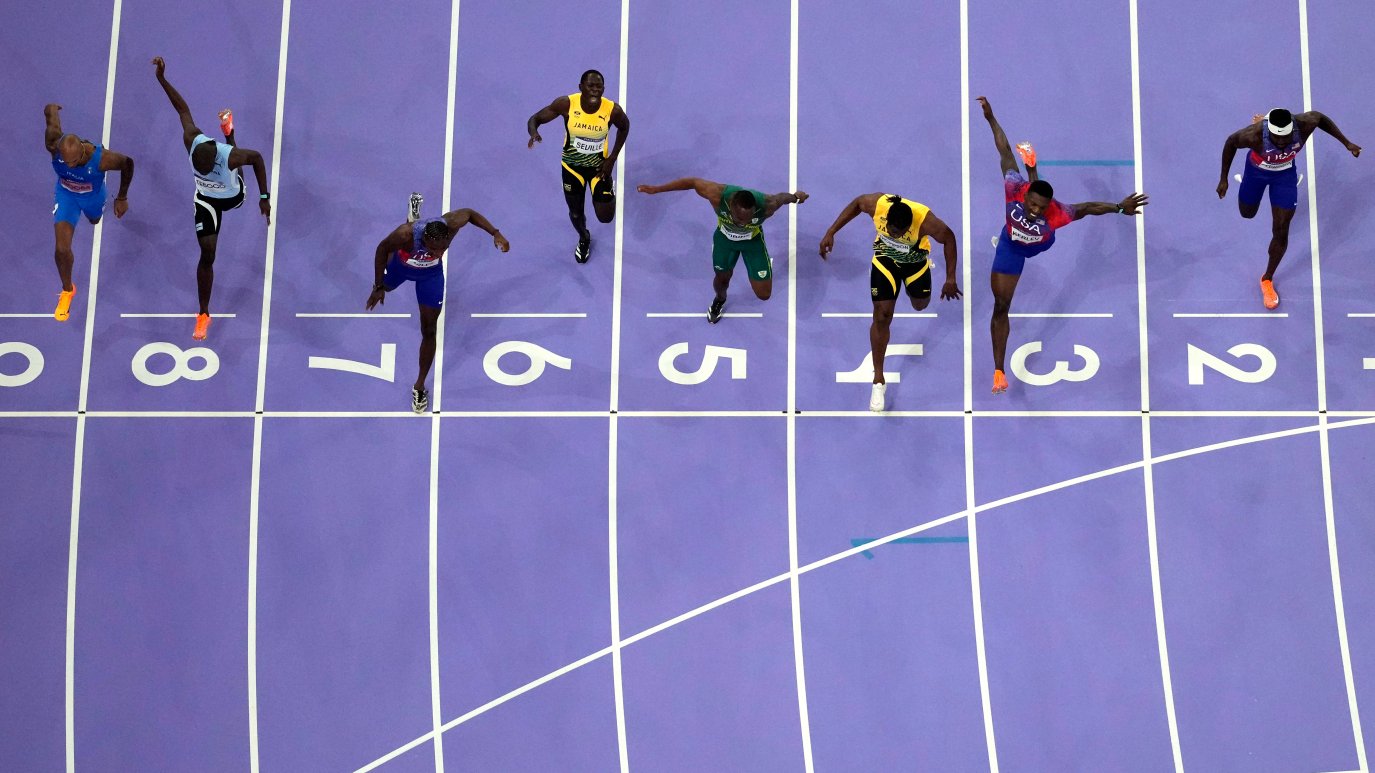
The 2024 Paris Olympics 100m final, held on August 4, 2024, at the Stade de France, stands as one of the most competitive races in modern track and field history. Noah Lyles of the United States secured the gold medal in a photo finish, clocking a personal best time of 9.79 seconds, edging out Jamaica’s Kishane Thompson by a mere five-thousandths of a second.
The Context of the 2024 Olympic 100m
The 100-meter sprint is traditionally considered the blue-ribbon event of the Summer Olympic Games. It represents the pinnacle of explosive human potential, testing the limits of acceleration, top-end speed, and mental fortitude under immense pressure. By 2024, the landscape of men’s sprinting had become increasingly globalized, with a new generation of athletes rising to challenge the traditional dominance of Jamaican and American sprinters.
Heading into the Paris Games, the field was remarkably deep. Unlike previous Olympic cycles where a clear, singular favorite might have emerged early in the season, the 2024 pre-Olympic circuit saw multiple athletes consistently clocking sub-9.90-second times. The inclusion of Kishane Thompson, who had dominated the Jamaican trials, and the continued high-profile career of Noah Lyles, who came into Paris as the reigning World Champion, created a palpable tension leading up to the final.
Analyzing the Final Field
The final composition was determined by a series of highly competitive semi-final heats. To reach the final, athletes needed not only to place within the top two of their respective heats but also to manage their physical output to ensure they had sufficient energy for the final race, which took place just hours later.
The finalists were:
- Noah Lyles (USA)
- Kishane Thompson (Jamaica)
- Fred Kerley (USA)
- Akani Simbine (South Africa)
- Lamont Marcell Jacobs (Italy)
- Letsile Tebogo (Botswana)
- Kenneth Bednarek (USA)
- Oblique Seville (Jamaica)
This lineup represented a diverse geographical spread, highlighting the growing competitiveness of African and European sprinters against the traditional North American powerhouses. The inclusion of Lamont Marcell Jacobs, the defending champion from Tokyo 2020, added a layer of historic stakes to the race.
The Race Mechanics: A Breakdown
The start of the 100m final is critical. At this elite level, reaction times are usually within a narrow window of 0.120 to 0.160 seconds. An athlete who reacts too slowly faces an immediate deficit that is difficult to recover from, given that the race is decided over such a short distance.
During the 2024 final, the field remained incredibly tight through the first 50 meters. Noah Lyles, known for his superior top-end speed and endurance during the second half of the race, started slightly behind his rivals. Kishane Thompson, in contrast, showcased a powerful drive phase that propelled him into an early lead.
As the athletes entered the final 30 meters, Lyles began his signature transition to "top gear." While many sprinters decelerate due to muscular fatigue, Lyles maintained his upright posture and frequency, allowing him to close the gap rapidly on Thompson. The final 10 meters were characterized by a desperate lean by both men. The official timing system—the Omega photofinish—eventually confirmed that Lyles had reached the line in 9.784 seconds, compared to Thompson’s 9.789 seconds.
Technical Performance Comparison
The performance of the top finishers in 2024 provided insights into modern sprint training methodologies, focusing on stride length and ground contact time.
| Athlete | Country | Reaction Time (s) | Final Time (s) | Placement |
|---|---|---|---|---|
| Noah Lyles | USA | 0.178 | 9.79 | 1st |
| Kishane Thompson | Jamaica | 0.176 | 9.79 | 2nd |
| Fred Kerley | USA | 0.108 | 9.81 | 3rd |
| Akani Simbine | South Africa | 0.134 | 9.82 | 4th |
| Lamont Marcell Jacobs | Italy | 0.151 | 9.85 | 5th |
| Letsile Tebogo | Botswana | 0.155 | 9.86 | 6th |
| Kenneth Bednarek | USA | 0.147 | 9.88 | 7th |
| Oblique Seville | Jamaica | 0.134 | 9.91 | 8th |
Note: Times for Lyles and Thompson were identical to the hundredth (9.79), with the thousandths differential determining the gold.
Factors Contributing to the Narrow Margins
Several technical factors contributed to the razor-thin margin between the top contenders.
1. The Drive Phase
The "drive phase" refers to the initial 20–30 meters where the runner remains in a crouched position to maximize force production against the track. In this final, the athletes who performed best were those who managed to transition from this low angle to an upright sprinting posture without "popping up" too early, which would cause them to lose momentum.
2. Stride Frequency and Length
Modern sprinting is a balance between stride frequency (how many steps per second) and stride length (how far each step covers). Lyles, having a taller frame, relies heavily on his ability to maintain a consistent stride length as the race progresses, a trait that helped him recover the distance lost at the start.
3. Environmental Conditions
The Stade de France track surface was engineered for energy return. The specific composition of the track material, combined with the atmospheric conditions in Paris on the evening of August 4, created an environment conducive to fast times. Athletes often adjust their spikes—specifically the length and configuration of the pins—to match the specific track hardness, which is a major variable in performance optimization.
Common Questions Regarding the 2024 100m Final
How was the winner determined when the times were identical? The 100m sprint is timed to the thousandth of a second using high-speed photo-finish cameras placed exactly at the finish line. While both Lyles and Thompson were credited with 9.79 seconds, the photo-finish showed Lyles' torso crossed the line roughly five-thousandths of a second earlier than Thompson's.
Why was the 100m final considered so historically close? It was one of the tightest fields in Olympic history. The difference between the gold medalist (9.79) and the eighth-place finisher (9.91) was only 0.12 seconds. This level of parity meant that any minor error in the start or a slight stumble in the transition could shift the entire podium.
Did the athletes use any specific technology to prepare? Elite sprinters utilize biomechanical analysis, which involves high-speed video tracking to measure joint angles and force vectors during the sprint. This data allows coaches to identify subtle inefficiencies, such as excessive lateral movement or suboptimal foot placement, which are corrected in training sessions leading up to the competition.
Is there a reason the 100m is the most watched event? The 100m final is the culmination of years of training for a race that lasts under ten seconds. The binary nature of the event—a clear winner and loser decided instantly—provides a high-stakes, easily understandable narrative that appeals to casual viewers and track enthusiasts alike.
How does training for a 100m final differ from other running events? Unlike middle or long-distance events that require aerobic capacity and endurance, the 100m is almost entirely anaerobic. Training focuses on maximum power output, central nervous system recovery, and explosive muscular recruitment. Athletes engage in heavy weightlifting to build fast-twitch muscle fiber efficiency, often using exercises that mimic the explosive nature of the start.
The Role of Mental Preparation
Beyond the physiological metrics, the 100m final is a battle of psychological resilience. Athletes must remain composed in the "call room" while dealing with nerves and intense media scrutiny. The ability to execute a pre-programmed race plan under the weight of an entire nation’s expectations is what differentiates the gold medalist from the rest of the field. Many sprinters utilize sports psychologists to refine their pre-race routines, ensuring they maintain a state of "relaxed intensity"—a psychological zone where they are alert and aggressive but not so tense that their muscles tighten, which would lead to a loss of form.
Legacy and Future Implications
The 2024 final solidified Noah Lyles’ position as a central figure in track and field and highlighted a shift in the sport's global balance of power. The results in Paris prompted national programs globally to re-evaluate their sprint pipelines, with increased investment in youth scouting and advanced sports science facilities. For the spectators, the race served as a reminder of the unpredictability of athletics, where the difference between glory and disappointment is measured in mere millimeters.
As the sport moves toward future competitions, the 2024 final will be referenced as the benchmark for depth and competitiveness in the modern era of sprinting. It demonstrated that as human performance reaches the ceiling of biological possibility, the marginal gains provided by technology, nutrition, and mental training become the decisive factors.
Final Recommendations for Aspiring Sprinters
For those looking to analyze or replicate the performances seen in Paris, the priority should be on mastering the fundamental mechanics of the start. Ensure that your drive phase is consistent, and prioritize regular timing sessions to identify exactly where your speed fluctuations occur. Working with a qualified coach to perform video gait analysis can help identify if your foot strike pattern is optimal for your physical build. Remember that explosive speed is a result of consistent, long-term training rather than a singular breakthrough. Focus on recovery protocols, such as adequate sleep and targeted muscle activation, to ensure your nervous system is prepared for the high-intensity loads required for sprinting.