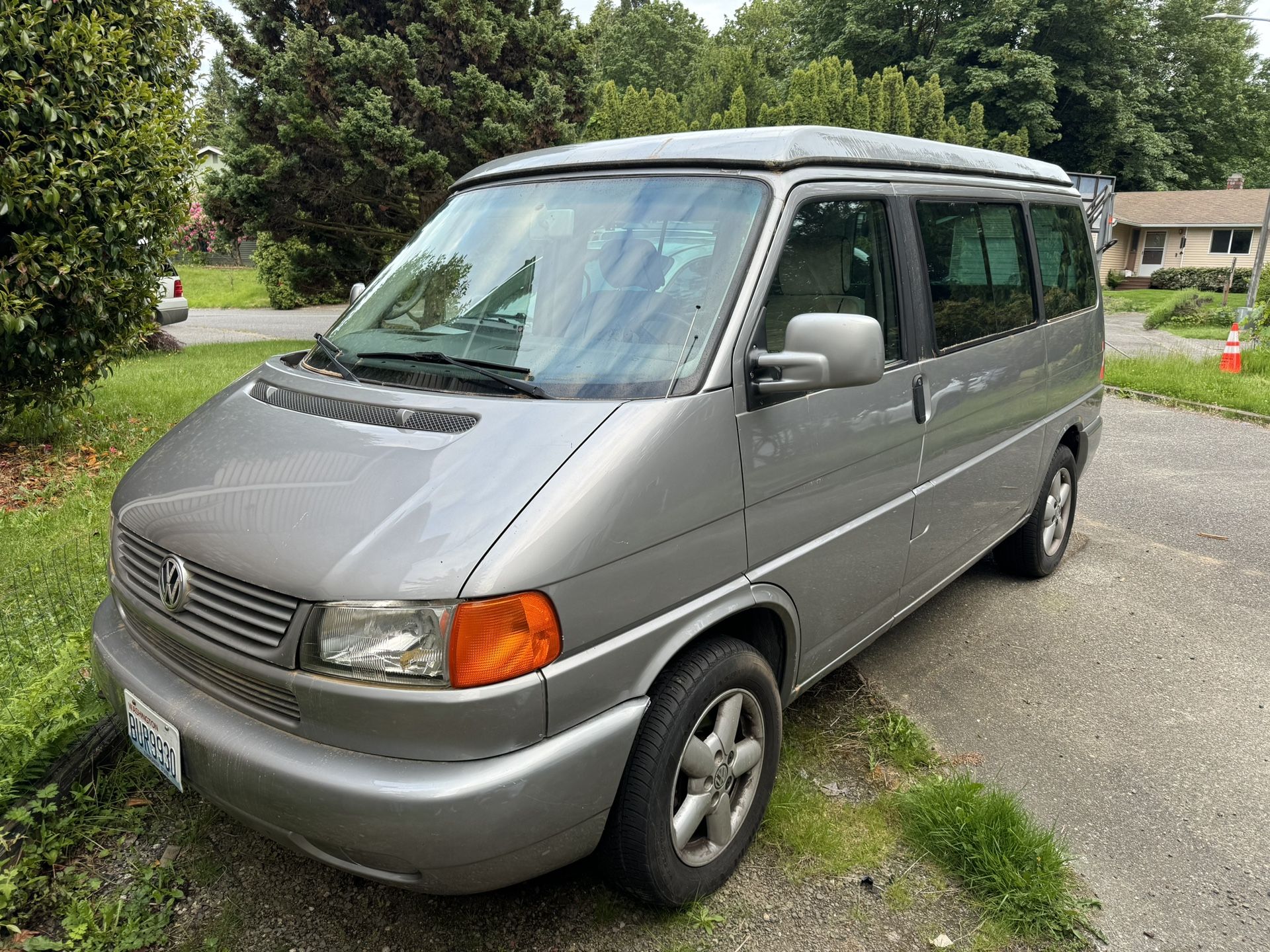
The 2003 Volkswagen EuroVan timeline marks the final chapter of Volkswagen’s front-engine, front-wheel-drive T4 van era in North America. This period concluded with the definitive phase of the Winnebago-converted Camper (MVV) and MultiVan variants, establishing a rare collector footprint defined by the 2.8-liter 24-valve VR6 engine and a reinforced chassis.
Introduction to the T4 Era and the Final 2003 Chapter
The Volkswagen EuroVan occupies a unique place in North American automotive history. As the direct successor to the rear-engine, air-cooled and later water-cooled Vanagon, the EuroVan introduced a modern layout featuring a front-mounted engine, front-wheel drive, and a liquid-cooled inline or V-format drivetrain. While the EuroVan was offered in various global markets under the Transporter or Caravelle names across multiple generations, North American buyers received a curated selection of models starting heavily in the 1993 model year, taking a brief hiatus for 1994, returning from 1995 through 2003, and ultimately bowing out due to shifting safety regulations and airbag requirements.
The year 2003 stands as the punctuation mark for this lineage. Understanding the 2003 Volkswagen EuroVan timeline requires exploring the technical evolution of the vehicle, the specific engineering updates that arrived in its final production year, and the aftermarket partnership with Winnebago Industries that turned standard chassis cabs into legendary camper vans. This comprehensive retrospective details the chronological milestones, mechanical progression, structural specifications, and enduring legacy of the 2003 Volkswagen EuroVan.
Pre-2003 Evolutionary Context: The Road to the Final T4
To comprehend the significance of the 2003 EuroVan, one must trace the vehicle's North American lineage from its bumpy introduction in the early 1990s through its mechanical renaissance at the turn of the millennium.
The 1993–1997 Phase: The 5-Cylinder Foundation
When Volkswagen launched the EuroVan in North America for the 1993 model year, it was powered by a 2.5-liter, five-cylinder gasoline engine producing approximately 109 horsepower. While praised for its interior packaging and car-like driving dynamics compared to the aging Vanagon, critics and owners quickly noted that the five-cylinder engine struggled under the immense weight of fully loaded camper configurations. After skipping the 1994 model year to restructure supply chains and evaluate demand, Volkswagen brought the EuroVan back for 1995 with minor adjustments, followed by the introduction of the long-wheelbase (LWB) chassis in 1997, which expanded cargo and living space significantly.
The 2000 Mechanical Revolution: Arrival of the 12-Valve VR6
The single most important milestone preceding the 2003 model year occurred in 2000. Volkswagen replaced the underpowered 2.5-liter inline-five with a 2.8-liter 12-valve VR6 engine, boosting output to 140 horsepower and 177 lb-ft of torque. This engine transformation made the EuroVan highway-capable and vastly improved its towing and climbing performance. Along with the VR6 came a robust heavy-duty 4-speed automatic transmission (the 01P unit), upgraded brakes, and modern electronic engine management systems.
The 2003 Model Year Chronology and Specifications
By 2003, Volkswagen had perfected the T4 platform for the North American market, equipping it with the most advanced powerplant the generation would ever receive: the 2.4-liter or rather 2.8-liter 24-valve VR6 engine.
Chronological Milestones of the 2003 Production Run
- Late 2002: Volkswagen of America announces that the 2003 model year will be the final production run for the EuroVan in the United States and Canada, citing upcoming federal airbag compliance standards that would require an expensive redesign of the T4 dashboard and steering architecture.
- First Quarter 2003: Assembly lines at the Hannover plant in Germany process the final batch of North American specification T4 chassis, routing specific allocations to Winnebago Industries in Forest City, Iowa, for camper conversion.
- Mid-2003: Dealerships receive the last shipments of the EuroVan MV (MultiVan) and EuroVan Camper. Special attention is paid to remaining inventory as enthusiast forums recognize the end of the line.
- Late 2003 / Early 2004: Official retail sales conclude, though remaining new units linger on dealership lots into early 2004. The T5 generation debuts in Europe but never crosses the Atlantic due to exchange rates and import tariffs (the Chicken Tax).
Technical Specifications Matrix
The 2003 Volkswagen EuroVan represents the pinnacle of T4 engineering. The table below outlines the core technical parameters of the final-year models.
| Specification | EuroVan GLS / MultiVan (MV) | EuroVan Camper (Winnebago) |
|---|---|---|
| Engine Type | 2.8L 24-valve VR6 (AXK) | 2.8L 24-valve VR6 (AXK) |
| Horsepower | 201 hp @ 6,200 RPM | 201 hp @ 6,200 RPM |
| Torque | 195 lb-ft @ 3,200 RPM | 195 lb-ft @ 3,200 RPM |
| Transmission | 4-speed electronic automatic (01P) | 4-speed electronic automatic (01P) |
| Drivetrain | Front-engine, front-wheel drive | Front-engine, front-wheel drive |
| Wheelbase | 132.5 inches (Long Wheelbase) | 132.5 inches (Long Wheelbase) |
| Seating Capacity | Up to 7 passengers | Sleeps 4, seats up to 4 with seatbelts |
| Curb Weight | Approx. 4,150 lbs | Approx. 5,731 lbs |
Mechanical Enhancements of the 2003 Powertrain
The defining mechanical characteristic of the 2003 EuroVan is the inclusion of the 24-valve VR6 engine, designated engine code AXK. Introduced for the 2002 model year and carried through 2003, this engine elevated output from the earlier 12-valve variant's 140 horsepower to a much healthier 201 horsepower, paired with 195 lb-ft of torque.
The 24-Valve VR6 Advantage
The 24-valve cylinder head utilized variable valve timing on both intake and exhaust camshafts, optimizing breathing across a broad rpm band. For a heavy vehicle like the Winnebago Camper, which routinely pushed gross vehicle weight ratings close to its limits, the extra 61 horsepower transformed the driving experience. Merging onto interstate highways and tackling mountain passes became markedly less stressful compared to the sluggish 5-cylinder variants of the mid-1990s.
Transmission Considerations
Power is routed through a heavy-duty 4-speed automatic transaxle. While robustly built to handle the VR6 torque curve, the 01P automatic transmission is widely recognized by mechanics and enthusiasts as the primary wear item on late-model EuroVans. Proper fluid maintenance, auxiliary transmission fluid cooling, and avoidance of excessive towing weight are critical operational prerequisites for preserving this transmission's longevity.
Trim Variations: MultiVan vs. Winnebago Camper
The 2003 EuroVan lineup in North America was strictly split into passenger-oriented and camping-oriented configurations, both utilizing the long-wheelbase chassis.
EuroVan MV (MultiVan) and GLS
The MultiVan was designed for executive transport, large families, and road-tripping versatility. Its cabin featured a configurable seating arrangement with removable middle-row bucket seats and a rear bench seat that folded flat into a sleeping surface. Integrated table modules, reading lights, and privacy curtains made it a flexible daily driver and weekend tourer. The GLS trim offered upgraded upholstery, automatic climate control, alloy wheels, and power accessories.
EuroVan Camper Built by Winnebago
The Winnebago-converted EuroVan Camper remains the most sought-after variant in the timeline. Winnebago took the raw LWB window van chassis and integrated a side-hinged pop-top roof, a pressurized water system, a propane-powered two-burner stove, a stainless steel sink, a refrigerator (running on 12V, 110V, or propane), a furnace, auxiliary house batteries, and cabinetry. This factory-authorized partnership ensured that buyers received a fully integrated recreational vehicle backed by both Volkswagen and Winnebago dealer networks.
Operational Limitations, Common Issues, and Maintenance
Owning and maintaining a 2003 Volkswagen EuroVan in modern times requires a clear understanding of its engineering quirks and service intervals. Because these vehicles are over two decades old, proactive maintenance is mandatory.
Transmission Durability and Cooling
The 01P automatic transmission operates under substantial thermal stress, particularly in camper configurations. Owners frequently install aftermarket auxiliary transmission fluid coolers to keep operating temperatures in check. Routine fluid and filter changes every 30,000 miles are essential to prevent valve body wear and premature failure.
Cooling System Integrity
The engine bay of the T4 EuroVan is tightly packaged, leading to elevated under-hood temperatures. Plastic coolant distribution pipes, expansion tanks, and thermostat housings are prone to embrittlement and cracking. Inspecting and replacing aging coolant hoses, water pumps, and auxiliary coolant pumps prevents catastrophic overheating events that can warp the aluminum cylinder head of the VR6 engine.
Timing Chain Service
While the 24-valve VR6 uses durable timing chains rather than a rubber belt, the chain guides and tensioners experience wear over time. Rattling noises upon cold startup serve as a primary diagnostic indicator that the timing chain assembly requires service—a labor-intensive procedure due to the tight transverse engine layout.
Frequently Asked Questions
Why was 2003 the final year for the Volkswagen EuroVan in North America?
Volkswagen discontinued the EuroVan in North America primarily due to impending federal safety regulations concerning airbag deployment speeds and passenger impact protection. Updating the T4 dashboard and restraint systems to meet these new standards was deemed economically unfeasible given the relatively low sales volume in the United States and Canada compared to European commercial markets.
What is the difference between the 12-valve and 24-valve VR6 engines in EuroVans?
The 12-valve VR6 was used in 2000–2001 EuroVans and produced 140 horsepower. The 24-valve VR6, introduced for 2002 and used exclusively through the 2003 model year, upgraded the cylinder head, added dual variable valve timing, and boosted output to 201 horsepower, dramatically improving acceleration and load-carrying capacity.
Are all 2003 EuroVans campers?
No. The 2003 lineup included passenger configurations such as the MultiVan (MV) and GLS, as well as the factory-authorized Winnebago Camper conversion. Passenger models feature flexible seating and fold-down beds, while Winnebago models include built-in kitchenettes, pop-top roofs, and auxiliary living systems.
Can a 2003 EuroVan be manually swapped if the automatic transmission fails?
Yes. Because the European T4 was frequently paired with manual transmissions, a dedicated enthusiast community has developed conversion kits and procedures to swap the failing 01P automatic transmission for a Euro-spec 5-speed manual transaxle, significantly increasing mechanical reliability and fuel efficiency.
What fuel economy can be expected from a 2003 EuroVan VR6?
Fuel economy varies significantly depending on vehicle weight and aerodynamics. A standard MultiVan typically achieves around 15 mpg city and 19 mpg highway, while the heavier Winnebago Camper generally averages 12 to 15 mpg depending on wind conditions, terrain, and driving style.
Conclusion and Next Actions
The 2003 Volkswagen EuroVan timeline represents the culmination of front-wheel-drive van engineering in North America before the market shifted entirely toward modern crossovers and full-size commercial vans. For prospective buyers, restorers, and enthusiasts, evaluating a 2003 model requires thorough inspection of the transmission service history, cooling system components, and structural condition of the camper pop-top canvas or MultiVan interior mechanisms. Prioritizing a pre-purchase inspection by a technician familiar with the VR6 engine platform ensures that this classic piece of automotive history remains a reliable vehicle for road trips and camping adventures.