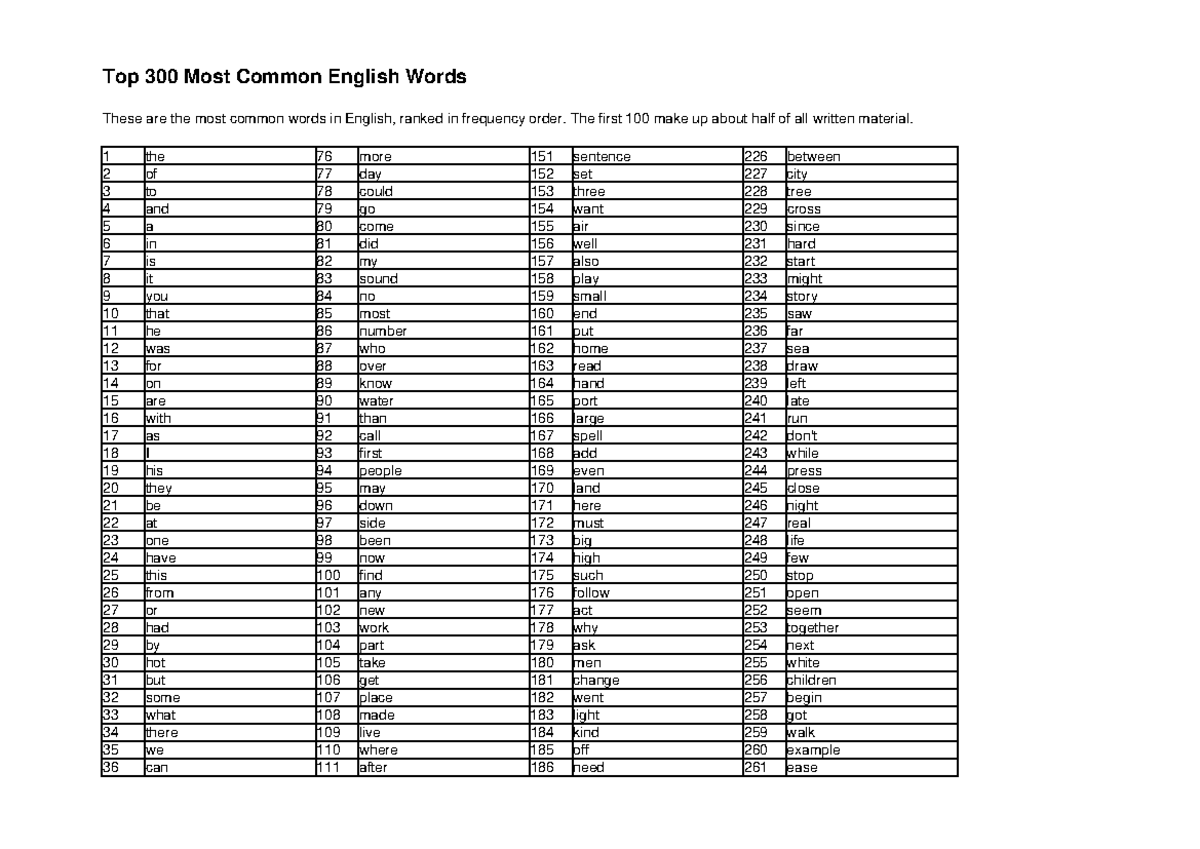
Understanding the 10 000 most common English words ranked by use provides a structural roadmap for language acquisition, lexicographical research, and natural language processing development. By examining frequency lists derived from massive corpora, learners and developers can prioritize vocabulary that maximizes comprehension and computational efficiency.
Understanding Word Frequency in the English Language
Language is inherently unbalanced in its distribution. A small fraction of terms accounts for the vast majority of everyday communication, while a vast periphery of specialized, archaic, or technical vocabulary makes up the rest. The concept of ranking the 10 000 most common English words rests on the empirical analysis of large bodies of text, known as corpora. These corpora include books, academic journals, transcribed speech, subtitles, and internet communications, allowing researchers to calculate exact occurrence frequencies.
The foundational principle governing word frequency is Zipf's Law, which states that the frequency of any word is inversely proportional to its rank in the frequency table. Consequently, the most common word appears roughly twice as often as the second most common word, and three times as often as the third. In practical terms, this mathematical distribution means that mastering a relatively small number of words yields an exponentially higher return on investment in terms of reading comprehension and conversational fluency.
Analyzing frequency lists requires distinguishing between word forms and lemmas. A lemma represents the base form of a word along with its inflected variants—for example, run, runs, ran, and running grouped under a single headword. While some frequency lists rank every unique surface form separately, advanced pedagogical and computational lists aggregate inflections to provide a more accurate picture of conceptual utility.
The Core Tiers of English Vocabulary Usage
To make a list of 10 000 words actionable, lexicographers typically break the hierarchy down into distinct operational bands. Each tier serves a different function in both human language acquisition and machine learning models, scaling from basic survival communication to professional-level literacy.
| Frequency Tier | Word Range | Cumulative Coverage | Primary Utility and Context |
|---|---|---|---|
| Tier 1: High-Frequency Core | 1 to 1,000 | ~85% of spoken text | Essential daily communication, structural grammar, and basic narrative comprehension. |
| Tier 2: Conversational Expansion | 1,001 to 3,000 | ~90% to 95% of general text | Standard news media, general fiction, and workplace correspondence. |
| Tier 3: Advanced Literacy | 3,001 to 5,000 | ~95% to 98% of standard text | Academic papers, complex literature, and professional essays. |
| Tier 4: Specialized & Peripheral | 5,001 to 10,000 | ~98% to 99%+ of comprehensive text | Niche terminology, literary nuances, passive vocabulary, and technical domains. |
Tier 1: The Essential Core (1–1,000 Words)
The first thousand words form the bedrock of the English language. This tier is heavily populated by grammatical glue: pronouns (he, she, it), auxiliary verbs (is, have, do), prepositions (in, on, at), and fundamental nouns and verbs (time, person, go, see). Without this foundational block, constructing a grammatically coherent sentence is impossible. Studies of conversational corpora indicate that mastering this initial tier allows an individual to understand roughly 85% of spoken English in casual contexts.
Tier 2: Conversational and Media Fluency (1,001–3,000 Words)
Expanding from one thousand to three thousand words bridges the gap between basic survival language and functional literacy. Words in this range include descriptive adjectives (happy, dangerous, complex), abstract nouns (success, theory, decision), and secondary verbs (achieve, determine, establish). This is the threshold where individuals can comfortably read standard newspapers, enjoy mainstream films without subtitles, and engage in professional discussions outside their immediate area of expertise.
Tier 3: Academic and Professional Range (3,001–5,000 Words)
As the ranking moves past the three thousand mark, the vocabulary shifts toward formal, academic, and literary expression. Words found in this bracket frequently appear in textbooks, financial reports, and sophisticated editorials. While native speakers acquire these terms naturally through extensive reading and formal education, language learners must often study them intentionally to pass standardized proficiency examinations such as the IELTS or TOEFL.
Tier 4: The Long Tail of Vocabulary (5,001–10,000 Words)
The upper half of a ten-thousand-word inventory represents the long tail of English usage. This tier contains specialized vocabulary, regional idioms, archaic terms, and domain-specific jargon that appear infrequently even in native discourse. While knowing these words yields diminishing returns for daily conversation, they are crucial for advanced literary appreciation, specialized academic research, and eliminating comprehension bottlenecks in technical reading.
Methodologies Behind Frequency Ranking
Generating an accurate list of the 10 000 most common English words requires sophisticated linguistic tools and massive datasets. Early frequency dictionaries, such as those compiled by Edward Thorndike and Irving Lorge in the mid-20th century, relied on manual counts of printed books and school texts. Today, computational linguistics relies on multi-billion-word corpora processed through automated algorithms.
Modern rankings typically draw from several benchmark datasets:
- The Corpus of Contemporary American English (COCA): A massive, genre-balanced corpus containing over one billion words of spoken text, fiction, popular magazines, newspapers, and academic writing.
- The British National Corpus (BNC): A 100-million-word collection samples from written and spoken British English, providing a balanced cross-section of 20th-century language use.
- Subtlex-US: A frequency list derived from American film and television subtitles, which often provides a more accurate reflection of modern spoken idiom and informal register than written corpora alone.
Researchers combine these sources to eliminate genre-specific biases. For instance, a list derived purely from academic journals would drastically overrepresent words like hypothesis or methodology, while a list derived solely from Twitter (X) data would skew toward slang, abbreviations, and temporal pop-culture references. Balancing these inputs ensures that a 10,000-word ranking accurately reflects general-purpose English.
Practical Applications for Language Learners
For second-language learners, knowing the 10 000 most common English words ranked by use transforms an overwhelming lexicon into a manageable, linear curriculum. However, attempting to memorize a list of ten thousand words in isolation is an inefficient strategy. Instead, learners leverage frequency data to structure their study habits.
Pareto Principle in Vocabulary Acquisition
The Pareto Principle (the 80/20 rule) applies directly to language acquisition. The first 1,000 words account for the vast majority of everyday communicative needs. As learners climb the frequency ladder, the amount of effort required to bridge comprehension gaps increases while the percentage of new text covered decreases. Understanding this curve prevents learners from burning out on obscure vocabulary before mastering the high-utility core.
Active Versus Passive Vocabulary
Frequency lists also help distinguish between active and passive vocabulary goals. Passive vocabulary consists of words a reader or listener recognizes and understands in context, while active vocabulary includes terms an individual can correctly produce in speech or writing. For the upper tiers of a 10,000-word list (specifically entries 5,000 to 10,000), passive recognition is often sufficient for reading comprehension, whereas Tiers 1 through 3 require active mastery.
Computational Linguistics and Natural Language Processing
Beyond human pedagogy, 10,000-word frequency rankings serve as critical training data for natural language processing (NLP) models, search engine algorithms, and machine translation systems.
When training large language models or building text-to-speech engines, developers use frequency rankings to:
- Tokenization Optimization: Designing vocabulary tokenizers that efficiently compress common words into single tokens while handling rare words through subword segmentation.
- Stop-Word Filtering: Identifying high-frequency, low-semantic-value words (such as the, and, of) that can be filtered out during information retrieval tasks to speed up search indexing.
- Readability Metrics: Calculating text complexity scores by analyzing the proportion of rare versus common words present in a given document.
Frequently Asked Questions
How many words do native English speakers know?
A native adult English speaker typically has a receptive vocabulary of 20,000 to 35,000 words, depending on their level of education. However, active daily usage relies on a much smaller subset, usually centered around the top 3,000 to 5,000 lemmas.
Does a 10,000-word list include proper nouns and slang?
Standard frequency lists generally exclude proper nouns (such as specific names of people, cities, or brands) and highly transient internet slang. They focus on common lexical items, including nouns, verbs, adjectives, and adverbs that maintain stable utility across decades.
Why do different frequency lists rank words differently?
Variations between lists stem from the underlying corpus used for the study. A list compiled from academic texts will rank scholarly terms higher, whereas a list compiled from television transcripts will prioritize conversational filler, idioms, and colloquialisms.
Is it necessary to learn all 10,000 words to be fluent?
No. Complete fluency and professional working proficiency can typically be achieved with a solid command of the top 3,000 to 5,000 words. The remaining entries in a 10,000-word list are primarily required for specialized reading, native-like nuance, and advanced literary comprehension.
How should I use a frequency list for studying?
Rather than rote memorization, use frequency lists to guide your reading materials and flashcard applications. Pair vocabulary study with extensive reading of graded readers, news articles, and books that match your current tier to see the words used in natural contexts.
Next Steps for Vocabulary Expansion
To apply a 10 000 most common English words ranked by use effectively, begin by assessing your current comprehension baseline through standardized vocabulary tests or reading samples. If you are a beginner, focus exclusively on the top 1,000 words before branching out. If you are an intermediate or advanced learner, isolate the 3,000 to 6,000 range to target the specific gaps holding back your reading comprehension in academic or professional environments. Combine targeted vocabulary review with daily exposure to authentic English media to reinforce recognition and retention over time.