Agentic CRM for insurance refers to customer relationship management platforms that utilize autonomous AI agents to perform complex, multi-step insurance workflows—such as policy quoting, renewals, and claims triaging—with minimal human intervention. Unlike traditional CRMs, these systems leverage reasoning loops and tool-use capabilities to proactively manage the policyholder lifecycle and operational tasks.
The insurance industry has long been burdened by administrative overhead, fragmented data, and the high cost of personalized service. In 2026, the transition from traditional "systems of record" to "agentic systems of action" has reached a critical tipping point. This evolution represents a fundamental shift in how insurance carriers, agencies, and brokers interact with their data and their customers.
The Evolution of CRM in the Insurance Sector
To understand the impact of agentic CRM, one must look at the progression of the technology. For decades, CRMs were glorified digital rolodexes—databases where agents manually entered notes and tracked policy numbers. The "Cloud Era" (2010–2020) made this data accessible from anywhere but did little to reduce the manual labor required to manage it.
The "AI-Augmented" phase (2023–2024) introduced generative AI features, such as email drafting and call summarization. However, these tools still required a human to trigger every action and verify every output. In 2026, the agentic CRM has emerged. These systems do not wait for a command; they are given goals. An agentic CRM can identify a policy about to lapse, analyze the customer’s recent life events (like a home purchase), cross-reference current underwriting guidelines, and execute a multi-channel retention campaign autonomously.
This shift is driven by the integration of Large Language Models (LLMs) with specialized "tools"—APIs that allow the AI to interact with external databases, state DMVs, weather reporting services, and claims processing software. The CRM is no longer a passive container for information; it is an active participant in the business.
Core Capabilities of Agentic CRM in 2026
The primary differentiator of an agentic system is its ability to reason through a problem and utilize tools to solve it. In the context of insurance, this manifests in several high-value areas.
Autonomous Underwriting Assistance
While fully automated underwriting has existed for simple products like travel insurance, agentic CRMs handle the nuance of complex commercial or life policies. The AI agent can autonomously gather missing data by contacting the applicant, verify medical records via secure portals, and flag specific risk factors for a human underwriter. This reduces the "ping-pong" effect of information requests that typically delays policy issuance.
Proactive Policy Management and Renewals
Retention is the lifeblood of the insurance industry. Agentic CRMs monitor data streams in real-time. If a policyholder’s credit score changes or if they move to a high-risk area, the agentic CRM can recalculate the risk profile and suggest—or even implement—policy adjustments. During the renewal window, the agent doesn't just send a generic notice; it reviews the entire year of the client's history and prepares a personalized renewal package that addresses specific changes in their risk exposure.
Intelligent Claims Triaging
When a catastrophe strikes, claims volume can overwhelm manual operations. Agentic AI agents can handle the initial intake, analyze uploaded photos using computer vision, and determine if a claim meets the criteria for "straight-through processing." For more complex claims, the agent gathers the necessary police reports and adjustor notes, presenting a complete file to the human specialist, thereby cutting days off the settlement cycle.
Technical Architecture of Agentic CRM
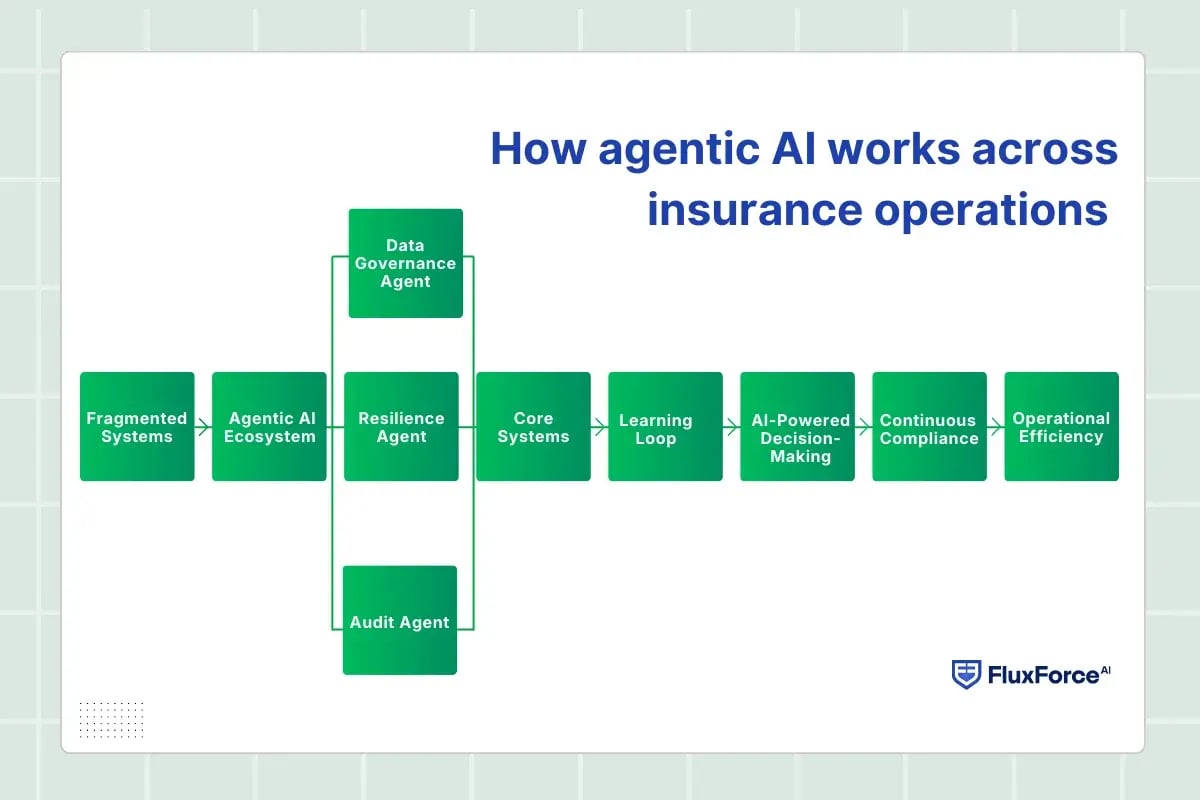
The "agentic" nature of these platforms relies on a sophisticated technical stack that goes beyond simple database management.
- Reasoning Engine: This is typically an LLM (such as GPT-4o, Claude 3.5, or a specialized insurance-tuned model) that uses frameworks like ReAct (Reason + Act) to plan its steps.
- Tool Integration (Function Calling): The CRM must be able to "call" external functions. For an insurance agent, this means having the authority to query a Motor Vehicle Record (MVR) database or check a property’s "Comprehensive Loss Underwriting Exchange" (CLUE) report.
- Retrieval-Augmented Generation (RAG): To remain accurate, agents must access a carrier’s specific, up-to-date policy documents and state-specific regulations. RAG allows the agent to pull the exact wording from a 2026 policy form to answer a customer's question without "hallucinating."
- Memory Management: The system maintains long-term memory of customer preferences and short-term "task memory" to ensure it doesn't repeat failed attempts at a process.
Comparing CRM Generations in Insurance
| Feature | Traditional CRM (Legacy) | AI-Augmented CRM (2024) | Agentic CRM (2026) |
|---|---|---|---|
| Primary Function | Data Entry & Storage | Content Generation | Goal Execution |
| Workflow | Manual / Rules-based | Human-triggered AI | Autonomous Reasoning |
| Data Handling | Structured Data only | Text Summarization | Multi-modal (Text, Voice, Image) |
| Customer Interaction | Form Letters | Chatbots (FAQ based) | Autonomous Problem Solving |
| Decision Support | Basic Reporting | Predictive Analytics | Prescriptive Action & Execution |
| Integration | Siloed / API limited | Connected Data | Orchestrated Tool Use |
Implementation Prerequisites and Strategy
Transitioning to an agentic CRM is not a "plug-and-play" endeavor. Insurance organizations must address several foundational layers before deploying autonomous agents.
Data Governance and Hygiene
An agentic AI is only as effective as the data it accesses. If the CRM contains duplicate records or outdated policy information, the AI agent will execute actions based on false premises. Organizations must implement robust data cleaning and master data management (MDM) protocols. In 2026, most leading carriers utilize a "Data Fabric" architecture to ensure the AI agent has a unified view of the customer across claims, billing, and policy administration.
API Connectivity
Agentic systems require high-velocity access to external and internal systems. Legacy "green-screen" mainframe systems often found in older insurance companies must be wrapped in modern API layers. Without this, the AI agent is "blind and paralyzed," unable to retrieve data or push updates to the core systems.
Regulatory and Ethical Compliance
Insurance is one of the most heavily regulated industries globally. In the United States, the National Association of Insurance Commissioners (NAIC) has established frameworks for the use of AI in insurance. Agentic systems must be designed with "explainability." If an AI agent denies a claim or increases a premium, there must be a transparent audit trail showing the reasoning and the data sources used. Furthermore, compliance with the EU AI Act (for those operating in Europe) requires rigorous risk assessments for autonomous systems.
Challenges and Risk Mitigation
Despite the efficiency gains, agentic CRMs introduce new risks that require careful management.
- Autonomous Error (Hallucinations): While RAG reduces errors, the risk of an agent misinterpreting a complex policy clause remains. To mitigate this, insurance firms use "guardrails"—software layers that restrict the agent’s actions based on predefined thresholds (e.g., an agent can approve a claim up to $5,000 but must flag anything higher for human review).
- Security and Privacy: Giving an AI agent the ability to "act" means giving it access to sensitive Personal Identifiable Information (PII) and Protected Health Information (PHI). End-to-end encryption and strict identity and access management (IAM) are non-negotiable.
- Change Management: The role of the insurance agent is shifting from "administrator" to "advisor." This requires significant upskilling. Staff must learn to oversee and "prompt-engineer" their digital counterparts rather than performing the manual tasks themselves.
The Future of Agency Operations
As we move through 2026, the competitive landscape is dividing between those who use agentic systems and those who do not. Agencies utilizing agentic CRMs are seeing a 40–60% reduction in "time-to-quote" and a significant increase in policyholder lifetime value due to more frequent, relevant touchpoints.
The ultimate goal is "Segment of One" marketing and service. In this model, every policyholder feels like they have a dedicated personal assistant who understands their specific risks and life changes. This level of hyper-personalization was previously impossible at scale, but agentic CRM makes it the standard operating procedure.
FAQ
What is the difference between a chatbot and an agentic CRM?
A chatbot is typically reactive and follows a pre-defined decision tree or generates text based on a prompt. An agentic CRM is proactive and goal-oriented. While a chatbot might answer "How do I file a claim?", an agentic CRM will say, "I see you were in an area with a major hail storm; I have already started a draft claim for your roof based on the weather data. Would you like me to submit it?"
Does an agentic CRM replace human insurance agents?
No. Instead, it replaces the repetitive, low-value tasks that consume up to 70% of an agent's day. This allows human agents to focus on high-stakes negotiations, complex risk consulting, and building deep emotional relationships with clients, which AI cannot replicate.
Is agentic CRM compliant with insurance regulations?
It can be, provided it is implemented with "Human-in-the-Loop" (HITL) triggers and clear auditability. Regulators like the California Department of Insurance and the NAIC require that AI-driven decisions be non-discriminatory and explainable. Agentic CRMs in 2026 are built with "Transparency Logs" to meet these requirements.
How long does it take to implement an agentic CRM?
A full-scale migration for a mid-to-large carrier typically takes 12 to 18 months. This includes data normalization, API integration, and the training of the agents on the company's specific product library and "underwriting appetite."
What are the typical costs associated with agentic CRM?
Costs generally include a per-user license fee (often higher than traditional CRM due to the compute cost of LLMs) plus "token" or "execution" fees for the autonomous tasks performed. However, the ROI is usually measured by a reduction in the "Expense Ratio" and an increase in "Retention Rates."
Final Recommendation
For insurance organizations looking to remain competitive in 2026, the move toward agentic CRM is no longer optional. Start by identifying the most friction-heavy workflow in your current lifecycle—typically claims intake or renewal processing—and run a pilot program with an agentic layer. Ensure that your data strategy is robust and that your compliance team is involved from day one. The goal is not just to automate, but to create a more responsive, intelligent, and human-centric insurance experience.