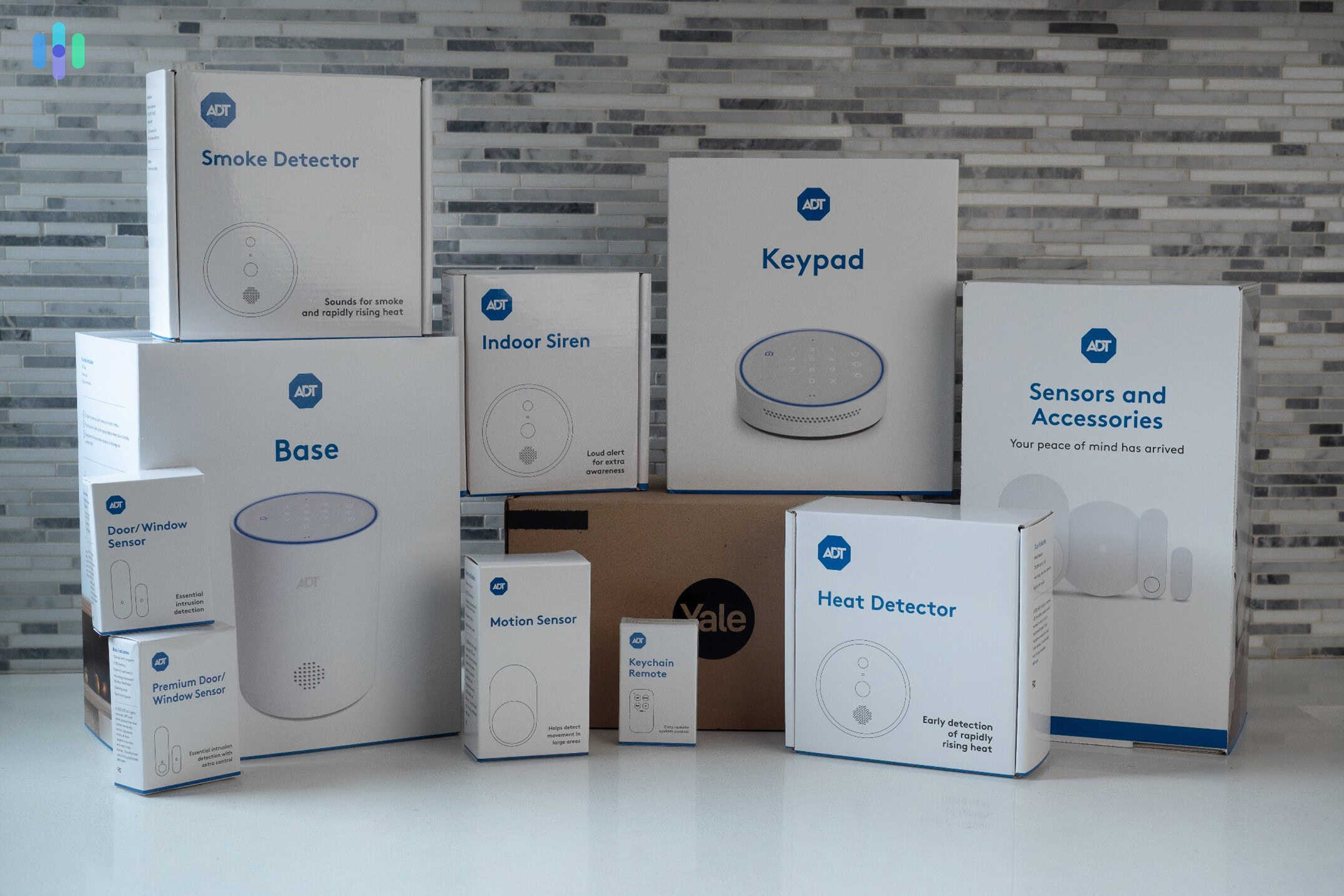
An ADT home security system provides professional-grade perimeter protection, indoor detection, environmental hazard monitoring, and smart home automation backed by 24/7 monitoring centers. Modern ADT systems blend traditional hardwired or wireless intrusion detection with Google Nest smart cameras and Z-Wave control, available through professionally installed custom packages or flexible self-setup options.
How the ADT Home Security System Works
At its core, an ADT home security system functions as an interconnected network of sensors, cameras, and user-interface control panels linked directly to ADT’s dedicated monitoring centers. When a sensor detects unauthorized entry, smoke, glass breakage, or water leaks, it sends a rapid signal to the main control hub. The hub immediately transmits this alarm event to ADT’s automated monitoring network while simultaneously sounding a local siren to deter intruders.
Signal transmission relies on dual-path technology, using your primary home Wi-Fi network or broadband connection alongside a dedicated cellular backup module. This dual-path approach ensures that even if an intruder cuts your landline wires or an internet outage occurs, the system maintains contact with emergency dispatchers via encrypted cellular channels. Furthermore, in the event of a localized power outage, an internal backup battery inside the central hub keeps the basic alarm functions operational for up to 24 hours.
- ADT Central Control Hub (Dual-Path Signal: Broadband Wi-Fi + Encrypted Cellular Backup)
- Intrusion Sensors (Door/Window, Motion, Glass Breakage)
- Environmental Sensors (Smoke, CO, Flood/Temperature Sensors)
- Video Surveillance (Google Nest Cams, Doorbell Cameras)
- ADT 24/7 Monitoring Center Network (SMART Signal Verification & Emergency Dispatch)
ADT utilizes a system called SMART Monitoring (System Monitoring and Response Technology) to streamline emergency verification. When an alarm triggers, the system can send instant text alerts to designated household contacts via the ADT Control or ADT+ mobile apps. Users can immediately verify or cancel the alarm with a single tap, drastically reducing false alarm fines from local law enforcement and speeding up dispatch times when a genuine threat occurs.
System Architecture and Core Hardware Components
Modern ADT equipment is split between core security sensors and smart video devices integrated through strategic hardware partnerships, primarily with Google. Understanding the hardware architecture helps homeowners evaluate which components best fit their home layout.
Control Panels and Base Stations
The control panel serves as the brain of the security ecosystem. ADT primarily offers two central hubs depending on your installation path:
- ADT Command Touchscreen Panel: Used primarily for custom professional installations, this 7-inch wall-mounted or tabletop touchscreen serves as an all-in-one control hub. It supports up to 128 wireless zones, features built-in Bluetooth disarming, and takes a snapshot via an integrated panel camera whenever the alarm is disarmed.
- ADT Smart Hub (ADT+ System): Primarily utilized in self-setup and modular installations, this compact tabletop base station connects to your home network, features a built-in keypad, emergency panic buttons, and an integrated siren. It communicates with sensors using secure, encrypted wireless protocols.
Intrusion Detection Hardware
Security begins at the perimeter of the home. ADT equips residences with several specialized sensors:
- Door and Window Contact Sensors: Micro-switch sensors installed on entry frames. When the magnetic connection between the frame sensor and the door magnet breaks, an alarm triggers.
- Passive Infrared (PIR) Motion Detectors: Designed to scan indoor open spaces, these sensors detect heat signatures in movement. Advanced models feature pet immunity, ignoring domestic animals weighing up to 60 or 80 pounds to eliminate false triggers.
- Glass Break Detectors: Using acoustic frequency technology, these sensors listen specifically for the sound frequency of breaking plate, tempered, or laminated glass within a 25-foot radius.
| Component | Primary Function & Coverage |
|---|---|
| Door/Window Sensors | Perimeter entry contact breaks |
| PIR Motion Detectors | Heat-signature motion tracking (Pet immune) |
| Glass Break Detectors | Acoustic sensor (25 ft window coverage) |
Environmental Hazard Sensors
Beyond crime prevention, ADT systems protect physical property from natural hazards. Life-safety equipment remains active 24/7, even when the primary security system is disarmed:
- Smoke and Heat Detectors: Combined photoelectric sensors detect smoldering fires while thermal sensors monitor sudden ambient temperature spikes.
- Carbon Monoxide (CO) Detectors: Electrochemical sensors detect invisible, odorless CO gas, sending an instant alert to the panel and monitoring station.
- Water Leak and Freeze Sensors: Placed near water heaters, washing machines, or basements, these devices trigger alerts upon contact with liquid or when ambient temperatures drop near freezing to prevent burst pipes.
Video Surveillance Integration
ADT fully integrates Google Nest hardware into its smart security packages. Video streams, recorded clips, and smart AI alerts are managed via the Google Home app and synchronized with ADT monitoring services:
- Google Nest Doorbell (Battery or Wired): Provides high-definition video with a vertical field of view, night vision, HDR, and intelligent alerts that distinguish between people, packages, vehicles, and animals.
- Google Nest Cam (Indoor/Outdoor): Battery-powered or wired security cameras that can be placed on exterior walls or interior shelves. They support continuous recording options, two-way audio talk, and local storage fallback during internet outages.
- Google Nest Cam with Floodlight: Combines dual LED floodlights with a motion-activated security camera for exterior perimeter surveillance.
ADT Installation Models: Professional vs. Self-Setup
ADT provides two distinct delivery models to suit different technical skills, living arrangements, and financial preferences: Custom Professional Installation and ADT Self-Setup.
| Professional Installation | ADT Self-Setup (DIY) |
|---|---|
| Tech custom designs & installs | User unboxes & sticks sensors to walls |
| Hardwired or wireless options | Fully wireless Z-Wave / Wi-Fi setup |
| Multi-year contract standard | No long-term contract option available |
| Best for larger homes & complex smart home configurations | Best for apartments, rentals, or small single-family residences |
Professional Installation
Under the traditional professional route, an ADT certified technician conducts an on-site security assessment of your property. The installer mounts hardware, hardwires panel power lines, configures Z-Wave automation routines, and verifies signal strength for every door, window, and camera.
This path is ideal for larger homes, complex architectural layouts, or properties requiring hardwired retrofits of existing security equipment. However, professional installation typically requires an installation fee (ranging from $99 to several hundred dollars depending on hardware scope) and standard 36-month monitoring contracts (24 months in California).
ADT Self-Setup
ADT Self-Setup (an evolution of the former Blue by ADT platform) is designed for renters, apartment dwellers, or budget-conscious homeowners. Equipment arrives pre-paired to the central hub. Users attach sensors using high-strength adhesive backing, plug in the base station, and configure settings using the ADT+ app.
Self-setup systems do not mandate long-term service contracts. Users can opt for month-to-month professional monitoring or self-monitoring while retaining full access to mobile app control, live camera streams, and custom notification parameters.
Smart Home Automation and Ecosystem Compatibility
Modern security systems act as the central hub for home automation. ADT achieves this through built-in Z-Wave wireless radios and high-level software integration with major smart home platforms.
ADT Control Hub
- Z-Wave Radios (Locks, Lights, Thermostats)
- Google Nest Native Cloud API Bridge
- Smart Voice Platforms (Alexa/Siri)
Z-Wave Protocol Support: The ADT Command panel and Smart Hub act as Z-Wave controllers. This allows homeowners to pair third-party devices such as Kwikset, Yale, or Schlage smart locks, Jasco smart light switches, and Honeywell or Trane smart thermostats. Users can create automated rules—such as setting the thermostat back and locking all doors automatically whenever the security system is armed in "Away" mode.
Google Home Ecosystem: Because of ADT’s equity partnership with Google, Nest products integrate directly with ADT monitoring. Video clips captured by Nest cameras can be accessed alongside alarm status information, and camera motion events can trigger home automation rules within the Google Home application.
Amazon Alexa and Apple HomeKit: ADT security systems support voice control via Amazon Alexa skill integration, enabling commands like "Alexa, arm ADT in Stay mode." Select ADT Command systems offer limited Apple HomeKit compatibility for Siri voice control and integration within Apple's Home app ecosystem.
Breakdown of Packages, Costs, and Monitoring Fees
Understanding ADT's pricing structure requires separating equipment costs, installation fees, and ongoing monthly subscription rates.
System Package Comparison
| Service Tier / Package | Key Included Hardware | Primary Monitoring Features | Typical Contract Requirement | Recommended User |
|---|---|---|---|---|
| Build Your Own (Self-Setup) | Base Hub, Door/Window Sensors, Motion Detector | Optional Month-to-Month Pro Monitoring or Self-Monitoring | No contract required | Renters, condo owners, DIY users |
| Essential Security (Pro Install) | Command Panel, 3x Door/Window Sensors, Motion Sensor | 24/7 Professional Intrusion & Cellular Backup Protection | 36-Month Contract | First-time buyers, small homes |
| Complete Security (Pro Install) | Touchscreen Panel, Entry Sensors, Motion Sensor, Flood/Smoke Detection | 24/7 Intrusion + Environmental Hazard Protection | 36-Month Contract | Standard single-family homes |
| Smart Home & Video (Pro Install) | Touchscreen Panel, Entry Sensors, Google Nest Doorbell & Outdoor Cam, Smart Lock | 24/7 Intrusion, Environmental Protection, Video Storage & Smart Automation | 36-Month Contract | Large homes wanting full automation |
Equipment Costs vs. Subscription Rates
- Equipment Expenses: Basic professional packages start at roughly $599, scaling past $1,500 to $2,000 for homes requiring multiple smart cameras, environmental sensors, and expanded perimeter protection. Equipment costs can be paid upfront or financed over 36 to 60 months for qualified buyers.
- Monthly Monitoring Fees: Professional monitoring rates range from approximately $29.99 to $60.00+ per month. Basic landline/wireless monitoring tiers occupy the lower price bracket, while plans that include video analytics, cloud clip storage, and full Z-Wave automation occupy the higher tier.
Key Advantages and Operational Drawbacks
Evaluating ADT requires weighing its high-tier operational support against its cost and contract structure.
Key Advantages
- Redundant Monitoring Infrastructure: ADT operates multiple interconnected monitoring centers across North America. If severe weather or a technical glitch takes one center offline, call volume seamlessly transfers to another center without service interruption.
- Integrated Life Safety: ADT’s 24/7 monitoring applies equally to fire, medical panics, and carbon monoxide alerts, dispatching emergency personnel even if homeowners are asleep or away from home.
- Extensive Google Integration: Native support for Google Nest cameras provides advanced video analytics—including package detection and facial recognition—backed by professional monitoring dispatch.
- Flexible Options: The availability of both custom professional installation and DIY self-setup gives users choices between hands-off expert execution and contract-free flexibility.
Operational Drawbacks
- Long-Term Contract Commitments: Standard professional installations mandate a 36-month monitoring agreement (24 months in California). Terminating service early can trigger cancellation penalties equal to a significant percentage of the remaining balance.
- Higher Overall Lifetime Cost: ADT’s monthly monitoring rates and equipment prices generally run higher than unmonitored DIY alternatives like Ring or SimpliSafe.
- Third-Party Dealer Network: ADT sells products both directly and through an Authorized Dealer network. Customer service experiences, equipment bundling, and installation quality can vary depending on whether you work with ADT corporate directly or a regional third-party dealer.
System Maintenance and Common Troubleshooting
To maintain reliable operation, ADT system owners should perform periodic maintenance and understand basic system troubleshooting protocols.
| Task | Recommended Frequency & Standard Procedure |
|---|---|
| System Test Mode | Monthly (via ADT app or keypad prior to testing) |
| Battery Maintenance | Every 3–5 years (CR123A / CR2032 lithium cells) |
| Sensor Re-syncing | As needed (Power cycle sensor & clear fault code) |
| Wi-Fi Re-pairing | Post-router updates (Re-link panel via settings) |
Performing a System Walk-Test
Homeowners should place their system into "Test Mode" at least once a month to verify sensor responsiveness without triggering false alarms to emergency dispatchers:
- Log into the ADT Control app or call ADT support to place the account in Test Mode for one hour.
- Arm the system in Away Mode while inside the house.
- Open each monitored door and window one by one, walking past motion sensors to trip them.
- Confirm that the central panel logs a trigger event for each specific sensor zone.
- Exit Test Mode via the app or keypad menu.
Replacing Wireless Sensor Batteries
Most wireless perimeter sensors use CR123A or CR2032 lithium coin batteries lasting between 3 to 5 years. When a sensor battery drops below operational voltage, the central panel displays a "Low Battery" warning accompanied by an alert chime.
- Open the sensor housing using a flathead screwdriver or by pressing the release tab.
- Remove the depleted battery and wait 30 seconds to allow the internal capacitor to fully drain.
- Insert the fresh lithium battery, observing correct polarity (+/-).
- Snap the cover shut. Disarm the system twice from the main panel to clear the low-battery warning from memory.
Resolving Cellular and Broadband Communication Errors
If the central panel shows a "Communication Failure" or "FC" error code, the system has lost connection to ADT monitoring:
- Wi-Fi Issues: If your home broadband connection changes (such as installing a new router or changing your network password), access the panel's internal settings menu to re-select your home Wi-Fi SSID and enter the new passkey.
- Cellular Module Power Cycle: If Wi-Fi is functional but the error persists, perform a soft reset. Disconnect the transformer plug from the wall outlet, open the panel cabinet, disconnect the internal battery backup harness, wait two minutes, reconnect the battery, and plug the transformer back in.
Frequently Asked Questions
What happens during an ADT system power outage?
When your home loses electrical power, the ADT central control hub automatically switches to its internal rechargeable backup battery. This keeps all perimeter security sensors, motion detectors, internal sirens, and cellular transmission modules operating for up to 24 hours. Once mains power returns, the system recharges the internal battery automatically.
Can I monitor an ADT security system myself without a subscription?
If you select the ADT Self-Setup hardware line, you can self-monitor the system using the ADT+ mobile app to receive push notifications and view live video feeds without a monthly professional monitoring fee. However, professionally installed ADT Command systems require an active monthly professional monitoring subscription to maintain panel functionality and app access.
How does ADT handle false alarms?
ADT uses a multi-step verification process to prevent false alarms. When a sensor trips, ADT initiates a 30-second delay period allowing you to enter your disarm code at the panel. If the system is not disarmed, ADT attempts to call the primary contact or sends a SMART Signal text alert, allowing the account holder to cancel the alarm with a single tap before police or emergency personnel are dispatched.
Are existing non-ADT hardwired security sensors compatible with a new ADT installation?
Yes, in many cases. ADT technicians can use hardwire-to-wireless translator modules (often referred to as an ADT Hardwire Module) to connect existing recessed contact sensors and pre-wired window circuits into a modern ADT Command panel. This saves money on purchasing new wireless hardware for every door and window.
Does ADT require a landline phone service?
No. While legacy ADT systems historically required a traditional copper landline, all modern ADT home systems utilize integrated cellular backup communicators and broadband Wi-Fi connections to transmit signals to monitoring centers. No landline phone service is required.
Final Verdict: Is an ADT Home System Right for You?
An ADT home security system remains one of the most reliable options for property owners seeking comprehensive, professionally backed security. Its primary strength lies in its dual-path monitoring infrastructure, rapid dispatch protocols, direct integration with Google Nest equipment, and local Z-Wave smart home capabilities.
Next Action Steps:
- Assess Your Needs: Determine whether you require a custom, professionally wired solution for a large property or a self-installed, contract-free arrangement suitable for apartments or smaller homes.
- Audit Security Zones: Count the total number of exterior doors, ground-floor windows, and open interior zones that require sensor coverage before requesting a quote.
- Evaluate Ecosystem Compatibility: If you already use Google Nest hardware, prioritize ADT integration packages to merge camera clips and monitoring under a unified management interface.
- Request a Detailed Quote: Obtain a itemized quote that clearly separates hardware costs, installation fees, and monthly subscription tiers to ensure your chosen package aligns with your long-term household budget.