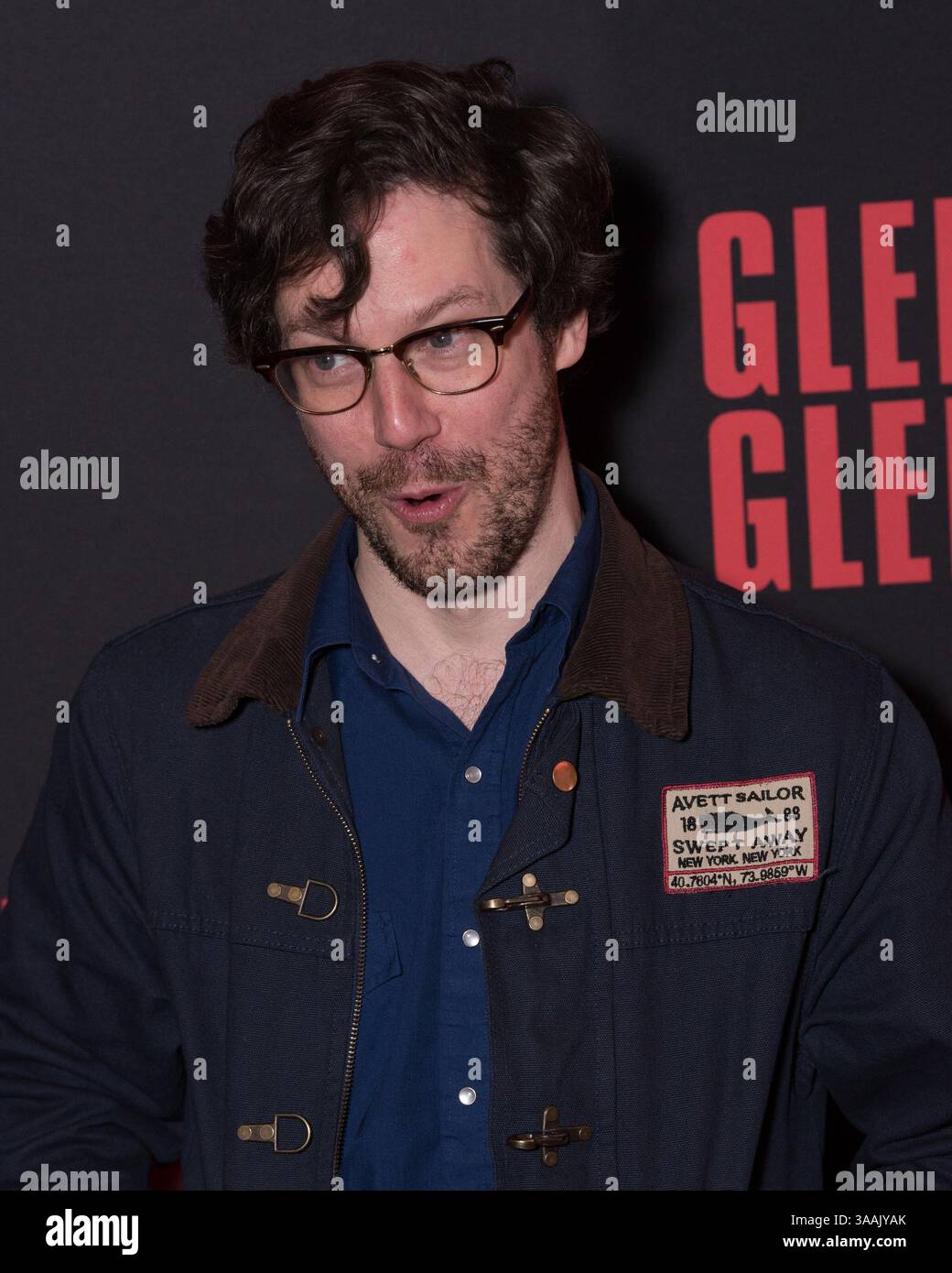
The 2025 Broadway revival of David Mamet’s Pulitzer Prize–winning drama Glengarry Glen Ross reunited theater audiences with one of the American stage’s most ruthless satires of corporate desperation. Directed by Tony Award winner Patrick Marber, this high-profile production featured a marquee cast led by Kieran Culkin, Bob Odenkirk, and Bill Burr, offering a fresh, biting exploration of sales culture, toxic masculinity, and the fragile American Dream.
Overview of the 2025 Production and Creative Direction
David Mamet’s 1984 play Glengarry Glen Ross stands as a high-water mark of modern American theater. Set in a pressure-cooker Chicago real estate office, the drama follows a group of small-time salesmen forced into a cutthroat sales contest: first prize is a new Cadillac, second prize is a set of steak knives, and third prize is termination.
Announced in late 2024 and staged during the 2025 Broadway season at the historic Palace Theatre, the revival brought Mamet’s classic text back to New York under the direction of Patrick Marber. Marber, renowned for his razor-sharp work on plays such as Closer and his Tony-winning direction of Tom Stoppard’s Leopoldstadt, approached the material with a emphasis on pacing, psychological tension, and rhythm.
Rather than leaning into pure nostalgia or updating the setting to contemporary digital sales environments, the 2025 staging remained rooted in its late-20th-century origins. This choice highlighted how little the core mechanics of transactional desperation have changed. The production’s scenic and lighting design emphasized claustrophobia and bleakness—contrasting the smoke-filled, red-booth Chinese restaurant of Act I with the stark, ransacked neon-lit office of Act II.
- Act I: The Chinese Restaurant
- Booth 1: Levene & Williamson (Begging & Bribery)
- Booth 2: Moss & Aaronow (Conspiracy & Theft)
- Booth 3: Roma & Lingk (Seduction & Manipulation)
- Act II: The Ransacked Office
- The Burglary Investigation (Detective Baylen)
- The Lead Board & Scramble for Survival
- Betrayal, Exposure, and Systemic Collapse
The Ensemble Cast: Dynamic and Performances
The primary draw of the 2025 revival was its powerhouse cast. Featuring actors celebrated for their work across television, stand-up comedy, and stage, the production harnessed their distinct comedic and dramatic talents to elevate Mamet's signature rhythmic dialog, often called "Mamet speak."
Kieran Culkin as Richard "Ricky" Roma
Fresh off his Emmy-winning performance in HBO's Succession, Kieran Culkin took on the role of Ricky Roma, the office's undisputed top seller. Roma is smooth, charismatic, and predatory—a master manipulator who sells not just land, but an illusion of friendship and existential security. Culkin brought an unpredictable, kinetic energy to the role, balancing Roma's verbal fluidity with an underlying menace that captured the character's relentless ambition.
Bob Odenkirk as Shelly "The Machine" Levene
Bob Odenkirk, widely acclaimed for his dramatic work in Better Call Saul and Breaking Bad, portrayed Shelly Levene. Once a legendary closer, Levene is now an aging salesman stuck in a catastrophic cold streak, desperate to keep his job and support his sick daughter. Odenkirk delivered a grounded performance, capturing the sweat-stained humiliation, fast-talking panic, and fleeting moments of hubris that define Levene's tragic arc.
Bill Burr as Dave Moss
Comedian and actor Bill Burr stepped into the role of Dave Moss, the angry, cynical salesman who conceives the plan to steal the office's prized "Glengarry leads" and sell them to a rival firm. Burr’s natural stage command and volatile delivery fit Moss’s simmering rage, transforming the character’s conspiratorial grievances into a display of corporate resentment.
Supporting Cast
The production was anchored by an exceptional supporting ensemble:
- Michael McKean played George Aaronow, the anxious, timid salesman caught in Moss’s scheming web. McKean conveyed the tragic paralysis of a man who senses moral ruin but lacks the spine to resist it.
- Donald Webber Jr. portrayed John Williamson, the stoic, bureaucratic office manager who controls the leads. Webber’s cool, unflappable demeanor served as the perfect foil to the frantic salesmen pleading for his favor.
- Howard W. Overshown appeared as James Lingk, the meek customer lured in by Roma’s pitch, embodying the vulnerability of the mark.
- John Pirruccello played Baylen, the cynical police detective investigating the office burglary.
Act-by-Act Structural Analysis
The structure of Glengarry Glen Ross is compact, running approximately 100 minutes without an intermission. The play relies entirely on character interaction, verbal momentum, and real-time tension.
- ACT I: THREE CONVERSATIONS
- Booth 1: Levene/Williamson (Desperate Pleading)
- Booth 2: Moss/Aaronow (Criminal Conspiracy)
- Booth 3: Roma/Lingk (The Pitch)
- ACT II: THE AFTERMATH
- Ransacked Office
- Detective Interrogations
- The Lingk Confrontation
- The Twist & Exposure of the Thief
- Return to Business as Usual
Act I: The Chinese Restaurant
Act I consists of three separate, consecutive dialogues taking place in booths at a local Chinese restaurant near the real estate office:
- Levene and Williamson: Shelly Levene tries every tactic—pleading, bribing, and cajoling—to convince Williamson to give him the premium "Glengarry leads." Williamson remains unyielding, demanding cash upfront that Levene cannot provide.
- Moss and Aaronow: Dave Moss vents his fury at the company’s ownership (Mitch and Murray) and proposes a burglary. He suggests breaking into the office, stealing the leads, and selling them to Jerry Graff. Moss pressures the reluctant Aaronow into becoming his accomplice by asserting that Aaronow is already implicated simply by listening to the proposal.
- Roma and Lingk: Ricky Roma delivers a winding, philosophical monologue on morality, risk, and autonomy to James Lingk, a stranger sitting in the adjacent booth. Roma seamlessly transitions from philosophical musings to a high-pressure sales pitch for land in Glengarry Highlands, closing the sale before Lingk fully realizes what has happened.
Act II: The Ransacked Office
Act II shifts to the real estate office the following morning. The space has been broken into, the phone wires cut, and the prized leads stolen. Detective Baylen interrogates each salesman in a back room.
As the investigation unfolds, Lingk arrives to demand his money back, pushed by his wife to cancel the contract within the three-day legal window. Roma spends the act trying to stall Lingk using deception, aided briefly by Levene, who feigns being a wealthy client to lend credibility to Roma's charade.
The climax occurs when Williamson inadvertently ruins Roma’s lie to Lingk. Furious, Roma berates Williamson and steps out. Left alone with Williamson, Levene accidentally reveals details about the break-in that only the thief would know. Williamson realizes Levene burglarized the office in league with Moss. Despite Levene’s desperate offers to share his proceeds, Williamson turns him over to the police out of cold, unyielding spite. The play ends as it began: the office remains a meat grinder, with Roma heading out for lunch and the remaining salesmen returning to their calls.
Comparative Matrix: Major Broadway Productions of Glengarry Glen Ross
Since its American premiere, Glengarry Glen Ross has seen multiple high-profile revivals. The 2025 production stands alongside a rich history of Broadway stagings.
| Year | Key Cast | Director | Venue / Production Notes |
|---|---|---|---|
| 1984 (Original) | Joe Mantegna (Roma), Robert Prosky (Levene), J.T. Walsh (Williamson), Lane Smith (Moss) | Gregory Mosher | Golden Theatre; nominated for 4 Tony Awards; Joe Mantegna won Best Featured Actor; awarded the 1984 Pulitzer Prize for Drama. |
| 2005 Revival | Liev Schreiber (Roma), Alan Alda (Levene), Gordon Clapp (Moss), Frederick Weller (Williamson) | Joe Mantello | Bernard B. Jacobs Theatre; won Tony Award for Best Revival of a Play; Liev Schreiber won Best Featured Actor. |
| 2012 Revival | Al Pacino (Levene), Bobby Cannavale (Roma), John C. McGinley (Moss), Richard Schiff (George Aaronow) | Daniel Sullivan | Gerald Schoenfeld Theatre; notable for Al Pacino playing Levene after having played Roma in the 1992 film adaptation. |
| 2025 Revival | Kieran Culkin (Roma), Bob Odenkirk (Levene), Bill Burr (Moss), Michael McKean (Aaronow) | Patrick Marber | Palace Theatre; acclaimed for bringing major television and comedy actors back to classical Mamet rhythms. |
Core Themes and Contemporary Relevance
Though written in the early 1980s, Glengarry Glen Ross remains a resonant critique of capitalism and workplace culture. The 2025 revival highlighted several core themes that speak directly to contemporary audiences:
The Commodification of Worth
In Mamet’s world, a person's value is defined entirely by their output. The salesmen are evaluated on a blackboard that ranks their sales volume daily. Failure to perform results in termination and public humiliation. This reduction of human dignity to quarterly metrics reflects modern gig-economy pressures, corporate downsizings, and relentless corporate burnout.
Language as a Weapon and Shield
Mamet's dialogue is famous for its truncated sentences, overlapping speech, profanity, and rhythmic repetition. In Glengarry Glen Ross, language is rarely used to communicate truth; it is used to dominate, obscure, manipulate, and survive. Roma uses eloquence to seduce; Moss uses hostility to coerce; Levene uses chatter to disguise fear; Williamson uses silence to exert power.
Salesman's Verbal Strategy:
- Ricky Roma: Seductive Monologue & Philosophical Illusion
- Dave Moss: Hostile Aggression & Manufactured Grievance
- S. Levene: Desperate Chatter & Nostalgic Appeals
- Williamson: Cold Bureaucracy & Bureaucracy of Silence
Toxic Masculinity and Vulnerability
The play examines an environment where vulnerability is fatal. The characters construct hyper-masculine facades built on bravado, misogyny, and financial status. However, beneath the aggressive posturing lies extreme fragility. The 2025 production emphasized the pathetic nature of these men, showing how their rejection of empathy ultimately drives their self-destruction.
Mastering "Mamet Speak": Pacing and Execution
Staging David Mamet requires specialized technical execution from both the actors and the director. The dialogue operates much like a musical score, where pauses, interruptions, and cadences are explicitly written into the script.
Script Notation Rule:
- [Ellipsis (...)] = Trailing off / hesitation
- [Dash (--)] = Abrupt interruption by another speaker
- [Profanity Rhythm] = Punctuation used to establish tempo, not just emphasis
Under Patrick Marber's direction, the 2025 ensemble achieved a precise balance between strict adherence to the text and raw emotional authenticity. Casting comedic performers like Odenkirk and Burr proved advantageous: comedians possess an innate understanding of timing, beat changes, and micro-pauses. Culkin’s natural fluency with rapid-fire, sarcastic dialogue—honed over seasons of prestige television—allowed him to navigate Mamet’s complex speech patterns effortlessly.
Practical Guide for Theatergoers and Collectors
For theater enthusiasts, collectors, and students of modern drama studying the 2025 production history, several practical details define this iteration:
- Venue and Atmosphere: The staging at Broadway's historic Palace Theatre utilized an intimate set design that brought the audience close to the action, amplifying the claustrophobic energy of both the restaurant and the ransacked office.
- Running Time: The production ran approximately 1 hour and 45 minutes with no intermission, requiring audience members to remain seated for the entire high-intensity performance.
- Archival Records: Performance records, cast production photos, and official opening-night documentations are maintained in public databases such as the Internet Broadway Database (IBDB) and coverage archives on Playbill.
Frequently Asked Questions
Who starred in the 2025 Broadway revival of Glengarry Glen Ross?
The 2025 Broadway revival starred Kieran Culkin as Ricky Roma, Bob Odenkirk as Shelly Levene, Bill Burr as Dave Moss, Michael McKean as George Aaronow, Donald Webber Jr. as John Williamson, Howard W. Overshown as James Lingk, and John Pirruccello as Detective Baylen.
What is the primary plot of Glengarry Glen Ross?
The play follows four Chicago real estate salesmen who are subjected to a high-stakes sales contest where the bottom performers will be fired. Desperate to secure valuable sales leads, the men engage in bribery, emotional manipulation, and ultimately burglary, leading to betrayal and office ruin.
Is there an intermission during the performance?
No, Glengarry Glen Ross is typically performed as a continuous, one-act play running roughly 1 hour and 45 minutes without an intermission. The unbroken structure maintains dramatic tension from the opening restaurant conversations through the final office fallout.
Who directed the 2025 Broadway production?
The 2025 revival was directed by Patrick Marber, the acclaimed playwright (Closer) and Tony Award-winning director (Leopoldstadt).
Why is Glengarry Glen Ross considered an American classic?
David Mamet’s play is celebrated for its revolutionary use of realistic, rhythmic dialogue ("Mamet speak"), its sharp critique of the American Dream, and its unsparing portrait of corporate desperation. It earned the 1984 Pulitzer Prize for Drama and remains one of the most frequently produced works in modern theater.
Recommended Next Steps for Theater Enthusiasts
To fully appreciate the legacy and artistic impact of the 2025 Glengarry Glen Ross revival:
- Read the Script: Study David Mamet’s published text to analyze his unique punctuation, rhythmic pauses, and character sentence structures on the page.
- Compare Adaptations: View the classic 1992 film adaptation directed by James Foley (featuring Al Pacino, Jack Lemmon, Alec Baldwin, and Kevin Spacey) alongside historical Broadway recordings to compare actor interpretations of Roma, Levene, and Moss.
- Explore Related Dramatic Works: Examine other major American workplace plays, such as Arthur Miller’s Death of a Salesman or David Mamet’s Speed-the-Plow, to understand how American theater portrays commerce, ambition, and personal identity.