The official 18-page Form I-693 PDF is the comprehensive instruction and document packet provided by U.S. Citizenship and Immigration Services (USCIS) for reporting the results of a mandatory immigration medical examination. This extensive document outlines who must complete the exam, which licensed civil surgeons are authorized to perform it, how the form must be handled to remain valid, and what specific vaccinations and health screenings are required for adjustment of status applicants.
Navigating the immigration process requires careful attention to detail, particularly when medical evaluations and government forms are involved. For individuals seeking lawful permanent residency in the United States, Form I-693 (Report of Immigration Medical Examination and Vaccination Record) represents a critical milestone. While the actual form filled out by the physician varies in length depending on the applicant's history, the overarching guidance, instructions, and standard appendices frequently total 18 pages of detailed regulatory and procedural information.
Understanding this documentation is essential for avoiding costly delays, Requests for Evidence (RFEs), or outright rejections of an adjustment of status application. This guide examines the structure, requirements, and best practices associated with the Form I-693 PDF, providing applicants with a clear roadmap from finding a civil surgeon to submitting the sealed envelope to USCIS.
The Purpose and Scope of Form I-693
Form I-693 is used by USCIS to determine whether an applicant for adjustment of status (such as a green card) is inadmissible to the United States on public health-related grounds. These grounds are established by the Immigration and Nationality Act (INA) and encompass communicable diseases of public health significance, failure to present proof of required vaccinations, physical or mental disorders associated with harmful behavior, and drug abuse or addiction.
The 18-page instruction packet associated with the form provides the legal and administrative framework for these evaluations. It explains that the medical examination is not a comprehensive general physical checkup for personal health management; rather, it is a targeted screening designed specifically to screen for conditions that pose risks to public health and safety under federal immigration law.
Furthermore, the document clarifies that applicants cannot perform their own medical examinations. The assessment must be conducted exclusively by a designated civil surgeon who has been officially authorized by USCIS. Attempting to submit medical records from a family doctor or an unapproved physician will result in the immediate rejection of the form and a delay in the immigration process.
Key Components of the Official USCIS Instruction Packet
The standard downloadable PDF package provided by USCIS serves multiple functions. Reviewing its layout reveals how applicants and physicians must navigate the documentation process:
- Administrative Instructions (Pages 1–5): These pages outline general eligibility, instructions on how to fill out the form, fee information, where to mail applications, and definitions of terms used throughout the document.
- Civil Surgeon Instructions (Pages 6–10): Written primarily for the examining physician, this section details the technical instructions, laboratory testing requirements, vaccination charts, and reporting standards mandated by the Centers for Disease Control and Prevention (CDC).
- The Form Sections (Pages 11–18): This portion includes the actual data-gathering fields divided into applicant information, medical history, physical examination, screening results for tuberculosis, syphilis, and gonorrhea, vaccination records, and the civil surgeon’s certification.
Because USCIS periodically updates these instructions to reflect changes in CDC guidelines—such as updated COVID-19 vaccination mandates or modified tuberculosis screening protocols—applicants must ensure they are downloading the most current version directly from the official USCIS Form I-693 page rather than relying on outdated cached copies from third-party websites.
Summary of Medical Examination Requirements
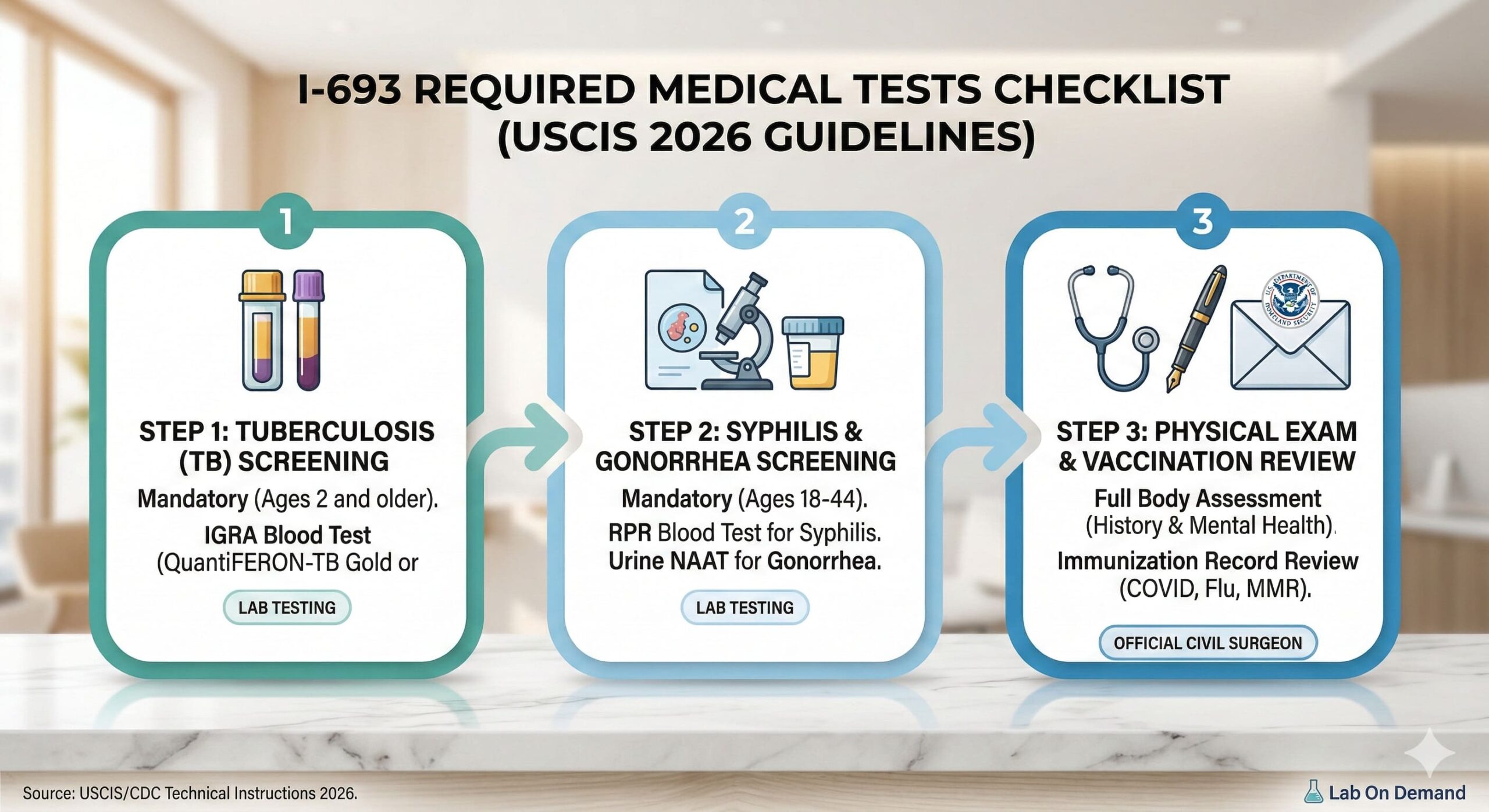
The medical evaluation mandated by Form I-693 covers several distinct health domains. The examining civil surgeon evaluates the applicant across four primary categories:
| Evaluation Category | Medical Focus / Test Required | Regulatory Standard / Governing Body |
|---|---|---|
| Communicable Diseases | Tuberculosis (TB), Syphilis, Gonorrhea, and other public health threats | CDC Technical Instructions for Civil Surgeons |
| Vaccinations | MMR, Polio, Tetanus/Diphtheria, Pertussis, Hepatitis A & B, Influenza, Varicella, COVID-19 | Advisory Committee on Immunization Practices (ACIP) |
| Physical/Mental Disorders | Behavioral, emotional, or mental abnormalities associated with harmful behavior | INA Section 212(a)(1)(A)(iii) |
| Drug Abuse/Addiction | History of substance use, abuse, or active addiction | INA Section 212(a)(1)(A)(iv) |
Tuberculosis Screening Protocol
Under current CDC technical instructions, all applicants aged two years and older residing in the United States must undergo an Interferon-Gamma Release Assay (IGRA) blood test or, in certain instances, a tuberculin skin test (TST) to screen for tuberculosis. If the screening test is positive, a chest radiograph (X-ray) is required to check for active pulmonary tuberculosis disease.
Vaccination Requirements
The vaccination requirements depend heavily on the applicant's age and medical history. Vaccines must be documented thoroughly on the form. If an applicant has already received certain vaccines, they should bring official vaccination records (translated into English if necessary) to their appointment. The civil surgeon can administer missing vaccines on-site or provide a waiver recommendation if a vaccine is medically inappropriate, contrary to religious beliefs, or unavailable seasonally.
Step-by-Step Filing and Submission Workflow
Successfully completing and submitting Form I-693 requires a disciplined, chronological approach. Missing a step or mishandling the document can invalidate months of preparation.
Step 1: Locate an Authorized Civil Surgeon
Applicants must search the official USCIS online tool to find a designated civil surgeon in their local area. Fees are not regulated by the government and vary significantly from one medical office to another, making it prudent to call multiple providers to compare pricing and inquire about what laboratory tests and vaccines are included in the baseline fee.
Step 2: Prepare Personal Documents and Medical Records
Prior to the appointment, the applicant should gather:
- A government-issued photo identification (such as a valid passport or driver's license).
- Form I-693 (though many civil surgeons prefer to fill out the most current digital or printed version themselves).
- A complete, written vaccination history.
- Medical documentation for any significant prior health conditions, chronic illnesses, or psychiatric treatments.
Step 3: Complete the Examination and Review the Form
During the appointment, the civil surgeon or their medical staff will conduct the physical exam, administer blood tests or X-rays if required, and review vaccination charts. Once results are available, the physician completes the form. It is vital that the applicant carefully reviews their personal biographical information (name, date of birth, alien registration number) for typographical errors before signing the certification.
Step 4: Secure the Sealed Envelope
The civil surgeon will place the completed Form I-693 inside a secure envelope and seal it. Crucial rule: USCIS will reject any Form I-693 that is returned to the applicant unsealed, opened, altered, or tampered with in any way. The applicant must submit this sealed envelope unopened along with their Form I-485 (Application to Register Permanent Residence or Adjust Status) or respond directly to an RFE notice.
Validity Periods and Timing Considerations
Historically, USCIS required Form I-693 to be submitted within a narrow timeframe after the civil surgeon's signature. However, administrative policies have evolved to address processing backlogs.
Under current USCIS guidelines, a properly completed Form I-693 signed by a civil surgeon does not expire, provided it is submitted in connection with an application for adjustment of status. USCIS officers have the discretion to accept forms even if significant time has elapsed, as long as there is no evidence of medical conditions that would render the applicant inadmissible post-adjudication. Nevertheless, applicants are generally advised to schedule their exam close to their filing date or wait until requested via an RFE to ensure the most seamless processing experience.
Common Mistakes to Avoid
Avoiding administrative pitfalls ensures that an immigration case moves forward without unnecessary interruptions. Pay close attention to the following frequent errors:
- Using Outdated Forms: Submitting an old version of the form will result in immediate rejection. Always verify the edition date listed in the bottom corner of the PDF against the active date on the USCIS website.
- Opening the Envelope: Looking inside the sealed medical envelope out of curiosity destroys its validity. USCIS treats an opened envelope as compromised.
- Failing to Sign: Both the applicant and the civil surgeon must sign the appropriate sections. Unsigned certifications are legally invalid.
- Omitting Vaccination Records: Without clear proof of required immunizations, the civil surgeon cannot clear the applicant, leading to mandatory re-vaccination or delays while medical records are hunted down.
Frequently Asked Questions
Can I fill out Form I-693 myself before seeing the doctor?
Yes, applicants are required to fill out Part 1 (Information About You) of the form prior to the appointment. However, the medical evaluation, test results, vaccination records, and physician certification sections must be completed exclusively by the authorized civil surgeon.
How much does the Form I-693 medical exam cost?
There is no set government fee for the medical examination itself. Fees are determined entirely by the private medical practice and typically range from $200 to $500 or more, depending on geographic location, required laboratory tests, and whether additional vaccinations must be administered on-site.
What happens if my chest X-ray shows a healed tuberculosis lesion?
If a chest X-ray reveals abnormalities suggestive of tuberculosis, the civil surgeon will refer the applicant for further evaluation, which may include sputum smears and cultures. If active TB is ruled out, the physician will clear the applicant, though additional follow-up or a specialized health department clearance may be documented.
Is the COVID-19 vaccine still mandatory for Form I-693?
Yes, the COVID-19 vaccination remains a mandatory component of the immigration medical examination unless an acceptable medical contraindication, age-appropriate exemption, or religious/moral waiver is established and approved in accordance with USCIS and CDC guidelines.
Can a civil surgeon outside the United States perform Form I-693?
No. Form I-693 is strictly for applicants undergoing adjustment of status inside the United States. Individuals applying for immigrant visas from abroad must complete their medical exams through designated panel physicians authorized by the Department of State, using different documentation procedures.
Conclusion and Next Actions
Mastering the 18-page instruction guide for Form I-693 ensures that applicants approach their immigration medical examination with confidence and precision. By verifying physician credentials, organizing vaccination records, and keeping the final medical envelope strictly sealed, applicants protect their adjustment of status filings from avoidable procedural delays.
To take the next step, visit the official USCIS website to download the latest edition of Form I-693 and its accompanying instructions, then use the civil surgeon locator tool to schedule your examination with an approved provider.