The Agentforce World Tour 2026 brings Salesforce's cutting-edge artificial intelligence and autonomous agent platform directly to global business hubs, mapping a comprehensive route across twelve key international destinations. This global series focuses on scaling autonomous agents, integrating advanced data ecosystems, and transforming enterprise productivity through human-in-the-loop workflows.
Understanding the Agentforce World Tour 2026 Landscape
The technological landscape of enterprise software has shifted dramatically from predictive analytics and conversational chatbots to autonomous agents capable of taking independent actions across business systems. Salesforce positioned Agentforce as a core pillar of this evolution, integrating it deeply into the Customer 360 ecosystem. The Agentforce World Tour 2026 serves as the primary physical touchpoint for enterprise leaders, administrators, developers, and ecosystem partners to experience these developments firsthand.
Organizing a global tour of this magnitude requires balancing standardized keynote messaging with region-specific regulatory requirements, data sovereignty frameworks, and industry use cases. As organizations grapple with deploying trusted artificial intelligence at scale, attendees at each stop look for practical guidance on data architecture, security hardening, prompt engineering, and change management. The tour layout reflects these priorities, offering localized breakout tracks that address specific regional compliance mandates alongside global technological standards.
The Global Route: Mapping the 12 Stops
Executing a twelve-city tour across multiple continents demands careful logistical synchronization and alignment with local business seasons. The 2026 itinerary spans major metropolitan areas known for high concentrations of enterprise technology adoption, financial services, healthcare innovation, and public sector digital transformation.
While exact dates and venue logistics fluctuate based on local calendar availability, the geographical spread ensures accessibility for participants from North America, Europe, Asia-Pacific, and Latin America. Each city stop is structured as a full-day immersive experience featuring general keynotes, product demonstrations, hands-on workshops, and networking pavilions.
Below is the structured overview of the 12 stops featured on the Agentforce World Tour 2026, highlighting their regional focus and primary industry alignment:
| Stop Number | City / Region | Primary Regional Focus | Key Industry Track |
|---|---|---|---|
| 1 | New York, USA | Financial Services & Enterprise Tech | Banking, Wealth Management, Insurance |
| 2 | London, United Kingdom | European Regulatory Compliance & FinTech | Financial Services, Public Sector |
| 3 | Tokyo, Japan | Advanced Robotics, Manufacturing & AI Integration | Automotive, High Tech, Manufacturing |
| 4 | Sydney, Australia | APAC Enterprise Transformation | Telecommunications, Retail, Public Sector |
| 5 | Frankfurt, Germany | Data Sovereignty & Industrial Automation | Manufacturing, Automotive, Enterprise IT |
| 6 | Paris, France | Luxury Retail, Consumer Goods & Energy | Retail, Consumer Packaged Goods, Utilities |
| 7 | Chicago, USA | Supply Chain, Logistics & Healthcare | Healthcare, Manufacturing, Transportation |
| 8 | São Paulo, Brazil | Latin American Emerging Markets & FinTech | Financial Services, Retail, Telecommunications |
| 9 | Toronto, Canada | North American Enterprise & Public Health | Healthcare, Public Sector, Financial Services |
| 10 | Singapore | Southeast Asian Digital Economy & Trade | Logistics, Financial Services, Technology |
| 11 | Atlanta, USA | Enterprise Logistics & Consumer Goods | Supply Chain, Retail, Higher Education |
| 12 | San Francisco, USA | Global Innovation, Developer Ecosystem & Finale | Developer Ecosystem, ISV Partners, Core AI |
Core Technical Themes and Product Capabilities
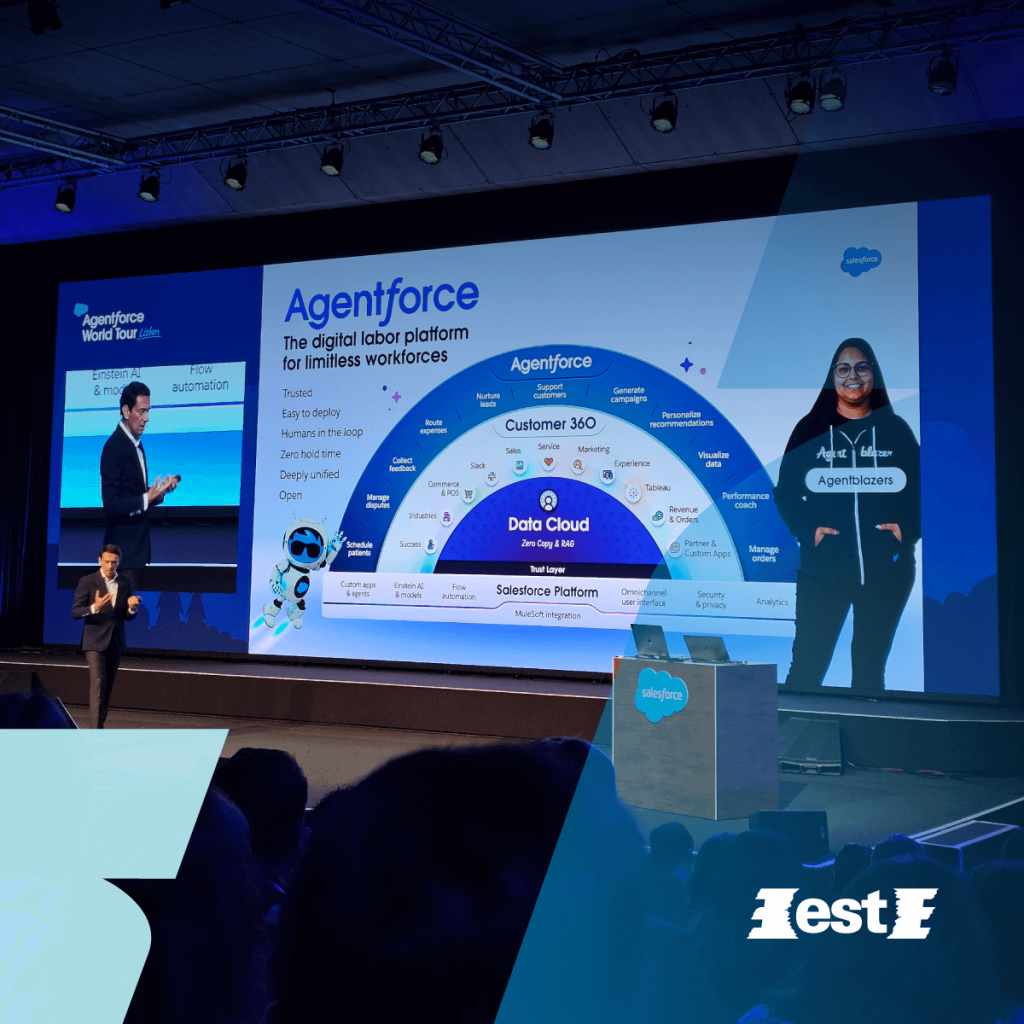
Attendees engaging with the Agentforce World Tour 2026 encounter deep dives into the technical architecture underpinning autonomous business operations. Moving beyond simple user interface enhancements, Agentforce introduces a robust framework combining the Data Cloud, the Atlas Reasoning Engine, and secure action execution.
The Atlas Reasoning Engine
At the heart of Agentforce lies the Atlas Reasoning Engine. Unlike traditional large language models that generate text sequentially based on statistical probability, Atlas evaluates user prompts, reviews available data context within the Data Cloud, formulates an execution plan, and determines whether an autonomous action or human escalation is required. Sessions across the tour break down how this reasoning loop prevents hallucinations and ensures operational predictability.
Data Cloud Integration
Autonomous agents are only as effective as the data they access. The tour places significant emphasis on Salesforce Data Cloud as the unified data foundation. Technical sessions demonstrate how organizations can ingest unstructured and structured data from disparate enterprise resource planning systems, data lakes, and legacy databases to provide agents with real-time context without requiring complex data migration projects.
Action Framework and APIs
Enterprise readiness depends on an agent's ability to safely execute actions—such as processing a refund, updating a customer record, or dispatching a field service technician. The 2026 tour showcases how administrators configure these actions using MuleSoft integrations, Flow Builder, and custom Apex code, maintaining strict permission sets and security guardrails.
Prerequisites and Preparation for Attendees
Maximizing the value of an Agentforce World Tour 2026 stop requires deliberate preparation. Whether attending as a technical architect, business executive, or Salesforce administrator, participants must align their organizational readiness with the advanced capabilities showcased on stage.
- Establish Data Governance Foundations: Organizations should review their existing data silos and access control policies. Understanding where customer data resides is essential before attempting to connect Data Cloud to autonomous agents.
- Review Current Salesforce Licensing: Attendees should verify their organization's existing Salesforce editions and add-on structures, particularly regarding Data Cloud consumption and Einstein AI features, to understand baseline implementation paths.
- Define Specific Use Cases: Participants achieve better outcomes by bringing concrete business challenges—such as reducing customer support handle times or automating lead qualification—to discuss with technical experts and ecosystem partners during breakout sessions.
- Complete Foundational Trailhead Modules: Familiarizing team members with introductory Trailhead trails on Agentforce and prompt engineering ensures that workshop participants can immediately engage with hands-on labs.
Navigating the Event Experience: Key Tracks and Sessions
Each stop on the tour is meticulously organized into specialized tracks designed to address the distinct needs of different professional personas. Understanding these tracks helps attendees plan their schedules effectively.
The Executive Leadership Track
Tailored for CIOs, CTOs, and line-of-business leaders, this track focuses on return on investment, change management, ethical artificial intelligence deployment, and strategic workforce transformation. Discussions center on how autonomous agents reshape organizational structures, shift employee skill requirements, and drive operational efficiency without compromising customer trust.
The Developer and Administrator Track
For the technical practitioners who build and maintain Salesforce environments, this track offers deep technical dives into Prompt Builder, Model Context Protocol, API integrations, and debugging autonomous agent workflows. Live coding demonstrations illustrate how to troubleshoot reasoning loops and handle edge cases where agents encounter ambiguous user inputs.
The Ecosystem and Partner Pavilion
Salesforce is built on a thriving ecosystem of independent software vendors and consulting partners. The exhibition floor at each tour stop features dedicated partner booths where attendees can explore pre-built industry accelerators, specialized security tools, and implementation accelerators designed to accelerate time-to-value.
Frequently Asked Questions
What is the primary objective of the Agentforce World Tour 2026?
The tour is designed to educate enterprise leaders and technical practitioners on deploying autonomous artificial intelligence agents using Salesforce technology, focusing on data integration, security, and scalable business workflows.
Do attendees need prior Salesforce development experience to participate?
No. While technical tracks require familiarity with Salesforce administration or development, executive and business-focused tracks are structured for leaders seeking strategic insights without requiring hands-on coding expertise.
How do organizations register for a specific city stop?
Registration is handled through the official Salesforce events portal. Due to capacity limits at convention venues across the twelve global stops, early registration is strongly recommended.
What security measures are highlighted for autonomous agents during the tour?
Sessions heavily emphasize the Einstein Trust Layer, detailing how data masking, zero-retention policies with model providers, and strict guardrails protect sensitive enterprise information from exposure.
Can attendees earn professional certifications during the tour?
While the tour primarily focuses on education, networking, and demonstrations, some stops offer specialized credentialing opportunities or discounted testing vouchers for Salesforce certifications.
Practical Next Steps for Enterprise Teams
Organizations looking to capitalize on the insights gained from the Agentforce World Tour 2026 should initiate a structured internal review immediately following the event. Begin by auditing current customer service workflows and data readiness within Salesforce Data Cloud. Assemble a cross-functional task force comprising IT leadership, legal counsel, and business unit managers to pilot a single, low-risk autonomous agent use case. By grounding AI deployment in measurable business objectives and rigorous data governance, enterprises can transition smoothly from exploration to scalable production execution.