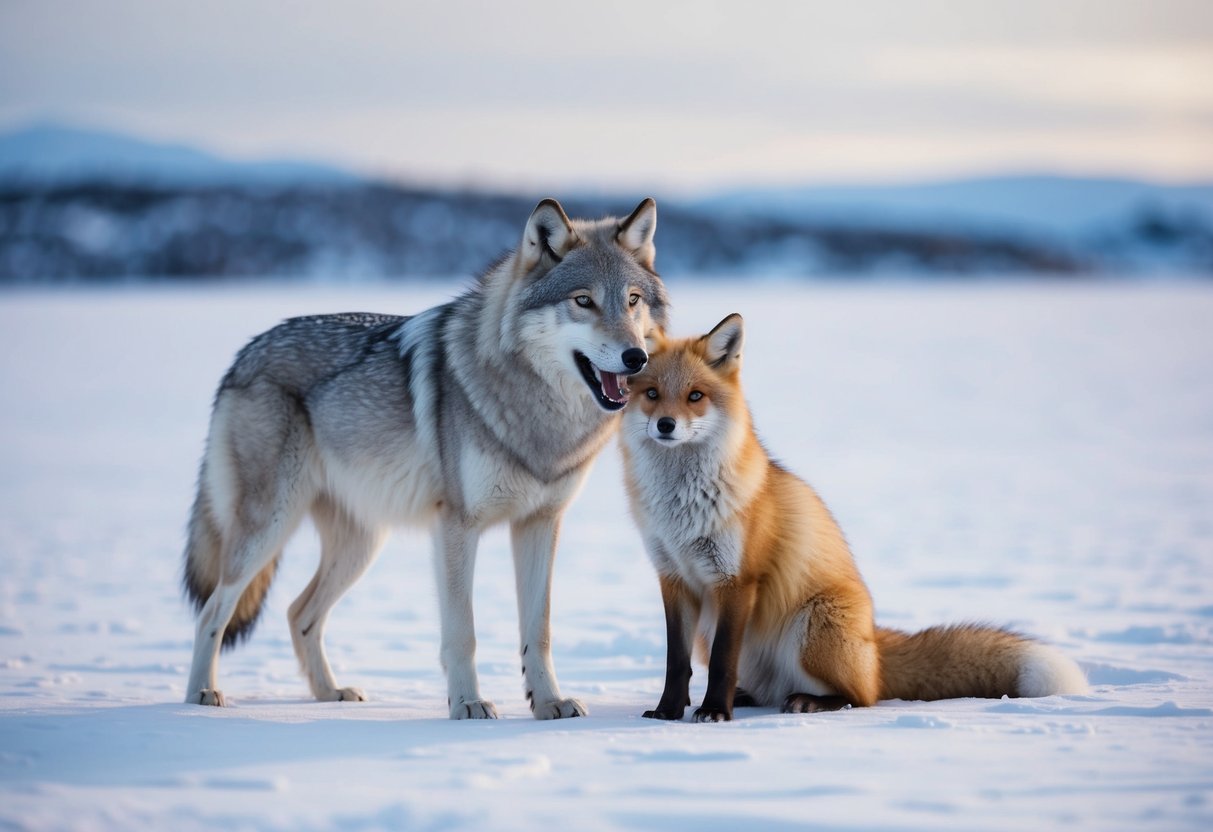
Wolves and foxes are indeed related, as both belong to the biological family Canidae, making them distant cousins within the order Carnivora. However, while they share a common ancestral lineage, they diverged millions of years ago into distinct evolutionary branches. This separation explains their notable differences in physical size, social behavior, and ecological adaptation.
Introduction to Canine Taxonomy
To understand the relationship between wolves and foxes, one must examine the science of taxonomy—the classification of organisms based on shared characteristics and evolutionary history. Both animals fall under the mammal class, the carnivore order, and the dog family, known scientifically as Canidae.
Within this family, however, the paths split significantly. Wolves belong to the subfamily Caninae and the genus Canis, a group that also includes coyotes, jackals, and domestic dogs. Foxes, on the other hand, are distributed across several different genera. The most common and widely recognized fox, the red fox (Vulpes vulpes), belongs to the genus Vulpes.
This taxonomic distinction highlights a fundamental biological truth: while they share a family tree, they are as different from one another as lions are from house cats within the feline family. Exploring their evolutionary roots reveals how these two iconic predators branched off to conquer very different ecological niches across the globe.
The Evolutionary Timeline: When Did They Split?
The evolutionary history of the dog family Canidae dates back roughly 40 to 50 million years to a small, tree-climbing mammal known as Prohesperocyon or similar early carnivores in North America. Over millions of years, these ancient ancestors diversified into three main subfamilies: Hesperocyoninae, Borophaginae, and Caninae. All modern dogs, wolves, and foxes descend from the subfamily Caninae.
Genetic studies and fossil records indicate that the ancestral lineage of modern foxes (Vulpes genus) diverged from the lineage that would eventually produce wolves, jackals, and coyotes approximately 10 to 12 million years ago.
- The Fox Branch: Foxes adapted early to a solitary, opportunistic hunting style. They maintained smaller bodies, highly flexible joints for maneuvering in dense cover or snow, and specialized sensory adaptations like oversized ears for detecting subterranean prey.
- The Wolf/Canis Branch: The lineage leading to wolves evolved later, heavily influenced by open grasslands and tundra environments. Their evolutionary pressure favored pack hunting, endurance running, and taking down large ungulate prey.
Comparative Biology: Wolves Versus Foxes
Despite sharing a common mammalian blueprint—possessing four legs, fur, sharp canine teeth, and acute senses—wolves and foxes display striking anatomical and physiological differences driven by their evolutionary paths.
| Feature | Wolves (Canis lupus) | Foxes (e.g., Vulpes vulpes) |
|---|---|---|
| Average Weight | 60 to 130+ pounds (27 to 59+ kg) | 8 to 30 pounds (3.6 to 14 kg) |
| Social Structure | Highly social pack animals with strict hierarchies | Generally solitary or live in small family pairs |
| Dietary Strategy | Apex predators targeting large hoofed mammals | Omnivorous generalists eating rodents, fruit, and insects |
| Tail Structure | Long, slender, and points downward when relaxed | Bushy, long, often tipped with white, used for balance and warmth |
| Pup Rearing | Cooperative raising involving the entire pack | Primarily raised by the mother with support from the male |
| Pup Development | Born blind and deaf; mature slowly over years | Born blind and deaf; disperse to find territory within months |
Physical Adaptations
The most obvious difference between a wolf and a fox is scale. Wolves are large, powerful endurance predators built to travel vast distances across rugged terrain and overpower large prey like deer, elk, and moose. Their long legs, deep chests, and powerful jaws are optimized for cooperative running and bringing down heavy animals.
Foxes are small to medium-sized carnivores. The red fox, the largest of the true foxes, rarely exceeds 30 pounds. Their lighter frames, exceptionally flexible spines, and long, bushy tails help them navigate thick brush, leap high into the air to pounce on mice beneath the snow, and maintain balance during tight turns.
Social Behavior and Ecology
Behaviorally, wolves and foxes occupy entirely different realms in the natural world, which dictates how they interact with their environments and other species.
Pack Life Versus Solitary Foraging
Wolves are fundamentally social animals. They live, hunt, and travel in packs typically consisting of an alpha breeding pair and their offspring from current and previous years. This complex social structure allows them to coordinate strategic hunts, defend large territories against rival packs, and protect vulnerable pups from predators like bears and cougars.
Foxes exhibit a much more solitary lifestyle. While they may form monogamous mating pairs during the breeding season and raise kits together, they generally hunt alone. A fox does not rely on a pack to secure food; instead, it targets smaller prey items such as voles, rabbits, insects, and even vegetation. This solitary nature makes foxes highly adaptable to suburban and urban environments, where they can scavenge human garbage and live undetected in small green spaces.
Habitat Range and Geographic Distribution
Both canids are remarkably adaptable, but their distribution patterns reflect their physical and behavioral capabilities.
- Wolf Distribution: Historically, wolves occupied nearly every terrestrial habitat in the Northern Hemisphere, from arctic tundra to dense forests and arid deserts. Human persecution drastically reduced their range, but conservation efforts have successfully restored wolf populations across parts of North America, Europe, and Asia.
- Fox Distribution: Foxes are among the most widely distributed carnivores on Earth. The red fox, in particular, spans almost the entire Northern Hemisphere and has been successfully introduced to Australia. Their ability to thrive near human settlements has allowed them to expand their footprint into agricultural and urban zones globally.
Frequently Asked Questions
Can wolves and foxes interbreed?
No, wolves and foxes cannot interbreed. Even though they belong to the same family (Canidae), they are separated by millions of years of distinct genetic evolution and belong to completely different genera (Canis versus Vulpes). They possess different numbers of chromosomes and incompatible reproductive systems, making successful mating biologically impossible.
Are foxes more closely related to cats or dogs?
Foxes are much more closely related to dogs. Both foxes and domestic dogs belong to the order Carnivora and the family Canidae. Cats belong to an entirely different family called Felidae. While foxes share certain physical traits with cats—such as vertical-slit pupils in some species and a somewhat solitary, stalking hunting style—their genetic makeup firmly places them in the dog family.
Can a wolf eat a fox?
Yes, wolves frequently kill and sometimes eat foxes. In regions where their territories overlap, wolves view foxes as competitors for food resources. Because wolves are vastly superior in size and strength, they will aggressively drive away or kill foxes to eliminate competition within their territory, a behavior known as interspecific killing.
Do foxes live in packs like wolves?
No, true foxes do not live in packs. They are solitary hunters and typically live alone or in simple family units consisting of a mated pair and their dependent kits. While some related canids like African wild dogs or jackals exhibit pack behaviors, the true foxes in the genus Vulpes maintain independent territories.
Why do foxes look like small dogs with cat-like features?
Foxes look like small dogs because they share a common canine ancestor. However, because they adapted to hunt small, agile prey like mice and rabbits in dense undergrowth, they evolved flexible spines, bushy tails for balance, and keen hearing—traits that superficially resemble the hunting behaviors and agility of felines, even though their genetics are purely canine.
Conclusion and Practical Takeaways
While wolves and foxes share a common ancestry within the dog family Canidae, millions of years of divergent evolution have shaped them into vastly different creatures. Wolves evolved into powerful, social apex predators built for pack hunting and large prey, whereas foxes adapted into nimble, solitary generalists capable of thriving in diverse environments ranging from deep wilderness to urban backyards. Understanding their taxonomy clarifies that while they are distant evolutionary cousins, their ecological roles, behaviors, and physical designs are uniquely specialized.