Art styles and movements represent the collective visual language of history, defined by specific time periods, cultural shifts, and philosophical responses to the world. Understanding these categories allows observers to decipher the intent behind a creator’s technique, identify the historical context of a work, and recognize the evolving definitions of aesthetics from antiquity to the contemporary era.
Defining the Distinction Between Style and Movement
In art history, the terms "style" and "movement" are frequently conflated, yet they serve distinct functions. A style refers to the consistent visual characteristics, techniques, and aesthetic choices that define an individual artist’s body of work or a regional tradition—such as the heavy brushwork of Expressionism or the geometric precision of Art Deco.
A movement, conversely, is a group of artists, usually occurring over a specific timeframe, who align under a shared philosophy, manifesto, or socio-political agenda. Movements are typically marked by a deliberate break from the status quo. For example, Impressionism was a movement where artists consciously rejected the rigid standards of the French Académie des Beaux-Arts in favor of capturing the fleeting effects of light. While a style can persist indefinitely as a mode of production, a movement is usually finite, functioning as a concentrated, disruptive event in art history.
Chronological Framework of Significant Artistic Shifts
The trajectory of art is rarely a linear progression; it is a series of reactions. When one movement becomes dominant, it eventually breeds a counter-movement.
The Classical and Pre-Modern Foundation
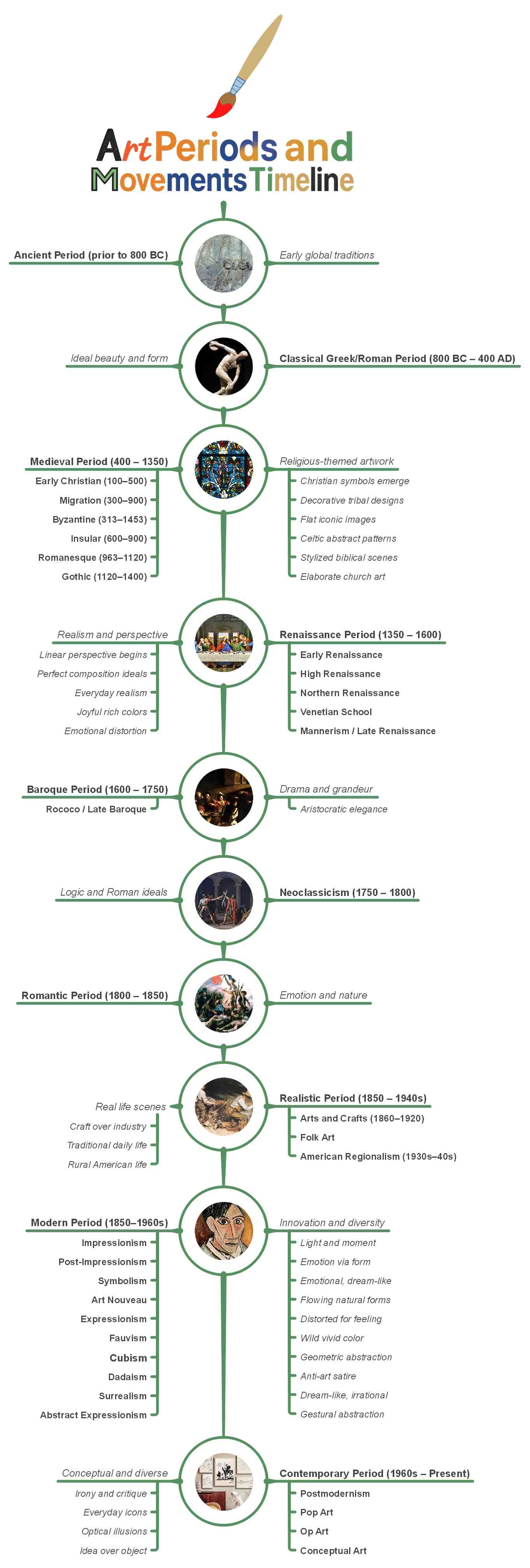
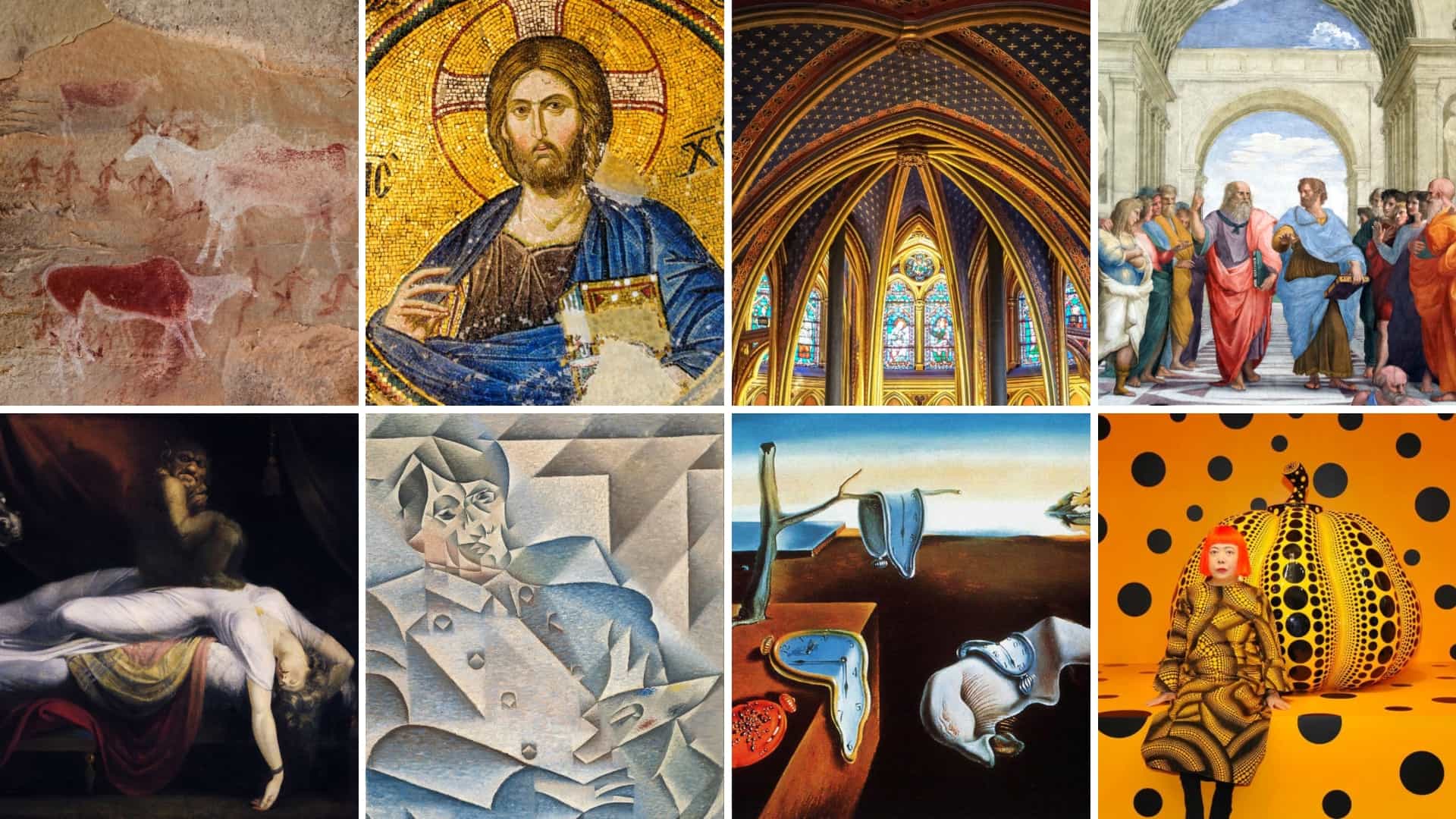
Ancient art, including the contributions of Egypt, Greece, and Rome, prioritized balance, proportion, and the pursuit of ideal form. This foundational focus on realism and human anatomy dictated the trajectory of Western art for centuries. During the Renaissance, the rediscovery of these classical principles, combined with advancements in perspective and oil painting techniques, shifted the focus toward humanism and scientific observation.
The Industrial Pivot and Modernism
The late 19th and early 20th centuries acted as a crucible for radical change. The advent of photography liberated painting from its traditional role of documentation, prompting artists to explore subjectivity. Movements like Fauvism and Cubism challenged the viewer’s perception of space and color. By the mid-20th century, Abstract Expressionism furthered this distance from reality, prioritizing the physical act of painting over representational accuracy.
Comparative Analysis of Major Movements
Distinguishing between movements requires examining their primary objective, the period in which they flourished, and their approach to the canvas.
| Movement | Timeframe | Primary Focus | Key Characteristics |
|---|---|---|---|
| Renaissance | 1400–1600 | Realism & Humanism | Linear perspective, depth, anatomy |
| Baroque | 1600–1750 | Drama & Grandeur | Chiaroscuro, high contrast, emotion |
| Impressionism | 1865–1885 | Light & Atmosphere | Loose brushwork, open composition |
| Cubism | 1907–1914 | Multiple Perspectives | Geometric forms, fragmented space |
| Surrealism | 1924–1966 | Unconscious Mind | Dream imagery, irrationality |
| Minimalism | 1960–1975 | Reduction | Industrial materials, geometry |
The Impact of Socio-Political Context on Artistic Evolution
Artistic movements do not emerge in a vacuum. They are often triggered by technological, political, or economic upheavals. The rise of the printing press catalyzed the spread of artistic ideas during the Renaissance, while the horrors of World War I prompted the development of Dadaism, a movement that mocked the logic and bourgeois values that many artists felt had led to such global conflict.
Similarly, the post-war economic boom in the United States shifted the center of the art world from Paris to New York, facilitating the rise of Abstract Expressionism. Understanding these external pressures is critical; if you view a Surrealist painting without considering the influence of Freudian psychology on the early 20th century, you lose the primary motivation behind the artist's attempt to map the unconscious mind.
Analyzing Style: Techniques and Execution
When evaluating a piece of art to determine its style, you must look beyond the subject matter and focus on the technical execution. This involves several critical dimensions:
- Brushwork (Handling of Media): Are the strokes visible and energetic (as in Post-Impressionism), or are they blended and invisible to create a smooth, porcelain finish (as in Neoclassicism)?
- Color Theory: Does the artist utilize a naturalistic palette, or do they employ arbitrary or symbolic color to evoke emotion, as seen in the works of Henri Matisse?
- Space and Composition: How does the artist organize the space? Do they utilize the "Rule of Thirds," extreme foreshortening, or a flat, two-dimensional arrangement that denies the viewer a sense of depth?
- Light and Shadow: The use of chiaroscuro—the strong contrast between light and dark—can drastically shift the narrative tone of a work, moving it from serene to theatrical.
Practical Guidance: How to Categorize an Unfamiliar Work
If you are faced with an unfamiliar work and wish to classify it, follow this systematic approach:
- Check for Physical Evidence: Look for dates, signatures, or location markers provided by the gallery or curator.
- Evaluate the Subject Matter: Is it an idealized religious scene, a portrait, a landscape, or an abstract collection of shapes? The subject often excludes specific time periods.
- Identify the Technique: If the painting lacks recognizable objects, focus on the texture and the artist’s hand. Is it aggressive (Abstract Expressionism) or calculated and precise (Hard-Edge Painting)?
- Contextualize via Movement Philosophy: Once you have a candidate movement, read their manifesto or primary critiques from the era. Does the work align with the group's intent, or is it an outlier?
Common Mistakes in Art Classification
A common pitfall is the assumption that an artist belongs to a single, static movement for their entire career. Many prominent artists evolved significantly. Pablo Picasso, for instance, transitioned through several distinct styles, including his Blue Period, Rose Period, and his leadership in the development of Cubism.
Another error is ignoring regional variations. While we refer to "The Renaissance," the Italian Renaissance differed significantly from the Northern Renaissance in terms of focus and medium usage; Italian artists leaned toward fresco and tempera, while Northern European artists embraced the detail and luminosity allowed by oil paints.
Frequently Asked Questions
How does an art movement officially begin? Most movements are formalized through a combination of a shared creative project, a written manifesto, or a specific exhibition where a group of artists presents a unified vision. Often, critics or journalists coin the movement's name, which the artists may eventually adopt.
Can an artist create art outside of a defined movement? Yes. While movements provide a framework for history, many artists are categorized as "independents" or "outliers." They may share thematic concerns with a movement but reject the label or the constraints of the group’s shared philosophy.
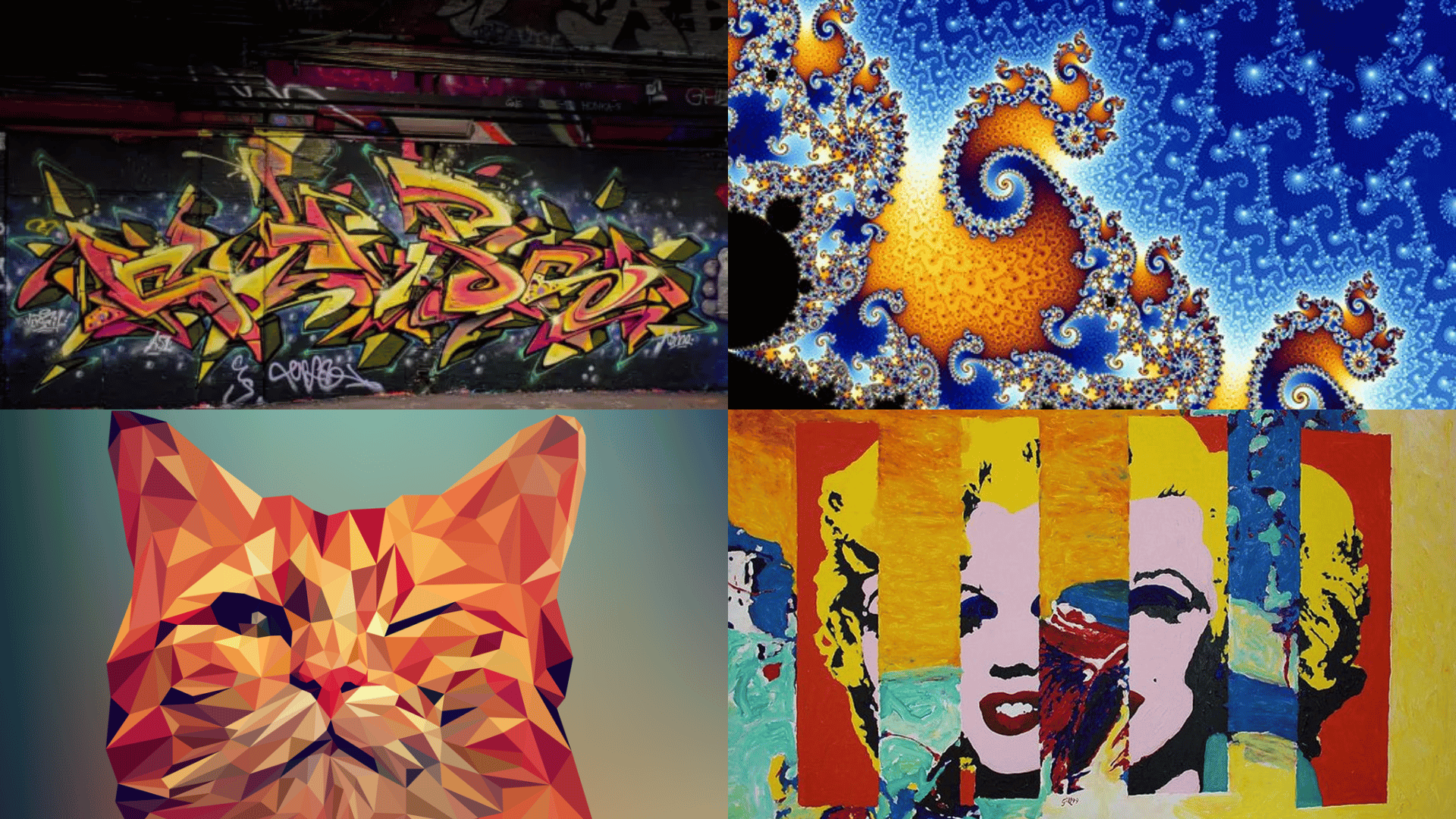
Is digital art now considered its own movement? As of 2026, digital art is considered a medium rather than a single movement. However, it is the foundation for various digital-first movements, such as Generative Art or Glitch Art, which use the specific properties of digital code and hardware as their primary medium.
Does current art still fall into distinct movements? Contemporary art is highly fragmented. Because of the globalized nature of information, it is difficult for a single movement to achieve the total dominance that movements like Impressionism or Pop Art once held. Modern practice is often defined by a "pluralism" where many styles coexist.
Why do movements eventually die out? Movements decline when their ideas become widely accepted, when they become commercially exploited to the point of losing their critical edge, or when a new generation of artists emerges with a philosophy that finds the previous movement’s methods irrelevant or restrictive.
Recommendations for Further Study
To deepen your understanding, focus on building a library of primary source documents—such as exhibition catalogs and artist letters—rather than relying solely on secondary summaries. Visit physical galleries to observe the physical scale and surface texture of works, as these details are often lost in digital reproductions. When viewing a collection, do not attempt to memorize dates; instead, focus on the "why" of the change—what was the artist trying to solve that the previous generation could not?