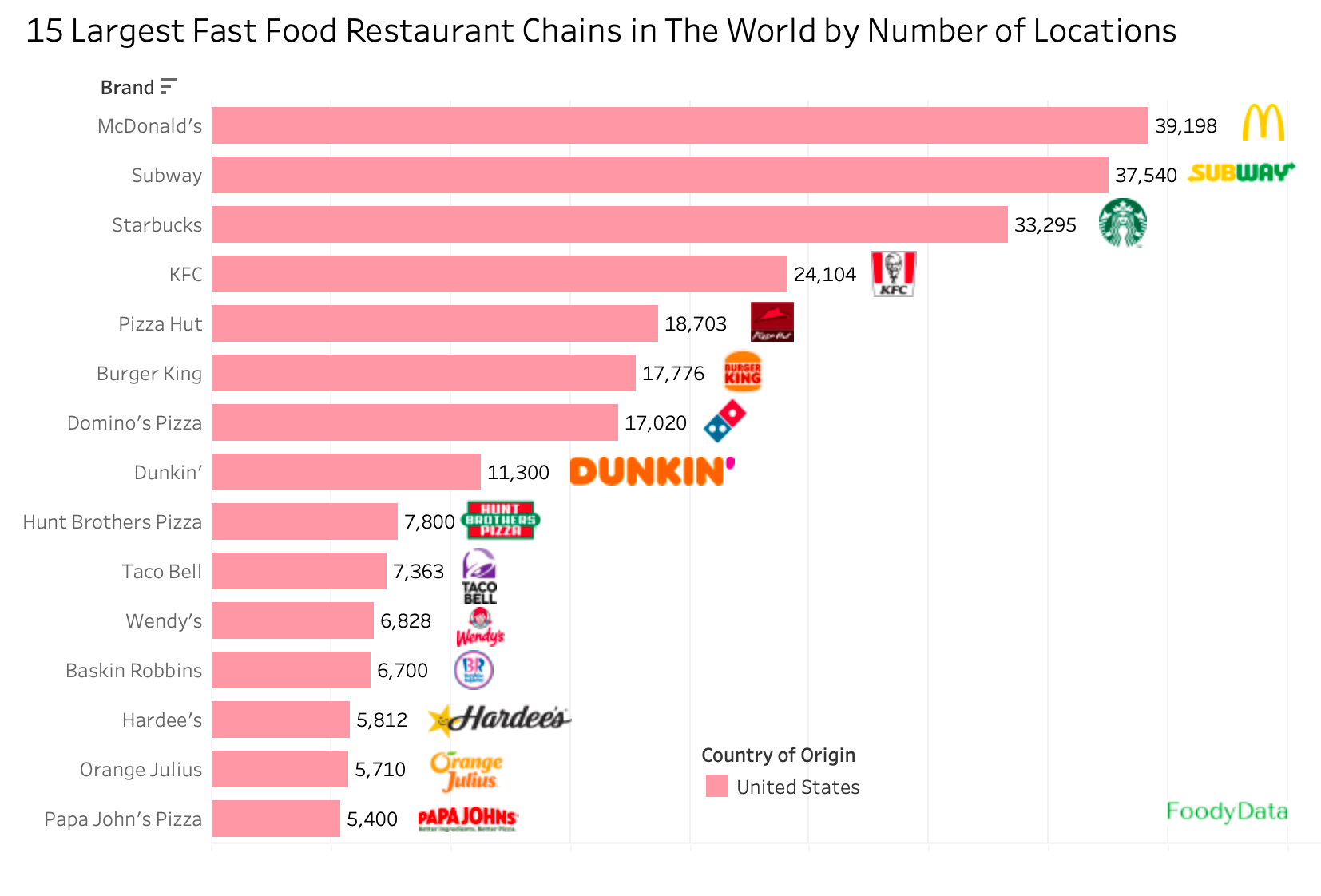
Subway holds the title for the fast food chain with the most individual franchise locations globally. As of 2026, the brand operates approximately 36,000 to 37,000 restaurant units across more than 100 countries. While other chains generate higher total annual revenue, Subway’s business model, focused on a smaller physical footprint and lower initial capital requirements for franchisees, has allowed for more extensive geographical saturation.
Understanding Global Expansion in the Quick-Service Industry
To determine which fast food chain has the most locations, one must distinguish between total annual revenue and total unit count. While brands like McDonald’s are often perceived as the largest due to their immense brand recognition and consistent revenue dominance, their physical store count is lower than that of Subway.
The primary driver of Subway’s position as the world leader in unit count is its specific franchising model. Unlike burger chains that require substantial kitchen infrastructure, industrial-grade ventilation, and large dining areas to manage high-volume frying and grilling, a typical Subway shop requires a relatively small square footage and minimal complex cooking equipment. This lower barrier to entry allows the company to establish storefronts in non-traditional spaces, such as inside gas stations, convenience stores, hospitals, and airports, where larger competitors would struggle to fit or operate profitably.
The Evolution of Unit Growth and Market Saturation
The rapid expansion of Subway throughout the late 20th and early 21st centuries serves as a case study in decentralized growth. By utilizing a franchise-only model—where the parent company owns very few corporate-run locations—the brand shifted the financial risk of site selection, staffing, and day-to-day operations to individual entrepreneurs.
This strategy led to a period of aggressive site acquisition, peaking in the mid-2010s. During this time, the company’s internal growth metrics focused primarily on the total number of outlets. In recent years, however, the strategy has shifted from sheer quantity toward the revitalization of existing locations. Despite a moderate contraction of total units from its peak, the brand retains enough volume to remain ahead of competitors such as McDonald’s, Starbucks, and Yum! Brands (which owns KFC, Taco Bell, and Pizza Hut) in terms of sheer outlet count.
Comparative Metrics: Unit Count vs. Revenue
While unit count is a common metric for assessing global reach, it does not necessarily equate to market dominance in financial terms. The following table provides a snapshot of how the industry leaders compare in terms of operational strategy and footprint.
| Brand | Primary Food Category | Approximate Unit Count (Global) | Operational Model |
|---|---|---|---|
| Subway | Sandwiches | ~36,000+ | Franchise-heavy |
| McDonald's | Hamburgers | ~42,000* | Mixed (Corporate/Franchise) |
| Starbucks | Coffee | ~39,000 | Mixed (Corporate/License) |
| KFC | Chicken | ~30,000+ | Franchise-heavy |
| Domino's | Pizza | ~21,000+ | Franchise-heavy |
Note: McDonald's total unit figures often include "system-wide" locations that may undergo frequent reclassifications based on regional master-franchise reporting, which can lead to variance in independent industry reports.
When evaluating these figures, it is essential to consider the definition of a "location." Some chains categorize a small kiosk in a retail store differently than a standalone drive-thru restaurant. Subway’s dominance is bolstered by its ability to integrate into "non-traditional" retail spaces, which effectively inflates the total count compared to chains that require standalone architecture.
Factors Influencing Global Location Density
Several operational and economic factors dictate why one brand can scale to tens of thousands of locations while another remains regionally concentrated.
1. Capital Expenditure (CapEx) Requirements
The cost to open a franchise is a deciding factor in how quickly a brand can scale. A new McDonald’s or KFC location requires significant investment in specialized, heavy-duty cooking equipment, fire suppression systems, and often real estate development. In contrast, the "Subway model" involves preparing sandwiches with cold-prep lines and ovens that occupy significantly less space. This lower initial investment attracts a larger pool of potential franchisees, facilitating faster growth in emerging markets.
2. Supply Chain and Logistics
Global scaling requires a sophisticated supply chain. Brands that use shelf-stable or easily sourced ingredients, such as bread, deli meats, and vegetables, often face fewer logistical hurdles than those requiring complex temperature-controlled meat supply chains. However, even with simpler menus, maintaining food safety standards across thousands of international locations remains the biggest operational challenge for the global leader.
3. Regulatory and Zoning Versatility
Because many Subway locations are designed as "in-line" units (located in shopping centers or strip malls), they bypass many of the complex zoning and architectural permits required for standalone structures. This flexibility allows for faster site selection and shorter time-to-open windows compared to traditional "QSR" (Quick Service Restaurant) setups.
The Role of Non-Traditional Locations
A significant portion of the competitive gap in unit numbers is explained by the move into non-traditional venues. A "traditional" restaurant serves as a standalone building with a drive-thru, whereas a non-traditional location is situated within a host facility.
Subway has historically been the industry leader in securing space within:
- Convenience Stores: Maximizing traffic from fuel station customers.
- Institutional Settings: Supplying hospitals, universities, and government buildings.
- Transit Hubs: Integrating into airport terminals and train stations where space is at a premium.
This strategy ensures that the brand is present at the point of consumption, rather than requiring the customer to seek out a destination restaurant. By effectively becoming a ubiquitous fixture in retail infrastructure, the brand maintains its leading position in location count.
Analyzing the Trends: 2026 and Beyond
As of 2026, the global fast food market is experiencing a shift. While the race for the "most locations" was the primary focus for decades, the current trend among major chains—including the leader in total units—is "market optimization." This means closing underperforming locations and renovating high-traffic ones to improve profitability per square foot.
Investors and industry analysts now focus more on "same-store sales" growth rather than net-new unit growth. As a result, the gap between the top few brands may narrow, not because the leader is failing, but because the strategy for long-term health has moved toward digital integration and mobile-ordering efficiency rather than the physical footprint alone.
Frequently Asked Questions
Does McDonald’s have more locations than Subway?
No. While McDonald's is the most valuable fast food brand in terms of global revenue and brand equity, Subway continues to report a higher number of total individual restaurant units. However, this count can fluctuate based on how each company reports satellite locations and temporary closures.
Why do some sources list different counts for these chains?
Discrepancies often arise due to the definition of a "location." Some sources include licensed kiosks in supermarkets or fuel stations, while others only count full-service restaurants. Additionally, differences in international reporting standards for master-franchise agreements can cause variations in official corporate filings.
Is the number of locations a good indicator of food quality?
No. The number of locations is primarily an indicator of business scalability, supply chain efficiency, and franchise demand. It does not reflect consumer preference, nutritional value, or culinary quality, which are subjective measures independent of global reach.
Which fast food chain is growing the fastest as of 2026?
While Subway holds the record for the highest current count, high-growth, modern fast-casual chains—such as those focusing on regional cuisines or healthier alternatives—are currently experiencing faster percentage-based growth in specific geographic markets. Larger global chains are currently focused more on brand transformation than aggressive net-new growth.
How does the franchise model affect location survival?
The franchise model allows a brand to expand rapidly by using the capital of local owners. However, it also creates a high degree of dependence on the individual success of those owners. If a franchisee struggles to meet corporate standards or regional economic demands, the brand may face a wave of closures, which is why unit counts often shift annually.
Recommendations for Further Research
If you are investigating the restaurant industry for market analysis or investment purposes, do not rely solely on unit counts. The true health of a global chain is found in its annual financial reports, specifically the "system-wide sales" and "average unit volume" (AUV).
To track the most current developments, consult the annual 10-K filings from publicly traded parent companies or the annual industry reports published by trade organizations like the National Restaurant Association. These documents provide audited data that separates reality from anecdotal growth claims. For those interested in the operational mechanics, reviewing the franchise disclosure documents (FDDs) for these chains provides deep insight into the costs and requirements for opening and operating these locations in 2026.