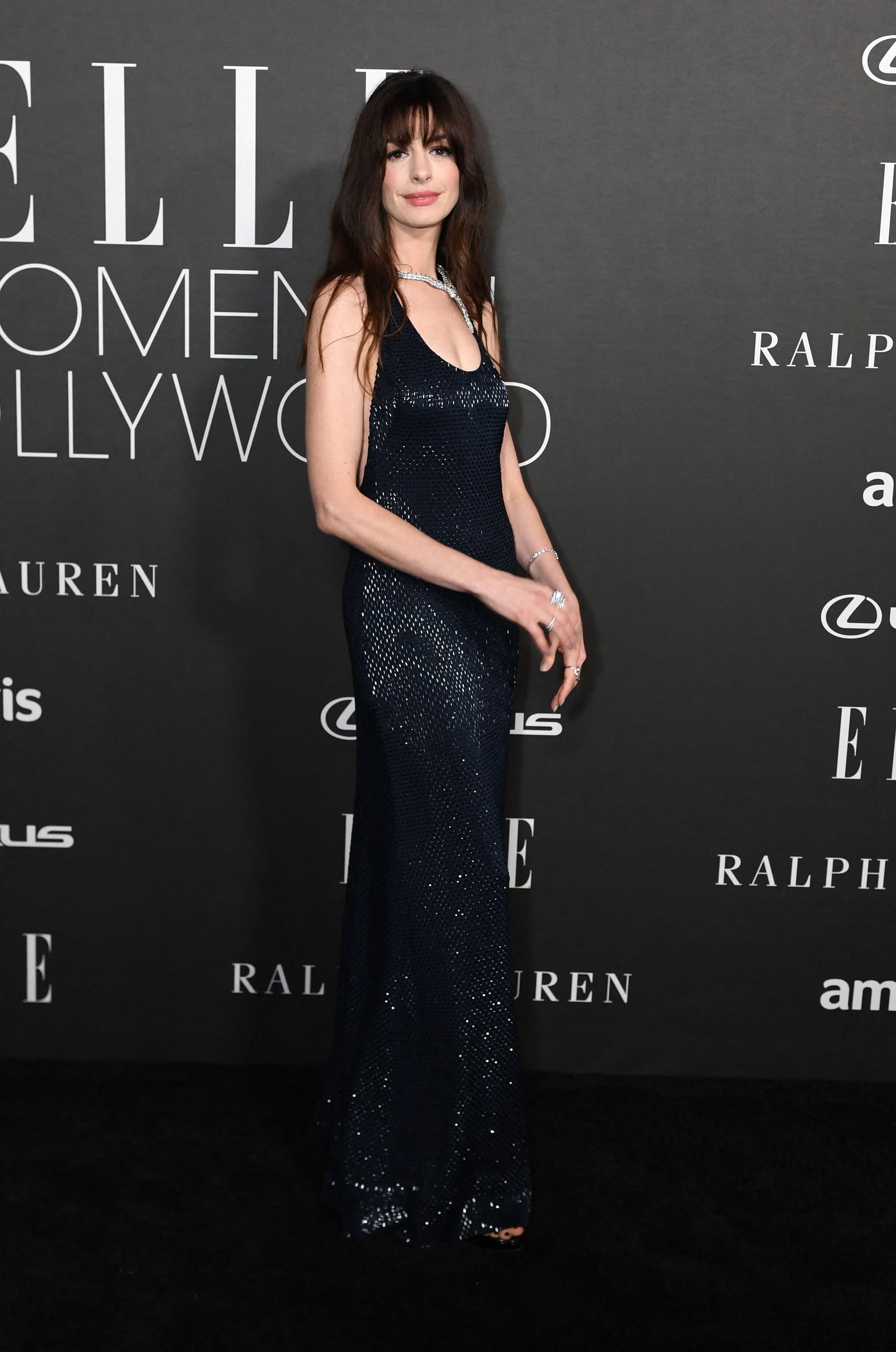
Anne Hathaway captivated the entertainment and fashion worlds at the 30th Screen Actors Guild Awards by wearing an archival cerulean blue Atelier Versace gown. The striking ensemble served as a deliberate, nostalgic homage to The Devil Wears Prada, cleverly invoking Miranda Priestly’s legendary cerulean monologue during Hathaway's onstage reunion with Meryl Streep and Emily Blunt.
The Moment Fashion and Cinema Collided
Red carpet fashion has evolved beyond simple aesthetic beauty; it has transformed into a sophisticated storytelling medium. In recent years, red carpets have witnessed the rise of narrative-driven fashion—frequently referred to as "method dressing." Actors and stylists increasingly use public appearances, press junkets, and award ceremonies to reference character histories, project themes, and cinematic legacies.
Few examples demonstrate this dynamic as vividly as Anne Hathaway’s appearance at the 2024 SAG Awards. Walking the red carpet and subsequently taking the stage alongside Meryl Streep and Emily Blunt, Hathaway wore an electric, sweeping blue gown that sent shockwaves through social channels and fashion commentary. The dress was not simply an eye-catching garment; it represented a meta-commentary on Hathaway’s own breakout role as Andy Sachs in the 2006 cinematic classic The Devil Wears Prada.
The reunion marked nearly two decades since the film debuted, yet the audience’s visceral reaction proved that the cultural footprint of the movie remains as sharp as ever. By selecting a shade intimately tied to one of the most celebrated monologues in modern film history, Hathaway showed how thoughtful styling can pay tribute to cinema while asserting modern red-carpet dominance.
Deconstructing the Gown: Couture Craftsmanship and Color Theory
While many viewers immediately linked the color of the gown to the iconic film, the garment itself stands as a masterwork of high-fashion construction. Designed by Donatella Versace for the Atelier Versace Spring/Summer 2015 Haute Couture collection, the dress represents an era of meticulous structural experimentation.
| Gown Specifications | Details |
|---|---|
| Designer | Atelier Versace (Haute Couture) |
| Collection | Spring/Summer 2015 Archival |
| Color Profile | Electric Cerulean / Rich Azure |
| Silhouette | Column Gown with Thigh-High Slit & Asymmetrical Cutouts |
| Signature Hardware | Silver Medusa-Buckled Fabric Belt |
| Lead Stylist | Erin Walsh |
The Architectural Blueprint
The dress features an off-the-shoulder, asymmetrical neckline that drapes across the clavicle, framed by structural twists and deliberate slash cutouts along the bodice. Atelier Versace is famous for blending structural rigidity with fluid sensuality, and this design relies heavily on complex internal corsetry that anchors the dress while allowing the fabric to drape naturally across the torso.
A wide, statement belt secured at the waist features silver hardware, a hallmark of Versace’s mid-2010s aesthetic, cinching the silhouette before releasing into an architectural column skirt with a daring thigh-high slit. The juxtaposition between geometric cutouts and sweeping fabric created dramatic movement both under the auditorium lights and when walking across the stage.
The Psychology of Cerulean
Color theory plays a crucial role in the gown's visual authority. Cerulean—a shade derived from the Latin caeruleus, meaning "sky" or "heavens"—occupies a unique position in the blue spectrum. It balances cyan and deep azure, projecting confidence, clarity, and precision. On high-resolution broadcast feeds, the saturated hue created maximum contrast against the neutral, warm tones of the SAG Awards stage and step-and-repeat backdrop, instantly drawing the viewer's eye.
The Cinematic Context: Why Cerulean Means Everything
To understand why this specific garment resonated so deeply across pop culture, one must revisit the foundational fashion text from which it draws its power: the 2006 adaptation of Lauren Weisberger's novel, directed by David Frankel.
The Anatomy of the Monologue
In The Devil Wears Prada, the color cerulean is not just a palette choice; it is an instrument of education and discipline. In one of the most quoted scenes in cinematic history, Hathaway’s character, Andy Sachs, snickers quietly as Editor-in-Chief Miranda Priestly (played with chilling restraint by Meryl Streep) deliberates between two nearly identical belts.
Priestly pauses the entire editorial department to systematically deconstruct Andy’s presumed independence from the fashion industry. Pointing directly at Andy's rumpled knitwear, Priestly famously explains:
"You think this has nothing to do with you. You go to your closet and you select... that lumpy blue sweater, for instance, because you’re trying to tell the world that you take yourself too seriously to care about what you put on your back. But what you don't know is that that sweater is not just blue, it's not turquoise, it's not lapis, it's actually cerulean."
Priestly proceeds to trace the lineage of that cerulean shade from Oscar de la Renta's 2002 gown collection and Yves Saint Laurent's military jackets down to casual departments and, ultimately, to the bargain bin where Andy purchased it. The monologue served as a cultural thesis on the pervasive, systemic influence of haute couture on mainstream consumer reality.
From Naïve Assistant to Couture Authority
By stepping out in an archival couture version of that exact shade nearly two decades later, Hathaway completed a full narrative loop. In the film, Andy Sachs begins as an oblivious outsider who views high fashion with condescension before learning to respect its craftsmanship and authority.
In real life, Hathaway has transcended the role to become a celebrated muse to premier fashion houses, including Versace and Bulgari. Donning an elite, runway-grade interpretation of the "cerulean sweater" was a sophisticated, self-aware wink to the audience: Andy Sachs didn't just learn how the industry worked—she conquered it.
The SAG Awards Reunion: Choreographing a Pop-Culture Triumph
Fashion moments rarely succeed in a vacuum; their resonance depends heavily on staging, timing, and interpersonal chemistry. The context surrounding Hathaway's blue dress made it an immediate cultural phenomenon.
Streep took the stage first to present the award for Best Male Actor in a Comedy Series, playfully tripping over the microphone stand and forgetting her glasses. Seconds later, Emily Blunt and Anne Hathaway walked out from opposite wings to join her. As Streep quipped that she didn't think she was anything like Miranda Priestly, Blunt and Hathaway seamlessly slipped into their cinematic personas.
Blunt retorted with one of her character’s trademark lines—"No, no, that wasn't a question"—while Hathaway deadpanned another iconic quote: "By all means, move at a glacial pace. You know how that thrills me."
The visual contrast on stage was striking. Streep wore a custom crimson, floor-length lace gown by Prada—a direct, playful literalization of the film's title. Blunt appeared in a vibrant red cut-out gown by Louis Vuitton. Hathaway's vivid cerulean gown created a primary-color triad alongside her co-stars, ensuring that each woman stood out distinctly while presenting a harmonious, polished tableau for photographers.
Comparative Analysis: The Evolution of Hathaway's Archival Fashion Era
Hathaway's 2024 SAG Awards appearance was not an isolated success; it formed part of a calculated stylistic renaissance led by celebrity stylist Erin Walsh. The duo has systematically redefined modern red-carpet dressing by championing vibrant archival selections and bold high-fashion silhouettes.
| Event & Year | Designer & Era | Garment Characteristics | Conceptual Narrative |
|---|---|---|---|
| SAG Awards (2024) | Atelier Versace (Archival Spring 2015) | Cerulean blue off-shoulder gown, structural waist belt, cutouts | Direct homage to The Devil Wears Prada and Andy Sachs |
| Met Gala (2023) | Atelier Versace (Custom) | Tweed and safety-pin gown combining Chanel and Versace codes | Tribute to Karl Lagerfeld blending classic Parisian tweed with Milanese rebellion |
| Cannes Film Festival (2022) | Armani Privé (Custom) | Minimalist white sequined column gown with dramatic organza train | Pure Hollywood glamour, emphasizing elegance and timeless refinement |
| Sundance Film Festival (2023) | Versace (Fall/Winter 2023) | Puffer-corset hybrid jacket paired with sheer tights and platform boots | Edge-driven street couture subverting winter utility wear |
| Fashion Awards (2023) | Valentino (Archival 1993) | Geometric off-white spaghetti-strap gown designed by Valentino Garavani | Homage to vintage Roman tailoring and haute couture preservation |
Through these coordinated appearances, Hathaway and Walsh have proved that pulling from fashion archives yields significantly higher cultural engagement than simply wearing off-the-rack current season looks. Archival couture brings an inherent pedigree, celebrating fashion history while mitigating the environmental fatigue associated with disposable red-carpet cycles.
Why "Method Dressing" Dominates Modern Style Culture
Hathaway’s blue dress exemplifies the contemporary phenomenon of thematic red carpet dressing. Where stylists once sought only to make clients look universally flattering, modern red-carpet campaigns function as narrative marketing extensions.
The Rise of Storytelling Over Simple Aesthetics
Audiences today consume fashion through digital snippets, viral breakdowns, and dedicated runway commentary accounts. A beautiful gown is quickly forgotten in a fast-scrolling feed, but a gown that contains an embedded riddle, an archival Easter egg, or a thematic callback generates sustained editorial engagement.
Other contemporary examples highlight this macro trend:
- Zendaya and Law Roach regularly lean into method dressing, wearing tennis-ball heels for sports dramas or robotic vintage Mugler couture for science-fiction premieres.
- Margot Robbie and Andrew Mukamal referenced historical Barbie garments from 1959 onward during the Barbie global press tour.
- Jenna Ortega adopted structural, Gothic-inspired silhouettes throughout her appearances supporting dark-fantasy franchises.
Hathaway’s blue dress operates on the same plane, though with a distinct twist: it paid tribute not to an upcoming project, but to an established cultural touchstone from her past. It proved that an actor can celebrate their classic creative milestones without being trapped by them.
Styling Lessons: How to Harness Intentional Color and Archival Silhouettes
While few people attend events requiring custom Atelier Versace haute couture, the aesthetic principles governing Hathaway's blue dress provide valuable styling insights for wardrobe development and formal dressing.
1. Identify Your Signature Statement Hue
Cerulean worked on Hathaway not solely because of the movie reference, but because it flattered her alabaster skin tone and dark brunette hair. Discovering high-contrast shades that complement personal undertones transforms an ordinary formal look into an unforgettable presence. Do not shy away from vivid primary colors in environments dominated by safe neutrals.
2. Balance Structure With Negative Space
The Versace gown achieved its striking effect through contrasting elements: a wide belt and sharp structure juxtaposed with asymmetrical cutouts and an exposed shoulder. When selecting eveningwear, balance reveals (such as a high slit or an off-the-shoulder neckline) with deliberate tailoring to ensure the final silhouette feels balanced rather than overexposed.
3. Embrace Narrative Continuity
Wardrobe choices gain depth when they carry personal or contextual significance. Whether selecting vintage jewelry passed down through family generations or sourcing an archival piece from an independent vintage dealer, wearing pieces with history creates natural conversation points and elevates personal style above transient micro-trends.
Frequently Asked Questions
Was Anne Hathaway’s blue dress actually designed by Prada?
No. Despite the film's title, the gown was designed by Atelier Versace. It was pulled from Donatella Versace’s Spring/Summer 2015 Haute Couture archive. The reference to "Prada" lies in the dress's cerulean blue hue, which directly honored the famous cerulean monologue delivered in the film The Devil Wears Prada.
Who styled Anne Hathaway for the 2024 SAG Awards?
Hathaway was styled by celebrated fashion stylist Erin Walsh. Walsh has been the creative force behind Hathaway’s recent high-profile fashion renaissance, curating looks that balance vintage couture, vibrant color blocking, and modern red-carpet trends.
What is the exact significance of the color cerulean in The Devil Wears Prada?
In the film, Meryl Streep’s character, Miranda Priestly, delivers an iconic monologue detailing how the high-fashion industry dictates color trends down to discount retailers. She uses Andy Sachs’s lumpy cerulean sweater to prove that even consumers who claim to ignore fashion are entirely governed by the aesthetic and economic decisions of fashion houses.
Which jewelry pieces accompanied the Atelier Versace gown?
Hathaway accessorized the gown with high jewelry from Bulgari, for whom she serves as an international brand ambassador. She wore diamond drop earrings, a sculptural silver choker-style necklace, and several diamond cocktail rings that complemented the gown's silver Medusa belt hardware without overpowering the vibrant blue fabric.
How did Hathaway’s co-stars coordinate their outfits for the reunion?
Meryl Streep and Emily Blunt both selected shades of red, with Streep wearing a custom lace Prada gown and Blunt wearing a minimalist, cut-out gown by Louis Vuitton. This coordinated styling allowed Hathaway’s cerulean blue gown to create an intentional, eye-catching color contrast, forming a striking primary-color palette across the stage.
Practical Takeaway: Auditing Wardrobe Color and Narrative
To translate the principles of Hathaway's iconic styling into everyday personal presentation, conduct a seasonal audit of your formalwear choices:
- Assess High-Saturation Palettes: Identify whether your current wardrobe relies too heavily on safe neutrals (black, navy, charcoal). Test deeply saturated shades like cerulean, emerald, or ruby to observe which colors create the highest visual impact against your natural complexion.
- Prioritize Archival and Vintage Sourcing: Instead of defaulting to fast-turnaround new collections, explore curated vintage and consignment boutiques for formal events. Archival garments frequently offer superior textiles, higher-quality seam construction, and singular silhouettes that set you apart from modern mass-market trends.
- Curate With Intention: Select accessories that echo structural elements of your garments—such as matching cool-toned silver jewelry to metallic hardware or structural belts—ensuring that every component of an outfit serves a cohesive visual narrative.