In aviation, category and class describe how aircraft are grouped by the Federal Aviation Administration (FAA). For pilots, category is a broad grouping like Airplane or Rotorcraft, while class specifies types like Single-Engine Land. For aircraft, category refers to intended use, such as Normal or Transport, dictating structural limits and certification standards.
Understanding the distinction between "category" and "class" is one of the first hurdles for any student pilot. The confusion stems from the fact that the FAA uses these terms in two entirely different contexts: the certification of airmen (pilots) and the certification of aircraft (the machines themselves). As of 2026, these definitions remain the bedrock of the National Airspace System, ensuring that pilots are qualified for the specific characteristics of the machines they fly and that those machines are built to handle their intended operations.
The Dual Definition: Airmen vs. Aircraft
To navigate FAA regulations, specifically 14 CFR Part 1.1, one must first determine which perspective is being discussed. If you are looking at a pilot’s plastic certificate, you are looking at Certification of Airmen. If you are looking at an airplane’s Airworthiness Certificate, you are looking at Certification of Aircraft.
This distinction is vital because a single word, like "Airplane," can serve as a category for a pilot's license, while a word like "Normal" serves as a category for the aircraft’s structural certification. Mixing these up in a checkride or a legal briefing can lead to significant misunderstandings of operating limitations.
Why the Distinction Matters
The FAA's primary goal is safety through standardization. By categorizing airmen, the regulator ensures a pilot who learned to fly in a small Cessna isn't legally allowed to jump into a Boeing 777 or a helicopter without further training. By categorizing aircraft, the regulator ensures that an airplane built for gentle cross-country flights isn't subjected to the high-G stresses of advanced aerobatics.
Certification of Airmen: What Pilots Can Fly
When a pilot earns a certificate, it is categorized and classed based on the complexity and environment of the aircraft. This hierarchy ensures that as a pilot moves to more complex machinery, they receive specific training and testing for those unique flight characteristics.
Categories of Airmen Certification
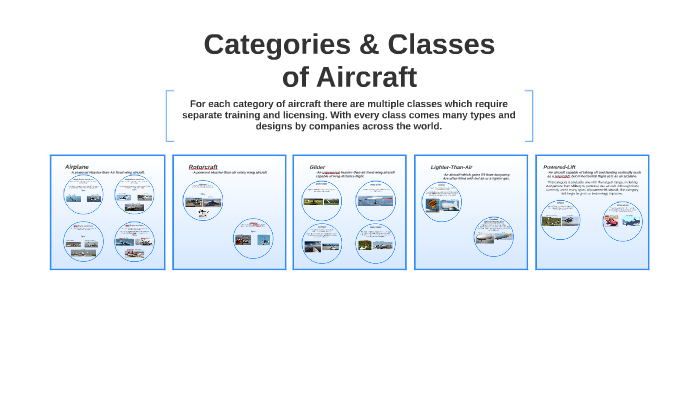
A category is the broadest grouping of aircraft. Under 14 CFR Part 61.5, the categories for pilot certification include:
- Airplane: Fixed-wing aircraft supported by dynamic reaction of air against its wings.
- Rotorcraft: Aircraft that depend on rotating blades for lift (Helicopters and Gyroplanes).
- Glider: Aircraft that do not depend on an engine for sustained flight.
- Lighter-than-air: Aircraft that rise via buoyancy, such as airships and balloons.
- Powered-lift: Aircraft capable of vertical takeoff and landing that transition to fixed-wing flight.
- Powered Parachute: A powered aircraft with a flexible wing.
- Weight-Shift-Control: Aircraft such as trikes that are steered by moving the fuselage relative to the wing.
Classes of Airmen Certification
Classes are subsets within a category. For the "Airplane" category, which is the most common path for new pilots, the classes are defined by where the aircraft lands and how many engines it has:
- Single-Engine Land (SEL): The most common entry point, covering aircraft like the Cessna 172 or Piper Archer.
- Multi-Engine Land (MEL): Aircraft with more than one engine, such as a Beechcraft Baron or a Piper Seminole.
- Single-Engine Sea (SES): Floatplanes or flying boats with one engine.
- Multi-Engine Sea (MES): Amphibious or sea-based aircraft with multiple engines.
If you hold a Private Pilot Certificate with an "Airplane Single-Engine Land" rating, you cannot legally fly a multi-engine airplane or a helicopter until you receive additional training and pass a "checkride" (practical test) to add those ratings to your certificate.
Certification of Aircraft: How Machines are Built
While pilot certification focuses on competency, aircraft certification focuses on airworthiness. This describes the purpose for which the aircraft was designed and the structural loads it can safely withstand. This information is found in the aircraft's Type Certificate Data Sheet (TCDS) and its Pilot’s Operating Handbook (POH).
Aircraft Categories
The FAA classifies aircraft into categories based on their intended use and operating limitations. As of 2026, the primary categories include:
- Normal: Intended for non-acrobatic operation. These aircraft are limited to a "load factor" of 3.8 Gs. Most general aviation trainers fall into this category.
- Utility: Permits limited acrobatic maneuvers, such as spins (if approved) and steep turns. These must withstand 4.4 Gs.
- Acrobatic: Designed for precision maneuvering and high-stress flight. These are tested to 6.0 Gs or higher.
- Transport: Includes large airliners and regional jets. These have more stringent redundancy and performance requirements.
- Commuter: Limited to multi-engine aircraft with 19 or fewer seats and a maximum takeoff weight of 19,000 pounds or less.
- Restricted: Aircraft used for specific purposes like crop dusting, forest fire fighting, or aerial surveying.
- Limited: Frequently applied to ex-military aircraft that have been transitioned to civilian use.
- Experimental: A broad category for amateur-built aircraft, racing planes, or aircraft used for research and development.
- Light-Sport (LSA): Simple, low-performance aircraft with specific weight and speed limitations, designed for lower-cost entry into aviation.
The "Class" of an Aircraft
In the context of aircraft certification, "class" is used less formally than in airman certification. It generally refers to a group of aircraft with similar propulsion, flight, or landing characteristics, such as "airplane," "rotorcraft," or "seaplane." However, when a pilot talks about "class," they are almost always referring to their license ratings (SEL, MEL, etc.).
| Perspective | Term | Examples / Subsets | Regulatory Focus |
|---|---|---|---|
| Airmen (Pilots) | Category | Airplane, Rotorcraft, Glider, Lighter-than-air | General pilot competency |
| Airmen (Pilots) | Class | Single-Engine Land, Multi-Engine Sea | Specific engine/landing environment |
| Aircraft (Machine) | Category | Normal, Utility, Acrobatic, Transport | Structural limits and maneuvers |
| Aircraft (Machine) | Class | Airplane, Rotorcraft, Glider | Physical design characteristics |
Operational Impact: Normal vs. Utility
One of the most practical applications of these definitions for pilots is the distinction between the Normal and Utility categories within a single aircraft. Many popular training aircraft, such as the Cessna 172 or the Piper Cherokee, are certified in both categories depending on how they are loaded.
In the Normal category, the aircraft can be loaded to its maximum gross weight, but the pilot is restricted from performing any maneuvers other than those required for normal flight (maximum bank angles of 60 degrees).
In the Utility category, the pilot typically must reduce the total weight of the aircraft (often by removing rear passengers or reducing fuel) and ensure the Center of Gravity (CG) is within a specific range. In return, the aircraft is legally permitted to perform maneuvers like intentional spins or steep turns with bank angles exceeding 60 degrees. This is because the structural margin of safety is higher when the aircraft is lighter.
Exceeding the limitations of the category listed in the POH is not just a regulatory violation under 14 CFR Part 91.9; it is a structural risk that can lead to in-flight breakups or loss of control.
Beyond Category and Class: Type Ratings and Endorsements
Understanding category and class is only the first step. For more complex or larger aircraft, the FAA requires additional "layers" of certification.
Type Ratings
While a "Class" rating covers all single-engine land airplanes, a Type Rating is required for specific aircraft that are particularly large or complex. As defined in 14 CFR Part 1, a type rating is required for:
- Large aircraft (over 12,500 pounds maximum takeoff weight).
- Turbojet-powered airplanes.
- Any other aircraft specified by the FAA through its type certificate procedures.
For example, a pilot with an "Airplane Multi-Engine Land" rating can fly a Beechcraft King Air (under 12,500 lbs) without a type rating. However, to fly a Boeing 737, that same pilot must undergo specific training and a checkride for the "B-737" type rating.
Endorsements
Endorsements are logbook entries from an instructor that authorize a pilot to operate aircraft with specific features within a category and class. Common endorsements include:
- Complex: Aircraft with retractable landing gear, flaps, and a controllable-pitch propeller.
- High-Performance: Aircraft with an engine producing more than 200 horsepower.
- Tailwheel: Aircraft with the third wheel at the rear instead of the nose.
- High-Altitude: Pressurized aircraft capable of operating above 25,000 feet MSL.
Transitioning Between Categories and Classes
Pilots frequently "add-on" categories or classes to their existing certificates. The requirements for this are outlined in 14 CFR Part 61.63.
Adding a Class Rating
If a pilot already holds an "Airplane Single-Engine Land" certificate and wants to add "Multi-Engine Land," they do not need to retake the written (knowledge) test. They simply need to receive the required flight training, obtain an instructor's endorsement, and pass a practical test (checkride) focusing on the differences—primarily engine-out procedures and multi-engine aerodynamics.
Adding a Category Rating
If a fixed-wing pilot wants to fly helicopters, they are adding a Category. This is more intensive than adding a class. While they still may not need to take a new private pilot knowledge test, they must meet the specific aeronautical experience requirements for rotorcraft (which are significantly different from airplanes) and pass a comprehensive checkride.
Frequently Asked Questions
Is "Single-Engine Land" a category or a class?
For pilot certification, Single-Engine Land is a class. The category is Airplane. This is a common point of confusion during oral exams, as many students mistakenly call "Airplane" the class. Remember: Category is the big bucket; Class is the smaller bucket inside it.
What category are most airliners?
In terms of aircraft certification (airworthiness), airliners are in the Transport category. This category has the highest standards for structural integrity, systems redundancy, and fire protection. For the pilots flying them, the category is Airplane, the class is Multi-Engine Land, and they must also hold a specific Type Rating for that model.
Can an aircraft belong to more than one category?
Yes. As mentioned, many general aviation aircraft are certified in both the Normal and Utility categories. The pilot determines which category they are operating in by calculating the weight and balance of the aircraft before flight. If the weight is below the utility limit and the CG is within the utility envelope, the aircraft is technically in the Utility category for that flight.
Does a pilot need a new license for every airplane model?
No. For most small, single-engine airplanes, a Private Pilot certificate with an "Airplane Single-Engine Land" rating allows you to fly any model (e.g., Cessna, Piper, Cirrus) provided you have the necessary endorsements (like high-performance or complex) and meet the insurance requirements. You only need a model-specific "Type Rating" for turbojets or aircraft over 12,500 lbs.
What is the "Experimental" category used for?
The Experimental category is used for aircraft that do not have a standard type certificate. This includes home-built planes, aircraft used for exhibition or air racing, and prototypes used for testing new technologies. These aircraft often have "Operating Limitations" issued by the FAA that restrict where and how they can be flown, such as avoiding densely populated areas.
Practical Recommendations for Pilots
If you are a student pilot or an aviator looking to expand your horizons in 2026, keep these steps in mind:
- Audit Your Certificate: Look at the "Ratings" section of your pilot certificate. Ensure you understand exactly which category and class you are authorized to fly.
- POH Verification: Before flying a new-to-you aircraft, check the "General" section of the Pilot’s Operating Handbook. Confirm which aircraft certification category it falls under (Normal, Utility, etc.) and what maneuvers are prohibited.
- Plan for Add-ons: If you intend to add a class rating (like Sea or Multi-engine), focus your study on the specific aerodynamic differences of that class rather than re-studying basic private pilot maneuvers.
- Stay Current on MOSAIC: If you fly Light-Sport Aircraft, stay informed on the latest 2026 MOSAIC (Modernization of Special Airworthiness Certification) regulations, which have expanded the weight and speed limits for aircraft that can be flown by Sport Pilots.
By mastering the nuances of category and class, you ensure legal compliance and, more importantly, a deeper understanding of the safety margins designed into every flight you take.