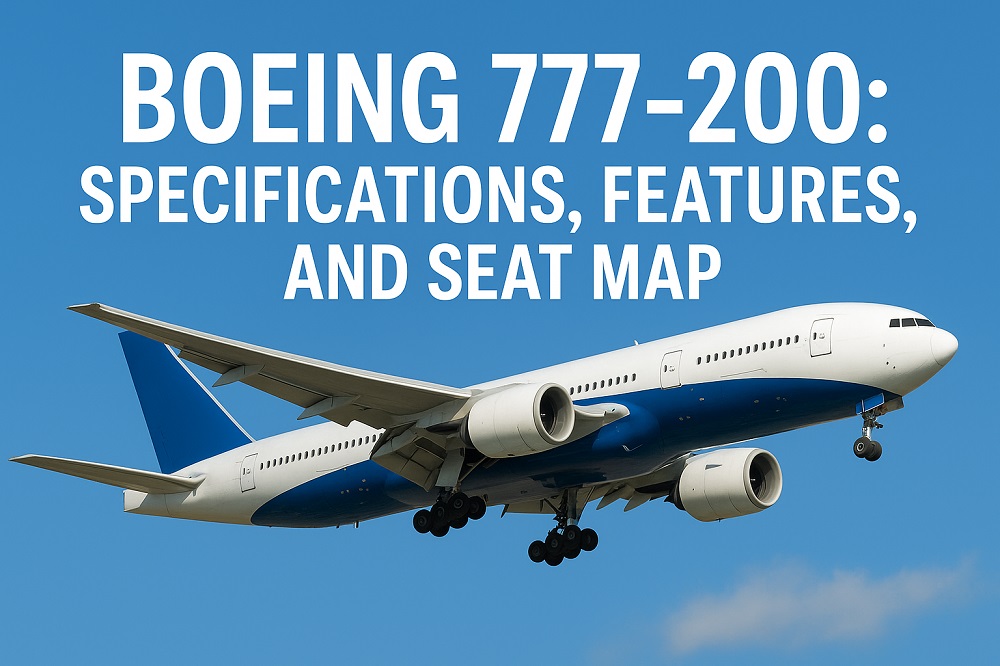
The Boeing 777 family represents the pinnacle of long-range, wide-body, twin-engine commercial aviation. Since its inception, it has evolved through several generations, offering a size range from 63.7 meters to 76.7 meters in length and passenger capacities typically spanning 300 to 426 seats, depending on the specific variant and cabin configuration.
The Boeing 777, often referred to as the "Triple Seven," was the first commercial aircraft to be designed entirely by computer using 3D CAD software (CATIA). It was developed to bridge the gap between the Boeing 767 and the 747, and to replace older wide-body tri-jets. As of 2026, the 777 remains a dominant force in international travel, particularly with the introduction of the 777X series, which incorporates advanced materials and aerodynamic innovations once reserved for the 787 Dreamliner.
The Evolution of the Boeing 777 Family
The 777 project was launched in the early 1990s as a response to airline demands for a twin-engine aircraft with a range and capacity comparable to existing four-engine jets but with significantly lower operating costs. The family is generally divided into three generations: the original 777 "Classics" (-200, -200ER, and -300), the second-generation Long-Range models (-200LR, -300ER, and the 777 Freighter), and the third-generation 777X (-8 and -9).
Each iteration has focused on increasing fuel efficiency, extending operational range, and maximizing payload capacity. The transition from the original -200 series to the -300ER represented a massive shift in the industry, as the twin-engine efficiency of the 777-300ER eventually led many airlines to retire their four-engine Boeing 747s and Airbus A340s in favor of the more economical Triple Seven.
777-200 Series: The Original Triple Seven
The 777-200 was the launch model of the family, entering service with United Airlines in June 1995. While the base model is now largely retired from major international fleets, its derivatives established the 777's reputation for reliability.
Boeing 777-200 (Standard)
The standard -200 was designed for domestic or shorter international routes. It has a length of 63.7 meters (209 feet 1 inch) and a wingspan of 60.9 meters (199 feet 11 inches). In a typical three-class configuration, it carries approximately 305 passengers with a range of 5,240 nautical miles (9,700 km).
Boeing 777-200ER (Extended Range)
The 200ER became the workhorse for many airlines in the late 1990s. While it maintains the same physical dimensions as the standard -200, it features a significantly increased Maximum Takeoff Weight (MTOW) and additional fuel capacity. This allows the -200ER to fly up to 7,065 nautical miles (13,080 km), making it capable of transoceanic routes that were previously the exclusive domain of larger aircraft.
Boeing 777-200LR (Longer Range)
Known as the "Worldliner," the -200LR was designed to connect almost any two cities on the globe. It holds the record for the longest distance flown non-stop by a commercial airliner. The size remains consistent with the -200 series, but it incorporates raked wingtips and additional fuel tanks. Its range is a staggering 8,555 nautical miles (15,843 km), enabling flights like Doha to Auckland or Singapore to New York.
777-300 Series: The High-Capacity Long-Haul Workhorse
Recognizing the need for a higher-capacity aircraft, Boeing stretched the fuselage of the 777 to create the -300 series. This variant is 10.1 meters longer than the -200, allowing for a substantial increase in both passenger and cargo volume.
Boeing 777-300
The standard -300 was intended as a 747-100/200 replacement. It carries about 368 passengers in three classes but has a shorter range of 5,995 nautical miles (11,100 km). It was primarily used by Asian carriers for high-density regional and medium-haul routes.
Boeing 777-300ER (Extended Range)
The 777-300ER is the most successful variant of the family. By combining the stretched fuselage of the -300 with the high-thrust GE90-115B engines and the fuel capacity of the -200LR, Boeing created an aircraft that defined the 21st-century long-haul market.
- Length: 73.9 meters (242 feet 4 inches)
- Wingspan: 64.8 meters (212 feet 7 inches)
- Range: 7,370 nautical miles (13,650 km)
- Capacity: 392 passengers (two-class) or 366 (three-class)
The 777-300ER features raked wingtips for improved aerodynamic efficiency and has been the primary choice for airlines replacing the 747-400.
The 777 Freighter (777F)
The 777 Freighter is based on the 777-200LR airframe but is optimized for dedicated cargo operations. It fills the gap between the 767-300F and the 747-8F. With a maximum payload of 102 metric tonnes, it offers the lowest trip costs of any large freighter. It shares the same dimensions as the -200LR but features a reinforced floor, a large main-deck cargo door, and no passenger windows. Its range with a full payload is approximately 4,970 nautical miles (9,200 km), which is exceptional for a dedicated cargo jet.
The 777X Generation: Pushing the Limits of Efficiency
As of 2026, the 777X series—comprising the 777-8 and the 777-9—is the newest addition to the lineup. These aircraft feature the massive GE9X engines and a new high-aspect-ratio composite wing. A unique feature of the 777X is its folding wingtips, which allow the aircraft to maintain a massive wingspan of 71.8 meters in flight while folding down to 64.8 meters on the ground to fit into existing airport gates (Code E).
Boeing 777-9
The 777-9 is the largest twin-engine jet in the world. It is longer than the 777-300ER by 2.8 meters, totaling 76.7 meters. It is designed to carry 426 passengers in a typical two-class layout with a range of 7,285 nautical miles (13,500 km). The cabin is wider than previous 777 models due to thinner internal wall insulation, allowing for 10-abreast seating with greater comfort.
Boeing 777-8
The 777-8 is the successor to the 777-200LR. It is 69.8 meters long and is optimized for ultra-long-range performance and maximum payload. It carries approximately 384 passengers with a range of 8,745 nautical miles (16,190 km). It serves as a direct competitor to the Airbus A350-1000.
Comparative Technical Specifications Table
The following table summarizes the key physical and operational metrics for the primary 777 variants in service as of 2026.
| Variant | Length (m) | Wingspan (m) | Max Seating (Typical) | Range (nmi) | MTOW (kg) |
|---|---|---|---|---|---|
| 777-200ER | 63.7 | 60.9 | 313 | 7,065 | 297,550 |
| 777-200LR | 63.7 | 64.8 | 317 | 8,555 | 347,810 |
| 777-300ER | 73.9 | 64.8 | 392 | 7,370 | 351,530 |
| 777F | 63.7 | 64.8 | Cargo Only | 4,970 | 347,815 |
| 777-8 | 69.8 | 71.8* | 384 | 8,745 | 351,535 |
| 777-9 | 76.7 | 71.8* | 426 | 7,285 | 351,535 |
*Note: 71.8m is the wingspan in flight; folded wingspan is 64.8m for airport compatibility.
Seating Capacities and Interior Configurations
The 777's fuselage diameter of 6.19 meters (20 feet 4 inches) allows for incredible flexibility in cabin layout. Most airlines have moved toward a 10-abreast (3-4-3) configuration in Economy Class for the 777-300ER and 777-9 to maximize revenue, though some premium carriers maintained a 9-abreast (3-3-3) layout for enhanced passenger comfort.
Class Breakdown
- Three-Class Layout: Typically includes 8-12 First Class suites, 42-60 Business Class seats, and 250-300 Economy/Premium Economy seats.
- Two-Class Layout: Common for shorter long-haul routes, eliminating First Class to increase Business and Economy capacity.
- High-Density Layout: Some regional versions of the 777-300 have been configured to carry over 500 passengers in a predominantly economy setup.
The 777X (777-9) features an internal cabin width that is 4 inches wider than previous models. This subtle change allows for 18-inch wide seats even in a 10-abreast configuration, addressing a common complaint regarding the "tight" feel of older 777-300ERs.
Engine Specifications and Performance Metrics
The Boeing 777 is powered exclusively by large-diameter turbofans. The choice of engines has been a defining characteristic of the aircraft's performance.
- GE90 Series: The GE90-115B, used on the -300ER and -200LR, was for years the world’s most powerful jet engine, capable of producing 115,000 lbs of thrust. Its massive carbon-fiber fan blades were a revolutionary step in propulsion technology.
- GE9X: Developed for the 777X, the GE9X is even larger, with a front fan diameter of 134 inches (340 cm). It utilizes 3D-printed parts and ceramic matrix composites (CMCs) to operate at higher temperatures, resulting in a 10% improvement in fuel burn compared to the GE90.
- Pratt & Whitney & Rolls-Royce: Earlier versions of the 777-200 and -300 offered the PW4000 and the Rolls-Royce Trent 800. These engines were popular for their reliability in the 1990s and early 2000s but were eventually superseded by the power and efficiency of the General Electric options.
Operational Range and ETOPS Considerations
The 777 was instrumental in the expansion of ETOPS (Extended-range Twin-engine Operational Performance Standards). Before the 777, twin-engine planes were heavily restricted in how far they could fly from an alternate airport. The 777 was the first aircraft to receive ETOPS-180 approval upon entry into service, meaning it could fly up to three hours away from an emergency landing site.
By 2026, the 777-300ER and 777X routinely operate under ETOPS-330 rules. This allows them to fly the most direct routes across the Pacific and Indian Oceans, significantly reducing flight times and fuel consumption. The reliability of the modern high-bypass turbofan has reached a point where the "safety" of having four engines is no longer a mathematical or operational requirement for long-haul travel.
Maintenance and Lifecycle Longevity
The 777 is designed for high-cycle, long-duration operations. The airframe makes extensive use of toughened epoxy resins and aluminum alloys. While not as "composite-heavy" as the 787, the 777X introduces the first major composite wing to the 777 family.
Maintenance programs for the 777 are well-established. Heavy maintenance checks (D-Checks) typically occur every 10–12 years, during which the aircraft is stripped down for detailed structural inspections. Because so many 777s were built, there is a robust secondary market for parts and a global network of qualified maintenance, repair, and overhaul (MRO) facilities. This ensures that even older -300ER models will likely remain in service well into the 2030s as they transition from Tier 1 passenger airlines to secondary operators or undergo "P2F" (Passenger-to-Freighter) conversions.
Frequently Asked Questions
What is the main difference between the 777-300ER and the 777-9?
The 777-9 is longer, more fuel-efficient, and features a new composite wing with folding tips. It uses the GE9X engine, which is significantly more efficient than the GE90 used on the -300ER. Additionally, the 777-9 has a wider internal cabin and larger windows inspired by the 787 Dreamliner.
Why do the 777X wings fold?
The 777X has a wingspan of nearly 72 meters to achieve maximum aerodynamic efficiency. However, most airport gates are designed for a maximum wingspan of 65 meters (Code E). By folding the wingtips after landing, the 777X can use the same gates as the 777-300ER without requiring airports to undergo expensive infrastructure upgrades.
How many passengers can a Boeing 777 carry?
Capacity varies by model and airline configuration. The smaller 777-200 typically carries around 300 passengers, while the 777-300ER carries between 360 and 396. The newest 777-9 is designed for a typical capacity of 426 passengers but can be configured for more in high-density layouts.
What is the maximum range of the Boeing 777?
The 777-200LR and the upcoming 777-8 offer the longest ranges. The 777-200LR can fly approximately 8,555 nautical miles, while the 777-8 is projected to reach 8,745 nautical miles. This allows for non-stop flights exceeding 17-18 hours.
Is the Boeing 777 still in production in 2026?
Yes, as of 2026, the 777X series (777-8 and 777-9) and the 777 Freighter are the primary models in production. Production of the classic 777-300ER has largely wound down in favor of the more efficient 777X models.
Next Actions for Fleet Planners and Enthusiasts
For those looking to understand the 777's place in a modern fleet, the next step is to evaluate the specific mission requirements:
- For Ultra-Long-Haul: Look toward the 777-8 or used 777-200LR airframes.
- For High-Capacity Hub-to-Hub: The 777-9 is the current industry standard for efficiency and volume.
- For Logistics: The 777F remains the most capable twin-engine cargo aircraft available, though keep an eye on 777-300ER passenger-to-freighter (P2F) conversion programs which offer a cost-effective alternative to new builds.
For detailed technical manuals and airport planning documents, visit the Boeing Commercial Airplanes official portal or consult the latest FAA Type Certificate Data Sheets (TCDS) for specific weight and balance limitations.