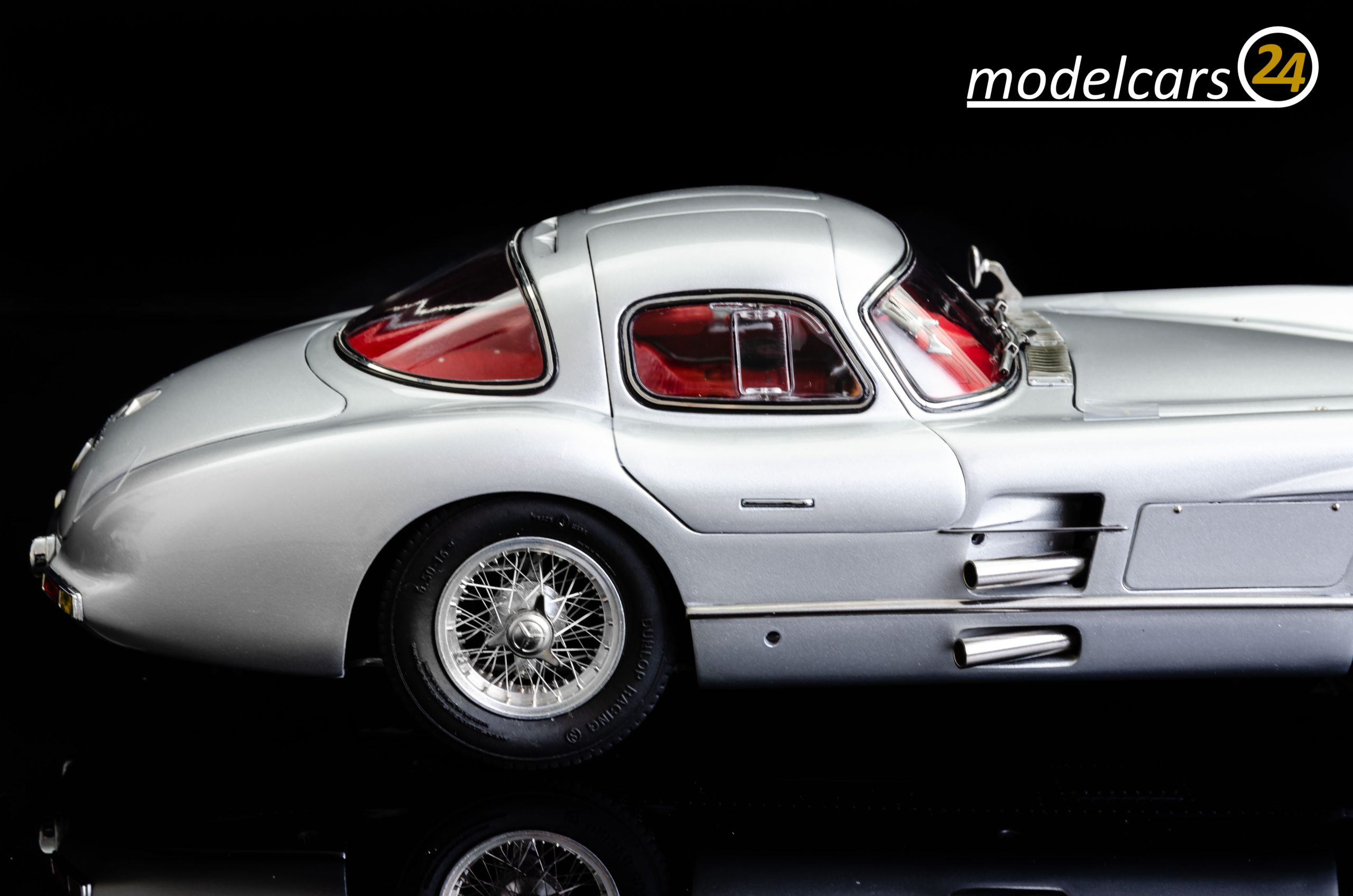
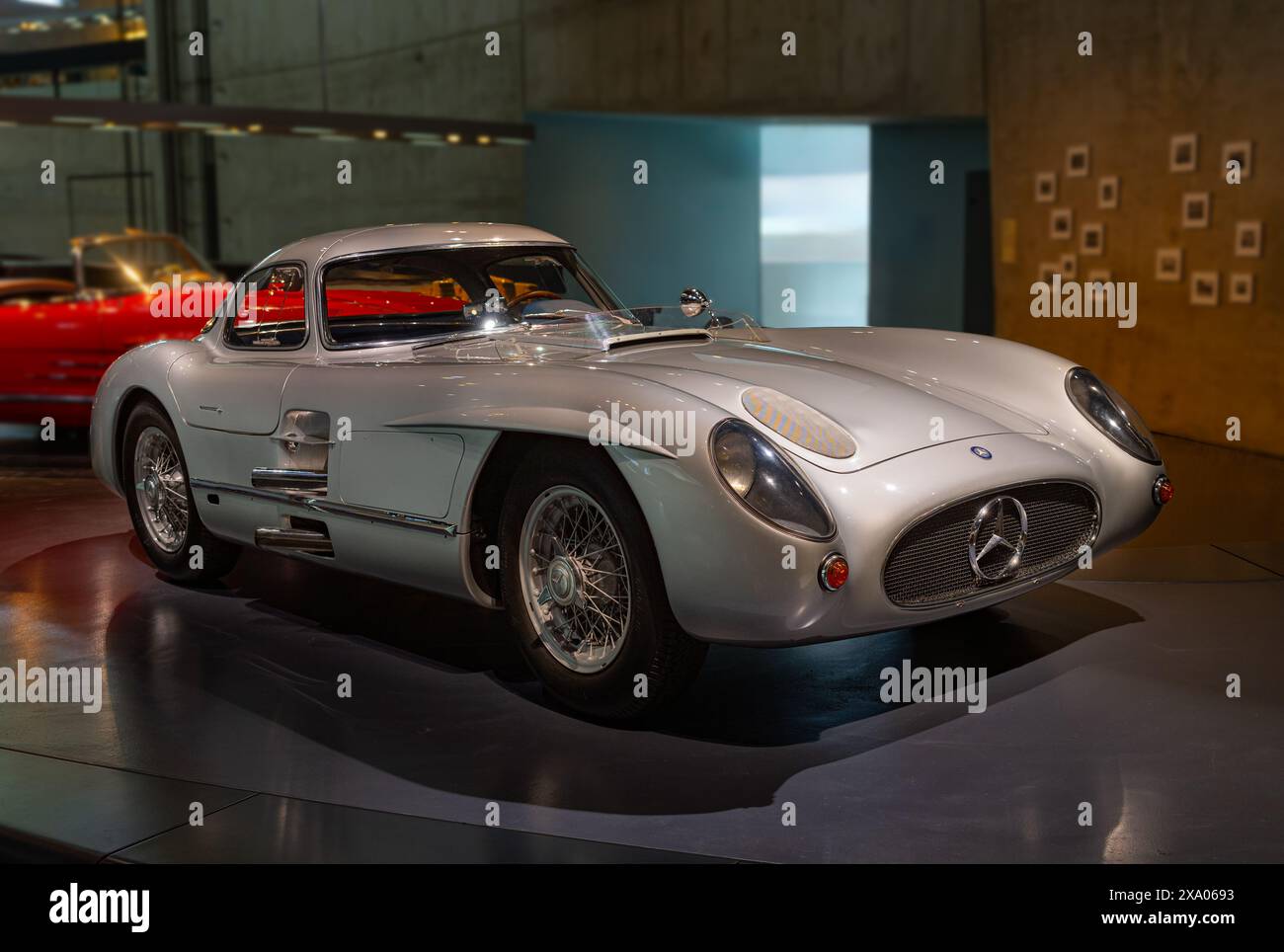
The Mercedes-Benz 300 SLR Uhlenhaut Coupe stands as a supreme engineering achievement of the 1950s, bridging the gap between legendary Grand Prix and endurance racing machines and road-legal supercars. Developed under the direction of motorsport chief Rudolf Uhlenhaut, this high-performance vehicle paired a derivative of the W196 Grand Prix open-wheel racer’s spaceframe chassis and direct-injection straight-eight engine with an enclosed, aerodynamic aluminum body. Only two examples were ever built, securing its status not merely as a priceless automotive artifact, but as a monumental milestone in mechanical engineering, aerodynamics, and high-speed structural design.
Historical Genesis and the Vision of Rudolf Uhlenhaut
To understand the engineering gravity of the 300 SLR Uhlenhaut Coupe, one must examine the competitive landscape of international motorsport in the mid-1950s. Mercedes-Benz dominated the World Sportscar Championship and Formula One under the leadership of Alfred Neubauer and chief engineer Rudolf Uhlenhaut. The W196 Grand Prix racer had already proven virtually unbeatable during the 1954 and 1955 seasons. For endurance racing, Mercedes-Benz developed the 300 SLR (W196S), an open-cockpit sports racing car that claimed victory in the 1955 World Sportscar Championship, most famously winning the Mille Miglia in the hands of Stirling Moss and Denis Jenkinson.
Rudolf Uhlenhaut recognized a distinct need for a closed-cockpit variant of the 300 SLR for long-distance endurance events like the Carrera Panamericana and the 24 Hours of Le Mans. Though the cancellation of motorsport activities by Mercedes-Benz at the end of the 1955 season—prompted by the tragic accident at Le Mans—prevented the car from ever racing competitively, Uhlenhaut claimed one of the prototype chassis for his personal company car.
This conversion transformed a brutal racing implement into the fastest road car of its era. Capable of reaching speeds approaching 290 kilometers per hour (180 miles per hour), the Uhlenhaut Coupe allowed its creator to travel rapidly across postwar Europe, cementing its legend among journalists and enthusiasts who marveled at a grand touring car with genuine Grand Prix pedigree.
Powertrain Architecture: The M196 Straight-Eight Engine
At the core of the 300 SLR Uhlenhaut Coupe is an engineering masterpiece: the M196 engine. Displacing 2,982 cubic centimeters, this inline-eight-cylinder engine was an architectural marvel derived directly from the W196 open-wheel competition cars.
Unlike conventional road cars of the era, the M196 utilized a radical desmodromic valve actuation system. By employing mechanical cams to both open and close the valves rather than relying on traditional coil springs, Mercedes-Benz engineers eliminated valve float at extreme engine speeds. This allowed the engine to reliably rev past 7,500 revolutions per minute, producing approximately 302 horsepower.
Key technical specifications of the M196 engine include:
- Engine Configuration: Inline-8, mounted at a 33-degree angle to lower the vehicle's center of gravity and reduce frontal area.
- Valvetrain: Dual overhead camshafts with desmodromic valve operation.
- Fuel Delivery: Bosch direct mechanical fuel injection, replacing carburetors to optimize atomization and volumetric efficiency.
- Construction: Lightweight Elektron (magnesium alloy) engine block and crankcase with wet-sleeve cylinder liners.
- Power Take-Off: The power was taken from the center of the engine crankshaft via a complex gear train rather than the end, reducing torsional vibration at high RPM.
The implementation of direct fuel injection was particularly revolutionary for a production-based or sports-racing vehicle in the 1950s. By spraying fuel directly into the combustion chambers rather than the intake tract, engineers achieved precise charge metering, enhanced volumetric efficiency, and instant throttle response.
Chassis Design and Spaceframe Engineering
The foundation of the 300 SLR Uhlenhaut Coupe is a multi-tubular spaceframe chassis. Designed to maximize torsional rigidity while minimizing mass, the frame consists of an intricate web of small-diameter steel tubes welded together into triangular patterns. This geometric configuration ensures that loads are distributed efficiently across the entire structure rather than concentrating at stress points.
Because the spaceframe tubes ran high along the sides of the cockpit to maintain structural integrity, the door sills were exceptionally wide. This physical constraint necessitated the defining visual and functional feature of the car: the gullwing doors, which hinged upward from the roof centerline to allow ingress and egress.
The suspension layout further demonstrated advanced motorsport engineering:
- Front Suspension: Independent double wishbones with coil springs and an anti-roll bar.
- Rear Suspension: Low-pivot swing axle system with transverse springs, designed to mitigate the dangerous oversteer tendencies associated with traditional swing axles by keeping the rear wheels perpendicular to the road surface during cornering.
Aerodynamics and Stopping Power
Aerodynamic efficiency was a primary focus for Rudolf Uhlenhaut. The lightweight aluminum bodywork was sculpted in a wind tunnel to reduce drag at high speeds, featuring flowing fenders, a low nose, and an integrated greenhouse that provided significantly better high-speed stability than the open-cockpit 300 SLR roadsters.
To arrest momentum from extreme velocities, the Uhlenhaut Coupe utilized massive inboard-mounted hydraulic drum brakes. The front brakes were positioned outboard initially on some W196 variants, but the sports cars frequently utilized large-diameter aluminum-finned drum brakes with turbo-cooling features.
To assist heavy braking from speeds exceeding 250 kilometers per hour, engineers incorporated the famous Aero-Brake—a large, hydraulically operated air flap situated behind the cockpit. When the driver pressed the brake pedal, the flap tilted upward into the airstream, creating massive aerodynamic drag to slow the car while reducing thermal stress on the mechanical friction brakes.
| Technical Parameter | Specification / Detail |
|---|---|
| Engine Type | M196 2.9-liter (2,982 cc) inline-8 |
| Valvetrain | Desmodromic actuation, dual overhead cams |
| Fuel System | Bosch mechanical direct fuel injection |
| Power Output | ~302 hp at 7,500 RPM |
| Chassis | Multi-tubular steel spaceframe |
| Body Material | Hand-formed aluminum alloy |
| Top Speed | Approx. 290 km/h (180 mph) |
| Production Run | Exactly 2 units built (Chassis #0007/55 and #0008/55) |
Comparison: 300 SLR Uhlenhaut Coupe vs. 300SL Gullwing (W198)
While casual observers frequently confuse the 300 SLR Uhlenhaut Coupe with the production 300SL "Gullwing" (W198) road car, their underlying engineering lineages are entirely distinct. The table below outlines the core technical and structural differences between the two vehicles.
| Feature | 300 SLR Uhlenhaut Coupe (W196S) | 300SL "Gullwing" Coupe (W198) |
|---|---|---|
| Primary Purpose | Pure endurance racing prototype adapted for road use | High-performance luxury sports car for retail buyers |
| Engine Lineage | Grand Prix derived straight-eight (M196) | Passenger-car derived inline-six (M198) |
| Chassis Structure | Complex multi-tubular racing spaceframe | Heavy stamped-steel ladder frame with tubular upper bracing |
| Fuel Delivery | Direct mechanical fuel injection | Direct mechanical fuel injection |
| Production Volume | 2 units ever produced | 1,400 coupe units produced |
| Pedigree | Direct sibling to the Mille Miglia and W196 F1 cars | Production derivative of the 300SL (W194) race car |
The Legacy and Cultural Footprint
The enduring legacy of the 300 SLR Uhlenhaut Coupe rests on its dual identity as an uncompromising racing machine and a bespoke road vehicle. For decades, both surviving chassis remained in the possession of Mercedes-Benz Classic, carefully curated in Stuttgart as treasured crown jewels of automotive heritage.
In May 2022, one of the two original Uhlenhaut Coupes (chassis #0008/55, known as the "Red Interior" car) was sold at a private auction held at the Mercedes-Benz Museum for a record-breaking sum of 135 million euros. The proceeds were dedicated to establishing the global Mercedes-Benz Fund, supporting educational and research scholarships in environmental science and decarbonization. This extraordinary valuation underscored the unique technological and historical stature of the vehicle within global engineering history.
Frequently Asked Questions
Why is the 300 SLR Uhlenhaut Coupe called by that name?
The car is named after Rudolf Uhlenhaut, the brilliant head of Mercedes-Benz’s test department and racing development in the 1950s. Because he converted one of the un-raced 300 SLR sports-racing prototypes into his personal company vehicle to travel across Europe, the model became permanently associated with his surname.
How many 300 SLR Uhlenhaut Coupes were manufactured?
Only two examples were ever built by Mercedes-Benz in 1955. Chassis number 0007/55 featured a blue interior, while chassis number 0008/55 featured a red interior. Both vehicles survive to this day, representing the pinnacle of 1950s automotive engineering.
What made the M196 engine’s valvetrain unique?
The engine utilized a desmodromic valvetrain, meaning the engine valves were opened and closed mechanically by dedicated cams rather than traditional steel valve springs. This design eliminated valve bounce at high engine speeds, allowing the straight-eight engine to operate reliably past 7,500 RPM.
Can a 300 SLR Uhlenhaut Coupe be driven on public roads?
Yes, the surviving Uhlenhaut Coupes are fully functional, road-registered vehicles equipped with lights, mufflers, and legal instrumentation. However, due to their extreme historical significance and multi-million-dollar valuations, they are driven only under controlled conditions by factory test drivers or historical custodians.
How does the Uhlenhaut Coupe differ from the 300SL Gullwing?
Although both cars feature iconic gullwing doors, the 300SL Gullwing was a production sports car built on a heavier stamped-steel ladder frame with an inline-six engine. The Uhlenhaut Coupe was an ultra-exclusive endurance racing prototype built around a complex tubular spaceframe and powered by a Grand Prix-derived straight-eight engine.
Conclusion and Next Actions
The Mercedes-Benz 300 SLR Uhlenhaut Coupe remains an undisputed masterclass in mechanical design, aerodynamic efficiency, and motorsport engineering. For enthusiasts, historians, and engineers alike, studying the vehicle offers deep insight into the golden era of mid-century automotive development. To further explore this milestone, consider reviewing technical monographs published by Mercedes-Benz Classic or visiting the Mercedes-Benz Museum in Stuttgart, Germany, where the remaining factory-owned chassis is preserved for public exhibition.