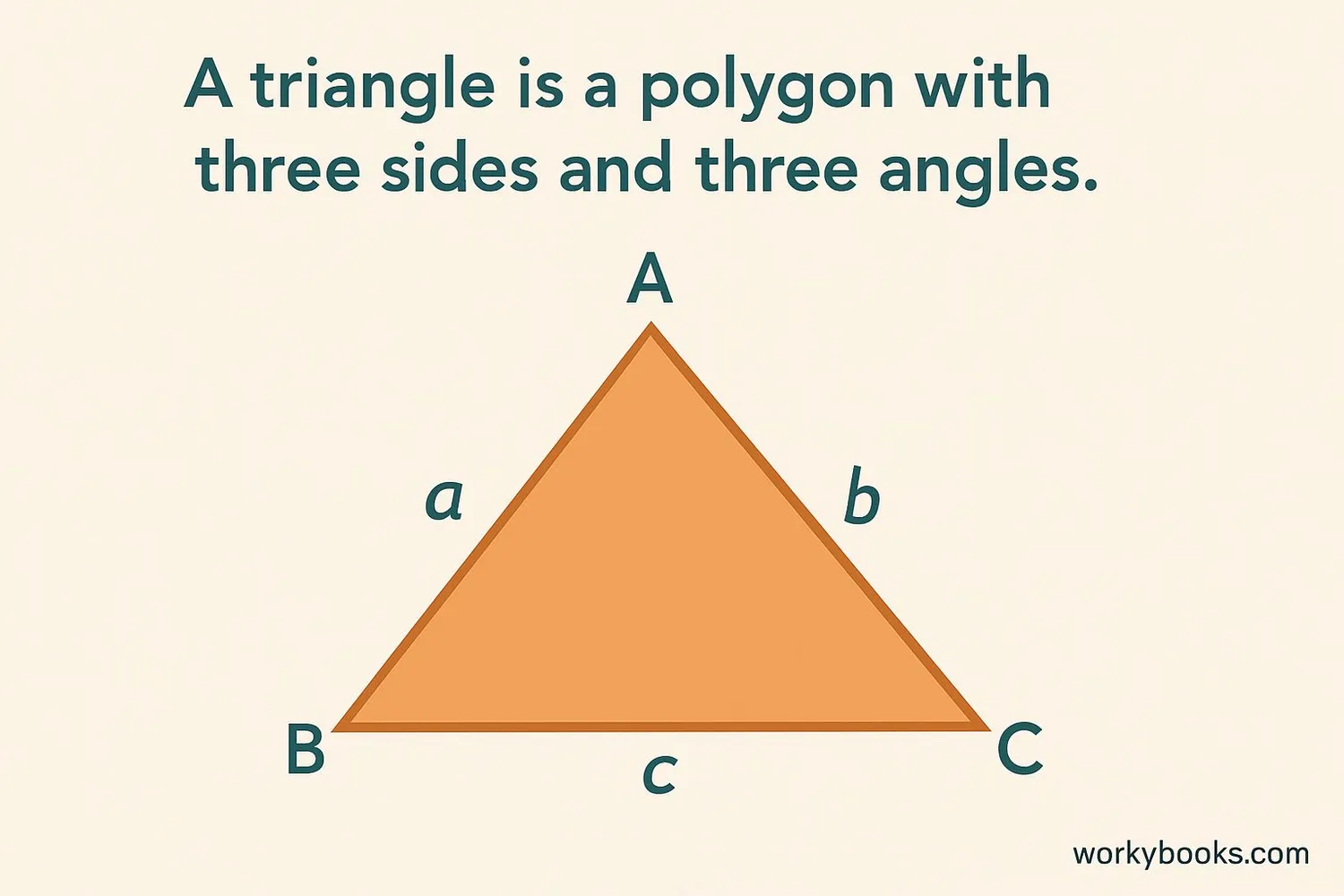
In a three-dimensional coordinate system, a triangle is defined as a flat, two-dimensional polygon consisting of three vertices and three linear edges, where each vertex is assigned an (x, y, z) coordinate. While the triangle itself remains a planar surface, its orientation and position within 3D space are governed by vector calculus and spatial geometry.
Defining the 3-Dimensional Triangle
A triangle in 3D space is the simplest possible polygon that can exist within a three-dimensional Euclidean environment. To understand its definition, one must first distinguish between the dimensionality of the object and the dimensionality of the space it occupies. Mathematically, a triangle is a 2-manifold; it has area but no volume. However, when we place it in a 3D context, we move from simple Cartesian (x, y) coordinates to a system that includes depth (z).
To define a 3D triangle, we require three distinct points in space, known as vertices:
- Point A: $(x_1, y_1, z_1)$
- Point B: $(x_2, y_2, z_2)$
- Point C: $(x_3, y_3, z_3)$
For these points to form a valid triangle, they must be non-collinear. If the three points lie on a single straight line, they form a degenerate triangle with zero area. In the geometric context of 2026, the use of 3D triangles is foundational to fields ranging from computational fluid dynamics to high-fidelity architectural rendering, where "triangulation" serves as the backbone for representing complex curved surfaces.
The Geometric Context: Planes and Orientation
One of the most critical aspects of a triangle in 3D space is the plane it defines. According to the axioms of Euclidean geometry, any three non-collinear points uniquely determine a single plane. Therefore, even though a triangle exists in 3D space, it is always perfectly flat relative to its own local coordinate system.
The Equation of the Plane
The "geometric context" of a 3D triangle often involves finding the equation of the plane that contains it. This is typically expressed in the general form: $$Ax + By + Cz + D = 0$$ To find this equation, mathematicians use the vectors formed by the triangle's edges. If we have vertices A, B, and C, we can create two vectors:
- Vector $\vec{AB}$ = $(x_2 - x_1, y_2 - y_1, z_2 - z_1)$
- Vector $\vec{AC}$ = $(x_3 - x_1, y_3 - y_1, z_3 - z_1)$
By calculating the cross product of these two vectors, we obtain the "normal vector" ($\vec{n}$), which is perpendicular to the surface of the triangle. The components of this normal vector $(a, b, c)$ provide the coefficients $A, B$, and $C$ for the plane equation.
Normal Vectors and Surface Orientation
In 3D computer graphics and physics simulations, the orientation of the triangle is defined by this normal vector. The direction the normal vector points determines the "front" face of the triangle versus the "back" face. This is essential for back-face culling (a technique to avoid rendering surfaces hidden from the viewer) and for calculating how light reflects off a surface.
Calculating Properties of 3D Triangles
While the basic properties of a triangle (perimeter and area) remain conceptually the same as in 2D, the formulas required to calculate them in a 3D context are more complex because they must account for the third coordinate.
Perimeter in 3D
The perimeter is simply the sum of the lengths of the three edges. To find the length of an edge in 3D, we use the distance formula derived from the Pythagorean theorem: $$d = \sqrt{(x_2 - x_1)^2 + (y_2 - y_1)^2 + (z_2 - z_1)^2}$$ Summing the distances between A-B, B-C, and C-A gives the total perimeter.
Area in 3D (The Vector Method)
In 2D, we often use $0.5 \times \text{base} \times \text{height}$. In 3D, finding the "height" relative to a "base" can be cumbersome. Instead, the cross product method is the standard. The area of a triangle in 3D space is equal to half the magnitude of the cross product of two vectors sharing a common vertex: $$\text{Area} = 0.5 \times |\vec{AB} \times \vec{AC}|$$ This provides a precise scalar value for the area, regardless of how the triangle is tilted or rotated in the $x, y, z$ coordinate system.
3D Triangle vs. Tetrahedron: Resolving Ambiguity
A common point of confusion for students is the difference between a "3D triangle" and a "triangle in 3D."
- 3D Triangle: A flat 2D shape positioned in 3D space (3 vertices, 1 face).
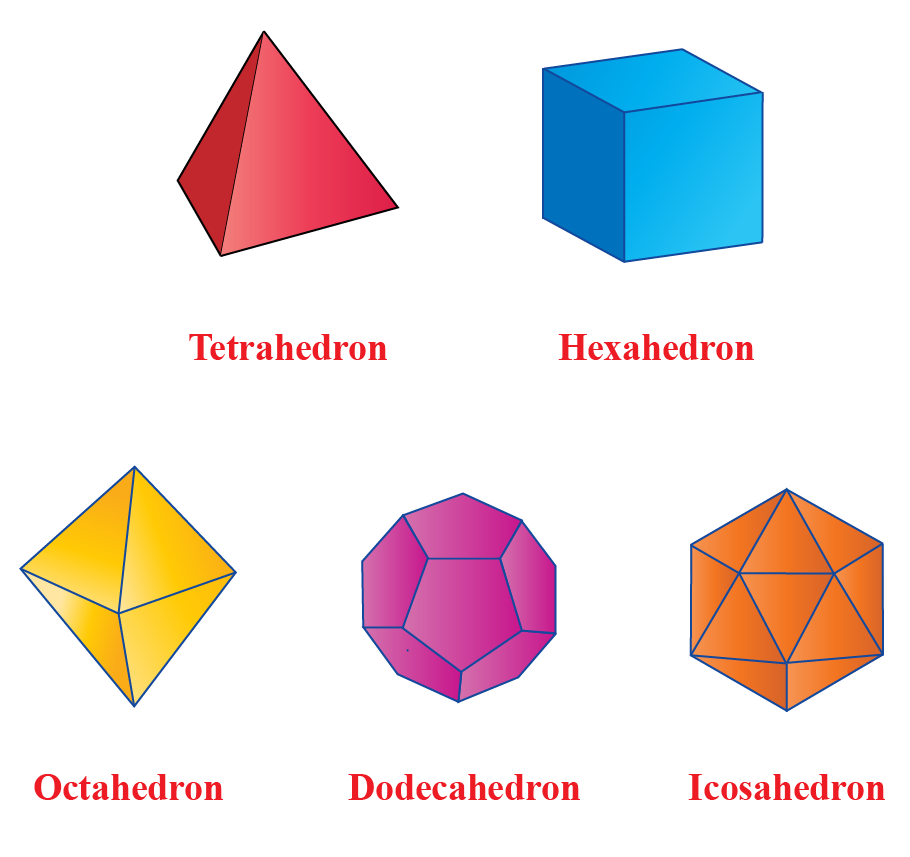
- Tetrahedron: A 3D solid (polyhedron) composed of four triangular faces (4 vertices, 4 faces).
The tetrahedron is the simplest possible 3D volume, often referred to as a "3-simplex" in topology. While a single triangle has zero volume, a tetrahedron is the first shape in the hierarchy of simplices that can actually contain space. In many technical contexts, such as Finite Element Analysis (FEA), engineers decompose solid objects into thousands of tetrahedrons to simulate stress and heat transfer.
| Property | 2D Triangle (Standard) | 3D Triangle (Planar) | Tetrahedron (3D Solid) |
|---|---|---|---|
| Vertices | 3 $(x, y)$ | 3 $(x, y, z)$ | 4 $(x, y, z)$ |
| Faces | 1 | 1 | 4 |
| Edges | 3 | 3 | 6 |
| Dimensions | 2D | 2D object in 3D space | 3D |
| Area | Calculated via $0.5bh$ | Calculated via Cross Product | Surface Area (sum of 4 faces) |
| Volume | N/A (0) | N/A (0) | Calculated via Scalar Triple Product |
Applications in Technology and Science
The geometric context of 3D triangles extends far beyond pure mathematics. In 2026, the mastery of triangular geometry is vital for several high-tech industries.
1. Computer-Aided Design (CAD) and 3D Modeling
Most 3D models used in video games, movies, and manufacturing are stored as triangular meshes. Because three points always define a flat plane, triangles are "guaranteed" to be planar, which makes them much easier for graphics hardware (GPUs) to process than quads (four-sided polygons), which can become "warped" or non-planar. Every complex character or machine you see in a digital environment is actually an assembly of millions of small 3D triangles.
2. Global Positioning Systems (GPS) and Geodesy
While we often think of GPS in terms of circles (trilateration), the mathematical reality involves calculating the intersection of spheres, which forms various triangular relationships in 3D space. Surveyors use "Triangulated Irregular Networks" (TIN) to represent the terrain of the Earth. A TIN model uses a series of non-overlapping 3D triangles to map elevations across a landscape, providing a more accurate representation than a simple 2D grid.
3. Structural Engineering
Triangles are the only polygons that are inherently rigid. A square can be pushed into a rhomboid without changing the lengths of its sides, but a triangle cannot be deformed without changing its side lengths. In 3D space, this property is exploited in space frames and geodesic domes. These structures use 3D triangular patterns to distribute weight and stress efficiently across a wide area.
Barycentric Coordinates: Navigation Within the Triangle
In the context of 3D triangles, simply knowing the vertices isn't enough for advanced applications like texture mapping or physics interpolation. We need a way to describe points inside the triangle. This is where Barycentric Coordinates come into play.
Any point $P$ inside a triangle defined by vertices $A, B,$ and $C$ can be expressed as a weighted average of those vertices: $$P = w_1A + w_2B + w_3C$$ Where $w_1 + w_2 + w_3 = 1$. These weights (coordinates) allow computers to smoothly blend colors, temperatures, or textures across the surface of a 3D triangle. For example, if vertex A is red and vertex B is blue, barycentric coordinates allow the system to calculate the exact purple hue at any specific point on the triangle's surface.
Common Geometric Challenges and Troubleshooting
Working with triangles in a 3D environment introduces several mathematical hurdles that do not exist in 2D.
Degeneracy and Floating Point Errors
A "degenerate" triangle occurs when the three vertices are collinear (forming a line) or coincident (multiple vertices at the same point). In 3D modeling software, degenerate triangles can cause "division by zero" errors in lighting calculations or physics crashes. Because 3D coordinates often involve complex decimals (floating-point numbers), two points that look the same might be slightly different, leading to "sliver" triangles—triangles that are extremely thin and cause rendering artifacts known as "Z-fighting."
Intersection Testing
A common task in 2026 robotics and autonomous vehicle navigation is Ray-Triangle Intersection. This involves determining if a line (like a laser sensor beam) passes through a specific 3D triangle. This is solved using the Möller-Trumbore algorithm, which uses barycentric coordinates to determine if the intersection point lies within the boundaries of the triangle without needing to calculate the plane equation first.
FAQ: Frequently Asked Questions
Can a triangle in 3D be curved?
By definition, a triangle consists of straight edges and a flat face. However, in "Curved Mesh" technologies emerging in 2026, engineers sometimes use "Bezier Triangles" or "NURBS" surfaces that appear curved. Mathematically, these are not Euclidean triangles but rather patches defined by control points. A standard geometric triangle is always planar.
How do you find the angle between two 3D triangles?
The angle between two triangles is the angle between their respective planes, often called the dihedral angle. To find it, you calculate the normal vector for each triangle using the cross product and then use the dot product formula: $$\cos(\theta) = \frac{|\vec{n_1} \cdot \vec{n_2}|}{|\vec{n_1}| |\vec{n_2}|}$$ The resulting $\theta$ is the angle at which the two triangles meet.
Is a 3D triangle always on a 2D plane?
Yes. Any three points in a 3D space that are not in a line will always lie on exactly one flat 2D plane. You cannot have a single triangle that "bends" into a third dimension; if it bends, it is no longer a single triangle but a set of multiple triangles or a different type of surface.
What is the "Normal" of a 3D triangle?
The normal is a vector that points directly out of the surface of the triangle, perpendicular to its plane. It is essential for determining how the triangle interacts with light and other objects. In most 3D software, the direction of the normal is determined by the "winding order" (the sequence—clockwise or counter-clockwise—in which the vertices are listed).
Why are triangles used instead of squares in 3D rendering?
Triangles are preferred because they are always "planar." If you take a square (four points) in 3D space and move one point up slightly, the square must bend or fold to keep the vertices connected, effectively turning it into two triangles. Triangles are the most "stable" primitive for digital geometry because they cannot be non-planar.
Practical Recommendations for Students and Professionals
When working with 3D triangles in a geometric or technical context, keep the following best practices in mind:
- Always Verify Non-Collinearity: Before performing calculations, ensure your three points do not lie on a single line. A cross product resulting in a zero vector is a clear indicator of a degenerate triangle.
- Mind the Winding Order: Whether you use a Clockwise (CW) or Counter-Clockwise (CCW) vertex order, be consistent. This affects the direction of the normal vector and can make your surfaces appear invisible or "inside out" in 3D software.
- Use Vector Math over Trigonometry: In 3D space, using sine and cosine for every calculation is computationally expensive and prone to error. Stick to vector operations (dot products, cross products, and magnitudes) whenever possible for better efficiency and precision.
- Consider Precision Limits: If you are working on a micro-scale or astronomical scale, be aware of the limits of 32-bit vs. 64-bit floating-point precision. Small errors in vertex positions can lead to significant errors in the calculated normal vector.
By understanding the 3D triangle not just as a shape, but as a mathematical entity defined by vectors and planes, you can better navigate the complex world of spatial geometry, whether for academic research or industrial application.