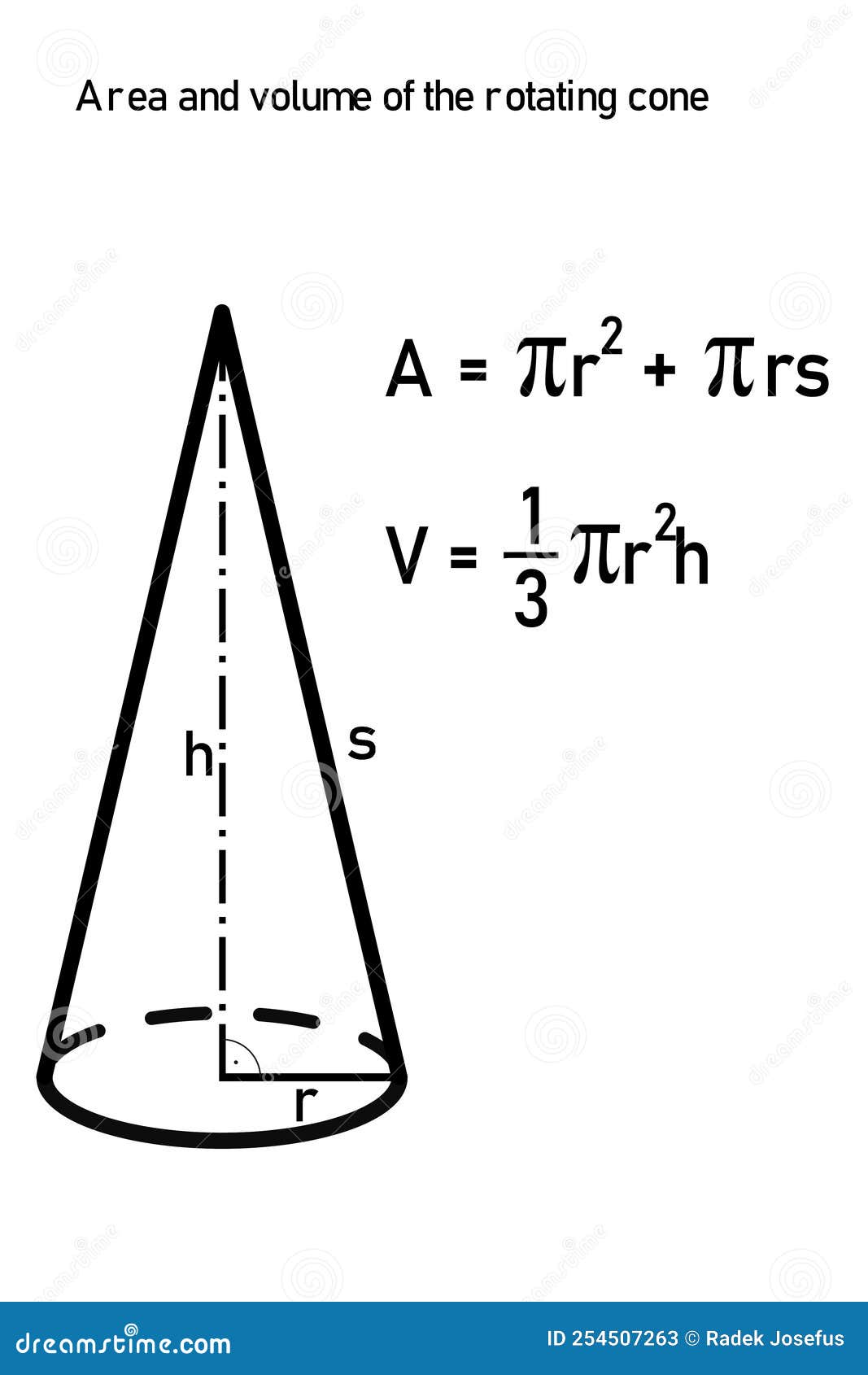
In Euclidean geometry, a standard cone consists of exactly one flat surface and one curved surface. The flat surface is the circular base that provides the solid's stability, while the curved surface tapers smoothly from the edge of the base to a single point known as the apex or vertex.
A cone is a distinctive three-dimensional geometric shape that bridges the gap between the angular nature of pyramids and the continuous curvature of cylinders. While it is often introduced in early mathematics as a simple solid, the structural and mathematical properties of a cone are foundational to fields ranging from architectural engineering to advanced calculus. To understand why a cone has exactly one flat surface, one must examine its definition as a solid of revolution and its topological properties.
The Anatomy of a Cone: Surfaces, Edges, and Vertices
To define a cone accurately, we must distinguish between its various components. Unlike polyhedra, which are solids composed entirely of flat polygonal faces (like cubes or pyramids), a cone is a non-polyhedron because it incorporates a curved boundary.
The Flat Surface (The Base)
The single flat surface of a cone is its base. In a standard "circular cone," this base is a perfect circle. However, in broader geometric terms, a cone can have an elliptical base. Regardless of the shape of the perimeter, the base remains a two-dimensional plane, which qualifies it as a "flat surface."
In practical applications, this flat surface is what allows a cone to stand upright on a horizontal plane. In the context of 2026 engineering standards, the stability of conical structures—such as those used in aerospace nose cones or specialized storage silos—depends entirely on the diameter and structural integrity of this flat base.
The Curved Surface (The Lateral Area)
The lateral surface of a cone is not flat. It is a single, continuous surface that wraps around the axis of the cone. If you were to "unroll" this curved surface and lay it flat on a table, it would form a sector of a circle. This transition from a 3D curved shape to a 2D flat sector is a key concept in "developable surfaces," which are surfaces that can be flattened onto a plane without distortion or stretching.
The Apex and the Edge
A cone possesses one vertex (the apex), which is the point where the curved surface terminates. It also has one edge, which is the circular boundary where the flat base meets the curved lateral surface. Because this edge is curved, a cone does not meet the strict definition of a polyhedron, which requires all edges to be straight lines.
How a Cone is Formed: The Solid of Revolution
One of the most effective ways to visualize why a cone has only one flat surface is to look at it as a solid of revolution. Imagine a right-angled triangle standing on one of its legs. If you rotate that triangle 360 degrees around that vertical leg (the axis), the path traced by the triangle creates a cone.
- The Vertical Leg: Becomes the height ($h$) of the cone.
- The Horizontal Leg: Becomes the radius ($r$) of the flat circular base.
- The Hypotenuse: Traces the curved lateral surface, creating the slant height ($s$).
Because only one side of the triangle (the horizontal leg) is tracing a flat plane at the bottom, only one flat surface is generated. The hypotenuse, being at an angle, moves through three-dimensional space to create the "slope" or curved side.
Mathematical Properties of the Cone's Surfaces
When calculating the physical properties of a cone, mathematicians treat the flat surface and the curved surface separately before combining them for a total surface area. This distinction is vital for students and professionals alike.
Calculating Surface Area
The total surface area ($A$) of a right circular cone is the sum of the area of the flat base and the area of the curved lateral side.
- Area of the Flat Surface (Base): Since it is a circle, the formula is $\pi r^2$.
- Area of the Curved Surface (Lateral): The formula is $\pi r s$ (where $s$ is the slant height).
- Total Surface Area: $A = \pi r^2 + \pi r s$.
The separation of these two formulas highlights the different geometric natures of the surfaces. The flat surface follows standard 2D circular geometry, while the curved surface requires the inclusion of the slant height, reflecting its three-dimensional extension toward the apex.
Slant Height vs. Vertical Height
It is a common mistake to confuse the vertical height ($h$) with the slant height ($s$). The vertical height is the distance from the center of the flat base to the apex. The slant height is the distance from any point on the edge of the flat base to the apex. These values are related by the Pythagorean theorem: $s^2 = r^2 + h^2$.
Comparing the Cone to Other Geometric Solids
To further clarify the "one flat surface" rule, it is helpful to compare the cone to other common 3D shapes. This comparison helps in identifying solids based on their surface properties.
| Shape | Number of Flat Surfaces | Number of Curved Surfaces | Number of Vertices |
|---|---|---|---|
| Cone | 1 (The base) | 1 (Lateral side) | 1 (The apex) |
| Cylinder | 2 (Top and bottom bases) | 1 (Lateral side) | 0 |
| Sphere | 0 | 1 (Continuous) | 0 |
| Pyramid (Square) | 5 (Base + 4 sides) | 0 | 5 |
| Frustum of a Cone | 2 (Top and bottom) | 1 (Lateral side) | 0 (Apex is removed) |
As shown in the table, the cone is unique because it is the only primary solid with exactly one flat surface and exactly one curved surface. A cylinder has a similar curved surface but requires two flat surfaces to "close" the solid. A pyramid replaces the curved surface with multiple flat triangles.
The Case of the "Frustum": When a Cone Has Two Flat Surfaces
In many practical scenarios, such as the design of a coffee cup or a lamp shade, we encounter a frustum. A frustum is a cone where the top (the apex) has been cut off by a plane parallel to the base.
While a standard cone has only one flat surface, a frustum has two flat surfaces: the original base and the new, smaller circular surface created by the cut. It is important for students to distinguish between a "mathematical cone" (which always tapers to a point) and a "truncated cone" (frustum), which has two flat ends. In high-level geometry and manufacturing, the frustum is often more common than the perfect cone because it allows for stacking and openings.
Historical and Theoretical Context
The study of the cone's surfaces dates back to ancient Greece. Euclid, in his Elements (circa 300 BC), defined a cone based on the rotation of a right triangle, as discussed earlier. Later, Apollonius of Perga wrote "Conics," a definitive work that explored how intersecting a plane with the surfaces of a cone creates different curves (ellipses, parabolas, and hyperbolas).
Apollonius recognized that the "surface" of a cone actually extends infinitely in both directions from the apex (a double cone). In this advanced theoretical view, the "flat surface" we call the base is simply a cross-section of an infinite curved surface. However, in the context of solid geometry and "3D shapes" used in education and standard engineering, we limit the cone to a finite object with a closed base.
The Role of the Flat Surface in Practical Design
The fact that a cone has one flat surface makes it an ideal shape for specific functions in the real world.
1. Stability and Gravity
Objects that need to stand upright while tapering toward the top use the flat base for a low center of gravity. A traffic cone is a perfect example; the flat, heavy base prevents it from tipping over, while the curved surface minimizes wind resistance.
2. Funneling and Flow
In fluid dynamics, the curved surface of a cone (or funnel) directs liquid toward a specific point. The flat surface is often replaced by an opening, but the geometric principle remains: the transition from a wide circular area to a narrow point. In 2026, precision-engineered conical nozzles are standard in 3D printing and chemical delivery systems to ensure laminar flow.
3. Acoustic Projection
Megaphones and speaker cones utilize the geometry of the cone to amplify sound. The flat surface (the "mouth" of the speaker) allows the sound waves to exit in a controlled, expanding pattern. The curved lateral surface acts as a guide, preventing the sound from dissipating too quickly in all directions.
Common Misconceptions About Cones
Despite its simplicity, several misconceptions persist regarding the surfaces of a cone:
- "A cone has two faces": In elementary geometry, some teachers refer to surfaces as "faces." However, in more rigorous mathematics, a "face" refers specifically to a flat surface. Therefore, a cone has one face (the base) and one curved surface.
- "The apex is a flat surface": The apex is a point (zero-dimensional), not a surface. It has no area.
- "All cones have circular bases": While "circular cone" is the default, a cone can have an elliptical base. It still only has one flat surface, but the math for the curved surface becomes significantly more complex.
Frequently Asked Questions
Does a cone have a face?
Yes, in the context of 3D shapes, a cone has one face. A face is typically defined as a flat surface. Since a cone has one flat circular base, it is said to have one face. The lateral side is a surface but is not considered a "face" in the strict sense of polyhedral geometry.
How many surfaces does a cone have in total?
A cone has a total of two surfaces: one flat surface (the base) and one curved surface (the lateral area). These two surfaces meet at a single curved edge.
Is a cone a polyhedron?
No, a cone is not a polyhedron. By definition, a polyhedron must have only flat faces and straight edges. Because a cone has a curved surface and a curved edge (the circumference of the base), it falls into the category of non-polyhedral solids.
What is the difference between a cone and a pyramid?
The primary difference is the nature of the lateral surface and the base. A pyramid has a polygonal base (like a square or triangle) and multiple flat triangular faces meeting at an apex. A cone has a circular (or elliptical) base and one continuous curved surface.
Can a cone have 0 flat surfaces?
A mathematical "conic surface" can exist without a base, representing just the "skin" of the cone. However, as a geometric solid, it must be closed. Without the flat surface (the base), it is an open shell rather than a solid volume.
Summary and Recommendations
The cone is a fundamental geometric solid defined by its one flat surface and one curved surface. This unique combination allows it to serve as a bridge between flat-planed objects and purely curved ones.
For students and educators, the most important takeaway is the distinction between the base and the lateral surface. When calculating areas or identifying shapes, remember that the "flatness" of the base is what defines the cone's relationship with the ground, while the "curvature" of the side defines its relationship with the apex.
If you are working on a project involving 3D modeling or physical construction in 2026, always verify whether you are dealing with a "right cone" (where the apex is directly above the center of the base) or an "oblique cone," as this will affect the symmetry of the curved surface, even though the number of flat surfaces remains one.