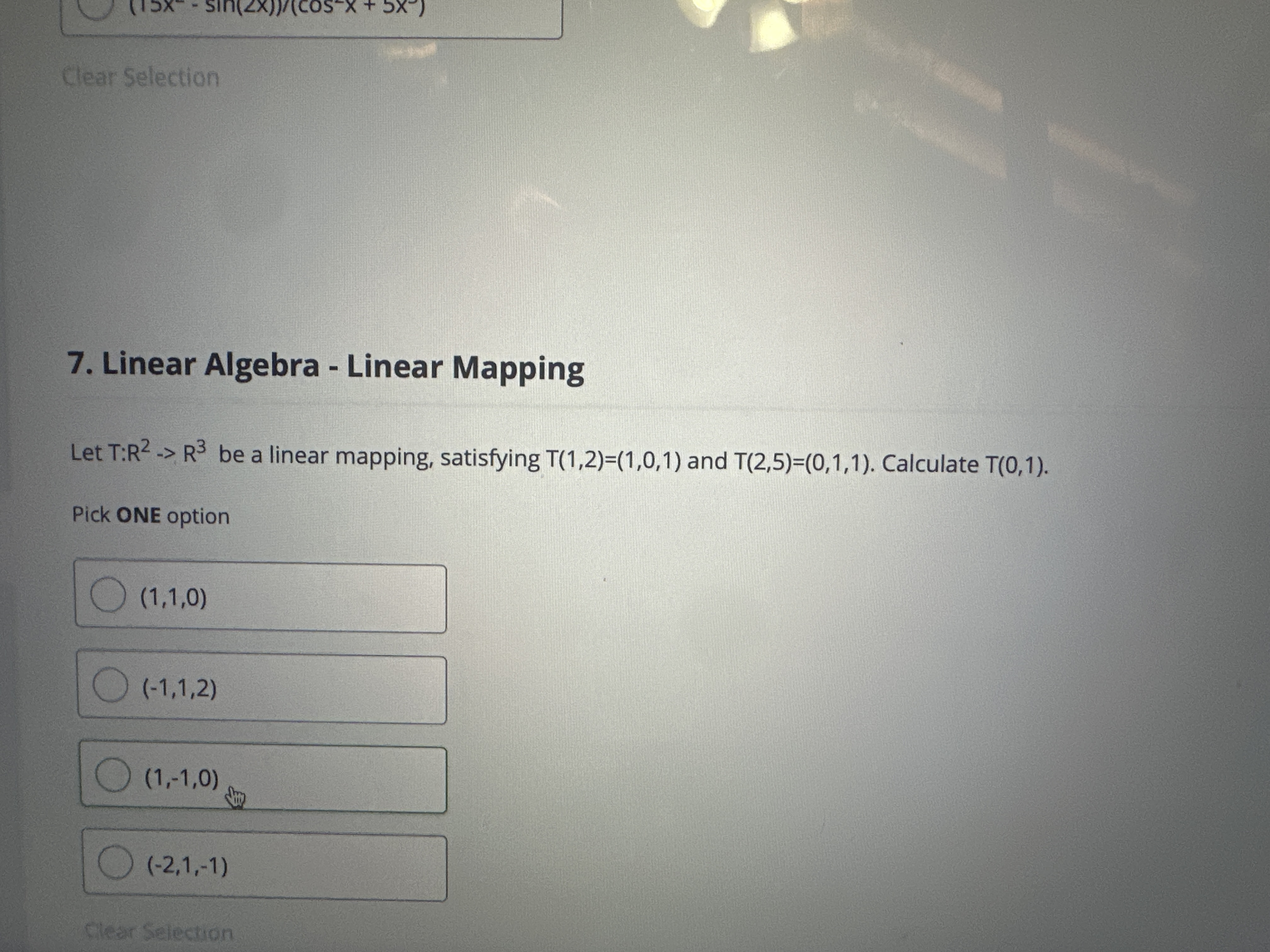
Linear algebra is the mathematical study of vectors, matrices, and the linear transformations that operate between them. It provides a structured framework for representing and solving systems of linear equations, transforming spatial data in computer graphics, and processing the massive multidimensional datasets that power modern artificial intelligence and machine learning models in 2026.
Linear algebra often feels intimidating to beginners because it introduces an abstract way of thinking about numbers. However, at its heart, it is a remarkably practical tool designed to handle multiple pieces of information simultaneously. Whether you are aspiring to become a data scientist, a software engineer, or a physicist, mastering these fundamentals is the first step toward understanding the complex algorithms that define our technological landscape.
Why Linear Algebra Matters in 2026
In the current technological era of 2026, linear algebra has transcended its role as a "pure" math subject to become the literal engine of digital progress. From the generative AI models that summarize our meetings to the real-time physics engines in virtual reality, linear algebra is the silent workhorse behind the scenes.
In data science, every piece of data—be it an image, a sound wave, or a user profile—is converted into a list of numbers called a vector. Analyzing millions of these vectors simultaneously requires the operations defined in linear algebra. In computer graphics, moving a character in a video game involves multiplying thousands of coordinate points by a matrix to calculate their new positions. Even in economics, linear algebra is used to model the interactions between different sectors of a global market.
By learning these concepts, you aren't just learning how to solve for $x$; you are learning the language of modern computation.
The Foundational Objects: Scalars, Vectors, and Matrices
To understand linear algebra, you must first become comfortable with its primary "characters." These objects are organized by their dimensionality.
Scalars: The Simplest Form
A scalar is a single number. It represents magnitude but has no direction. In everyday life, temperature, age, and price are scalars. In the context of linear algebra, we use scalars to "scale" other objects—making them larger or smaller.
Vectors: Magnitude and Direction
A vector is an ordered list of numbers. Geometrically, you can think of a vector as an arrow in space starting from the origin (0,0). It has both a length (magnitude) and a specific direction.
- Notation: Vectors are usually written as a column of numbers inside brackets.
- Dimensions: A vector with two numbers exists in 2D space; a vector with three numbers exists in 3D space.
- The "Data" View: In a spreadsheet, a single row representing one person (Height, Weight, Age) can be treated as a 3-dimensional vector.
Matrices: Grids of Information
A matrix is a rectangular array of numbers arranged in rows and columns. If a vector is a list, a matrix is a table. We describe matrices by their dimensions: an $m \times n$ matrix has $m$ rows and $n$ columns.
- Purpose: Matrices are most powerful when viewed as functions. They can take a vector, chew on it, and spit out a new, transformed vector. This is the basis of all computer transformations.
| Object | Dimension | Visual Representation | Practical Example |
|---|---|---|---|
| Scalar | 0D | A single point | A 5% interest rate |
| Vector | 1D | An arrow/line | A GPS coordinate (Lat, Long) |
| Matrix | 2D | A grid/spreadsheet | A digital grayscale image |
| Tensor | 3D+ | A cube or stack of grids | A color video file (Width x Height x Color x Time) |
Fundamental Vector Operations
Once you have vectors, you need to know how to manipulate them. There are two primary operations that form the basis of almost everything else.
Vector Addition
You can add two vectors of the same dimension together by adding their corresponding components. Geometrically, this is the "tip-to-tail" method. If you walk 3 miles North (Vector A) and then 4 miles East (Vector B), your total displacement is the sum of A and B.
Scalar Multiplication
This involves multiplying every component of a vector by a single scalar number. If you have a vector pointing North with a magnitude of 1, and you multiply it by the scalar 3, you get a new vector pointing North with a magnitude of 3. This is why we call the numbers "scalars"—they scale the vector.
The Dot Product
The dot product takes two vectors and returns a single scalar number. It is calculated by multiplying corresponding components and adding them up.
- Interpretation: The dot product tells you how much two vectors "align." If the dot product is high, they point in a similar direction. If it is zero, the vectors are orthogonal (perpendicular) to each other. This is the mathematical foundation for "recommendation engines" that decide which movies you might like based on how closely your "preference vector" aligns with a "movie vector."
The Matrix as a Linear Transformation
One of the biggest hurdles for beginners is moving past the idea that a matrix is just a "box of numbers." In linear algebra, a matrix is an action.
When you multiply a matrix by a vector, you are performing a linear transformation. You are moving that vector from one place in space to another.
- Scaling: A matrix can stretch or shrink a vector.
- Rotation: A matrix can spin a vector around the origin.
- Shearing: A matrix can push the top of a vector one way and the bottom another.
This concept is crucial for understanding Basis Vectors. In any coordinate system (like the standard XY grid), we have "unit vectors" that define the direction of 1 unit on the x-axis and 1 unit on the y-axis. A matrix transformation tells these unit vectors where to go. Wherever they land, the rest of the space follows them linearly.
Solving Systems of Linear Equations
Historically, linear algebra was developed to solve multiple equations with multiple variables simultaneously. For example:
- $2x + 3y = 8$
- $1x - 2y = -3$
In beginner algebra, you might use substitution. In linear algebra, we represent this as $Ax = b$, where $A$ is a matrix of coefficients, $x$ is a vector of variables, and $b$ is a vector of constants.
Gaussian Elimination
The standard method for solving these is Gaussian Elimination (or Row Reduction). By performing operations on the rows of the matrix (like swapping rows or adding multiples of one row to another), we can simplify the matrix into an "identity" form where the values of $x$ and $y$ become obvious. This is how software like Excel or specialized engineering tools solve massive systems of thousands of variables in milliseconds.
Essential Concepts: Rank, Span, and Basis
To truly speak the language of linear algebra, you must understand the "space" these objects live in.
- Span: The span of a set of vectors is every possible point you can reach using only those vectors and scalar multiplication. If you have two vectors pointing in different directions in a 3D room, their span is a flat 2D plane cutting through that room.
- Linear Independence: A set of vectors is linearly independent if none of them can be built by combining the others. They are not "redundant." If you have three vectors but one is just the sum of the other two, you don't actually have three unique directions of movement.
- Basis: A basis is a set of linearly independent vectors that "span" the entire space. It is like the minimum set of directions you need to get anywhere in that space.
- Rank: The rank of a matrix tells you the number of "useful" dimensions it outputs. If a $3 \times 3$ matrix has a rank of 2, it means it collapses 3D space into a 2D plane, losing information in the process.
Determinants and Inverses
Before moving to advanced topics, two "measurements" of a matrix are vital:
The Determinant
The determinant is a single scalar value derived from a square matrix. It tells you how much the area (in 2D) or volume (in 3D) of a shape changes after the transformation.
- If the determinant is 1, the area stays the same.
- If the determinant is 0, the matrix has "squashed" space into a lower dimension (like flattening a cube into a line), and the transformation cannot be reversed.
The Inverse Matrix
If a matrix $A$ represents a transformation (like rotating 90 degrees), the inverse matrix ($A^{-1}$) is the transformation that "undoes" it (rotating back 90 degrees).
- Crucial Note: Only matrices with a non-zero determinant have an inverse. If you've flattened space to zero volume (determinant 0), you've lost information, and you can't "un-flatten" it back to its original state.
Eigenvalues and Eigenvectors: The Heart of AI
Perhaps the most famous advanced concept for beginners is the Eigen-pair. During most matrix transformations, vectors are knocked off their original path (rotated). However, for every transformation, there are usually some specific vectors that stay on their original line; they are only stretched or squished.
- Eigenvector: The vector that stays on its span during a transformation.
- Eigenvalue: The factor by which that eigenvector is stretched or squished.
Why does this matter? In 2026, these are used in Principal Component Analysis (PCA) to find the most important patterns in a dataset. If you have a dataset with 1,000 variables, eigenvalues help you identify the 3 or 4 variables that actually drive the results, allowing you to ignore the "noise."
Common Mistakes Beginners Make
- Treating Matrix Multiplication like Addition: You cannot multiply matrices of any size. The number of columns in the first matrix must match the rows in the second. Also, $A \times B$ is almost never the same as $B \times A$. Order matters!
- Ignoring Geometric Intuition: Many students get bogged down in the arithmetic of adding and multiplying. Always try to visualize what is happening to the "grid." If you can't visualize a 10-dimensional vector (no one can), visualize a 2D one and realize the logic usually scales up.
- Forgetting the Determinant: Always check if a determinant is zero before trying to solve a system. A zero determinant means the system might have no solution or infinite solutions.
Frequently Asked Questions
Do I need to be good at calculus to learn linear algebra?
No. While calculus and linear algebra eventually intersect in fields like differential equations, linear algebra is largely independent. You only need a solid grasp of high school algebra (solving for $x$, basic graphing) to start. In fact, many students find linear algebra more logical and intuitive than calculus because it deals with straight lines rather than curves.
Why is it called "Linear" algebra?
It is called "linear" because the transformations it studies preserve two properties: additivity and homogeneity. In simple terms, it means the lines in your coordinate grid remain lines and stay parallel after a transformation, and the origin $(0,0)$ never moves. If a transformation curves the lines or moves the origin, it is "non-linear" and falls outside standard linear algebra.
Can I learn linear algebra using Python?
Yes, and in 2026, it is highly recommended. Using the NumPy library allows you to perform these operations on real datasets immediately. Seeing a matrix multiplication happen in code often makes the concept of "dimensions" much clearer than doing it by hand on paper.
What is a "System of Linear Equations" in real life?
Imagine you are managing a juice bar. You have recipes that require different amounts of apples and oranges. You have a fixed total amount of fruit and a target number of bottles to produce. Each recipe is a linear equation. Solving the "system" tells you exactly how many of each recipe you can make without having any fruit left over.
Is Linear Algebra used in Quantum Computing?
Absolutely. Quantum states are represented as vectors (specifically "state vectors"), and quantum gates (the operations performed on qubits) are represented as matrices. Understanding linear algebra is the absolute prerequisite for entering the field of quantum programming in 2026.
Next Steps for Mastery
To move from a beginner to an intermediate level, your next action should be to practice visualizing transformations.
- Watch Visual Tutorials: The "Essence of Linear Algebra" series by 3Blue1Brown is widely considered the gold standard for developing geometric intuition.
- Use Computational Tools: Download a Python environment and experiment with the
numpy.linalgmodule. Try creating a matrix and applying it to a set of coordinates to see how they move. - Work Through a Formal Course: Platforms like MIT OpenCourseWare offer Gilbert Strang’s world-renowned lectures for free. His approach focuses on the "Big Picture" of the four fundamental subspaces, which provides a deep structural understanding.
By focusing on the "why" behind the matrices rather than just the "how" of the arithmetic, you will build a foundation that supports a lifetime of technical learning.