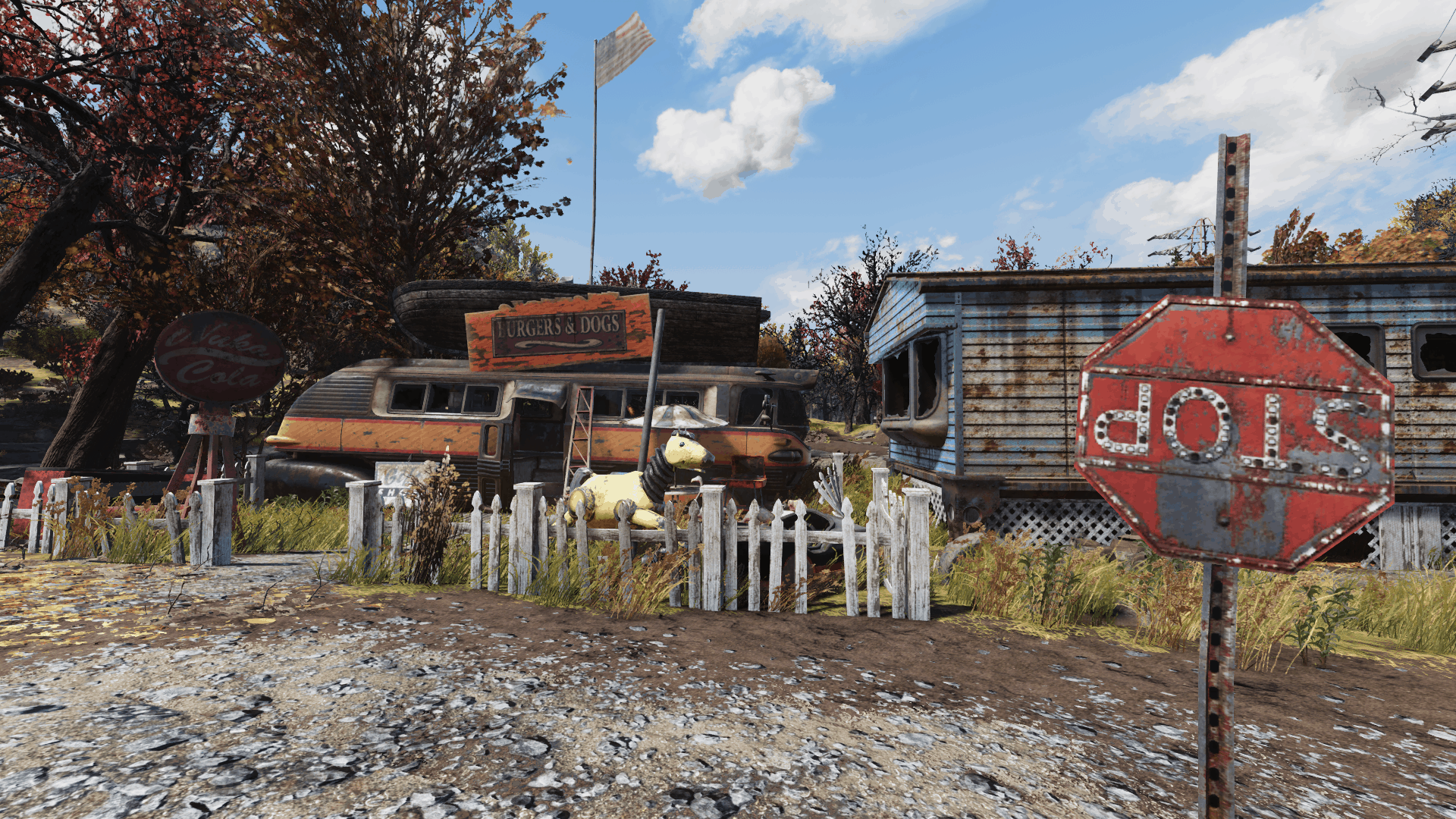
In the Fallout universe, Appalachia is the post-apocalyptic open-world setting of Fallout 76, representing a radiation-scarred version of West Virginia. Set twenty-five years after the Great War of 2077, Appalachia features diverse biomes, mutated wildlife, dangerous faction territories, and player-triggered nuclear blast zones that alter resources and boss encounters across the region.
Overview of Post-War Appalachia
Unlike the devastated urban ruins of the Capital Wasteland (Washington D.C.) or the Commonwealth (Boston), Appalachia escaped direct strategic hits during the Great War. Because fewer nuclear warheads detonated across the Allegheny Mountains, much of the region's natural geography, industrial infrastructure, and dense pine forests survived the initial nuclear barrage intact.
However, Appalachia did not escape ecological destruction. The collapse of civil infrastructure, combined with toxic industrial dumping prior to 2077 and subsequent fallout drift, transformed the landscape into a volatile wasteland. The primary ecological threat in early post-war Appalachia was the Scorched plague, a mutagenic infection spread by subterranean mutated bats known as Scorchbeasts. Transmitted via airborne spores and physical contact, the plague turned humans and animals into hive-minded, calcified ghouls called the Scorched.
Map of Appalachia:
- [Toxic Valley]
- Ash and chemical run-off
- [The Forest]
- Vault 76
- Mildest biome
- [Savage Divide]
- High peaks
- Top of the World
- [The Mire]
- Overgrown swamp
- Strangler Vines
- [Ash Heap]
- Strip mines
- Burning coal seams
- [Skyline Valley]
- Storm-wracked South
- [Cranberry Bog]
- Watoga / Dropped Nukes
When Vault 76 opened its heavy steel door on Reclamation Day in 2102, the vault dwellers emerged into a region devoid of surviving human life. Early automated systems, Holotapes, and terminal entries revealed that original survivor groups—including local Responders, the initial Appalachian chapter of the Brotherhood of Steel, the Free States movement, and local Raiders—had succumbed to internal conflict and the relentless spread of the Scorched. Later years brought human settlers, raiders, and military expeditions back into the valley, establishing active settlements like Foundation, Crater, and Fort Atlas across Appalachia’s distinct biomes.
The Distinct Biomes of Appalachia
Appalachia is divided into seven primary geographical regions, each possessing distinct radiation levels, enemy levels, climate conditions, and crafting resources.
1. The Forest
- Environmental Threat Level: Low
- Visual Characteristics: Rolling green hills, autumn foliage, intact highways, and historic landmarks.
- Key Locations: Vault 76, Flatwoods, Morgantown, The Whitespring Resort, Point Pleasant.
- Overview: The Forest serves as the entry zone for Vault 76 dwellers. It features minimal natural radiation, mild environmental hazards, and relatively weak enemy populations such as Feral Ghouls, Liberator Bots, and young Radroaches. It provides essential early-game resources like Wood, Boiled Water, Soot Flowers, and Snaptail Reeds.
2. Toxic Valley
- Environmental Threat Level: Low to Moderate
- Visual Characteristics: Stark white ash-covered ground, industrial run-off pools, and heavy chemical haze.
- Key Locations: Crater (formerly Space Station Crash Site), Clarksburg, Wavy Willard's Water Park, Grafton.
- Overview: Located in the northern sector of the map, the Toxic Valley is dominated by chemical pollution from pre-war industrial plants. The white dust covering the landscape is toxic industrial residue rather than snow. Common threats include Snallygasters, Grafton Monsters, Radscorpions, and mutated Anglers.
3. Ash Heap
- Environmental Threat Level: Moderate
- Visual Characteristics: Dark soot, burning underground coal fires, massive mining excavators, and heavy industrial haze.
- Key Locations: Welch, Lewisburg, Mount Blair, Garrahan Mining Headquarters, Abandoned Mine Shaft Elaine.
- Overview: Positioned in the southwest, the Ash Heap is an industrial wasteland ruined by aggressive automation and strip-mining executed by pre-war corporations like Garrahan Mining and Hornwright Industrial. The air quality requires airborne hazard protection (such as Gas Masks or Hazmat Suits) to prevent disease. Mining excavators, Mole Miners, and Protectrons dominate the area.
4. Savage Divide
- Environmental Threat Level: Moderate to High
- Visual Characteristics: Steep granite cliffs, mountain passes, ski resorts, and central highway networks.
- Key Locations: Top of the World, Fort Atlas, Pleasant Valley Ski Resort, Spruce Knob (Foundation), Monongah Mine.
- Overview: Running vertically down the middle of Appalachia along the Allegheny Mountain range, the Savage Divide forms a natural barrier between the lower-level western biomes and the dangerous eastern biomes. Navigating its sheer drops requires careful route planning. High-level Super Mutants, Yao Guai, and Wendigos frequent the mountain trails.
5. The Mire
- Environmental Threat Level: High
- Visual Characteristics: Dense, sun-blocking tree canopies, bioluminescent flora, murky swamps, and massive Strangler vines.
- Key Locations: Berkeley Springs, Harpers Ferry, Vault 94, Valley Galleria, Camp Venture.
- Overview: Situated in the northeast, The Mire is an overgrown wetland created when a G.E.C.K. (Garden of Eden Creation Kit) in Vault 94 malfunctioned and detonated, rapidly mutating local plant and animal life. The region remains in perpetual twilight due to the dense canopy overhead. Highly aggressive creatures such as Mirelurk Queens, Fog Crawlers, Hermit Crabs, and Gulpers inhabit the swamp.
6. Cranberry Bog
- Environmental Threat Level: Very High
- Visual Characteristics: Deep red cranberry fields, crisscrossed by deep trenches, abandoned military fortifications, and futuristic architecture.
- Key Locations: Watoga City, Drop Site V9, Forward Station Alpha, Kerwood Mine, Sunrise Field.
- Overview: Located in the southeastern corner, the Cranberry Bog is the endgame region of base Appalachia. The terrain features deep, treacherous trenches filled with toxic sludge. Watoga, a pre-war automated city of the future, sits in the center of the bog. The region serves as the primary nesting ground for Scorchbeasts and their queen.
7. Skyline Valley
- Environmental Threat Level: High (Special Weather Hazards)
- Visual Characteristics: Rolling southern hills beneath a perpetual electrical storm with red lightning and unnatural atmospheric disturbances.
- Key Locations: Shenandoah National Park region, Vault 63, Camp Liberty, Rapidan Camp.
- Overview: Positioned along the southern border of Appalachia, Skyline Valley is dominated by massive atmospheric electrical storms centered around Vault 63. The area introduces specialized Lost enemies (electrically charged human mutants) and unique weather-driven public events.
Mechanics of Nuclear Fallout Zones
One of the central mechanics in Fallout 76 is the ability for players to trigger tactical nuclear strikes. Dropping a nuke creates a localized Fallout Zone (or Nuke Zone) that drastically alters the landscape, flora, fauna, and environmental hazards for approximately two real-time hours.
Nuclear Launch Workflow:
- Acquire Nuclear Keycard (Shoot down Cargo Bot)
- Decrypt Silo Launch Code (Alpha, Bravo, or Charlie)
- Fight through Silo Security Controls (Robots, Mainframe Repair)
- Target Map Coordinates (Target Site Prime, Monongah Mine, etc.)
- Blast Zone Forms: Rads jump to +60/sec, Flora mutates, Bosses spawn
Launching a Nuclear Missile
To initiate a nuclear strike, players must complete several steps:
- Acquire a Nuclear Keycard: Shot down from automated U.S. Government Cargo Bots flying throughout Appalachia.
- Obtain Code Pieces: Intercept encrypted transmission codes dropped by Scorched or Ghoul Officers, or use decrypted weekly code combinations.
- Clear a Missile Silo: Navigate Site Alpha, Site Bravo, or Site Charlie while overcoming high-level Assaultrons, Sentry Bots, and security lockdowns.
- Target the Coordinates: Select a 25-meter radius destination on the Appalachian map.
Consequences of a Nuclear Blast
When a missile impacts a targeted zone:
- Extreme Radiation: Radiation levels inside the blast sphere jump dramatically, inflicting 30 to 60+ RADs per second without protective gear. Power Armor, Hazmat Suits, or the Chinese Stealth Armor are mandatory for survival.
- Mutated Flora: Common plants within the target zone transform into radioactive variants. Harvesting these plants yields Raw Flux (Cobalt, Crimson, Fluorescent, Violet, and Yellowcake).
- Mutated Fauna: Enemy creatures inside the blast zone drop specialized crafting materials: Glowing Mass, Hardened Mass, and High-Radiation Fluids.
- Endgame Boss Encounters: Nuking specific locations triggers world bosses:
- Nuking Fissure Site Prime (Cranberry Bog) triggers the public event Scorched Earth, summoning the Scorchbeast Queen.
- Nuking Monongah Mine (Savage Divide) triggers A Colossal Problem, forcing players inside a collapsing mine to fight Earle Williams, a massive Wendigo Colossus.
- Nuking Abandoned Mine Shaft 2 (Ash Heap) summons the Ultracite Titan.
Comparative Analysis of Appalachian Regions
The following table summarizes the structural, environmental, and tactical differences across Appalachia’s distinct biomes:
| Region | Threat Level | Primary Hazards | Signature Mutated Flora | Key Bosses / Events | Key Materials |
|---|---|---|---|---|---|
| The Forest | Low (Levels 1–10+) | Mild Radiation, Feral Ghouls | Rhododendron, Firecap | Leader of the Pack, Tea Time | Wood, Basic Herbs, Water |
| Toxic Valley | Low-Mid (Levels 10–25) | Toxic Chemical Pools, Haze | Mutated Mutagen plants | Grafton Day, Swarm of Suitors | Acid, Fertilizer, Steel |
| Ash Heap | Mid (Levels 25–35) | Air Toxicity, Burning Coal Seams | Ash Rose | Seismic Activity (Ultracite Titan) | Ash, Lead, Ore, Coal |
| Savage Divide | Mid-High (Levels 30–50) | Vertical Drops, Super Mutants | Blackberry, Glowing Fungus | A Colossal Problem (Monongah Mine) | Lead, Scrap Metal, Ballistic Fiber |
| The Mire | High (Levels 40–50+) | Low Visibility, Strangler Vines | Strangler Bloom, Brain Fungus | Heart of the Swamp | Chemicals, Leather, Plant Extracts |
| Cranberry Bog | Very High (Level 50+) | Trenches, Dense Scorchbeasts | Cranberries, Ferns | Scorched Earth (Scorchbeast Queen) | Ultracite, Raw Violet/Crimson Flux |
| Skyline Valley | High (Level 50+) | Lightning Strikes, Electrical Hazards | Storm-mutated variants | Neurological Warfare | Weather Components, Battery Scrap |
Major Factions Operating in Appalachia
The human story of Appalachia revolves around several key organizations competing for resources, security, and ideology across West Virginia.
Appalachian Faction Map:
- [Responders]
- Emergency Services
- Based at Whitespring
- [Brotherhood of Steel]
- Military Order (Fort Atlas)
- Paladin Rahmani / Knight Shin
- [Raiders]
- Housed at Crater
- Led by Meg Groberg
- [Settlers]
- Builders from Washington
- Housed at Foundation (Spruce Knob)
- [Enclave]
- Shadow government
- Managed by MODUS (Whitespring)
The Responders
Originally formed by surviving police, firefighters, and emergency medical technicians immediately after the Great War, the Responders sought to assist survivors across the Forest and Toxic Valley. Though wiped out by the Scorched before Vault 76 opened, the faction was revived years later by new arrivals operating out of the Whitespring Refuge, coordinating humanitarian aid and expeditionary flights to areas like Pittsburgh (The Pitt).
The Brotherhood of Steel (Appalachian Chapter)
The original Appalachian chapter was led by Captain Elizabeth Taggerdy, communicating via long-range satellite with High Elder Roger Maxson in California. After exhausting their forces fighting Scorchbeasts at Fort Defiance (Defiance / Allegheny Asylum), they were wiped out. Years later, an expeditionary force sent from Lost Hills under Paladin Leila Rahmani and Knight Daniel Shin established a new stronghold at Fort Atlas in the Savage Divide, asserting military control over local technology.
The Raiders of Crater
Formed from surviving wealthy families and cutthroats who fled Appalachia during the Scorched outbreak, this syndicate returned under the leadership of Meg Groberg. Occupying the crashed space station in the Toxic Valley now known as Crater, they operate as an organized criminal faction competing directly with new arrivals for control over territory and pre-war gold reserves.
The Settlers of Foundation
Originating from Washington D.C., the Settlers are a industrious collection of construction workers, engineers, and families led by Paige. They renovated the former Spruce Knob lookout in the Savage Divide into a heavily fortified town named Foundation. They specialize in agriculture, excavation, and long-term settlement infrastructure.
The Enclave
Operating silently from the hidden subterranean command bunker beneath The Whitespring Resort, the Appalachian Enclave was a elite branch of the pre-war United States shadow government. After internal civil war purged its human members, the facility fell under the control of MODUS, an advanced artificial intelligence network. MODUS assists Vault 76 dwellers who qualify for Enclave general rank, granting access to nuclear launch silos.
Crafting and Resource Management in Radioactive Fallout Zones
Surviving and thriving in Appalachia’s high-radiation end-game environments requires specialized crafting routines, particularly surrounding Stable Flux.
Stable Flux Crafting Process:
- Inputs:
- [Raw Flux x10] (Harvested Plant)
- [Glowing Mass x1] (Dropped by Enemy)
- [Hardened Mass x1] (Dropped by Enemy)
- [High-Rad Fluids x1] (Dropped by Enemy)
- [Workbench Crafting] (Requires Chemist / Super Duper Perks)
- Output:
- [Stable Flux x1] (Permanent Crafting Material)
Raw Flux Types and Harvesting Locations
Raw Flux spoils quickly into Inert Flux if not processed rapidly at a Chemistry Station. Equipping the Green Thumb perk doubles the yield per plant harvested.
- Raw Cobalt Flux: Harvested from Mutated Corn, Wild Mutos, or Firecracker Berries in nuclear zones (frequently dropped near Mama Dolce's in Morgantown or Lake Reynolds).
- Raw Crimson Flux: Harvested from Blight, Cranberries, and Aster in nuclear zones (abundant when nuking the Cranberry Bog).
- Raw Fluorescent Flux: Harvested from Rhododendron and Glowing Fungus in nuclear zones (abundant around Whitespring Resort blast zones).
- Raw Violet Flux: Harvested from Mutated Ferns and Giant Pitcher Plants (plentiful along the edges of the Cranberry Bog blast zones).
- Raw Yellowcake Flux: Harvested from Ash Roses, Blackberries, and Melon Blooms (frequently found in Ash Heap and Toxic Valley blast zones).
Crafting Stable Flux
To convert 10 Raw Flux into 1 Stable Flux (which never spoils and is required for crafting Jetpacks, Prime Weapon Receivers, Decontamination Showers, and Underarmor Upgrades), players must combine the raw plant matter with dropped materials from blast-zone creatures:
- 10 Raw Flux (of a specific type)
- 1 Hardened Mass
- 1 Glowing Mass
- 1 High-Radiation Fluids
Note: Using the Super Duper perk card under Luck grants a 30% chance to double the yield when crafting Stable Flux.
Character Preparation and Radiation Protection
Navigating radioactive zones across Appalachia requires balancing radiation mitigation against combat capabilities.
Radiation Resistance Gear
- Power Armor: Models such as the Excavator, T-51b, T-60, X-01, Ultracite, and Union Power Armor provide inherent 42% damage reduction and a hidden 90% radiation damage reduction, making them the standard choice for nuke zone combat.
- Hazmat Suit / Prototype Steel Mill Helmet: Provides 1,000 Radiation Resistance, completely shielding the wearer from environmental fallout, but offers zero physical or energy damage resistance.
- Chinese Stealth Armor: Grants 1,000 Radiation Resistance while providing moderate physical resistance, fall damage reduction, and built-in stealth cloaking while crouching.
Managing Mutations
Exposure to heavy radiation in Appalachia induces genetic Mutations that grant powerful passive bonuses at the cost of specific penalties. Players manage these using key Luck perk cards:
- Starched Genes (Rank 2): Prevents RadAway from curing mutations and stops new, unwanted mutations from forming when taking radiation.
- Class Freak (Rank 3): Reduces the negative side effects of mutations by 75%.
- Strange in Numbers: Increases positive mutation effects by 25% if teammate(s) are also mutated.
Key Appalachian Mutations:
| Mutation | Positive Effect | Penalty (Base) |
|---|---|---|
| Marsupial | +Carry Weight, High Jump | -1 Intelligence |
| Speed Demon | +Movement/Reload Speed | +Hunger/Thirst Drain |
| Adrenal Reaction | +Damage at Low Health | -50 Max HP |
| Herbivore | x2 Benefits from Vegetables | Cannot eat Meat |
| Carnivore | x2 Benefits from Meat | Cannot eat Vegetables |
Frequently Asked Questions
What is the main difference between Appalachia and other Fallout settings?
Appalachia did not suffer a direct nuclear strike on its major urban centers during the Great War of 2077. As a result, its natural ecosystems, mountain forests, and industrial structures survived in far better condition than Boston or Washington D.C. Its primary post-war catastrophe was biological: the Scorched plague spread by subterranean Scorchbeasts.
How do player-launched nukes change the map in Fallout 76?
When a player launches a missile at a set coordinate, a circular red Fallout Zone covers that radius for roughly two hours. Inside the zone, atmospheric radiation spikes drastically, flora mutates into Raw Flux components, enemies transform into hardened variants dropping high-tier crafting materials, and specific locations spawn endgame world bosses.
Where is the best place to drop a nuke for endgame materials?
For raw farming of Glowing Mass, Hardened Mass, and High-Radiation Fluids, targeting The Whitespring Resort (Savage Divide) is popular due to high density feral ghoul spawns. For crafting Violet Flux and fighting the Scorchbeast Queen, targeting Fissure Site Prime (Cranberry Bog) is the industry standard.
Can you explore Appalachia completely solo?
Yes. All regional storylines, exploration zones, biomes, and main quests across Appalachia can be completed individually. However, public events within nuclear blast zones (such as Scorched Earth or A Colossal Problem) naturally draw whole servers of players working together to defeat massive boss health pools.
How do you protect against air hazards in the Ash Heap and Mire?
The Ash Heap and certain swamp zones in The Mire feature airborne environmental hazards that cause respiratory diseases. Players can protect themselves by equipping a Gas Mask, Space Helmet, Scout Armor Mask, Hazmat Suit, or any full set of Power Armor.
Strategic Recommendations for Exploring Appalachia
To maximize efficiency and survival when venturing into post-war West Virginia:
- Establish a Mobile C.A.M.P.: Place your Construction and Assembly Mobile Platform near key resource nodes (such as Acid or Lead deposits) along boundary lines between mid-tier and high-tier biomes (e.g., western Savage Divide).
- Lock In Key Perks Early: Prioritize acquiring Starched Genes (Luck, unlocked at level 30) and Fireproof (Endurance) to handle ambient environmental damage and blast zone fallout mechanics smoothly.
- Save Raw Flux Materials: Never harvest Raw Flux without high durability on your gear and a clear inventory space. Raw Flux spoils into Inert Flux quickly if not immediately combined with High-Radiation Fluids, Hardened Mass, and Glowing Mass at a Chemistry Station.
- Prepare Specialized Loadouts: Utilize the Punch Card Machine available at train stations to maintain at least two builds: a high-damage combat build for boss fights in Cranberry Bog, and a high-efficiency crafting/stealth loadout for exploring dense, hazardous biomes like The Mire and Skyline Valley.