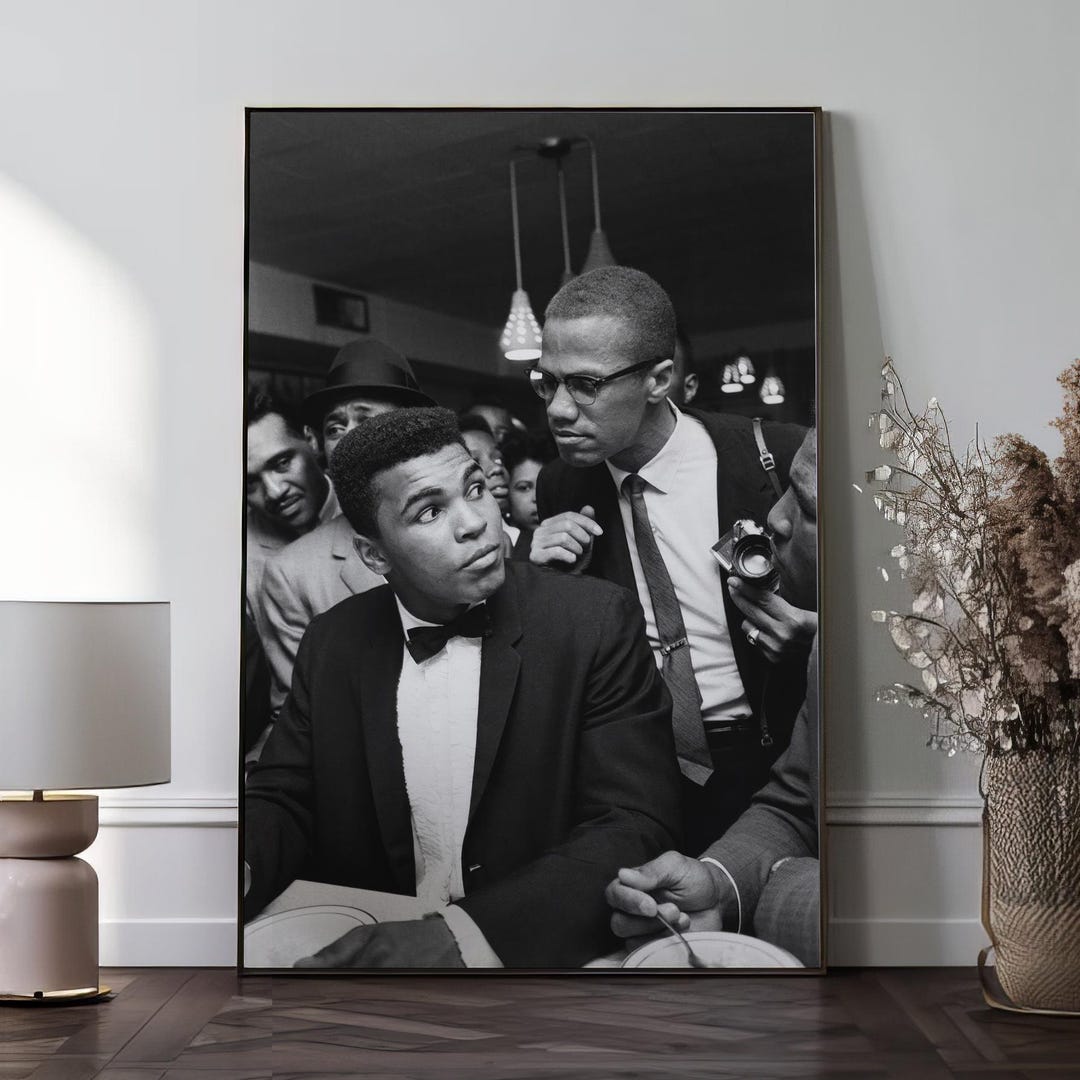
The relationship between heavyweight boxing champion Cassius Clay (later Muhammad Ali) and civil rights leader Malcolm X was a pivotal alliance in the African American freedom struggle and American sports history, beginning with a fateful meeting in 1962 and ending abruptly in 1964 due to escalating ideological schisms within the Nation of Islam.
Historical Foundations: The Convergence of Sports and Civil Rights
The historical trajectory of twentieth-century America was profoundly altered when the worlds of elite athletics and militant Black nationalism intersected. In the early 1960s, Cassius Clay was a rising, charismatic star in the heavyweight boxing division, boasting an Olympic gold medal and an unblemished professional record. Beneath his flashy exterior and rhyming bravado lay a deep racial consciousness shaped by the Jim Crow realities of segregated Louisville, Kentucky.
Concurrently, Malcolm X served as the national spokesman for the Nation of Islam (NOI), a religious and sociopolitical organization led by Elijah Muhammad. The NOI preached Black self-reliance, economic independence, and separation from white American society, which it termed a corrupt and oppressive system. Malcolm X was the dynamic voice of this movement, converting thousands to Islam and challenging the integrationist strategies of mainstream civil rights leaders like Martin Luther King Jr.
When Clay first encountered the teachings of the Nation of Islam—and subsequently Malcolm X—in Miami, Florida, around 1962, he found an intellectual framework that mirrored his own burgeoning frustrations with systemic racism. Malcolm X recognized the immense propaganda and cultural value of a young, undefeated sports hero aligning with the NOI. Their mutual attraction was instantaneous: Malcolm X provided intellectual grounding and spiritual direction, while Clay offered youth, global visibility, and a charismatic platform that could reach millions of disaffected young people.
The Miami Encounter and the Rise of an Unlikely Alliance
The relationship shifted from casual association to a close mentorship during the buildup to Clay's legendary February 1964 heavyweight championship bout against Sonny Liston. While sports writers heavily favored the intimidating Liston, Clay trained intensely in Miami under the unofficial guidance of Malcolm X, who frequently visited his training camp.
During this period, Malcolm X acted as both a political mentor and a protective older brother figure to Clay. He shielded the young boxer from exploitative promoters and media critics while guiding him deeper into the theological and social doctrines of the Nation of Islam. Their dynamic was characterized by sharp intellect meeting raw athletic genius. Malcolm X saw in Clay a potential standard-bearer for Black liberation who could articulate the NOI's message on a global stage far grander than any pulpit.
| Malcolm X (Mentor & Strategist) | Cassius Clay / Muhammad Ali |
|---|---|
| Provided theological grounding | Offered global athletic platform |
| Guided political consciousness | Brought youth and mainstream focus |
| Shielded from predatory promoters | Amplified the Nation of Islam |
This alignment culminated immediately after Clay defeated Sonny Liston on February 25, 1964. The newly minted champion shocked the sporting world not just by winning the title, but by announcing the following morning that he had joined the Nation of Islam. Shortly thereafter, Elijah Muhammad bestowed upon him the name Muhammad Ali, replacing what he called his "slave name."
The Schism: Ideological Fractures Within the Nation of Islam
Despite the outward appearance of an unbreakable bond, intense internal power struggles within the Nation of Islam were already threatening to destroy the alliance. By early 1964, Malcolm X was falling out of favor with Elijah Muhammad and other high-ranking NOI officials. Tensions arose over Malcolm's growing national prominence, jealousy from other ministers, and, most critically, Malcolm's independent investigations into moral scandals surrounding Elijah Muhammad.
Furthermore, Malcolm X was growing disillusioned with the insular, separatist policies of the NOI. Following the assassination of President John F. Kennedy in November 1963—an event Malcolm controversially characterized as "chickens coming home to roost"—Elijah Muhammad silenced him for 90 days. During this suspension, Malcolm decided to break away from the NOI entirely to form his own religious and political organizations, the Muslim Mosque, Inc., and the Organization of Afro-American Unity.
This rupture placed Muhammad Ali in an impossible dilemma. Ali had pledged absolute loyalty to Elijah Muhammad, whom he viewed as a spiritual savior. The leadership of the Nation of Islam demanded that its members cut all ties with Malcolm X, branding him a traitor and a hypocrite after his public departure in March 1964.
The Bitter Breakup and Public Alienation
The final fracture in the friendship of Ali and Malcolm X occurred during a fateful trip to Africa and the Middle East in the spring of 1964. Both men happened to be in international locations around the same time, with Malcolm embarking on his historic Hajj pilgrimage to Mecca, which profoundly broadened his views on racial brotherhood.
When Malcolm X attempted to greet Muhammad Ali in Accra, Ghana, in May 1964, Ali visibly turned his back on him. Influenced heavily by direct instructions from NOI leadership in Chicago—particularly fierce loyalist Louis X (later Louis Farrakhan)—Ali viewed Malcolm through the lens of betrayal. Ali publicly denounced his former mentor, stating that Malcolm had "gotten off the boat" and separated himself from the true teachings of Elijah Muhammad.
This public rebuff was deeply painful to Malcolm X, who had invested immense emotional and ideological capital into Ali. Malcolm recognized that Ali was acting under intense organizational pressure and sectarian coercion, yet the public humiliation signaled the definitive end of their personal and political partnership. Less than a year later, on February 21, 1965, Malcolm X was assassinated while speaking at the Audubon Ballroom in New York City by gunmen associated with the Nation of Islam.
Retrospective Views and Historical Legacy
In the years following Malcolm X's assassination, Muhammad Ali's perspective on his former mentor evolved significantly. As Ali matured away from the rigid orthodoxies of the NOI—particularly after embracing traditional Sunni Islam in the 1970s—he expressed profound regret over his treatment of Malcolm X.
In various later interviews and memoirs, Ali acknowledged that breaking ties with Malcolm X was the greatest mistake of his life. He admitted that Malcolm had been correct about the corruption within the NOI leadership and that he had been too young, impressionable, and bound by organizational loyalty to recognize the truth. Ali's subsequent humanitarian work, global activism, and personal evolution reflected many of the universalist human rights principles that Malcolm X had championed in the final, turbulent year of his life.
Frequently Asked Questions
When did Ali and Malcolm X first meet?
Cassius Clay and Malcolm X first met in Detroit in 1959, but their relationship deepened significantly in Miami, Florida, in 1962, where Malcolm began actively mentoring the young boxer regarding the teachings of the Nation of Islam.
Why did Muhammad Ali join the Nation of Islam?
Ali joined the Nation of Islam because its teachings on Black self-reliance, racial separation, and resistance to white supremacy resonated deeply with his personal experiences of racism in America. He was also heavily influenced by the intellect, charisma, and mentorship of Malcolm X.
What caused the end of their friendship?
The friendship ended due to Malcolm X's ideological break with the Nation of Islam and its leader, Elijah Muhammad, in early 1964. Bound by loyalty to the NOI, Ali chose to side with Elijah Muhammad and publicly severed ties with Malcolm X.
Did Muhammad Ali ever regret turning away from Malcolm X?
Yes. In later years, Muhammad Ali openly expressed deep regret for how he treated Malcolm X during the split, calling it the biggest mistake of his life and acknowledging Malcolm's wisdom and foresight.
Next Actions and Further Exploration
To deepen your understanding of this historical relationship, explore primary source documents such as Malcolm X's autobiographical writings, audio recordings of their joint appearances, and scholarly biographies of Muhammad Ali that examine the intersection of 1960s sports culture and civil rights activism.