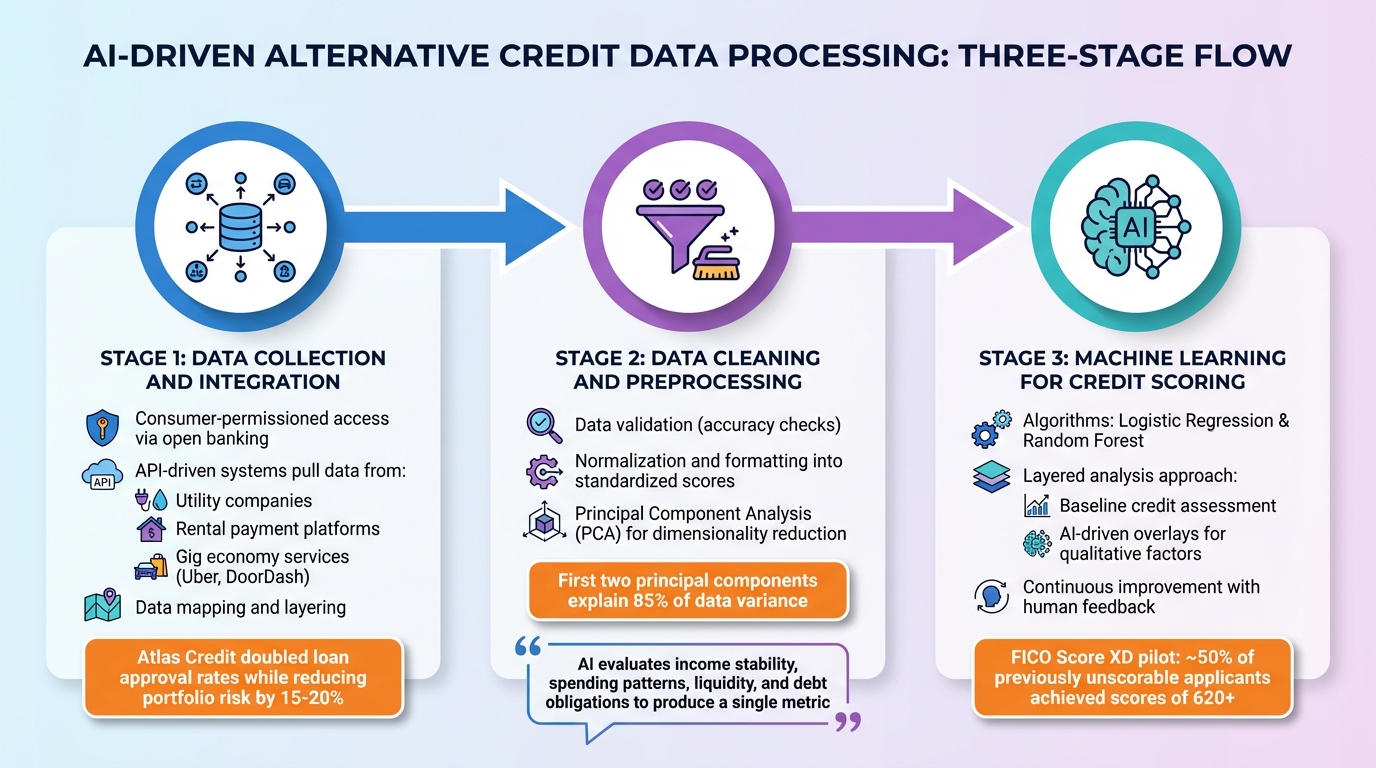
ADP loans leverage real-time payroll, tax, and employment data to provide a high-fidelity view of a borrower’s financial health, moving beyond traditional FICO scores. By integrating this "alternative credit" data, lenders can offer faster approvals, more accurate risk assessments, and expanded access to capital for small businesses and employees.
The landscape of business and consumer lending has undergone a seismic shift as of 2026. For decades, creditworthiness was determined by stagnant, historical data points—often trailing the current reality of a business by six to eighteen months. Today, the integration of payroll data from giants like ADP into the lending ecosystem has popularized "alternative credit," a model where real-time cash flow and employment stability serve as the primary indicators of risk. This evolution is particularly critical for small-to-medium enterprises (SMEs) and "credit-thin" individuals who may lack the traditional collateral or long-term credit history required by legacy banking institutions.
The Shift from Static Credit to Real-Time Data
Historically, lenders relied on the "Three Cs" of credit: Character, Capacity, and Collateral. While these remain relevant, the method of measuring them has changed. Traditional credit reports from bureaus like Experian or Equifax provide a snapshot of past debt performance. However, they often fail to capture the immediate trajectory of a business.
ADP, as a global leader in human capital management (HCM), sits on a goldmine of financial data. This data includes gross-to-net payroll calculations, tax withholding records, and employee retention rates. When this data is harnessed for lending—often referred to as ADP-fueled loans—it allows for a "cash-flow-first" underwriting approach. In 2026, lenders are less concerned with what a business did two years ago and more focused on the fact that the business successfully processed a $50,000 payroll last Friday.
The Problem with Traditional Underwriting
Traditional underwriting is often labor-intensive. It requires business owners to gather tax returns, bank statements, and profit-and-loss (P&L) statements manually. This process is prone to human error and fraud. Furthermore, for a startup or a rapidly growing business, a tax return from the previous year might not reflect its current capacity to service debt.
Alternative credit, powered by ADP’s data infrastructure, solves this by providing a direct, verified link between the payroll processor and the lender. This reduces the "information asymmetry" that often leads banks to reject viable loan applications.
How Payroll Data Fuels the Alternative Credit Engine
The core of the "ADP loans" concept isn't necessarily that ADP is the bank, but rather that ADP acts as the data conduit. Through the ADP Marketplace and various API integrations, business owners can grant permission to third-party lenders to view their payroll data.
1. Verified Income and Employment (VOIE)
For individual employee loans or Earned Wage Access (EWA), payroll data provides instant Verification of Income and Employment. Instead of waiting for a HR representative to sign a form, a lender can ping ADP's systems to confirm that an individual is currently employed and what their net take-home pay is. This is the foundation of modern personal lending and mortgage pre-approvals in 2026.
2. Tax Liability and Compliance Records
One of the best indicators of a business's health is its ability to meet tax obligations. Because ADP manages tax filing for millions of companies, a lender can see that a business is current on its payroll taxes. A business that is struggling usually misses tax payments before it misses loan payments; thus, this data serves as an early-warning system for lenders.
3. Employee Retention and Stability
In the alternative credit world, labor stability is a proxy for operational stability. A company with high turnover may be facing internal turmoil, which could lead to a decline in revenue. Conversely, a business with a stable, growing headcount according to ADP records is often viewed as a lower risk, even if its traditional credit score is mediocre.
The Role of the ADP Marketplace in Business Funding
As of 2026, the ADP Marketplace has become a central hub for fintech-driven lending. Small businesses can browse various "Capital" apps that integrate directly with their payroll dashboard. When a business applies for a loan through these partners, the "data fuel" flows automatically.
Accelerated Approval Timelines
In a traditional environment, a business loan could take weeks to fund. With payroll-backed alternative credit, the timeline is often reduced to 24–48 hours. Because the lender doesn't need to manually verify the company's revenue—they can see it via the ADP data feed—the "Know Your Business" (KYB) and underwriting phases happen almost instantaneously.
Dynamic Credit Limits
Some lenders now offer revolving lines of credit that fluctuate based on payroll volume. If a company hires ten new employees and its payroll increases, the lender may automatically increase the credit limit, recognizing the expansion. This "living credit line" is only possible through the deep integration of HCM data.
Comparing Credit Models: Traditional vs. Payroll-Fueled
To understand why this shift matters, it is helpful to compare the two dominant models of credit evaluation used in 2026.
| Feature | Traditional Credit (Bureau-Based) | Alternative Credit (Payroll-Fueled) |
|---|---|---|
| Data Source | Trade lines, credit cards, bank loans. | Payroll, tax deposits, headcount trends. |
| Data Recency | 30–90 days old. | Real-time / Same-day. |
| Verification | Manual (PDFs, paper statements). | Automated via API (e.g., ADP DataCloud). |
| Accessibility | Requires established history (2+ years). | Accessible to startups and "credit-thin" firms. |
| Risk Assessment | Based on past defaults. | Based on current cash flow and stability. |
| Primary Beneficiary | Large, established corporations. | SMBs, gig workers, and growth-stage firms. |
Alternative Credit for the Individual: Beyond the Business Loan
While much of the focus is on business capital, ADP's data also fuels alternative credit for the individual consumer. The "ADP loan" ecosystem includes products like the Wisely card and Earned Wage Access (EWA) programs.
Earned Wage Access (EWA)
EWA is perhaps the purest form of payroll-fueled credit. It allows employees to access wages they have already earned but have not yet been paid due to the traditional bi-weekly pay cycle. In 2026, EWA is no longer seen as a "perk" but as a standard financial tool. ADP’s data tells the EWA provider exactly how many hours the employee worked and their hourly rate, allowing for a risk-free advance on their own money.
Impact on Credit Scores
For many workers, especially those in the "gig economy," traditional credit scores are a barrier to entry for things like auto loans or apartments. By using payroll data, these individuals can prove their "ability to pay" through their consistent earnings history on ADP, even if they don't have a long history of using credit cards.
Data Security and the Ethics of Alternative Credit
The use of payroll data for lending raises significant questions regarding privacy and data ownership. In 2026, the regulatory environment (including updates to the CFPB’s rules on open banking) mandates that the consumer or business owner must provide "explicit, informed consent" before their data is shared with a lender.
The "Permissioned Data" Model
ADP utilizes a permissioned data model. A lender cannot simply "scrape" a company's payroll data. The business owner must authorize the connection through a secure portal. This ensures that the data is used only for the specific purpose of the loan application.
Encryption and Compliance
Data transmitted between ADP and financial institutions is subject to high-level encryption standards (such as AES-256). Furthermore, these integrations must comply with global standards like GDPR and CCPA, ensuring that "alternative credit" does not become a backdoor for unauthorized surveillance of employee or employer finances.
Challenges and Limitations of Payroll-Based Lending
Despite the advantages, payroll-fueled credit is not a silver bullet. There are inherent limitations to relying solely on HCM data for credit decisions.
- Incomplete Financial Picture: Payroll shows money going out (to employees) and tax liabilities, but it doesn't always show money coming in (revenue) unless the lender also integrates with a bank's cash-flow data or a point-of-sale (POS) system.
- Sector Volatility: Certain industries, like seasonal retail or construction, may have volatile payrolls that don't necessarily indicate a lack of creditworthiness. Lenders must be sophisticated enough to adjust their algorithms for these nuances.
- Data Fragmentation: Not every business uses ADP. While ADP has a massive market share, the "alternative credit" ecosystem requires interoperability between various payroll providers (like Gusto, Paychex, or Workday) to be truly universal.
The Future of "ADP Loans" and Alternative Credit
Looking toward the end of 2026 and beyond, we can expect the "ADP loan" concept to become even more embedded in the employee experience. We are moving toward a world of "embedded finance," where the distinction between a payroll platform and a financial institution continues to blur.
Imagine a scenario where an ADP-processed employee applies for a mortgage, and the "credit score" is replaced by a "Financial Reliability Index" that combines their five-year employment history, their consistent 401(k) contributions, and their history of on-time tax withholdings. This is the promise of alternative credit: a more holistic, fair, and accurate representation of financial health.
Frequently Asked Questions
Does ADP directly lend money to businesses?
ADP primarily acts as a data provider and platform connector. While they offer products like Wisely for employees, most "ADP loans" for businesses are facilitated through third-party lenders found on the ADP Marketplace. These lenders use ADP’s verified payroll data to make faster, more accurate lending decisions.
How does using my payroll data help me get a loan?
Traditional lenders often require years of tax returns and a high FICO score. If your business is growing rapidly or is relatively new, your payroll data provides "real-time" proof of your revenue and stability. Showing a lender that you have a consistent and healthy payroll can often override a lack of traditional credit history.
Is my payroll data safe when I apply for these loans?
Yes. Modern integrations use secure APIs where you, the business owner, must explicitly grant permission for a lender to view specific data points. The data is encrypted, and lenders are usually only given "read-only" access to the information necessary for underwriting, protecting you from unauthorized changes to your payroll.
Can an employee get a loan based on ADP data?
Yes, through Verification of Income and Employment (VOIE) services. When an employee applies for a personal loan or mortgage, the lender can use ADP's automated systems to verify their salary and employment status instantly. This speeds up the application process and can help employees with "thin" credit files qualify for better rates.
What is the difference between ADP-fueled loans and a bank loan?
The primary difference is the speed and the data used. A bank loan might take weeks and focus on your personal credit score and collateral. An ADP-fueled loan (alternative credit) focuses on your business's current cash flow as evidenced by your payroll records, often leading to faster funding and less paperwork.
Practical Next Steps for Businesses
If you are a business owner using ADP and looking for capital in 2026, your first step should be to explore the ADP Marketplace. Search for "Capital" or "Lending" partners that offer direct integration.
Before applying, ensure your payroll records are clean and your tax filings are up to date within the ADP system, as this is the primary data the lender will see. By leveraging the "alternative credit" path, you can often bypass the friction of traditional banking and secure the working capital needed to scale your operations.