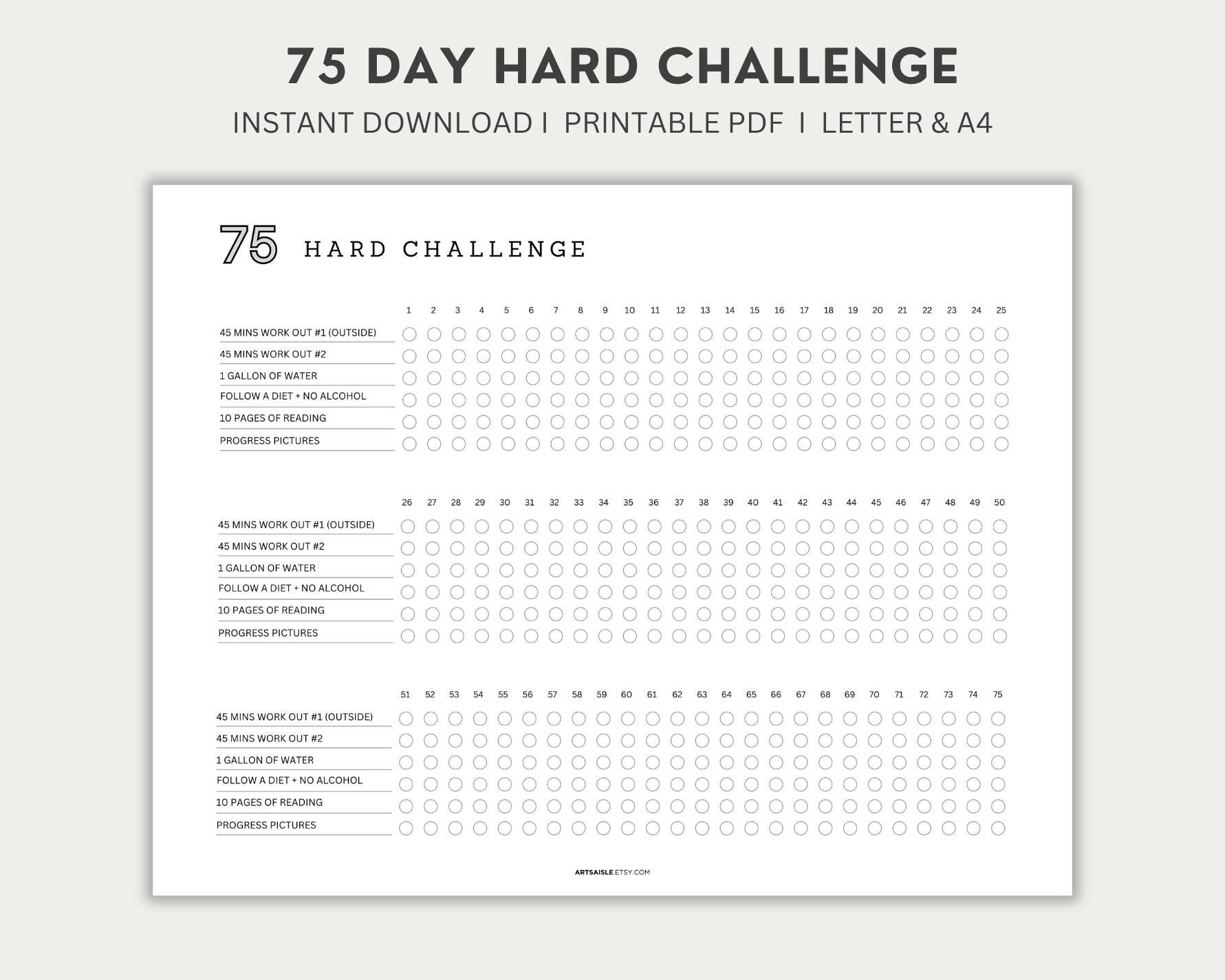
The 75 Hard Challenge is a rigorous 75-day mental toughness program requiring two daily 45-minute workouts, a strict diet with no alcohol or cheat meals, a gallon of water, ten pages of non-fiction reading, and a daily progress photo. Failing any single task requires an immediate restart from day one, prioritizing discipline over physical transformation.
While frequently searched as the "70 Hard challenge," the actual program that has dominated the fitness landscape since its inception is the 75 Hard Challenge. Developed by entrepreneur and podcaster Andy Frisella in 2019, the program is positioned not as a traditional fitness plan, but as a "Transformational Mental Toughness Program." By 2026, the challenge has evolved from a viral social media trend into a foundational protocol for those seeking to overhaul their self-discipline, resilience, and time management.
The Philosophical Foundation of 75 Hard
To understand the 75 Hard trend, one must first distinguish it from standard weight-loss challenges or 30-day "shreds." The program was designed to solve the problem of "weakness" and the tendency to negotiate with oneself when things get difficult. Frisella’s premise is that most people lack the "tactical" skills of discipline, grit, and fortitude.
By 2026, the cultural conversation around fitness has shifted significantly toward cognitive health and mental resilience. 75 Hard aligns with this shift by making the physical results—which are often significant—secondary to the psychological conditioning. The "all-or-nothing" nature of the rules is intended to eliminate the "gray area" of modern life, where small compromises often lead to the abandonment of long-term goals.
The Five Non-Negotiable Rules
The 75 Hard Challenge is defined by five critical tasks that must be completed every single day for 75 consecutive days. There are no "rest days," no substitutions, and no modifications allowed within the official protocol.
1. Follow a Strict Diet
The program does not mandate a specific diet like Keto, Paleo, or Veganism. Instead, it requires the participant to choose a structured nutrition plan intended for physical improvement and stick to it with zero deviations.
- No Cheat Meals: Even a single "forbidden" food item constitutes a failure.
- No Alcohol: This is perhaps the most difficult aspect for many, as it removes a primary social lubricant and stress-relief mechanism.
2. Two 45-Minute Workouts
Participants must complete two separate 45-minute workouts every day.
- The Outdoor Requirement: At least one of these workouts must be outdoors, regardless of the weather. Whether it is a blizzard, a heatwave, or a rainstorm, the outdoor element is non-negotiable. This is designed to build "mental callousness" by forcing the individual to perform in suboptimal conditions.
- Separation: The two workouts cannot be back-to-back. They must be separate sessions to force the participant to manage their schedule more effectively.
3. Drink One Gallon of Water
Staying hydrated is a core pillar of the program. Drinking a full gallon (approximately 3.78 liters) of plain water daily is required. This task teaches persistence and constant awareness of one's goals throughout the day, as a gallon of water cannot easily be consumed in one sitting without physical discomfort.
4. Read 10 Pages of Non-Fiction
The program emphasizes mental growth alongside physical effort. Participants must read 10 pages of a non-fiction book that provides educational or self-improvement value.
- No Audiobooks: The act of physically sitting down and focusing on text is required to build focus and concentration.
- Material: The books typically focus on business, philosophy, psychology, or personal development.
5. Take a Daily Progress Photo
While seemingly superficial, the daily photo is a exercise in tracking small, incremental changes that are often invisible day-to-day. It also serves as a final "check-off" task that is frequently forgotten, leading many participants to fail late at night when they realize they missed the photo.
The "Day One" Rule: The Cost of Failure
The most defining feature of the 75 Hard Challenge is the restart policy. If you miss a single task—even if it is forgetting to take the progress photo or only drinking 120 ounces of water instead of 128—you must immediately return to Day 1.
This zero-tolerance policy is the primary driver of the program's success in building mental toughness. It removes the "I'll make it up tomorrow" mentality that plagues most fitness attempts. By 2026, many participants use specialized apps to track these tasks, but the psychological weight of potentially losing 60 or 70 days of progress creates a high-stakes environment that forces extreme organization.
Safety Considerations and Technical Depth
Because the 75 Hard Challenge is so intense, it is not without risks. Medical professionals and fitness experts often point to three primary areas of concern: overtraining, nutritional sustainability, and hyponatremia.
Overtraining and Recovery
The lack of rest days is a significant departure from standard sports science. Most professional athletes incorporate "active recovery" or full rest days to allow muscle tissue to repair and to prevent central nervous system fatigue. Doing 75 days of two-a-day workouts can lead to overuse injuries like stress fractures or tendonitis. To mitigate this, successful participants often use one of the 45-minute blocks for lower-intensity movement like walking or yoga.
Nutritional Risks
Since the "diet" is self-selected, there is a risk that individuals will choose overly restrictive plans that do not provide enough calories to support 90 minutes of daily exercise. It is essential to consult with a nutritionist or use a science-based approach to ensure your chosen diet is "fueling" the work rather than just starving the body.
Water Toxicity (Hyponatremia)
While rare, drinking a gallon of water too quickly can lead to hyponatremia, a condition where sodium levels in the blood become dangerously low. This is particularly relevant if the participant is sweating heavily during outdoor workouts and not replacing electrolytes. The Mayo Clinic notes that balance is key to avoiding water intoxication.
Comparison of Challenge Variants
As the 75 Hard trend grew, several variations emerged to cater to different levels of physical ability and lifestyle constraints. The most notable is "75 Soft," which is often preferred by those with high-intensity jobs or physical limitations.
| Feature | 75 Hard (Official) | 75 Soft (Community Variant) |
|---|---|---|
| Workouts | Two 45-min (one must be outside) | One 45-min (anywhere) |
| Diet | Strict diet, no cheat meals | Eat "clean" in general |
| Alcohol | Zero tolerance | Only on social occasions |
| Water | 1 Gallon (128 oz) | 3 Liters (~101 oz) |
| Reading | 10 pages non-fiction (no audio) | 10 pages of any book |
| Failure Penalty | Restart at Day 1 | Continue from current day |
| Primary Goal | Mental Toughness/Discipline | Sustainable Habit Building |
Logistics and Preparation for 2026
Entering the 75 Hard Challenge in 2026 requires more than just willpower; it requires a logistical strategy. Because the challenge takes 75 days, you must account for changing seasons, travel, and social obligations.
- Meal Prep is Non-Negotiable: Without a fridge full of compliant food, the "no cheat meal" rule will eventually be broken by a busy schedule.
- The "First Thing" Rule: Successful finishers almost always complete their first workout and their reading before the workday begins. This leaves the second workout and the remainder of the water for the evening.
- Water Pacing: To avoid midnight bathroom trips or the risk of drinking too much at once, participants should aim to finish half their water by noon.
- Weather Gear: Since you must work out outside, having the correct technical apparel for your local climate (moisture-wicking fabrics, thermal layers, or waterproof trail shoes) is a prerequisite.
Common Mistakes to Avoid
Even the most dedicated individuals often fail 75 Hard on their first attempt due to common pitfalls:
- The "Hidden" Alcohol: Forgetting that certain sauces, desserts, or "virgin" drinks might contain alcohol or flavorings that technically violate the "no alcohol" rule.
- Waiting Until 11 PM to Read: Fatigue makes it nearly impossible to absorb 10 pages of non-fiction late at night.
- Underestimating the Water: Many people find the water to be the hardest part, not the workouts.
- Inadequate Electrolytes: Drinking a gallon of plain water without adequate salt and potassium intake can lead to lethargy and muscle cramps.
Is 75 Hard Right for You?
The 75 Hard Challenge is effectively a "boot camp" for the mind. If your primary goal is simply to lose 10 pounds, there are much more efficient and less stressful ways to achieve that. However, if you feel that you have lost control of your habits, struggle with consistency, or want to prove to yourself that you can do something difficult, the program offers a unique framework for transformation.
Before starting, it is highly recommended to have a physical check-up. The American Council on Exercise emphasizes the importance of progressive loading; jumping from zero activity to 90 minutes a day is a recipe for injury.
Recommended Next Actions
- Define Your Diet: Clearly write down what your diet entails. Define exactly what constitutes a "cheat" so there is no ambiguity on Day 40.
- Select Your Books: Buy your first three non-fiction books in advance.
- Audit Your Schedule: Look at your calendar for the next 75 days. If you have a wedding, a vacation, or a surgery scheduled, decide now how you will navigate the rules or choose a different start date.
- Download a Tracker: Use an app or a physical calendar to mark your progress, ensuring you never miss the daily photo.
Frequently Asked Questions
Can I do two workouts inside if the weather is dangerous? No. According to the official rules, one workout must be outdoors regardless of conditions. If the weather is truly life-threatening (e.g., a hurricane or extreme wildfire smoke), the only option within the rules is to wait for a break in the weather or accept that you cannot complete the challenge at this time. Most participants choose a "safe" outdoor activity like walking during inclement weather.
Do audiobooks count for the reading requirement? No. The rule specifically states you must read 10 pages of a physical or digital book (e-reader). The intent is to practice the discipline of focused, manual reading, which requires more cognitive effort than listening to an audiobook while multitasking.
What happens if I forget the progress photo but did everything else? You must restart at Day 1. The challenge is about attention to detail and following through on all commitments. Forgetting the "easy" tasks is seen as a lapse in the mental discipline the program aims to build.
Can the workouts be 30 minutes and 60 minutes? No. Each workout must be at least 45 minutes long. You cannot "bank" time from one workout to shorten the other. Both must meet the minimum threshold of 45 minutes.
Is there a specific time the "day" ends? In the 75 Hard protocol, the day ends when you go to sleep. If you are awake until 2:00 AM completing your tasks, it still counts as the previous day, provided you haven't slept yet. However, this is a dangerous game to play, as it usually leads to failure the following morning.