Exchange-traded funds tracking specific market sectors offer targeted exposure to distinct segments of the economy, allowing investors to overweight or underweight industries based on macroeconomic conditions, cyclical trends, and portfolio diversification goals. Understanding the structural differences, underlying indexes, and risk profiles of top sector funds is essential for building a resilient, adaptable investment strategy.
Understanding Sector ETFs and Market Classification
Sector exchange-traded funds (ETFs) pool capital from investors to purchase baskets of stocks within a specific industry or economic sector. The most widely recognized framework for this classification is the Global Industry Classification Standard (GICS), developed jointly by MSCI and S&P Dow Jones Indices. The GICS framework currently divides the global equity market into 11 distinct sectors:
- Communication Services
- Consumer Discretionary
- Consumer Staples
- Energy
- Financials
- Health Care
- Industrials
- Information Technology
- Materials
- Real Estate
- Utilities
By isolating these segments, sector ETFs remove the need for investors to pick individual winning stocks within an industry. Instead, participants can capture the aggregate performance of an entire economic pillar. This structural approach appeals to both tactical traders attempting to time macroeconomic cycles and long-term portfolio managers executing strategic asset allocation.
Disclaimer: The following overview is for educational and informational purposes only and does not constitute financial, legal, or tax advice. Market conditions fluctuate, and past performance does not guarantee future results. Consult a qualified financial professional before making investment decisions.
Criteria for Evaluating Sector Funds
Before committing capital to any sector-specific vehicle, investors must evaluate several core metrics to ensure the fund aligns with their time horizon, risk tolerance, and cost parameters. Navigating these factors helps separate high-quality institutional-grade funds from narrow, high-cost thematic alternatives.
Expense Ratios and Total Cost of Ownership
The expense ratio represents the annual fee charged by the fund manager, expressed as a percentage of the fund's average assets under management. For broad-based sector ETFs—particularly those tracking major GICS benchmarks—expense ratios are generally low, often ranging from 0.08% to 0.15%. Minimizing these fees is vital, as compounding costs erode net returns over long holding periods.
Liquidity and Trading Volume
Average daily trading volume and assets under management (AUM) dictate a fund's liquidity. High liquidity ensures tight bid-ask spreads, allowing investors to enter and exit positions rapidly without incurring high execution costs or price slippage. Major institutional funds often boast billions in AUM and millions of daily traded shares.
Index Methodology and Weighting Schemes
Investors must examine whether a sector ETF uses a market-capitalization-weighted methodology or an equal-weighted approach.
- Market-cap weighting (such as the Select Sector SPDR funds) allocates larger percentages of the fund to mega-cap corporations. While this provides stability, it can introduce single-stock concentration risk.
- Equal weighting assigns the same percentage to every constituent in the index, offering greater diversification across mid-sized and smaller firms within that sector, though it often incurs higher portfolio turnover and rebalancing costs.
The 7 Best Sector ETFs to Watch
The following selection highlights prominent sector ETFs that serve as foundational building blocks or tactical instruments for market participants. These funds cover major economic segments with high liquidity, transparent index tracking, and established track records.
1. Technology Select Sector SPDR Fund (XLK)
As the dominant growth engine of modern equity markets, the technology sector commands immense investor attention. XLK tracks the Technology Select Sector Index, capturing companies from software, technology hardware, storage, and semiconductors.
- Primary Focus: Software, IT services, technology hardware, and semiconductor equipment.
- Key Characteristics: Heavily influenced by mega-cap industry leaders, making its performance closely tied to structural trends like artificial intelligence, cloud computing, and enterprise software adoption.
- Considerations: Offers high growth potential but carries elevated valuation risk and volatility during economic downturns or periods of rising interest rates.
2. Health Care Select Sector SPDR Fund (XLV)
The health care sector represents a classic defensive growth allocation, combining steady consumer demand with continuous scientific innovation. XLV tracks companies ranging from pharmaceuticals and biotechnology to medical equipment and healthcare providers.
- Primary Focus: Pharmaceuticals, healthcare equipment, biotechnology, and managed care.
- Key Characteristics: Generally exhibits lower volatility than cyclical sectors due to inelastic consumer demand for medical treatments, devices, and pharmaceuticals regardless of broader economic conditions.
- Considerations: Subject to regulatory scrutiny, patent expirations, and legislative drug-pricing debates that can impact specific sub-segments.
3. Financial Select Sector SPDR Fund (XLF)
Financials form the circulatory system of the global economy, encompassing banking, insurance, capital markets, and consumer finance. XLF tracks the performance of institutions sensitive to interest rate spreads, credit cycles, and economic expansion.
- Primary Focus: Diversified banks, insurance underwriters, asset management firms, and investment banking.
- Key Characteristics: Highly sensitive to monetary policy, yield curve movements, and broader credit health. Performs well in rising interest rate environments where net interest margins expand.
- Considerations: Vulnerable during systemic credit events, liquidity crunches, or recessions that trigger loan defaults and market sell-offs.
4. Vanguard Consumer Discretionary ETF (VCR)
Consumer discretionary companies provide non-essential goods and services—such as automobiles, luxury goods, entertainment, and specialty retail—that consumers purchase when disposable income is high. VCR captures the upside of consumer confidence and economic booms.
- Primary Focus: Internet and direct marketing retail, automotive manufacturers, hotels, restaurants, and leisure equipment.
- Key Characteristics: Highly cyclical. Performance correlates directly with employment rates, wage growth, consumer sentiment, and borrowing costs.
- Considerations: Tends to underperform during periods of inflation, high interest rates, or economic contraction when consumers pull back on discretionary spending.
5. Vanguard Consumer Staples ETF (VDC)
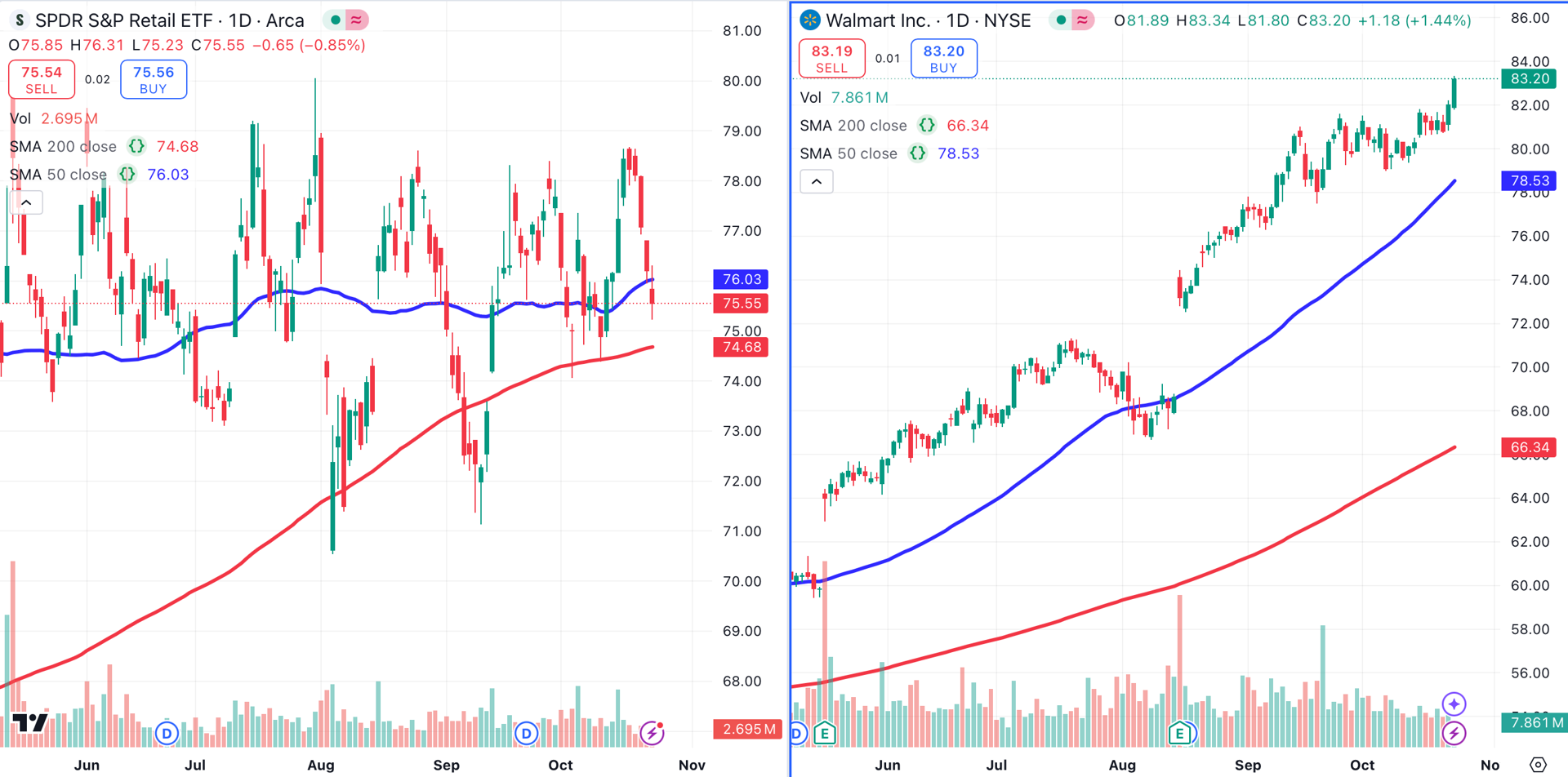
In contrast to discretionary spending, consumer staples encompass essential goods like food, beverages, hygiene products, and household items. VDC offers exposure to defensive stalwarts that maintain steady revenue streams through all economic cycles.
- Primary Focus: Packaged foods, soft drinks, hypermarkets, supercenters, and personal care products.
- Key Characteristics: Known for consistent dividend payouts and lower beta, acting as a buffer during market corrections and volatile trading sessions.
- Considerations: May lag during aggressive bull markets where high-growth, speculative sectors outpace steady, mature consumer goods companies.
6. Energy Select Sector SPDR Fund (XLE)
The energy sector covers traditional fossil fuel extraction, refining, equipment, and pipeline operations. XLE tracks large-scale integrated oil and gas companies, exploration firms, and equipment providers.
- Primary Focus: Oil and gas exploration, production, refining, marketing, and energy equipment services.
- Key Characteristics: Highly sensitive to geopolitical events, global supply-demand imbalances, OPEC production quotas, and underlying crude oil and natural gas prices.
- Considerations: Historically cyclical and volatile, but often serves as an effective hedge against inflationary spikes and commodity price surges.
7. Industrial Select Sector SPDR Fund (XLI)
Industrials encompass companies manufacturing capital goods, providing commercial services, and operating transportation networks, aerospace systems, and defense equipment. XLI captures capital expenditure cycles within the broader economy.
- Primary Focus: Aerospace and defense, industrial machinery, transportation, electrical equipment, and construction engineering.
- Key Characteristics: Sensitive to manufacturing data, global trade volumes, supply chain dynamics, and infrastructural spending initiatives.
- Considerations: Serves as a reliable economic barometer; however, margins can be compressed by rising raw material costs and labor shortages.
Sector ETF Comparison Matrix
| ETF Ticker | Primary Sector | Weighting Style | Expense Ratio (Approx.) | Risk Profile |
|---|---|---|---|---|
| XLK | Information Technology | Market-Cap | Low (~0.09%) | High Growth / Volatile |
| XLV | Health Care | Market-Cap | Low (~0.09%) | Moderate / Defensive Growth |
| XLF | Financials | Market-Cap | Low (~0.09%) | Cyclical / Rate-Sensitive |
| VCR | Consumer Discretionary | Market-Cap | Low (~0.10%) | High Cyclicality |
| VDC | Consumer Staples | Market-Cap | Low (~0.10%) | Low Beta / Defensive |
| XLE | Energy | Market-Cap | Low (~0.09%) | High Commodity Sensitivity |
| XLI | Industrials | Market-Cap | Low (~0.09%) | Cyclical / Economic Barometer |
Tactical vs. Strategic Allocation Strategies
Investors generally deploy sector ETFs using one of two primary methodologies: strategic asset allocation or tactical sector rotation.
Strategic Core-Satellite Approach
In a core-satellite portfolio, the core consists of broad market index funds tracking the S&P 500 or total stock market. Sector ETFs act as "satellites" around this core, allowing investors to tilt their portfolios toward favored industries without abandoning broad diversification. For instance, an investor might maintain an 80% core in a total market fund and allocate 20% across technology and healthcare ETFs to capture specific long-term secular trends.
Tactical Sector Rotation
Tactical rotation involves shifting allocations dynamically based on macroeconomic indicators, business cycle phases, and interest rate environments. Economic cycles typically transition through four stages:
- Early-Cycle: Financials, Consumer Discretionary, and Real Estate often outperform as the economy rebounds from recession.
- Mid-Cycle: Information Technology and Industrials gain momentum as business expansion stabilizes.
- Late-Cycle: Energy and Materials experience peak demand as commodity prices climb.
- Recessionary: Consumer Staples, Utilities, and Health Care attract defensive capital seeking safety and steady dividends.
While tactical rotation can enhance returns, it requires disciplined market monitoring and exposes investors to timing risk and higher tax turnover in taxable accounts.
Common Mistakes to Avoid When Trading Sector ETFs
Navigating sector funds requires discipline to avoid common behavioral and structural pitfalls. Recognizing these errors helps preserve capital and maintain long-term portfolio efficiency.
- Chasing Past Performance: Buying a sector ETF simply because it generated exceptional returns over the prior twelve months often results in buying at the top of a cyclical peak.
- Overlooking Concentration Risk: Many market-cap-weighted sector funds are heavily concentrated in their top three or four holdings. If a single mega-cap company experiences a downturn, the entire fund can suffer disproportionately.
- Ignoring Tax Implications: Frequent buying and selling of sector ETFs within taxable brokerage accounts can trigger capital gains taxes and reduce net compounding returns.
- Misunderstanding Sub-Sector Nuances: Assuming all funds within a broad category behave identically is dangerous. For example, a biotechnology ETF carries vastly different clinical trial and regulatory risks than a pharmaceutical giant holding established cash-flowing drug portfolios.
Frequently Asked Questions
What is the difference between a broad market ETF and a sector ETF?
A broad market ETF tracks an entire index—such as the S&P 500 or Russell 2000—providing immediate diversification across all major industries. A sector ETF isolates a single economic segment, such as technology or energy, allowing investors to concentrate exposure in a specific industry while still holding a basket of stocks rather than individual equities.
Are sector ETFs suitable for long-term buy-and-hold investors?
Yes, certain defensive or secular-growth sector ETFs (such as healthcare or technology) can serve as long-term holdings for investors looking to overweight specific structural trends. However, purely cyclical sectors require active monitoring and rebalancing to avoid deep drawdowns during economic contractions.
How do rising interest rates affect sector ETFs?
Rising interest rates impact sectors differently. Financials often benefit from wider lending margins, while utilities, real estate, and high-growth technology stocks typically face pressure because higher risk-free yields make fixed-income investments more attractive and increase borrowing costs.
What fees should I expect when purchasing sector ETFs?
Most major sector ETFs feature low expense ratios ranging from 0.08% to 0.15% annually. Investors should also account for brokerage commissions (though most retail platforms offer commission-free trading) and potential bid-ask spreads when executing trades.
Conclusion and Next Actions
Sector ETFs provide a flexible, cost-effective mechanism for targeting distinct segments of the global economy. Whether constructing a core-satellite portfolio or executing tactical sector rotation, understanding fund weighting methodologies, expense structures, and macroeconomic sensitivity is critical. Review your current portfolio allocation, identify any unintended concentration risks or gaps in cyclical exposure, and consult a certified financial planner to align your sector selections with your overarching long-term wealth strategy.