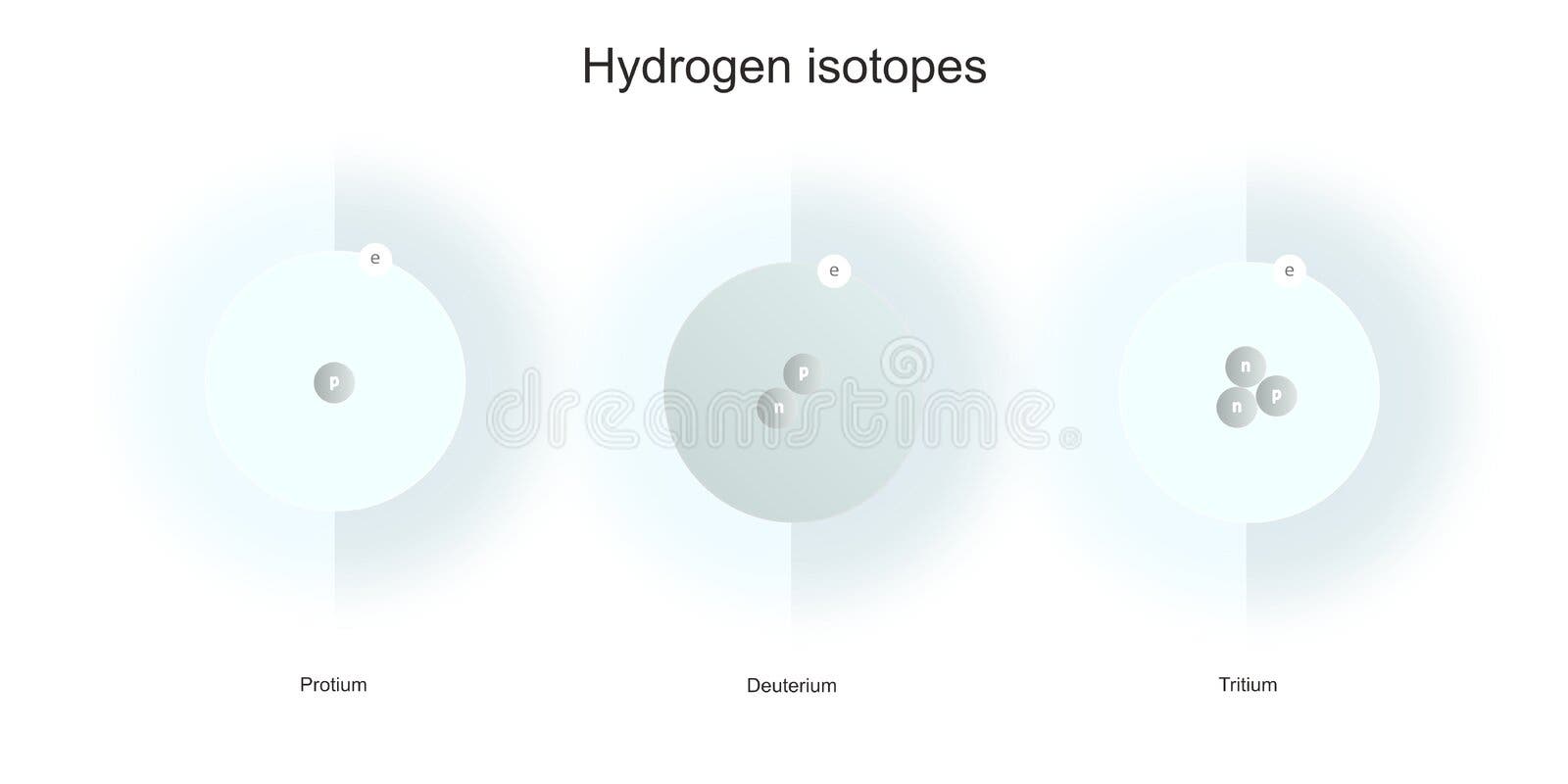
Hydrogen, the simplest and most abundant element in the universe, exists in three primary naturally occurring and artificially produced atomic variants known as isotopes. These three isotopes—Protium, Deuterium, and Tritium—share a single proton in their atomic nuclei, which defines the chemical identity of hydrogen, but they differ significantly in their neutron counts, physical properties, natural abundance, and practical applications in science and industry.
Introduction to Atomic Structure and Hydrogen Isotopes
To understand the three isotopes of hydrogen, one must first examine the fundamental architecture of an atom. An atom consists of a dense central nucleus made of positively charged protons and electrically neutral neutrons, surrounded by a cloud of negatively charged electrons. The chemical identity of any element is determined exclusively by its atomic number, which is the total number of protons in its nucleus. Hydrogen has an atomic number of one, meaning every hydrogen atom possesses one proton.
Isotopes are variants of a particular chemical element that share the same number of protons but contain varying numbers of neutrons. Because neutrons carry no electrical charge but add mass to the atom, different isotopes of the same element share nearly identical chemical behaviors—since chemistry is driven primarily by electron configurations—while exhibiting distinct physical properties, particularly regarding atomic mass and nuclear stability.
In the case of hydrogen, this variation in neutron count yields three distinct structural configurations:
- Protium ($^1\text{H}$): Zero neutrons.
- Deuterium ($^2\text{H}$ or $\text{D}$): One neutron.
- Tritium ($^3\text{H}$ or $\text{T}$): Two neutrons.
The presence or absence of these neutrons alters the atomic mass drastically on a relative scale, giving rise to unique applications ranging from nuclear fusion research and heavy water production to biochemical tracing and astrophysical studies.
1. Protium ($^1\text{H}$): The Most Abundant Isotope
Atomic Composition and Characteristics
Protium is by far the most common isotope of hydrogen, making up more than 99.98% of all hydrogen found in nature. The nucleus of a protium atom consists of a single proton and absolutely zero neutrons. A single electron orbits this lone proton, making protium the simplest and lightest stable atom in the universe. Because it lacks neutrons, its mass number is one, and its atomic mass is approximately 1.0078 atomic mass units (amu).
Natural Abundance and Occurrence
Because of its overwhelming abundance, when scientists or laypeople refer to "hydrogen" in general conversation or standard chemical equations, they are almost always referring to protium. It is found bound to oxygen in water ($\text{H}_2\text{O}$), in organic compounds throughout all living matter, in vast molecular clouds in interstellar space, and as the primary fuel driving stellar nucleosynthesis in main-sequence stars like our Sun.
Role in Stellar Physics
In astrophysical contexts, protium serves as the foundational fuel for the proton-proton chain reaction, the primary nuclear fusion process that powers stars. Inside the core of the Sun, intense pressure and temperatures force protium nuclei to collide with sufficient energy to overcome electrostatic repulsion, ultimately fusing them together to form helium-4, releasing immense amounts of energy in the form of gamma rays and neutrinos.
2. Deuterium ($^2\text{H}$): The Stable Heavy Hydrogen
Atomic Composition and Characteristics
Deuterium, often designated by the symbol $\text{D}$ or $^2\text{H}$, contains one proton and one neutron in its nucleus. This single neutron roughly doubles the mass of the atom compared to protium, giving deuterium an atomic mass of approximately 2.014 amu. Discovered in 1931 by Harold Urey, Ferdinand Brickwedde, and George Murphy at Columbia University—an achievement that earned Urey the 1934 Nobel Prize in Chemistry—deuterium is classified as a stable isotope, meaning it does not undergo radioactive decay over time.
Natural Abundance and Production
Deuterium is a rare isotope in nature. Out of every roughly 6,400 to 7,000 hydrogen atoms in Earth's oceans, only one is a deuterium atom. Despite this low concentration, the sheer volume of water on Earth means that the total amount of deuterium is staggering.
To isolate deuterium from ordinary water, industrial processes exploit slight physical and chemical differences between protium and deuterium compounds. The most prominent industrial methods include:
- Girdler Sulfide Process: A chemical exchange process utilizing hydrogen sulfide and water at different temperatures to enrich water in deuterium concentration.
- Distillation: Fractional distillation of liquid hydrogen or water, taking advantage of the slightly higher boiling point of heavy water ($\text{D}_2\text{O}$) compared to normal water ($\text{H}_2\text{O}$).
Practical Applications
Deuterium plays a critical role in several high-technology and scientific sectors:
- Nuclear Reactors: Deuterium oxide, commonly known as heavy water, is utilized as a neutron moderator in certain types of nuclear fission reactors (such as CANDU reactors). Heavy water slows down fast neutrons effectively without absorbing them, allowing natural uranium to be used as fuel instead of enriched uranium.
- Nuclear Fusion Research: Deuterium is a primary fuel candidate for magnetic confinement and inertial confinement fusion reactors (such as tokamaks), paired with tritium, because the deuterium-tritium fusion reaction has a high energy yield at relatively achievable temperatures.
- Scientific Tracers and NMR Spectroscopy: Deuterated compounds—where hydrogen atoms are replaced with deuterium—are widely used in nuclear magnetic resonance (NMR) spectroscopy to resolve chemical structures without interference from normal hydrogen signals, and in metabolic tracing studies.
3. Tritium ($^3\text{H}$): The Radioactive Isotope
Atomic Composition and Characteristics
Tritium, designated as $^3\text{H}$ or $\text{T}$, is the heaviest naturally occurring isotope of hydrogen. Its nucleus contains one proton and two neutrons, resulting in a mass number of three and an atomic mass of roughly 3.016 amu. Unlike protium and deuterium, tritium is radioactive. It undergoes beta-minus decay with a half-life of approximately 4.5 years, transforming into helium-3 ($\text{^3He}$) by emitting a low-energy beta particle (an electron) and an electron antineutrino.
$$\text{^3H} \rightarrow \text{^3He} + e^- + \bar{\nu}_e$$
Because its beta particles have very low energy—with a maximum energy of about 18.6 kiloelectronvolts—they cannot penetrate human skin. However, tritium poses significant radiological hazards if it is inhaled, ingested, or absorbed through the body, as it can substitute for normal hydrogen in water molecules within biological tissues.
Natural and Artificial Sources
Tritium is extremely rare in nature. It is produced continuously in the upper atmosphere when cosmic ray neutrons collide with nitrogen-14 nuclei:
$$n + \text{^{14}N} \rightarrow \text{^{12}C} + \text{^3H}$$
Because of its relatively short half-life of 12.32 years, natural production maintains only a tiny equilibrium inventory of tritium on Earth (estimated to be a few kilograms globally at any given time). Consequently, industrial quantities of tritium are produced artificially. This is typically achieved by bombarding lithium-6 targets with neutrons inside nuclear fission reactors:
$$^6\text{Li} + n \rightarrow ^4\text{He} + ^3\text{H}$$
Practical Applications
Despite its radioactivity and scarcity, tritium has vital applications in defense, industry, and emerging energy sectors:
- Thermonuclear Weapons: Tritium is combined with deuterium in the secondary stages of modern thermonuclear weapons to boost efficiency and yield through enhanced nuclear fusion.
- Self-Powered Lighting (Radioluminescence): Tritium gas is sealed inside phosphor-coated glass tubes. As tritium decays, the emitted beta particles strike the phosphor lining, causing it to glow continuously for years without any external electrical power source. This technology is used in emergency exit signs, watch dials, and military compasses.
- Fusion Energy Development: Tritium is paired with deuterium in experimental magnetic confinement fusion reactors (such as ITER) to study controlled thermonuclear fusion as a virtually limitless, clean energy source.
Comparative Analysis of Hydrogen Isotopes
To clearly evaluate how these three atomic variants differ across key physical and nuclear metrics, review the structured comparison table below.
| Property | Protium ($^1\text{H}$) | Deuterium ($^2\text{H}$) | Tritium ($^3\text{H}$) |
|---|---|---|---|
| Protons | 1 | 1 | 1 |
| Neutrons | 0 | 1 | 2 |
| Mass Number | 1 | 2 | 3 |
| Approx. Atomic Mass | 1.0078 amu | 2.0141 amu | 3.0160 amu |
| Natural Abundance | ~99.985% | ~0.015% | Trace (Cosmogenic) |
| Stability | Stable | Stable | Radioactive ($\text{t}_{1/2} \approx 12.32\text{ years}$) |
| Primary Production | Natural extraction | Industrial separation | Nuclear reactor neutron irradiation |
| Key Uses | Organic chemistry, water, stellar fuel | Heavy water moderation, NMR, fusion | Radioluminescence, fusion fuel, defense |
Frequently Asked Questions
Why do the isotopes of hydrogen have different names unlike other elements?
Most elements' isotopes are identified purely by their mass numbers, such as Carbon-12 and Carbon-14. Hydrogen is unique because its isotopes exhibit unusually large mass differences relative to one another. Because adding one neutron doubles the mass of a protium atom, and adding two triples it, these isotopes display distinct physical and chemical kinetic isotope effects that warranted distinct historical names (Protium, Deuterium, and Tritium, derived from Greek roots for "first," "second," and "third").
Is heavy water radioactive?
No, heavy water ($\text{D}_2\text{O}$) is not radioactive. Deuterium is a stable isotope that does not undergo radioactive decay. While heavy water has different physical properties than normal water—such as a higher density, higher boiling point, and slightly different freezing point—it does not emit ionizing radiation. However, consuming large quantities of pure heavy water can disrupt biological enzyme kinetics and cellular metabolism because of kinetic isotope effects.
Can humans drink heavy water safely?
Drinking a small amount of heavy water is entirely harmless because the human body naturally contains small traces of deuterium. However, if a person were to replace a significant percentage of their body's total water content with heavy water (typically over 20% to 25%), it would become toxic and potentially lethal by inhibiting cell division and metabolic enzyme functions.
How does tritium decay into helium?
Tritium undergoes beta-minus decay because it has an unfavorable neutron-to-proton ratio (two neutrons to one proton), which makes the nucleus unstable. To achieve a more stable energy state, one of tritium's neutrons spontaneously converts into a proton, emitting an energetic electron (beta particle) and an electron antineutrino in the process. The resulting nucleus contains two protons and one neutron, which is the stable isotope helium-3.
Are there any other isotopes of hydrogen beyond these three?
Yes, laboratory experiments using particle accelerators have synthesized heavier, highly unstable synthetic isotopes of hydrogen ranging from hydrogen-4 up to hydrogen-7. These isotopes possess extreme neutron excesses, have half-lives on the order of $10^{-22}$ to $10^{-23}$ seconds, and decay almost instantaneously via neutron emission. They do not exist in nature and hold significance only for theoretical nuclear physics research.
Practical Considerations and Future Outlook
The study and manipulation of hydrogen isotopes remain central to advanced scientific research. While protium forms the baseline of organic chemistry and biochemical processes, and deuterium provides critical tools for structural chemistry and fission moderation, tritium stands at the threshold of humanity's quest for clean, abundant energy.
As international research into magnetic and inertial confinement nuclear fusion progresses through facilities worldwide, securing sustainable supplies of tritium and developing advanced breeding blankets—materials that generate tritium on-site within a fusion reactor using lithium—will represent a critical engineering milestone. Understanding the distinct properties of protium, deuterium, and tritium is therefore essential not only for academic chemistry and physics but also for the future of global energy infrastructure.