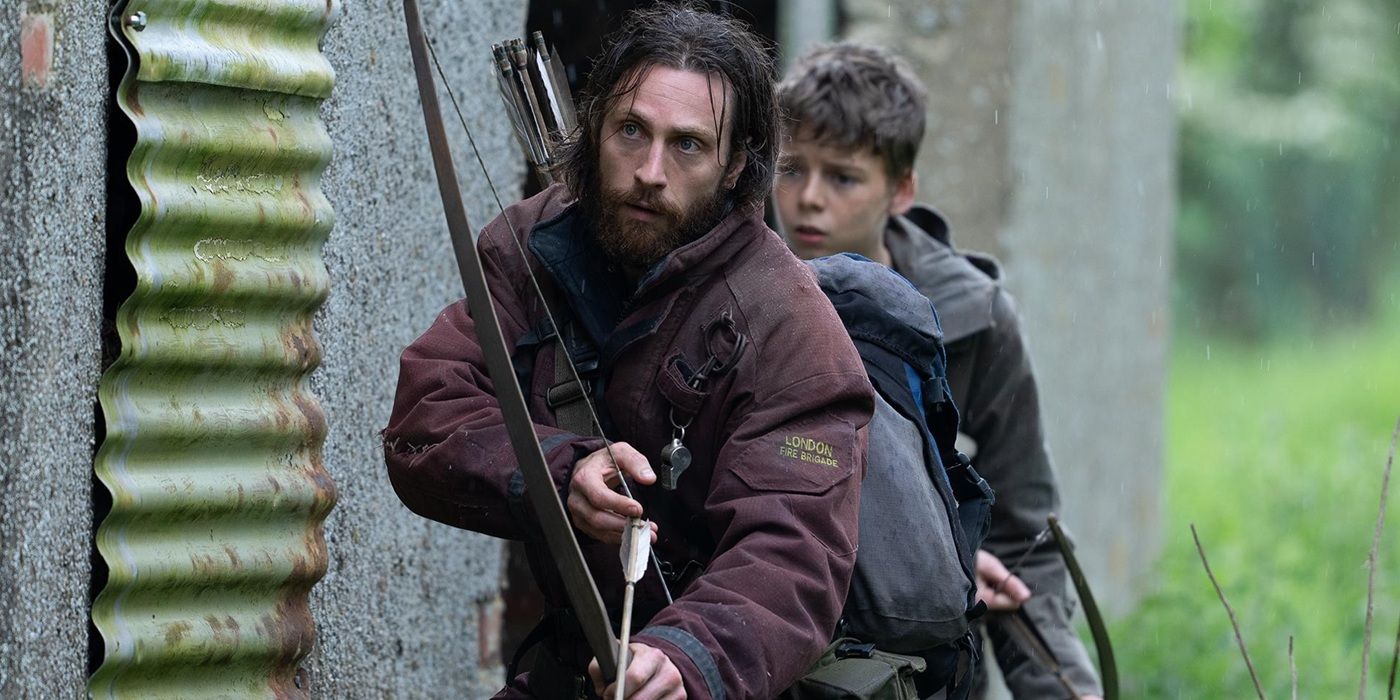
In the 2025 release of 28 Years Later, the long-awaited sequel to Danny Boyle’s seminal "28" franchise, the depiction of firearms marks a radical departure from its predecessors. While 28 Days Later focused on the immediate chaos of scavenging and 28 Weeks Later showcased the overwhelming (yet ultimately futile) firepower of the U.S. military, 28 Years Later presents a world where nearly three decades of decay have fundamentally altered the landscape of weaponry. In this post-apocalyptic United Kingdom, the "Rage" virus remains a threat, but the primary conflict has shifted to a struggle for resources, reliability, and the preservation of aging mechanical systems.
The film's weaponry reflects a "post-industrial" reality. In the year 2026, looking back at the cinematic choices made by Boyle and writer Alex Garland, it is clear that the focus was on historical British staples and civilian-grade hardware that could survive 28 years of minimal maintenance. The sleek, modular platforms of the early 21st century have largely been replaced by rugged, manually operated rifles and sidearms with proven longevity.
The Evolution of Scarcity: From Military Might to Survivalist Necessity
To understand the guns of 28 Years Later, one must first examine the timeline of the franchise. In the original 2002 film, the protagonists encountered British soldiers armed with the L85A1 (SA80). At that time, these weapons were contemporary but notoriously unreliable in harsh conditions. By the time of 28 Weeks Later (2007), the U.S. military had moved in with M4A1 carbines, M16A4s, and HK416s, representing the height of mid-2000s tactical technology.
In 28 Years Later, that military infrastructure has vanished. The 5.56×45mm NATO rounds that were once plentiful have become a precious commodity, and the complex gas systems of modern assault rifles have often succumbed to carbon fouling and lack of replacement parts. Consequently, the survivors in the newest chapter have turned toward weapons that prioritize simplicity.
The Return of the Bolt-Action: The Lee-Enfield No. 4 Mk I
Perhaps the most iconic firearm featured in 28 Years Later is the Lee-Enfield No. 4 Mk I. While technically an antique by modern military standards, its presence in the film is a masterstroke of regional realism. For a survivor in the British Isles, a Lee-Enfield represents one of the most robust and high-capacity bolt-action rifles ever produced.
The Lee-Enfield's "cock-on-closing" bolt design allows for a significantly higher rate of fire than the Mauser-style actions found in traditional hunting rifles. In the film, we see characters utilizing the 10-round detachable box magazine—a massive advantage when facing multiple "Infected" who do not feel pain and require rapid, successive hits to neutralize. Furthermore, the .303 British caliber provides significant "stopping power," a technical necessity when dealing with the hyper-aggressive movements of Rage-afflicted targets. From a maintenance perspective, the Enfield is built to withstand the trenches of World War II, making it perfectly suited for the damp, unforgiving climate of a derelict Great Britain.
Civilian Defensive Tools: The Rise of the Double-Barrel Shotgun
In the absence of functional military logistics, civilian firearms—specifically those common in rural UK farming communities—take center stage. The Over-Under and Side-by-Side 12-gauge shotguns are ubiquitous throughout 28 Years Later.
The technical reasoning for this is twofold:
- Mechanical Simplicity: A break-action shotgun has very few moving parts compared to a semi-automatic or even a pump-action firearm. There is no feed ramp to jam, no magazine spring to fail, and no gas port to clog.
- Ammunition Versatility: In a world where factory-loaded ammunition is 28 years old, "hangfires" and "squibs" (rounds with insufficient pressure) are common. A break-action shotgun allows a user to quickly clear a faulty shell and reload without fighting a jammed slide or complex extraction failure.
In several key sequences, characters are seen using "Birdshot" loads—not for their lethality, but for their ability to deliver a wide spread to the face and eyes of an Infected, effectively blinding the target and allowing for a silent kill with a melee weapon. This tactical nuance highlights the film's commitment to realistic survivalism over stylized action.
The Sidearm Paradigm: Reliability Over Capacity
Sidearms in 28 Years Later are treated as "last-ditch" tools. The Browning Hi-Power makes a return, serving as a narrative bridge to the first film. As a 9mm Parabellum handgun with a 13-round capacity, it is one of the few semi-automatics still in regular use. However, the film also highlights the Webley Revolver and various Smith & Wesson Model 10 variants.
The preference for revolvers among the older survivors in the movie is a nod to the "dead primer" problem. If a round of 28-year-old ammunition fails to ignite in a semi-automatic pistol, the user must manually rack the slide to clear the chamber—a two-handed operation that can be fatal in a close-quarters struggle. With a revolver, the user simply pulls the trigger again to rotate the cylinder to a fresh round. This "fail-forward" capability is a recurring theme in the film’s technical choreography.
Comparison of Primary Weaponry Across the "28" Trilogy
| Feature | 28 Days Later (2002) | 28 Weeks Later (2007) | 28 Years Later (2025) |
|---|---|---|---|
| Primary Platform | L85A1 (British Army Surplus) | M4A1 / HK416 (US Military) | Lee-Enfield / Double-Barrel Shotgun |
| Common Caliber | 5.56x45mm NATO | 5.56x45mm / .308 Win | .303 British / 12-Gauge |
| Primary Intent | Emergency Defense | Containment & Purge | Sustained Survival / Hunting |
| Maintenance Level | Moderate (Field Stripping) | High (Military Logistics) | Extreme (Improvised Repairs) |
| Ammunition Source | Abandoned Military Caches | Active Supply Lines | Scavenged / Hand-Loaded |
The "Franken-Guns": Improvised and Modified Weaponry
One of the most striking visual elements of 28 Years Later is the "Franken-gun"—firearms that have been repaired or modified using non-standard parts. As original stocks rot and springs lose their tension, survivors have turned to woodworking and blacksmithing to keep their tools functional.
- Pistol Grips and Stocks: Several rifles in the film feature hand-carved oak or ash stocks, replacing the original polymer or walnut that has cracked over decades of exposure to the elements.
- Improvised Suppressors: Given that noise attracts the Infected from miles away, the film depicts the use of "oil filter" suppressors and "solvent traps." While these are technically inefficient compared to modern suppressors, they provide enough decibel reduction to prevent a single shot from alerting an entire valley.
- Bypassing Safeties: In a technical detail appreciated by firearms enthusiasts, some of the older semi-automatics in the film have had their magazine disconnect safeties removed to prevent malfunctions caused by grit and grime build-up in the grip frame.
The Chemistry of Decay: Ammunition and Gunpowder in 2026
A critical aspect of the "28 years later" timeframe is the degradation of chemical propellants. Modern smokeless powder is remarkably stable, but it is not eternal. High humidity, such as that found in the UK, can cause the nitrocellulose in gunpowder to break down over decades.
The film subtly addresses this through "misfire" scenes. The characters do not treat every pull of the trigger as a guaranteed discharge. This creates a high-tension atmosphere where every shot is a gamble. We see the protagonists meticulously storing their ammunition in airtight containers or even attempting to "re-prime" old brass using improvised mercury fulminate—a dangerous and volatile process that underscores their desperation.
Ballistic Performance Against the "Infected"
Unlike traditional "undead" zombies, the Infected in the 28 universe are living humans driven by rage. They are susceptible to blood loss and organ failure, but their adrenaline levels allow them to shrug off wounds that would incapacitate a normal person.
The survivors in 28 Years Later have learned that "stopping power" is a myth; what matters is central nervous system (CNS) disruption. This has led to a preference for heavy, slow-moving projectiles. The .303 British round from the Lee-Enfield, for instance, is far more likely to shatter bone and drop an Infected instantly than the high-velocity, small-diameter 5.56mm rounds used by the military in the earlier films.
Maintenance and Preservation: The Survivor’s Routine
Technical depth in the film is also shown through the daily maintenance routines of the characters. We see the use of "animal fat" as a substitute for gun oil (CLP). While animal fat is acidic and can eventually damage metal, it is often the only lubricant available to prevent the catastrophic rusting of a rifle's action in the British rain.
The film also depicts the "lapping" of bores. Characters are seen using abrasive pastes to smooth out the interior of rusted barrels, a desperate measure that restores some measure of accuracy at the cost of long-term barrel life. These details move the firearms from being mere "props" to being "characters" that reflect the age and wear of the world they inhabit.
Frequently Asked Questions
Why don't the characters use more modern assault rifles?
In the 28 years following the outbreak, the industrial base required to manufacture the complex springs, gas rings, and high-quality magazines for rifles like the AR-15 or L85A3 has collapsed. While these weapons may still exist in "hoards," their reliability decreases significantly without access to specialized cleaning solvents and replacement parts. Bolt-action and break-action weapons are simply easier to keep running using primitive tools.
Is the Lee-Enfield actually a good choice for a zombie apocalypse?
In a UK-specific context, yes. It was the standard-issue rifle for the British military for decades, meaning there are hundreds of thousands of them in private hands, museums, and old armories. It is rugged, has a 10-round capacity (high for a bolt-action), and uses a caliber (.303) that is highly effective at stopping a fast-moving human target.
Can ammunition really last 28 years?
Yes, if stored in a cool, dry place. However, the UK's climate is damp. Ammunition stored in basements or abandoned vehicles would likely suffer from "corrosion" on the brass and "degradation" of the primer. The film accurately depicts the reality that 28-year-old ammo is prone to failure, requiring survivors to be selective about when they pull the trigger.
Why are suppressors so common in the film if the world ended 28 years ago?
The "suppressors" seen in the film are largely improvised. In a world where the "Rage" virus is triggered by sound, silence is a survival requirement. Survivors would prioritize the fabrication of "baffle cans" or "shroud extensions" out of necessity, even if they only last for a dozen shots before needing repair.
Are there any "new" guns in the movie?
There are no "newly manufactured" firearms in the traditional sense. However, the film features "zip guns"—crude, single-shot weapons made from steel tubing and elastic bands. These are used primarily by the lowest tier of survivors who lack the resources to scavenge or maintain "legacy" firearms.
Strategic Recommendation for Survivalist Analysis
For those analyzing the tactical world-building of 28 Years Later, it is recommended to focus on the sustainability of the platform rather than its raw firepower. When evaluating firearms for a "long-term" post-collapse scenario (20+ years), the primary metrics should be:
- Parts Interchangeability: Can the firing pin be fashioned from a nail?
- Caliber Commonality: Is the round scavengable from historical local sources?
- Manual of Arms: Does the weapon function without complex gas or recoil-operated cycles?
The shift from the "tactical" aesthetic of the 2000s to the "survivalist" aesthetic of the 2020s in the 28 franchise provides a fascinating look at how we perceive the longevity of our technology. In 2026, 28 Years Later remains the gold standard for portraying the slow, mechanical decay of the modern world.